November 6, 2026
What Is a Capsule Collection? a 2026 Brand Guide
What is a capsule collection? A small, edited product group whose pieces combine across looks, channels and seasons. Learn how brands plan one.
A capsule collection is a deliberately limited group of products designed to work together through shared styling, color, function or aesthetic principles, with each piece combining into several looks or uses. Its defining feature is compatibility, not a particular number of products.
If a small launch contains products that don't work together, what makes it a capsule rather than just a short line? That distinction matters when designers, merchandisers and product development leads approve the range, count its variants and prepare it for buyers.
Published 6 November 2026
What a Capsule Collection Is and How It Differs
A capsule collection is a brand's edited product release. A capsule wardrobe is an individual's system for combining owned garments. Both rely on coordination, but they serve different owners and require different planning decisions.
The modern concept is commonly traced to Susie Faux, a London boutique owner who promoted durable wardrobe essentials during the 1970s, according to The Washington Post's history of the capsule wardrobe. Seasonal additions could supplement that foundation, making the idea a framework for focused assortment planning rather than merely a small launch.
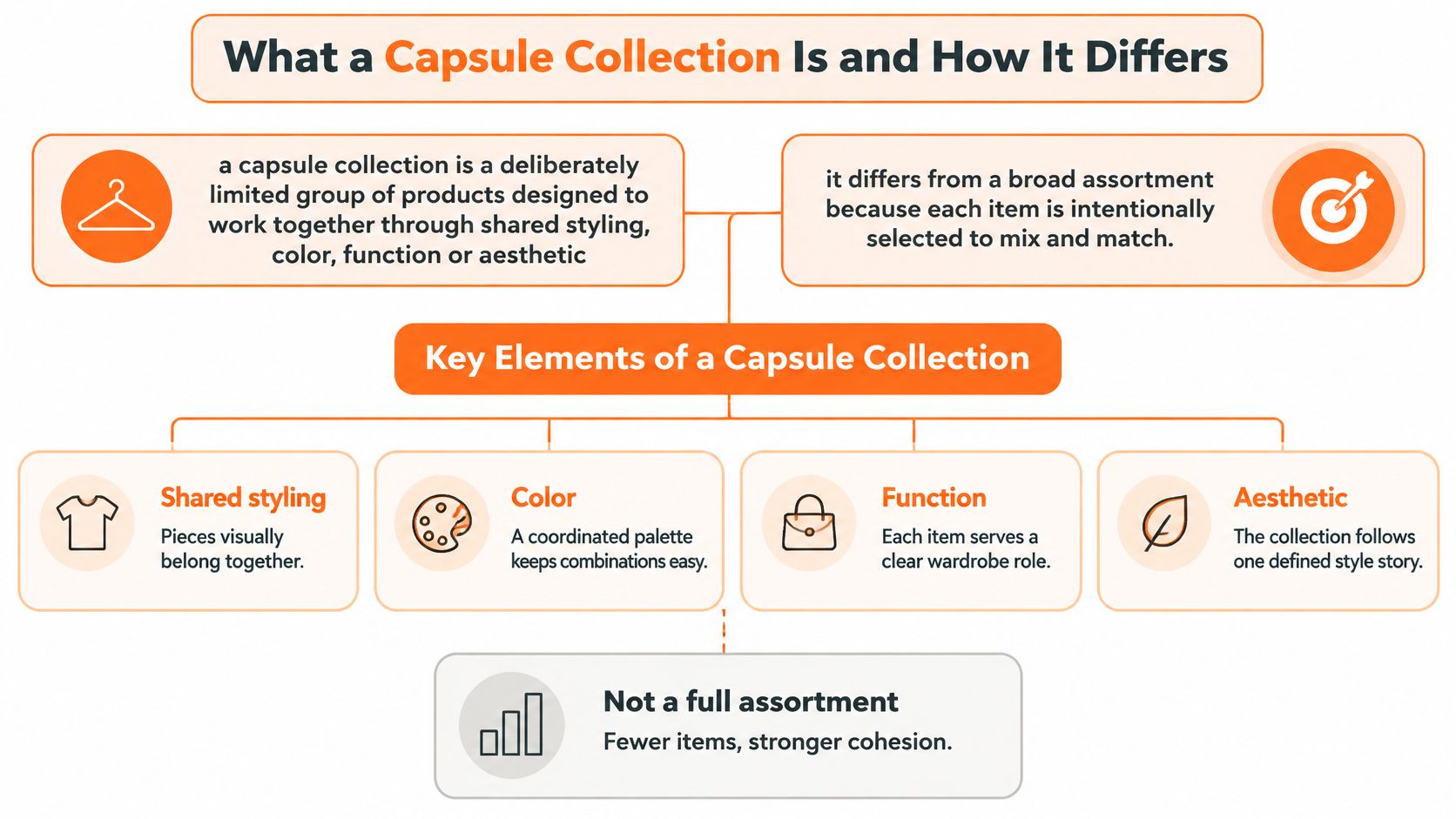
The concept map below places a coordinated collection at the center of shared styling, color, function and aesthetic.
Count is a constraint, not a definition
There's no universal item count. Published explainers use ranges around 5–20 pieces for collections and 25–40 items for wardrobes, but these aren't industry standards, as the distinctions discussed by Fashion-a-holic illustrate.
Size is relative to the brand's main assortment, customer, climate and channels. A narrow release can still create substantial work if every design has extensive color, size or regional variants.
Capsule collection, capsule wardrobe and seasonal assortment compared
| Attribute | Capsule collection | Capsule wardrobe | Seasonal assortment |
|---|---|---|---|
| Owner | Brand | Individual consumer | Brand |
| Purpose | Edited product release built on one coherent story | Personal system for combining owned garments | Broad range covering a full season |
| Size | No fixed count; set by the brand's constraints | Published guides span about 5 to 40 items across capsule interpretations | Set by the sales plan and category depth |
| Scope of styles | Limited and cross-compatible | Limited and interchangeable | Wide; may include unrelated styles, colors and categories |
| Key test | Each piece combines into several looks or uses | Each garment combines into several outfits | Each category is justified by the sales plan |
Think of the central collection as connected to interchangeability, a shared palette, a customer use case and bounded style breadth. A matching campaign treatment alone doesn't establish those connections.
Range-review test: Can each style combine with several others, or does it need its own separate merchandising explanation?
Why Brands Build Capsule Collections
Donna Karan's 1985 Seven Easy Pieces brought the capsule idea into mainstream designer fashion: interchangeable workwear components designed for home, office, weekday, weekend and day-to-night dressing, as described by Modern Retail. The components included a bodysuit, fitted jacket, skirt, trousers, cashmere sweater, leather jacket and an evening look.
The illustration presents that wardrobe-system approach.
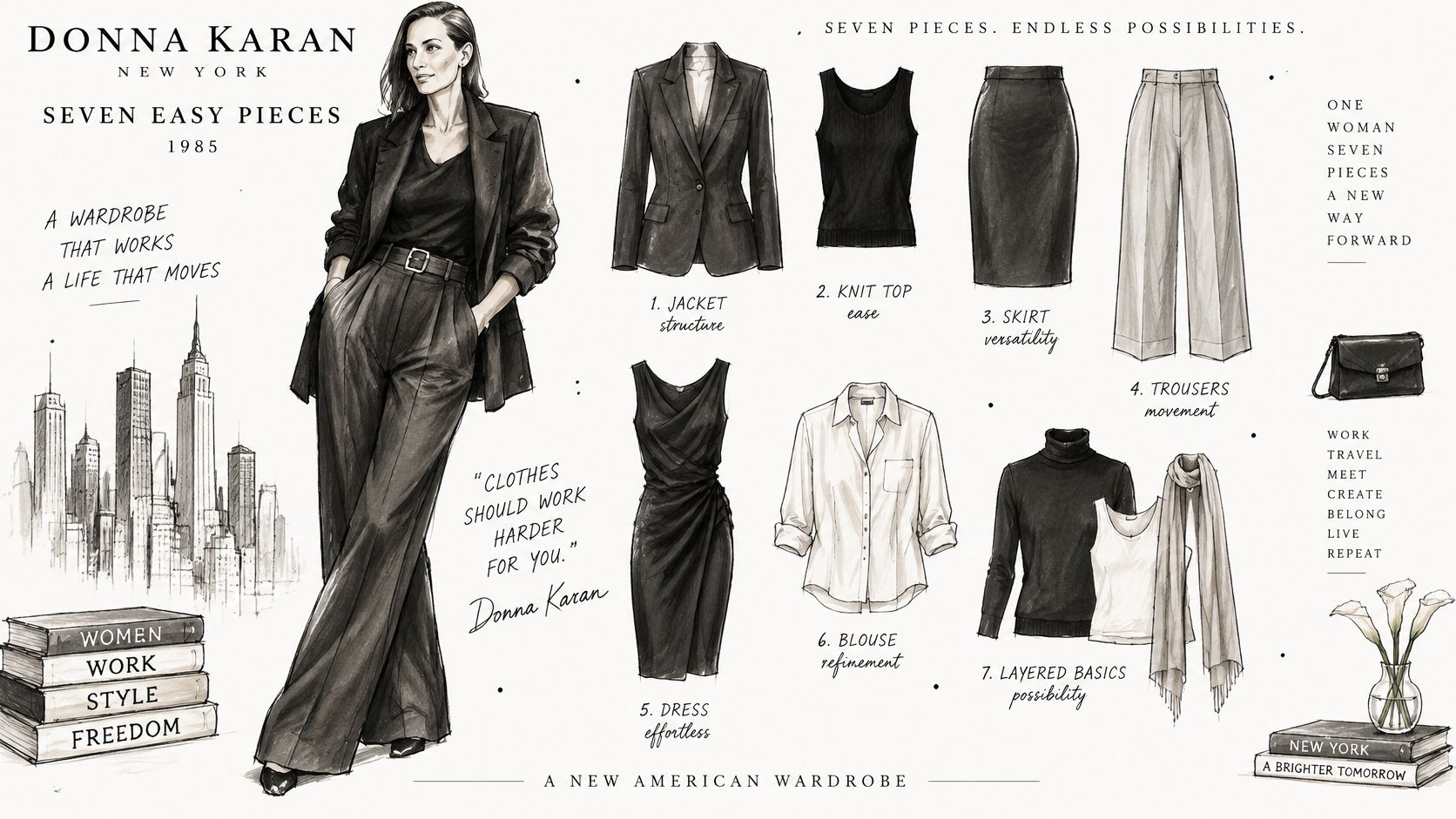
The lasting lesson wasn't the count. It was the decision to prioritize versatility over novelty alone and present a complete system rather than isolated SKUs.
Translate the system into a merchandising proposition
- Clearer storytelling: An edited group can sit together on a line sheet and support a focused campaign. Buyers can understand the proposition without assembling the story themselves.
- Earlier coordination: A defined customer scenario gives design, merchandising and marketing a common basis for resolving product choices.
- More useful combinations: Coordinated products support different outfits, lookbook treatments and buyer conversations without requiring unrelated additions.
Compatibility shouldn't mean making everything look identical. Computer-vision research on capsule creation treats compatibility and diversity as joint objectives: products need to work together without becoming repetitive.
For launch planning, distinguish the product that attracts attention from the supporting assortment. The retail doorbuster insights from CIQRA provide a useful adjacent perspective on the role of an attention-driving product, but a capsule still needs coherent relationships beyond its hero item.
For a visual companion to the wardrobe concept, watch the video below.
Before selecting products, answer this: Which customer scenario does this group serve?
How to Build a Capsule Collection Step by Step
Start with a written range brief, not a folder of attractive references. The brief should let a designer propose products and a merchandiser challenge them using the same rules.
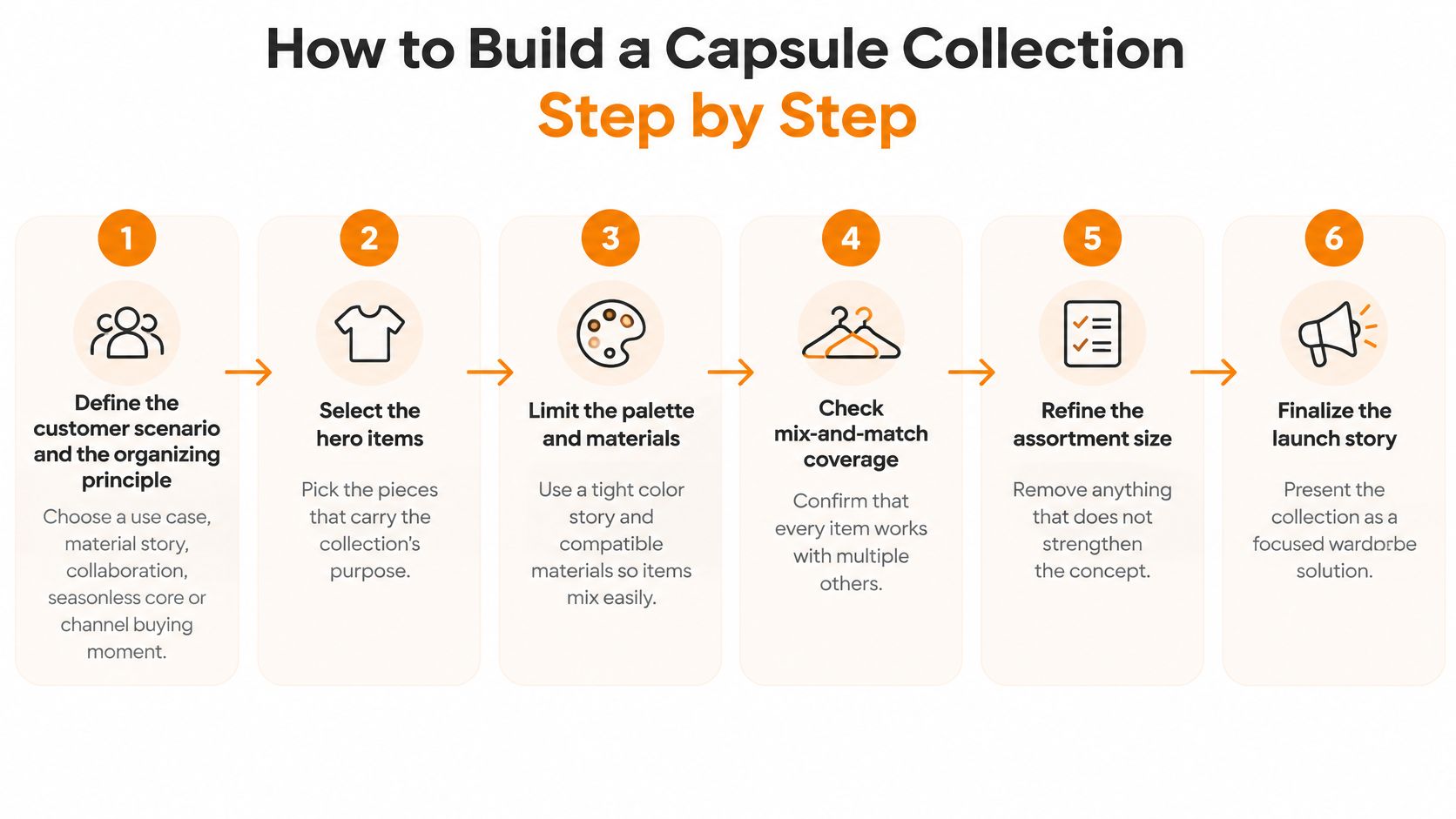
The process below connects the creative concept to a controlled assortment.
Establish the boundaries
Define the scenario and organizing principle. Choose a use case, material story, collaboration, seasonless core or channel buying moment. For example, a travel-workwear capsule should address packing, layering and professional dressing, not merely share a fabric.
Set the counting convention before approval. Specify styles, colorways, finished SKUs or categories. List exclusions such as carryover basics, packaging variants, replenishment items and channel-only products so teams don't count different things.
Assign product roles. Core products provide continuity, bridge products connect the foundation to directional pieces, and statement products supply novelty. Use those roles to challenge duplication rather than treating every proposed design as equally necessary.
Test the range before committing
Score compatibility. Build a matrix with styles along both axes. Check color, proportion, occasion and layering, then remove weakly connected products or identify them explicitly as statement exceptions.
Check breadth and depth together. Review category coverage, inventory commitment, price architecture and size coverage. Fashion-assortment planning research treats breadth, inventory depth and the basic-to-trend mix as interdependent decisions, not separate approvals.
Lock constants and permitted variations. Record which materials, names, palette relationships and product roles stay fixed across regions and channels. Name the variables that buyers may change without reopening the collection concept.
Many published capsule references sit around 10–30 pieces, with minimalist versions around 5–10 and larger interpretations approaching 50, according to WearView's capsule collection glossary. Treat a target near the middle of that range as a working constraint, not a requirement.
Counting bases and what each one changes
| Counting basis | Example | What it changes |
|---|---|---|
| Styles | A hypothetical dress in four colors counts as one style | Keeps range review focused on design decisions |
| Colorways | That dress counts as four colorways | Raises sample, fabric and inventory workload |
| Finished SKUs | Each size and color combination is separate | Drives buy plans and warehouse targets |
| Categories | Shoes, bags and jewelry counted together | Changes how the mix is reviewed and balanced |
| Exclusions | Carryover basics, packaging variants, replenishment items | Keeps the count comparable across seasons |
Four colorways aren't automatically four finished SKUs. That's only true if each colorway has a single size or sellable configuration; otherwise, the size-and-color combinations determine the SKU total.
Written inclusion rules matter even in consumer systems. Wiser Hours' explanation of Project 333 describes 33 items or fewer for three months, including accessories, jewelry, outerwear and shoes but excluding underwear, sleepwear, lounge wear, workout clothing and a permanently worn ring.
Fix the counting basis before comparing range size, sample workload or inventory targets.
Use the same discipline when connecting the capsule to broader assortment planning in fashion: the creative edit and the buy plan must describe the same products.
How Do You Set the Color Story for a Capsule?
A capsule needs a color story that works across the proposed products. Without it, teams can approve individually attractive colorways that don't produce a convincing set.
Build the palette around product roles
- Start with anchor neutrals. Put dependable, easy-to-match colors on core styles. Choose them for the customer scenario, not because they're conventional.
- Use accent families to connect products. Bridge pieces should link the foundation to statement products rather than introduce a separate palette.
- Make exceptions deliberate. Keep statement colors within a defined family, and specify which supporting products make them usable.
- Review every additional colorway. Check its role, sample requirement and inventory commitment before approval. An analogous color scheme can provide a practical starting point for related hues, but proximity on a color wheel doesn't replace product review.
Check the palette in the actual category
In beauty, examine shades and undertones across the intended routine or look. Products don't need identical colors, but their relationships should make sense when used together.
For jewelry, review metal tones, stone colors and finishes as a layered set. For home, put glazes, woods and textiles into a room or material context rather than approving isolated swatches.
A color that works on its own still needs a reason to belong in the collection.
Keep these choices tied to the use case. A workwear anchor shouldn't automatically carry into an evening product if the material, finish or intended styling calls for something different.
Record the palette, exceptions and regional permissions. Designers and buyers should work from the same named references, with physical material checks where color accuracy matters.
Running a Capsule Across Channels and Seasons
A capsule stays coherent when every buyer, channel and region draws from the same product information while selecting the products appropriate to its customers. Separate assortments shouldn't become separate, conflicting versions of the collection.
Work through the execution layers
- Shared product catalog: Keep each style's details alongside its current visuals. Distinguish approved information from exploratory options so buyers don't select an unapproved variant.
- Whole-line review: Inspect the complete mix before creating account views. Check whether removing a bridge product leaves a statement piece without support.
- Buyer-specific presentation: Prepare wholesale line sheets and separate assortments for accounts or channels, while preserving common names and product identities.
A department store and a specialty boutique may need different selections. The operational question is whether those selections still communicate the same collection logic; NanoPIM's guide to customer experience across sales channels offers useful context for distinguishing coordinated channel execution from being present in multiple places.
For seasonal continuity, retain the approved foundation and reassess bridge and statement products. A documented season lineup helps teams distinguish carryover decisions from new development, while saved creative workflows can preserve repeatable visual treatments.
Put each tool in the right role
Sprello is our product. Its row below describes our capabilities; the other rows describe tool categories, whose scope can differ by vendor and configuration.
Tools that support capsule planning and execution
| Tool type | Best use for a capsule | Limits |
|---|---|---|
| Spreadsheets and slide decks | Tracking roles, counts and buy targets; arranging review pages | Can contain images, but aren't a purpose-built shared product catalog; linked files and versions need manual control |
| PLM systems | Tech packs, BOMs, sampling and approvals | Concept visuals and buyer-specific assortments aren't their primary purpose; capabilities differ by system |
| Merchandise planning and open-to-buy suites | Demand forecasting, budget allocation and open-to-buy | Creative concept visuals, wholesale line sheets and buyer presentation aren't their primary focus |
| Sprello | Canvas turns sketches, CADs, materials and references into photoreal product visuals and colorways, with saved workflows; connects them to one shared catalog, line review, wholesale line sheets and separate buyer assortments per account or channel | Complements PLM and planning suites; doesn't do tech packs, BOMs, pattern making, demand forecasting or open-to-buy |
In Sprello, selected visuals and product details flow from the catalog into line sheets and buyer assortments. Those presentations can cover North America, Europe, department stores, specialty boutiques, flagship stores or own retail.
Keep regional variations within brand guardrails and naming conventions. A local selection can change without changing the underlying identity of the products or obscuring which version has been approved.
Where Capsule Collections Fall Short
Fewer styles don't necessarily mean less consumption. A capsule can support intentional buying, but it can also become another recurring drop, limited-edition purchase or premium upsell.
A 2025 study on minimalist wardrobes reported that a three-week intervention involving 37 women increased subjective happiness while sustainability attitudes remained stable; a separate survey of 318 women found that minimalism supported sustainable values but also increased fashion-purchase engagement. Those findings don't justify treating capsule size as evidence of reduced environmental impact.
Replace assumptions with checks
- Fewer styles means less consumption: Examine whether customers use the products repeatedly or add each new release to what they already own.
- Small means simple: Review variants, size coverage, packaging and localized executions. Style count alone doesn't describe the operational load.
- A brand capsule is a customer's wardrobe: Check compatibility with products customers already own. A coordinated release doesn't automatically improve their existing wardrobe system.
Sustainability claims need product and behavior evidence. Evaluate durability, expected wear frequency, replenishment behavior, return rates, material impacts, production quantities and compatibility with existing possessions.
Measure the commercial and use outcomes together
Read sell-through and repeat purchase alongside wearability, returns, product longevity and unsold inventory. Strong initial sales may show that the launch attracted buyers, but they don't establish that customers kept or used the products.
Separate the questions in the post-launch review. Did buyers understand the assortment? Did customers purchase supporting products? Did fit, shade or styling mismatches drive returns?
Then examine the exceptions. A statement product that sells well independently may be commercially useful, but that doesn't prove it strengthened the collection's combinability.
A capsule is an assortment strategy, not an environmental certification.
The practical response isn't to abandon capsules. It's to define the intended benefit precisely and measure that benefit rather than relying on a small-looking range or minimalist campaign.
Capsule Collection Questions Answered
Can a small brand run a capsule collection?
Yes. Start with a range your team can review, sample and buy responsibly, rather than copying another brand's count. Use the counting convention and role map from the step-by-step method to keep approvals consistent.
Does every capsule need a single color story?
Not necessarily a uniform palette, but it needs intentional color relationships. The color-story method allows exceptions when supporting products make them coherent; adding unrelated colorways should require a clear customer or channel reason.
Should a capsule sell the same selection in every channel?
No. Buyers can select different products while preserving the collection's organizing principle and approved product identities. The channel execution model separates shared information from account-specific selections so local relevance doesn't create conflicting records.
How do you know a capsule is working?
Assess commercial performance together with product-use outcomes. The checks under capsule limitations help distinguish an attractive launch from a range that customers keep, combine and use over time.
Do capsules work outside apparel?
Yes. The same coordination principle can guide beauty shades or routines, layered jewelry sets and home objects connected through a room or material story, extending the interchangeability principle described in Braun's capsule wardrobe guide.
For non-apparel teams, replace outfit combinations with the relevant test: a usable routine, a convincing layered set or a coordinated living space. Don't force wardrobe terminology onto a category when a clearer product relationship is available.
Confirm Your Capsule Brief and Book a Demo
Before making samples, confirm the organizing principle, counting convention, core–bridge–statement role map, exclusions and color story. Record the variables allowed by region and channel, and assign someone to approve exceptions.
Bring a brief that can be tested
- Collection logic: The customer scenario and the relationships that justify including each product.
- Operational boundaries: The counting basis, exclusions and approved variant structure.
- Presentation requirements: The accounts, channels and regions that need separate selections.
Sprello is AI for product development & merchandising. From product concept to buyer-ready collection. It supports fashion & apparel, beauty & cosmetics, jewelry & accessories, and home & lifestyle, complementing PLM and planning suites rather than replacing them.
A demo starts with your catalog size and use case, followed by a walkthrough designed for your team's workflows. On one of your own product categories, the walkthrough can show the shared catalog, Canvas visuals, line review, wholesale line sheets and separate buyer assortments.
Bring the completed brief so the discussion stays grounded in your actual range, its counting rules and the buyer presentations your team needs.
Sprello connects AI product visuals with a shared catalog and buyer-ready collection presentations, helping teams review a capsule as a coordinated range. Visit Sprello to book a demo, and bring your capsule brief to test the workflow on your own product category.
Related
More to explore
Fresh reads

Creative Asset Management Software: A Practical Guide
Creative asset management software keeps product visuals, SKUs and approvals in one governed system. Compare it with DAM and PIM tools, and learn how to choose.

Fashion Ecommerce Photography: Shot Lists, AI and Scale
Fashion ecommerce photography for catalog-scale brands: the shot list per SKU, AI model rules, size coverage and enterprise controls. Updated 2026.

AI Generated Model Photos: A Practical Guide for Brands
Learn what AI generated model photos are, how brands produce them, the QA checks, disclosure rules and when to pilot them across SKUs and channels.