
So, what exactly is synthetic media? In a nutshell, it's any kind of media—like an image, a video, a piece of music, or text—that's been created or altered using artificial intelligence. It's not about capturing something that already exists; it's about generating something entirely new.
What Is Synthetic Media Simply Explained
Think of it this way: instead of a photographer snapping a picture, an AI algorithm paints one from scratch based on millions of data points it has learned from. Instead of a film crew shooting a video, an AI can create a digital person and have them speak your script perfectly.
At its heart, synthetic media is all about using AI to build content algorithmically. You’re not recording the real world. You’re using data and sophisticated instructions to construct a piece of media from the ground up.
Let's say you need a new marketing video. The old way involved hiring actors, finding the right location, and a full day of shooting. The new way? You can create a lifelike digital spokesperson, drop them into any background you want, and have them deliver your lines—all without leaving your desk.
The Main Types Of Synthetic Media
"Synthetic media" is an umbrella term for a whole family of AI-powered creative tools. The field is growing fast, but most of what you'll see falls into a few distinct categories. Getting a handle on these different types makes the whole concept a lot clearer.
To give you a better idea, let's break down the main categories of AI-generated content and what they actually do.
Types Of Synthetic Media At A Glance
| Type of Media | Simple Description | Common Example |
|---|---|---|
| Synthetic Images | Pictures generated entirely by an AI. | A photorealistic portrait of a person who doesn't exist. |
| Synthetic Video | Video content created or manipulated by AI. | A digital avatar presenting a training module. |
| Synthetic Audio | Voices, sounds, or music created by algorithms. | An AI-generated voiceover for an advertisement. |
| Synthetic Text | Written content produced by an AI language model. | An AI writing a draft for a social media post. |
Each of these types opens up a whole new world of possibilities for creators and businesses alike. Here's a little more on what they involve:
Synthetic Images: We're talking about AI creating everything from hyper-realistic product photos to stunning fantasy art, all from a simple text prompt.
Synthetic Video: This is a big one. It covers everything from animated avatars to complex deepfakes. A really practical use is generating professional digital presenters, which is a great way to start creating realistic avatars for your videos.
Synthetic Audio: This includes everything from text-to-speech that sounds uncannily human to cloning a person’s voice or even having an AI compose a unique piece of music.
Synthetic Text: Large language models can now write surprisingly good articles, emails, marketing copy, and even computer code, often making it hard to tell if a human wrote it or not.
Key Takeaway: Synthetic media fundamentally changes how we think about content. It's a shift from capturing reality to generating it, giving us the power to create high-quality content at scale without the usual production headaches.
How AI Learns To Create Content
So, how does a computer learn to create a photorealistic image or a voice that sounds completely human? It’s not magic—it's all about a powerful learning process. The engine behind all synthetic media is a fascinating field of artificial intelligence called Generative AI. This isn't your standard AI that just sorts or analyzes data; this technology actually learns the deep patterns within that data to create something brand new.
Think of it like teaching an AI to recognize a “cat.” You’d feed it millions of cat pictures—every breed, color, and size imaginable. After a while, the AI doesn't just memorize what it's seen. It starts to build a true statistical understanding of what makes a cat a cat: the pointy ears, the whiskers, the specific shape of their eyes.
Once it has that deep understanding, it can generate a completely unique image of a cat that has never existed before, pulling from all the different features it now knows. It's all about recognizing patterns and then using them to create.
The Forger And The Detective
One of the most brilliant methods for training these AI models is something called a Generative Adversarial Network, or GAN for short. The best way to picture a GAN is to imagine a game between two AIs: a Forger and a Detective.
The Forger (Generator): This AI's only job is to create fake content. It might start with just random noise but tries to turn it into something believable, like a human face.
The Detective (Discriminator): This AI's job is to call out the fakes. It gets a mix of real images from the training data and the Forger’s attempts, and it has to guess which is which.
At the beginning, the Forger is awful at its job, and the Detective spots every single fake with ease. But here's where it gets interesting. Every time the Forger fails, it gets feedback on what went wrong and tries again, making its next fake just a little bit better. This constant pressure forces the Detective to get smarter, too, learning to spot even more subtle imperfections.
This back-and-forth competition is what makes the whole system work. It’s a relentless cycle that pushes both AIs to improve at an astonishing speed. The Forger becomes a master at creating convincing fakes, while the Detective becomes an expert at identifying them.
This "adversarial" game plays out for thousands, sometimes millions, of rounds. Eventually, the Forger gets so good that its creations are virtually indistinguishable from the real thing, regularly fooling the highly-trained Detective. That’s the point when the model is finally ready to generate the high-quality synthetic content we see today. It's been sharpened by constant, competitive feedback.
The Rapid Growth Of AI-Generated Content
Synthetic media isn't some far-off, futuristic concept anymore. It's here, and it's completely changing the game for content creation. This isn't just about a few neat tools popping up; it’s a massive economic shift that’s making high-quality content cheaper, faster, and available to pretty much everyone. The appetite for AI-generated content is just exploding in fields like marketing, entertainment, and even education.
The numbers don't lie. The global market for synthetic media was already valued at around $7.7 billion just a few years ago. But hold on, because forecasts show it’s on track to hit an incredible $77 billion by 2034. That's a compound annual growth rate of nearly 25.9%, a clear sign that this technology is becoming a major force.
A Democratized Creative Landscape
So, what does all this growth really mean? It means the walls are coming down. Not long ago, creating a slick marketing video or a professional-looking campaign meant you needed a hefty budget, a whole team of specialists, and a studio full of expensive gear.
Now, a single entrepreneur or a small business can pump out content that looks just as good, but in a tiny fraction of the time and for a sliver of the cost. This newfound access is a game-changer, letting more voices and ideas break through the noise.
Think of how the AI actually learns. It's all about data. The infographic below gives you a simple look at the process—the AI chews through enormous datasets (Photos), runs through countless training cycles (Epochs), and then generates something entirely new (Outputs).
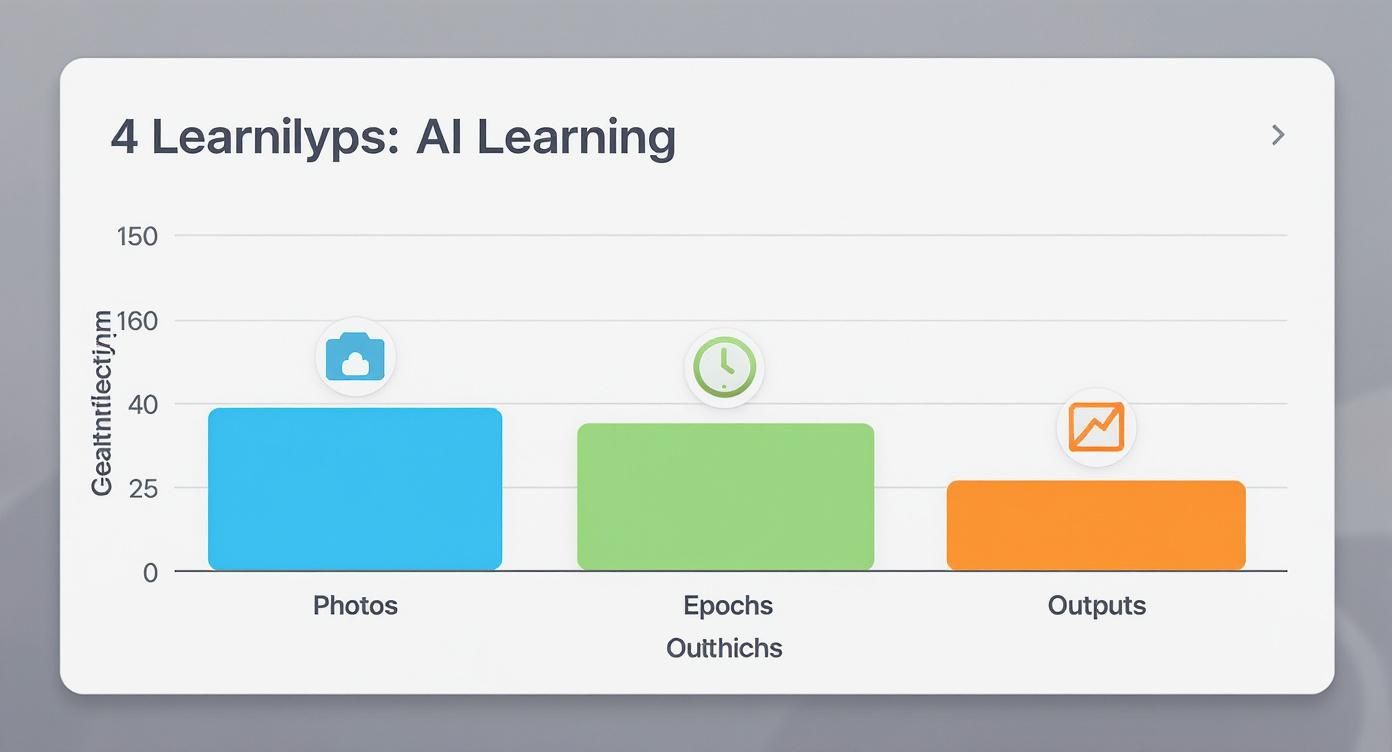
What this really shows is that the magic of synthetic media comes from two things: a massive amount of training data and an intense, repetitive learning process.
The Accelerating Pace Of Innovation
And the technology isn't standing still. It's getting better, faster, and more powerful at a dizzying speed. To get a handle on where things are headed, it's worth keeping up with the latest trends in AI content generation. The models behind these tools are becoming more realistic and easier to use with every update.
Key Takeaway: The boom in synthetic media is more than just a market trend—it’s fundamentally altering what's possible creatively. We're heading into a future where the biggest barrier to creating amazing digital content is your own imagination, not your budget. This shift is leveling the playing field for businesses and creators everywhere.
Putting Synthetic Media To Work
So, what's all this technology really good for? The magic of synthetic media isn't just the tech itself—it's what it lets creators and businesses do. By sidestepping the usual production headaches, companies are discovering a whole new world of speed, personalization, and cost-effectiveness. This isn't some far-off future concept; it's already solving real problems in everything from marketing to professional training.
Think about a marketing team trying to launch a global ad campaign. Traditionally, that meant hiring actors, scouting locations, filming for days, and spending a small fortune. With synthetic media, that same team can create a lifelike AI avatar, drop them into any virtual backdrop, and have them speak the script in a dozen languages. The best part? It can all be done in a few hours.
This is a massive leap forward, giving teams more freedom and making them far more productive. The business value is becoming undeniable, especially in major markets. To put it in perspective, the United States synthetic media market was valued at around $1.36 billion. That number is expected to climb to $4.55 billion by 2032, which shows just how fast companies are jumping on board. If you're curious about what's driving this growth, you can find more details in this insightful report on SNS Insider.
Redefining How Content Gets Made
The impact here goes way beyond just saving a bit of cash. Synthetic media is changing the entire process of how we think about and create content, especially for industries that need a lot of customized material. This is where you really start to see the benefits stack up.
For instance, an e-commerce brand can now spin up thousands of unique product videos, each fine-tuned for a different type of customer. Instead of running one generic ad and hoping for the best, they can test endless variations to find what truly connects with people—something that used to be way too expensive to even consider. You can dive into our guide on how to create video ads with AI to see just how easy this has become.
Let's look at a few other powerful ways it's being used:
- Corporate Training: Businesses are building interactive training programs with AI instructors. This makes learning consistent and scalable, so employees can get the training they need whenever and wherever they are.
- Entertainment and Gaming: Game developers and filmmakers are using this tech to create incredibly realistic characters, build huge digital worlds, and produce amazing visual effects, all without needing giant film crews or physical sets.
- Healthcare Education: Medical schools are creating hyper-realistic surgical simulations. These tools let aspiring surgeons practice tricky procedures in a safe, risk-free setting, honing their skills long before they step into an actual operating room.
Key Takeaway: Synthetic media isn't just a novelty; it's a practical tool that solves real business problems. It simplifies complex production workflows, makes personalization possible on a massive scale, and opens up creative doors that were once locked for most companies.
The table below breaks down just how different the workflow looks when you compare old-school methods to the new synthetic approach.
Traditional Vs Synthetic Media Content Creation
| Task | Traditional Method | Synthetic Media Method | Key Benefit |
|---|---|---|---|
| Talent Casting | Days or weeks to find and hire actors. | Select a digital avatar in minutes. | Speed & Cost |
| Location Filming | Securing permits, travel, and on-site crew. | Choose a virtual background instantly. | Flexibility |
| Multilingual Content | Hire new actors and re-shoot for each language. | Clone a voice and translate with AI in hours. | Scalability |
| Editing & Revisions | Costly and time-consuming re-shoots. | Edit the script and re-render the video. | Efficiency |
As you can see, the shift is dramatic. This practical application is what turns synthetic media from a cool idea into a must-have tool for modern creators. By automating the grunt work and knocking down old barriers, it frees up teams to focus on what really matters: strategy and creativity, not the logistical nightmare of production. The end result is a faster, more flexible, and more powerful way to engage with your audience.
Navigating The Ethical Questions
It’s impossible to talk about a technology this powerful without facing the serious responsibilities that come with it. A real look at synthetic media means being honest about how it could be misused. The very same tools that help us create incredible marketing videos can also be used to generate convincing deepfakes for spreading lies or committing fraud.
These aren't just what-if scenarios. We've already seen fake audio clips used to frame people and AI-generated images spark confusion. It all brings up some tough questions about digital consent, who owns what, and how we can even know what’s real anymore.
Building A Framework For Trust
The good news is, the conversation doesn't stop at the risks. As the tech advances, so do the efforts to keep it in check. People on the front lines—innovators, lawmakers, and industry leaders—are working hard to build in safeguards.
A multi-part strategy is taking shape, zeroing in on detection, verification, and clear, commonsense guidelines. The goal is to give everyone the tools to tell the difference between what’s real and what’s generated.
Here are a few key things happening right now:
- Advanced Detection Tools: Researchers are creating smart algorithms that can spot the tiny digital clues left behind by AI generators, making it easier to flag synthetic content.
- Digital Watermarking: Some platforms are now embedding invisible watermarks into the media they generate. Think of it as a digital signature that can trace a piece of content back to its origin.
- New Regulations: Lawmakers are also getting involved. Tennessee’s ELVIS Act, for example, protects musicians' voices from being used by AI without permission, while other laws are targeting non-consensual deepfakes.
These legal rules are essential for drawing clear lines in the sand. For brands, staying on top of them is key to running campaigns that are both effective and ethical. Our guide on compliant synthetic influencer advertising digs deeper into how to do just that.
Promoting Responsible Innovation
At the end of the day, this isn't about stopping progress. It's about steering it in the right direction. The rise of believable AI-generated content underscores the need to confirm the authenticity of images in the AI era. Building trust is a team effort, from the developers building the AI to the marketers using it.
By putting transparency and ethics first, we can tap into the amazing creative potential of synthetic media while keeping its darker side at bay. The future really depends on building a culture of accountability around these tools.
This balanced view addresses the legitimate concerns while actively searching for solutions. By mixing tech safeguards with smart regulation and a commitment to doing the right thing, the industry can build a solid foundation of trust. This ensures synthetic media can be a force for creativity and connection, empowering creators while protecting everyone else.
The Future of Digital Creation
When we look at what's coming next, it’s obvious that synthetic media isn't just another shiny new tool. It's a fundamental change in how we think about, create, and interact with digital content. We're stepping into a future where the biggest hurdle to creating something amazing isn't your budget or technical know-how—it's just your imagination.
Think about what this means for entertainment. We're on the cusp of truly personalized experiences, where a story could literally change based on who's watching it. Or picture educational content that’s not a one-size-fits-all video, but an interactive simulation that adapts to how a student learns. For businesses and creators, this completely changes the game, cutting down production timelines from weeks to mere hours.
The money follows the momentum, and the numbers here are staggering. The global synthetic media market is already valued at around $5.06 billion. But that’s just the start. It's expected to rocket to nearly $21.7 billion by 2033. That’s a compound annual growth rate of 18.1%, which tells you just how quickly this is becoming mainstream. If you want to dive deeper into the projections, Grand View Research has some great data.
As this technology matures, it promises to unlock new forms of creativity and connection. It democratizes storytelling, allowing anyone to build compelling digital experiences.
The bottom line is that we're moving into an era where your ideas can come to life faster and with more creative freedom than ever before. This technology is building a more dynamic, personal, and accessible digital world for all of us.
Frequently Asked Questions
As you dive into synthetic media, you're bound to have some questions. It’s a new frontier for many, so let's clear up a few of the most common ones to give you a solid footing.
Are Synthetic Media And Deepfakes The Same Thing?
That's a great question, and the answer is no—but they are related.
Think of synthetic media as the big umbrella term. It covers any kind of media that's been created or modified by AI. This includes all sorts of positive and creative things, like AI-generated music for your podcast, unique images for your marketing campaigns, or even virtual presenters for training videos.
A deepfake, on the other hand, is a very specific type of synthetic media. It’s the one that often gets the bad press. Deepfakes usually involve swapping one person's face onto another in a video so convincingly that it’s hard to tell it’s fake. Unfortunately, they're often used for malicious purposes.
The easiest way to think about it is this: all deepfakes are synthetic media, but not all synthetic media are deepfakes. What really separates them is the intent behind their creation.
Is Using Synthetic Media Legal?
This is where context is everything. The legality of synthetic media hinges entirely on how you use it. If you're creating original marketing visuals, generating unique art, or producing corporate training videos with AI avatars, you're generally on safe and legal ground. In fact, it's becoming a standard business practice.
The legal trouble starts when the technology is used to commit fraud, spread disinformation, defame someone, or steal intellectual property. The law is racing to keep up. We're already seeing new regulations pop up, like Tennessee's ELVIS Act, which was created to protect artists' voices from being copied by AI without their permission.
To stay on the right side of the law, just follow these simple rules:
- Always respect copyright and intellectual property.
- Get clear consent before using a real person’s likeness or voice.
- Be transparent and ethical in how you apply the technology.
How Can Small Businesses Use Synthetic Media?
Getting started is way more straightforward than you might think, and you definitely don't need to be a tech wizard. User-friendly AI platforms have made it possible for small businesses to jump right in and create amazing content.
For instance, you could be generating stunning images for your social media ads in minutes. Or maybe you need a professional voiceover for a product demo? You can do that, too. Some tools even let you create an entire video ad from a single text prompt.
The best way to begin is to find a bottleneck in your current process. Are you constantly struggling to get enough visual content? Is professional video production just too slow and expensive? Once you know the problem, you can find an AI tool built to solve it. Many offer affordable plans that let you produce high-quality content at a fraction of the time and cost.
Ready to see how AI can completely change your approach to video marketing? With Sprello, you can create high-converting ads and social content in minutes—no filming or complicated editing required. Generate scripts, build scenes with AI avatars, and produce polished videos effortlessly. Start creating faster and smarter at https://sprello.ai.


