
A content distribution strategy is your game plan for getting your hard work in front of the right people. It's how you publish, share, and promote everything from blog posts to videos across different channels to connect with your audience.
Without a solid plan, even the most brilliant content can end up gathering dust on your server. It's the crucial step that makes sure people actually see what you've created.
Why Your Best Content Is Going Unseen
Finishing a great piece of content feels like you've crossed the finish line, but honestly, you're just getting started. So many creators fall into the "publish and pray" trap—they hit the publish button and just hope for the best. That's a surefire way to fail.
Your content isn't just up against your direct competitors. It's fighting for attention with every other article, video, and cat meme on the internet.
A real content distribution strategy is what connects your creation to actual business results. It’s what turns a simple blog post into an asset that pulls in traffic, captures leads, and establishes you as an authority in your space.

The Foundational Pillars of Distribution
Before you can build a killer distribution plan, you need to know the lay of theland. Content channels generally fall into three buckets: owned, earned, and paid media. The most effective strategies don’t just pick one; they mix all three to build a powerful presence that drives real growth.
To figure out where to focus, it helps to see them side-by-side.
The Three Pillars of Content Distribution
| Media Type | Definition | Examples | Key Benefit |
|---|---|---|---|
| Owned Media | Channels you control directly. | Your website, blog, email list, company social media profiles. | Complete control over messaging and timing. |
| Earned Media | Organic exposure you get from others. | Press mentions, guest posts, social shares, backlinks, reviews. | Builds credibility and trust (powerful social proof). |
| Paid Media | Paying to promote your content. | PPC ads, social media ads, sponsored content, influencer marketing. | Immediate, predictable, and highly targeted reach. |
Each pillar has its strengths, and they work best when they support each other.
A balanced approach is key. Relying only on owned media limits your reach. Focusing solely on paid media can be expensive and unsustainable. The magic happens when you use owned and paid channels to generate earned media, creating a self-sustaining cycle of growth.
For instance, understanding how the social media algorithm explained in our other posts works can make a huge difference for your earned media. When you create content that platforms want to show people, you get more organic shares and mentions without spending a dime.
Ultimately, this turns individual pieces of content into strategic tools that help your business grow.
Laying the Groundwork for Your Distribution Plan
A great content distribution strategy doesn’t just happen—it’s carefully built on a solid foundation. Before you even think about which social media platform to post on, you need to tie your distribution efforts directly to real business outcomes. This is where we move from just talking about content to making it work for you.
Without this initial planning, you're just throwing content at the wall and hoping something sticks. A clear plan ensures every single piece you share has a purpose and a path to achieving it.
Define Your Audience Down to the Details
You can't get your content in front of the right people if you don't know who they are. Generic demographics like "women, ages 25-40" just don't cut it anymore. You need to build detailed audience personas that feel like real people with specific problems, goals, and online habits.
Think of this deeper understanding as your compass. It guides everything from the channels you choose to the tone of voice you use in your captions.
To really get to know them, ask yourself some pointed questions:
- What are their biggest professional pain points? I mean, really get specific. What keeps them up at night about their job or their business?
- Where do they hang out online? Are they scrolling LinkedIn for industry news, asking for advice in niche Slack communities, or watching tutorials on YouTube? Find their digital water cooler.
- What content formats do they actually consume? Do they have time for a 30-minute webinar, or are they more likely to engage with quick, scannable infographics and short videos?
Answering these questions turns your strategy from a broad guess into a targeted mission. You'll know exactly where your content needs to be and what it needs to look like to grab their attention.
Set KPIs That Actually Matter
Let’s be honest: vanity metrics like impressions and follower counts feel good, but they don’t pay the bills. An effective distribution plan is measured by key performance indicators (KPIs) that connect directly to your business goals. Your content should be a growth engine, and your metrics have to prove it.
It’s time to shift your focus from surface-level numbers to what really moves the needle.
Your goal isn't just to be seen; it's to be seen by the right people and inspire them to take a specific action. That's the difference between creating noise and creating an impact.
Here are a few meaningful KPIs you should be tracking:
- Qualified Lead Generation: How many potential customers from a specific channel (like a guest post or a LinkedIn campaign) requested a demo or downloaded a resource?
- Conversion Rate by Channel: What percentage of visitors from your social posts actually sign up for your newsletter or make a purchase? This tells you which channels are most persuasive.
- Customer Acquisition Cost (CAC): How much are you spending on paid distribution to get one new customer? This is crucial for evaluating the ROI of your paid efforts.
- Website Traffic from Referrals: Which guest posts, podcast appearances, or social shares are driving the most engaged traffic back to your site?
These are the metrics that tell a story about what’s working and what isn’t, helping you double down on your most effective channels.
Balance Your Organic and Paid Efforts
A sustainable content distribution strategy almost always needs a smart mix of organic and paid channels. If you rely only on one, you're leaving yourself vulnerable. Organic reach can be unpredictable, and a purely paid approach is expensive—it stops the second you turn off the budget.
Think of it like investing. Organic is your long-term, steady growth stock, building brand equity over time through things like SEO and community engagement. Paid is your short-term, high-impact trade that can deliver immediate results and let you test new ideas quickly.
The key is finding the right balance for your budget and goals. For many businesses, just knowing where to put their resources is a huge hurdle. It’s a common pain point; B2B marketers report that while 97% have a content strategy, a shocking 66.5% struggle with resource allocation. With 32% planning to increase spending on owned channels like blogs and email, the focus is clearly on building reliable "content homes." You can learn more about these key findings here.
A practical way to think about allocating your budget might be:
- 70% Organic: Invest your team's time and energy into high-quality blog content (SEO), email marketing, and genuine community building. This is your foundation.
- 30% Paid: Use targeted ads on platforms like LinkedIn or Google to amplify your best-performing organic content, promote a big launch, or reach a very specific audience segment.
This balanced approach ensures you're building a resilient, long-term asset with your content while still being able to jump on short-term growth opportunities. Get this groundwork right, and you're well on your way to building a powerful and measurable distribution machine.
Choosing the Right Channels for Maximum Impact
Trying to be everywhere at once is a classic recipe for burnout, not results. A smart content distribution strategy isn’t about plastering your content across every platform you can think of. It’s about showing up where it actually matters.
The real key is to stop chasing every shiny new channel and start building a focused mix of platforms where your message will genuinely connect and make an impact. This means digging deeper than the surface-level trends and really understanding the unique strengths of each channel.
Aligning Content with Channel Strengths
Every platform has its own vibe, its own culture, and its own unwritten rules. Something that crushes it on one channel will completely fall flat on another. Getting a feel for these nuances is what separates a scattered, "spray and pray" approach from a truly strategic one.
Think of your blog and SEO efforts as your long-term authority builders. This is home base. It's where you publish your most in-depth, valuable content—the stuff that builds trust and attracts organic traffic for months, even years, to come.
LinkedIn, on the other hand, is built for B2B thought leadership. You might publish a detailed case study on your blog, but for LinkedIn, you'd pull out the most compelling findings and repackage them into a slick carousel post. That format is perfect for busy professionals scrolling their feeds, giving them quick, valuable insights and positioning you as an expert.
It's all about matching the format to the platform:
- Long-form articles and guides: These belong on your blog. It’s the perfect place for them to be optimized for search engines and become a central resource for your audience.
- Data-driven infographics: These are gold on Pinterest and LinkedIn. Visual data gets shared like crazy and can be a huge driver of referral traffic.
- Quick tips and tutorials: Perfect for the fast-paced world of TikTok or Instagram Reels. Short, engaging videos are king for grabbing attention quickly.
- Behind-the-scenes content: This kind of authentic, temporary content thrives on Instagram Stories, helping you build a genuine, personal connection with your followers.
Focusing on Audience Behavior, Not Just Demographics
Knowing your audience’s age and location is table stakes. To really nail your channel selection, you have to understand how they behave on these platforms. Are they scrolling Facebook to see what their family is up to, or are they actively looking for product recommendations in groups? Do they jump on X (formerly Twitter) for breaking news or to network with peers in their industry?
This behavioral context is everything. When you understand it, you can start building a truly cohesive presence. The goal is to create a seamless experience by integrating your content across all the touchpoints where your audience is already hanging out—a concept often called Omnichannel Marketing. Your message feels consistent and powerful whether they find you through a Google search, a social post, or an email.
And things are always changing. Marketers have to adapt, and fast. This chart from Sprout Social clearly shows a big push toward diversifying content formats to keep people engaged.
It's clear that relying on just one type of content is no longer enough. The trend is all about mixing it up with strong visuals and audio.
Don't just follow the crowd to a trending platform. First, confirm your audience is actually there and actively looking for the kind of value you provide. A small, highly engaged audience on a niche platform is always more valuable than a massive, indifferent one on a mainstream channel.
As social platforms evolve, so do the tools we use. To keep up with the demand for high-quality video, a whopping 45% of marketers are planning to invest more in AI-powered tools. While people still prefer human-made content, 94% of marketers are already using AI to work more efficiently. This hybrid approach—human creativity, amplified by AI—is where we're headed. You can discover more insights in the full report.
Building a Focused Channel Mix
Once you’ve got the lay of the land, it's time to build your mix. Please, don't try to master ten channels at once. Start with a core set of 2-3 platforms where you know you can show up consistently and do great work.
A really effective way to structure this is the "hub and spoke" model.
- Your Hub (Owned Media): This is your website or blog—the central pillar of your strategy. All your big, evergreen content lives here, fully optimized for SEO. It's the permanent home for your best stuff.
- Your Spokes (Distribution Channels): These are the social platforms, newsletters, and other channels you use to promote and repurpose your hub content. Each spoke should be custom-tailored to that specific channel's audience and format. You can learn more about this by exploring our guide on multi-platform content delivery.
For example, one comprehensive guide on your blog (the hub) can be spun out into dozens of assets:
- A LinkedIn article hitting the key takeaways for a professional audience.
- A series of Instagram posts featuring powerful pull quotes and stats.
- An email newsletter that drives your subscribers back to read the full guide.
- A short, punchy video for TikTok that breaks down the single most actionable tip.
This focused, hub-and-spoke approach ensures every piece of content you create has a clear purpose, driving traffic back to your owned assets and building a powerful, interconnected digital presence.
How to Execute Your Strategy Smarter, Not Harder
A brilliant strategy is only as good as its execution. This is where we roll up our sleeves and turn those big ideas into a practical, repeatable workflow. The goal? Maximize the impact of every single asset you create without burning out. It’s all about working smarter, not just harder.
The key to this whole operation is content repurposing. Instead of the endless grind of creating something new from scratch every single day, you can turn one pillar piece of content into a dozen targeted assets. This isn't about being lazy; it’s about being strategic and respecting the effort that went into your original work.
The Art of Content Repurposing
Think of your big content pieces—a detailed guide, a webinar, or a deep-dive case study—as the sun in your content solar system. Everything else revolves around it, drawing energy and life from that central source. This approach keeps your message consistent while adapting it perfectly for different platforms and audiences.
Here’s a glimpse of what this looks like in the real world:
- That comprehensive blog post you wrote? Break it down into a LinkedIn carousel highlighting the key stats and takeaways.
- The customer interview you filmed? Spin it into a series of powerful quote graphics for Instagram and X (formerly Twitter).
- All that data from your latest research report? Turn it into a visually engaging infographic for Pinterest to drive some serious referral traffic.
You're not just reposting the same link everywhere. You're fundamentally changing the format to fit what people expect on each platform, giving your audience fresh ways to engage with your core ideas.
Creating a Practical Distribution Calendar
A distribution calendar is your command center. It’s what turns good intentions into consistent action, ensuring your content goes out on time, to the right channels, and with a clear purpose. Without one, you're just scrambling, and your posting becomes erratic and ineffective.
Your calendar doesn’t need to be complex. A simple spreadsheet or a tool like Sprello can work wonders. What matters is that it tracks the essentials.
A distribution calendar isn’t just a schedule; it's a strategic tool. It forces you to think ahead about how each piece of content will be promoted, who will handle it, and what you expect to achieve. This simple act of planning is what separates professional operations from amateur efforts.
This diagram shows a simple, effective workflow for adapting your content for search, social, and visual platforms.
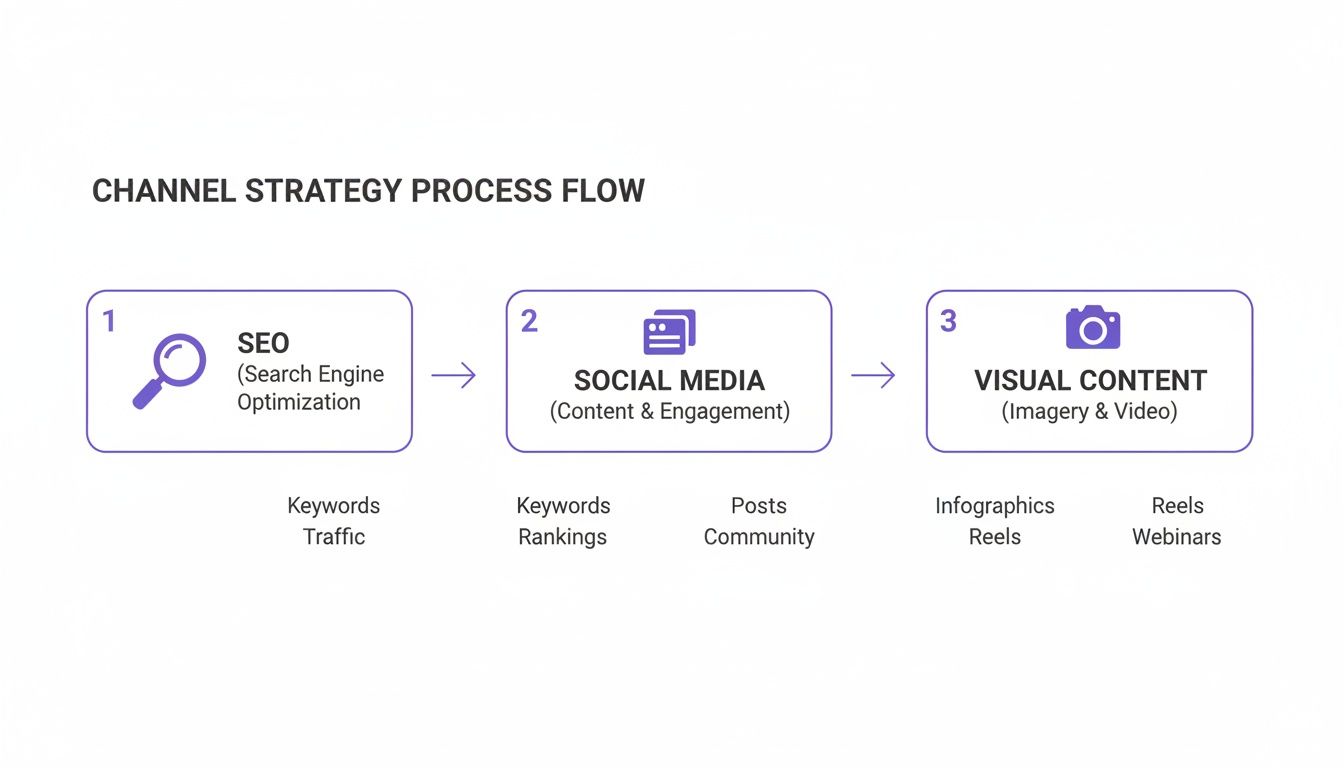
This process shows how a core idea first becomes a search-optimized article, then gets broken down into engaging social formats before being reimagined as highly shareable visual content.
A Real-World Content Repurposing Workflow
To make this crystal clear, here’s how a single blog post can fuel your content calendar for weeks. This is a practical example you can adapt for your own strategy.
| Original Asset | Repurposed Format | Target Channel | Key Goal |
|---|---|---|---|
| 1,500-word blog post | 3-part text series | Spark professional discussion | |
| 1,500-word blog post | 5-slide carousel | Share key takeaways visually | |
| 1,500-word blog post | 60-second video script | TikTok/Reels | Deliver one actionable tip |
| 1,500-word blog post | Infographic | Drive referral traffic | |
| 1,500-word blog post | Email newsletter summary | Email List | Nurture existing leads |
This systematic approach keeps your content alive and working for you long after you hit "publish," ensuring you squeeze every last drop of value from your initial investment.
Prioritizing High-Impact Formats
As you build out your calendar, you need to be smart about where you invest your time. Right now, video is absolutely dominating.
The numbers don't lie. By 2026, short-form video is expected to be used by 60% of marketers, making it a non-negotiable part of most distribution strategies. On platforms like TikTok and Instagram, a staggering 49% of marketers report that short-form video generates the highest ROI. Even better, businesses combining blog content with a strong video plan can see engagement rates 5x higher than static posts alone. You can explore the full marketing statistics on HubSpot for a deeper dive.
This isn’t just a passing trend; it's a clear signal of where your audience’s attention is going. Adding video to your repurposing workflow—even simple clips created with a tool like Sprello—is essential if you want to stay relevant.
How to Measure and Optimize Your Distribution Efforts
Putting your content out there is a huge milestone, but your content distribution strategy isn't complete without closing the loop with one final, critical step—measurement. If you aren't tracking performance, you don't really have a strategy. You're just guessing. Data is what stops the guesswork and starts empowering you to make smart decisions that make every future campaign better.
The whole point isn't just to collect numbers but to find insights you can actually use. You need to figure out which channels are pulling their weight, what content formats your audience loves, and where you should be putting more of your time and money.
Identifying KPIs That Truly Matter
It’s easy to get distracted by vanity metrics like likes and impressions. Sure, they show reach, but they don't tell you if you're reaching the right people or getting them to take a meaningful action. To really measure success, you have to connect your metrics back to your original business goals.
Think about it: a blog post with thousands of views but a 95% bounce rate and zero leads isn't a success. On the flip side, a niche guest post that only brings in 50 visitors but turns 10 of them into qualified leads? That's a home run.
Here are a few channel-specific KPIs to get you started:
- Email Marketing: Look past the open rate. Zero in on the click-through rate (CTR) on your links and, even better, the conversion rate of people who clicked and then did what you wanted them to (like signing up for a demo).
- Social Media: The engagement rate (comments, shares, saves) is a good pulse check on audience connection. But the real money is in tracking website referral traffic and conversions from each platform, which you can do easily with UTM parameters.
- SEO & Blog Content: Keep an eye on organic traffic, keyword rankings, and time on page. The ultimate goals here are new leads generated from organic search and the number of backlinks earned from other trusted sites.
These are the metrics that show you what's actually impacting your bottom line, moving you beyond surface-level stats.
Conducting Regular Performance Reviews
Data is just noise if you don't do anything with it. A simple monthly or quarterly performance review is the key to sharpening your content distribution over time. This isn’t about building some massive, complicated report. It’s a quick, focused check-in to see what’s working, what isn’t, and why.
Keep the review process simple. A basic dashboard or spreadsheet tracking your core KPIs for each main channel is all you need.
During your review, make sure you're asking these questions:
- Which channels brought in the most qualified traffic and leads? This shows you where your best audience hangs out.
- Which content formats—like videos, carousels, or long-form articles—got the highest engagement? This tells you what to create next.
- What was the ROI on our paid distribution? Compare what you spent on ads to the value of the leads or sales it brought in.
- Are there any channels that are just dead weight? It’s perfectly fine to stop investing in something that isn’t delivering.
This is how measurement goes from a boring task to an active, strategic tool that ensures your distribution plan gets smarter with every cycle.
The purpose of measurement is not to prove you were right, but to find out what is right. Be prepared to be surprised by the data and willing to pivot your strategy based on what it tells you.
Using Analytics to Pinpoint Opportunities
Your analytics tools are a goldmine waiting to be explored. For example, Google Analytics can show you exactly which social platforms or referral sites are sending you the most engaged visitors—the ones who stick around, view more pages, and actually convert.
Once your strategy is running, it's vital to know how to measure advertising effectiveness to make sure your paid budget is being spent wisely.
Imagine you dig into your data and discover that a single guest post you wrote for an industry blog is consistently your third-highest source of referral traffic. That’s a huge signal. It tells you that this is your ideal audience, and you should immediately start looking for more collaboration opportunities with similar publications. Understanding these nuances is key, and you can dive deeper into different approaches in our guide on what is attribution modeling.
Likewise, if you see that short video clips on LinkedIn are driving way more demo requests than static image posts, the data is screaming at you: make more video for LinkedIn! This is where tools like Sprello can be a game-changer. It helps you quickly test different video hooks and formats, letting you iterate based on real performance data faster than you ever could before.
By constantly analyzing and optimizing, your content distribution becomes a dynamic, intelligent system that gets more efficient over time, turning your content into a reliable engine for growth.
Common Questions About Content Distribution
Even with the best strategy in place, you're bound to run into a few questions once you start getting your hands dirty. Let's walk through some of the most common ones I hear so you can keep moving forward.
How Many Channels Should I Use?
It’s so easy to fall into the trap of wanting to be everywhere at once. But that's a surefire recipe for burnout and, ironically, a weaker presence overall. The real key? Quality over quantity.
I always advise people to start small and go deep. Pick just 2-3 channels where you know for a fact your ideal customers are hanging out and paying attention. Pour your energy into mastering those platforms. This lets you create amazing, tailored content that actually connects, instead of just thinly spreading generic updates across ten different sites.
Once you’ve got a smooth, repeatable system going and you're seeing real results, then you can start thinking about adding another channel to the mix.
Content Marketing vs. Content Distribution
This one trips people up all the time, but it's actually pretty simple. Think of it like a restaurant.
- Content Marketing is the whole kitchen operation: planning the menu, sourcing the best ingredients, and cooking an incredible meal. It's the entire creative process of making something valuable that your audience will love.
- Content Distribution is getting that delicious meal from the kitchen to the tables. It’s the delivery—all the ways you get your finished content in front of the right people at the right moment.
You can't have one without the other. An amazing meal with no one to eat it is a total waste, just like brilliant content with no audience is a huge missed opportunity. Distribution is what makes sure all your hard work actually gets seen.
I like to think of it this way: Content marketing builds the asset. Content distribution unlocks its value. If you don't have a plan to serve what you've created, you've really only done half the job.
Distributing Content with a Tiny Budget
A small budget isn't a roadblock; it's an invitation to get creative and laser-focused on what you can control. The trick is to go all-in on your owned and earned media channels and be incredibly smart with your time.
Here are a few low-cost tactics that punch way above their weight:
- Go All-In on SEO: This is your best friend for long-term, free growth. Creating content that shows up in search results is like building an engine that brings you a steady flow of qualified traffic for months, sometimes even years.
- Lean on Your Email List: This is a direct line to your biggest fans. It costs virtually nothing to send an email, giving it one of the best ROIs of any channel you own.
- Join the Conversation: Where does your audience talk shop? Find those niche subreddits, Slack groups, or industry forums and become a helpful, authentic voice. Share your knowledge and content where it adds real value—don't just spam links.
- Repurpose Like a Pro: Squeeze every drop of value from your work. That one blog post? It can become a dozen social media updates, a script for a quick video, an infographic, and even a few key slides for a presentation.
How Long Until I See Results?
This is the big one, and the honest answer is: it depends. Patience is non-negotiable in content distribution because the timeline for results can be wildly different from channel to channel.
Paid ads can give you feedback almost instantly, which is great for quick data on what messages are hitting the mark. Organic channels, on the other hand, are a marathon, not a sprint. Building a real presence through SEO or community engagement can easily take 3-6 months before you start to see significant momentum.
The most critical factor is just sticking with it. Keep an eye on leading indicators like engagement rates and referral traffic. These early signals will tell you if your strategy is working long before you see a big jump in sales.
Ready to create high-converting social videos in minutes? Sprello helps you produce ads and social content with AI—no filming or complex editing required. Test more ideas and ship more videos with Sprello today.


