November 14, 2026
What Is SKU Rationalization? a Practical Guide for 2026
What is SKU rationalization? A structured review of every SKU to keep, modify, consolidate or exit it, with criteria for fashion, beauty and home brands.
SKU rationalization is the structured review of every SKU in an assortment to decide whether each one is kept, reduced, redesigned, replenished differently or discontinued. Every candidate leaves the review tagged with one of five actions: retain, monitor, modify, consolidate or exit.
Most explanations of what SKU rationalization is stop at a sales ranking. Sort by revenue, cut the bottom decile, done. That answers a narrower question than the one that decides whether the cut works, because it tells you what a SKU sold rather than where its buyers go next.
A slow seller can hold a real place in the range: the only color that completes a size run, the entry price that recruits new customers, the item that shares a basket with your best seller. Cut it on sales alone and the revenue doesn't vanish. It moves, sometimes to a competitor.
Published November 14, 2026
What Is SKU Rationalization in Plain Terms?
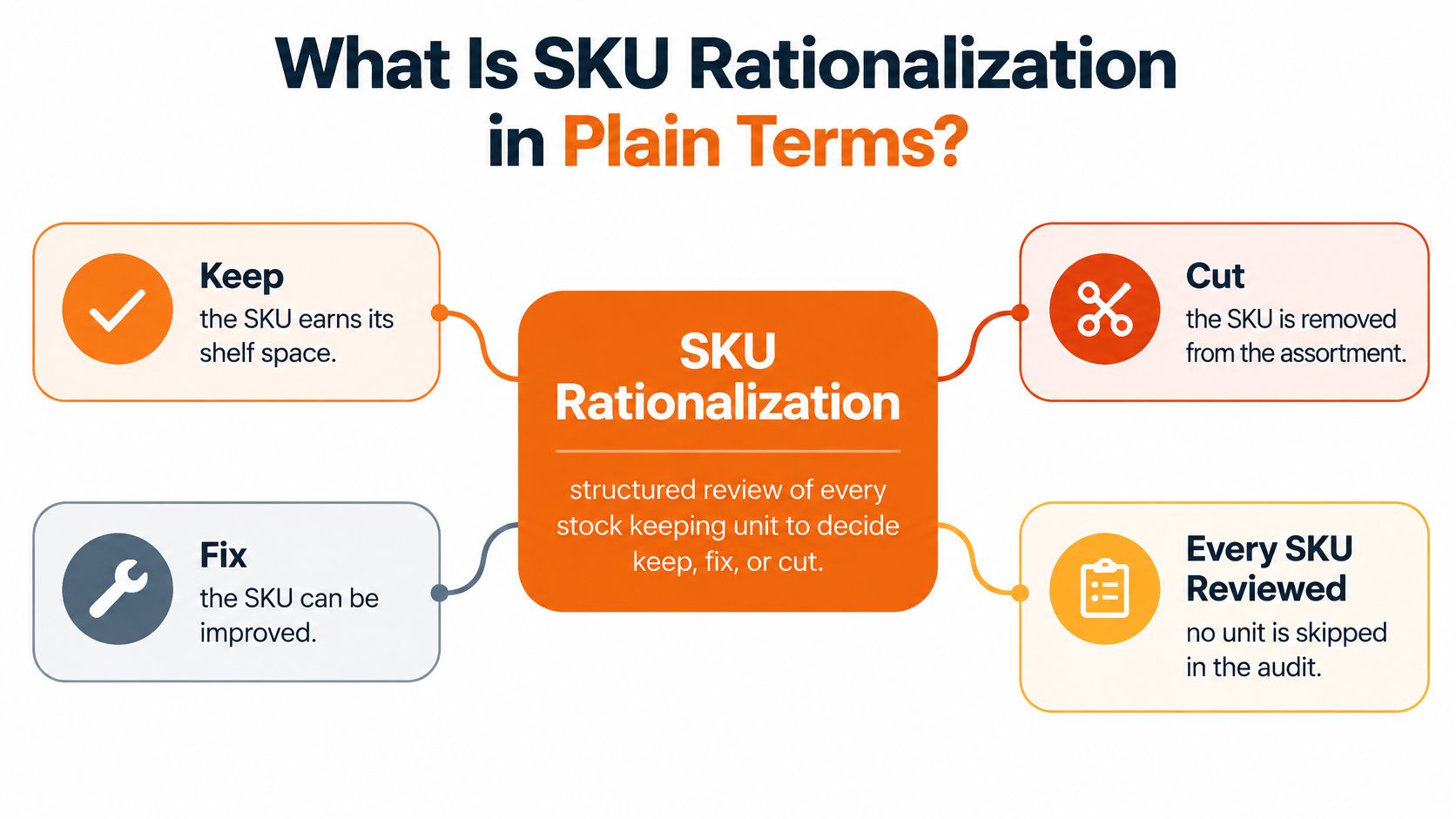
SKU rationalization is the structured review of every stock keeping unit in a product assortment to decide whether each item should be kept, reduced, redesigned, replenished differently, or discontinued. It isn't a unit-sales exercise: the SKU rationalization reference at Warematch describes a decision that weighs sales velocity, gross-margin contribution, inventory turnover, return rates, demand patterns, carrying costs and strategic value together.
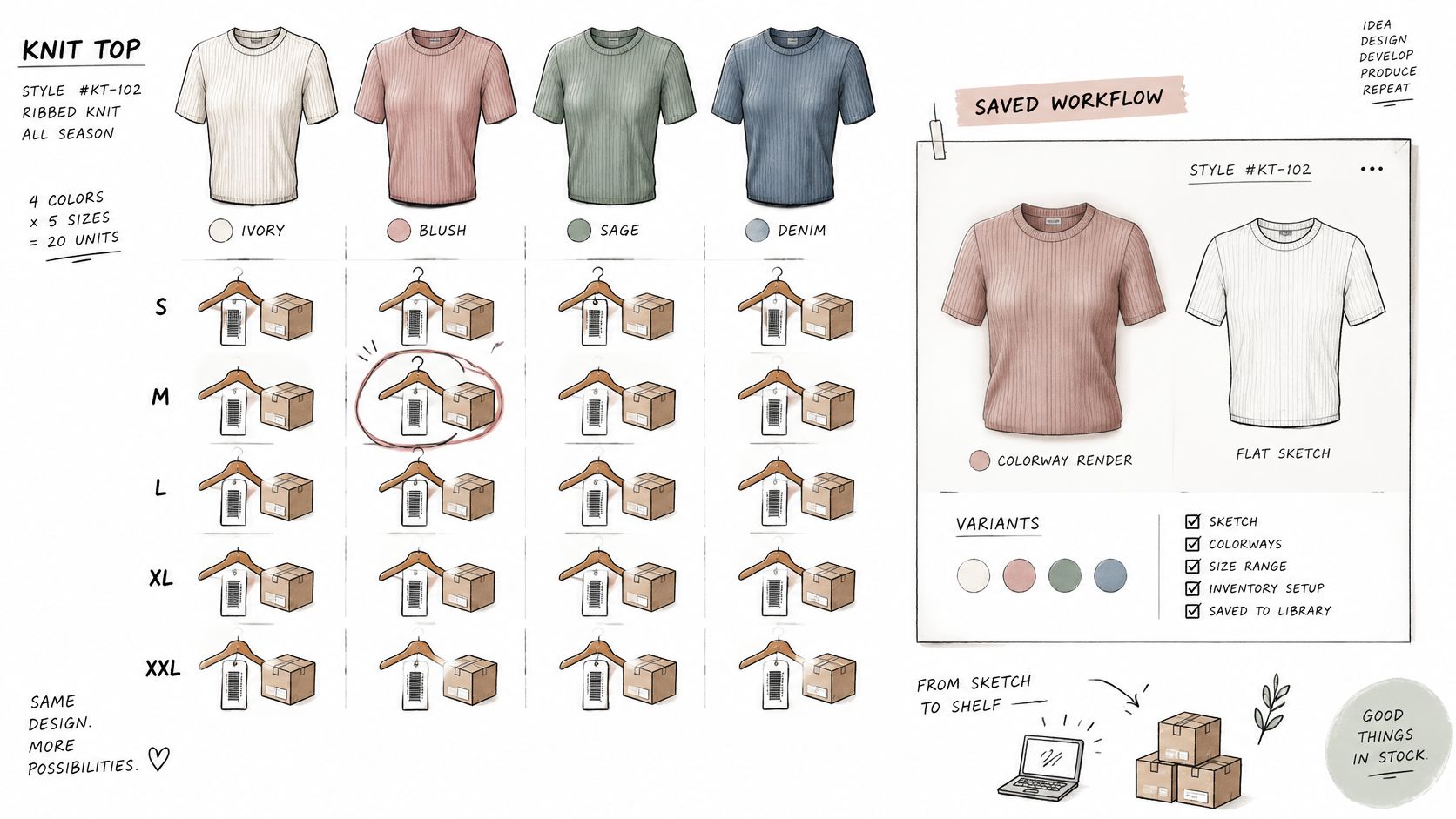
A SKU is one sellable variation, not one design. Once sizes, colors, fits, finishes and regional packs multiply, a single style becomes dozens of separate units, each with its own forecast, barcode, inventory position and end-of-life plan.
The clearest way to picture the work is a wardrobe edit. You don't keep a jacket because you've worn it twice, and you don't bin it because you've worn it forty times. You ask what it pairs with, whether it fills a gap, and whether it earns the rail space it takes up.
A practical review assigns each SKU to one of five action categories:
| Action | What it means | Typical trigger |
|---|---|---|
| Retain | Keep the SKU as it is | Strong contribution, healthy turnover or a unique customer role |
| Monitor | Keep it and review at the next cycle | Soft sales, but not yet enough history to decide |
| Modify | Change the variant's price, material, fit or pack | Good demand held back by cost, presentation or a fixable defect |
| Consolidate | Merge it into a near-duplicate | Two variants serve the same customer need |
| Exit | Discontinue it and clear remaining stock | Weak contribution after substitution and carrying cost are checked |
The goal is portfolio optimization, not indiscriminate reduction. A color, size, regional variant or packaging format can post low individual volume and still carry a collection or a customer need, which is why the review ties each action to a measurable threshold such as sell-through, gross margin return on inventory investment, days of supply or months without sales.
That shared scoring aligns merchandising, supply chain, finance and creative around one set of product-level facts. It also accounts for complexity, because every added SKU creates another forecasting, procurement, storage, replenishment, content and end-of-life obligation. The review tests whether the commercial return justifies it.
Why Does Every Extra SKU Cost So Much?
The bill arrives long before a product reaches a shelf. Industry benchmarking reported that the bottom 30 to 40 percent of apparel and footwear SKUs generated less than 5 percent of gross commercial revenue while absorbing more than 25 percent of working capital and design resources, according to Fashionating World's report on apparel retailers pruning product lines.
The same report put incremental development and administrative carrying costs at roughly $3,000 to $10,000 for each introduced SKU, covering technical specifications, pattern-making, fit approvals, sampling, fabric commitments, forecasting, warehouse tracking and replenishment decisions. Treat those as industry estimates rather than a benchmark for your brand, and replace them with your own fully loaded cost per SKU before you set a threshold.
The stage-gate question: before a variant joins the line or survives another season, can you name the revenue it will bring, the samples it needs and the markdown it risks? If any answer is missing, it isn't approved yet.
The pattern is decades old. Supermarket assortments grew from about 6,000 SKUs in the 1980s to more than 30,000 in the early 1990s, and very broad ranges were tied to higher inventory costs and more out-of-stocks, a history documented in a Springer chapter on retail assortment management. The payoff of pruning shows up just as clearly: McKinsey's retail analytics brochure reports an example in which SKU count fell 25 percent, changeovers became faster and gross margins improved, while warning that cut-the-tail programs underperform when they ignore commercial and supply-chain interactions.
Five lines to record for every new or underperforming variant:
- Expected revenue contribution, in units and value, not a hunch.
- Required samples and approvals, including fit rounds.
- Committed materials, especially minimum fabric buys.
- Operational handling, from receiving and labeling to picking.
- Markdown exposure if the variant misses forecast.
Content belongs on that list too. Every retained colorway needs its own imagery for the site, the marketplaces and the wholesale deck, which is why some teams assess an AI photoshoot for clothing brand workflow before adding another variant to the line.
Which Metrics Should a Rationalization Review Use?
Decide on contribution, not on unit sales alone. Pull the same fields for every SKU and for its parent style, so a weak variant can be read against the design it belongs to.
| Metric | What it tells you | Trap to avoid |
|---|---|---|
| Sales velocity | How fast the SKU sells through each week | Low velocity may come from a stockout, not weak demand |
| Gross margin contribution | Profit left after cost and markdowns | Margin alone ignores the demand the SKU brings to the range |
| Inventory turnover | How often stock sells and is replaced | Fast turns can hide an undersized stock position |
| Return rate | Share of units sent back | High returns often point to fit or shade problems, not a bad design |
| Days of supply | Stock on hand divided by daily sales | A long figure signals overbuying, but check the seasonal window |
| Months without sales | Time since the last sale | Seasonal items need a window as long as their selling season |
| Carrying cost | Storage, handling and capital tied up | Often missing from spreadsheet reviews |
| Stockout rate | How often the SKU is unavailable | Stockouts also suppress sales of other items in the same order |
Reading the Signals Together
Thresholds have to come from your own sales history. A velocity floor borrowed from another brand, or from a different category in your own range, will flag healthy products and protect weak ones. Set the floor per category, because a knit and a coat don't share a selling rhythm.
The seasonality window matters just as much. A winter coat scored on July data looks dead and a resort print scored in November looks worse. Months without sales needs a measurement window as long as the item's actual selling season, or the metric answers a question nobody asked.
A SKU becomes a candidate for exit when several weak signals agree at once: thin margin, slow velocity, long days of supply, and no unique role in the line. One bad number is a prompt to investigate, never a verdict.
If your team is still building the range this review will judge, our guide to assortment planning in fashion covers how the architecture gets set before any SKU is scored. Before the next line review, pull these eight fields for every candidate and its parent style, and bring the sheet to the meeting.
Can Removing a SKU Lose Demand?
Ranking the catalog by sales and cutting the bottom decile answers a narrower question than the one that decides the outcome. It tells you what a SKU sold. It says nothing about the customer who bought it, what they switch to when it's gone, or whether they switch at all.
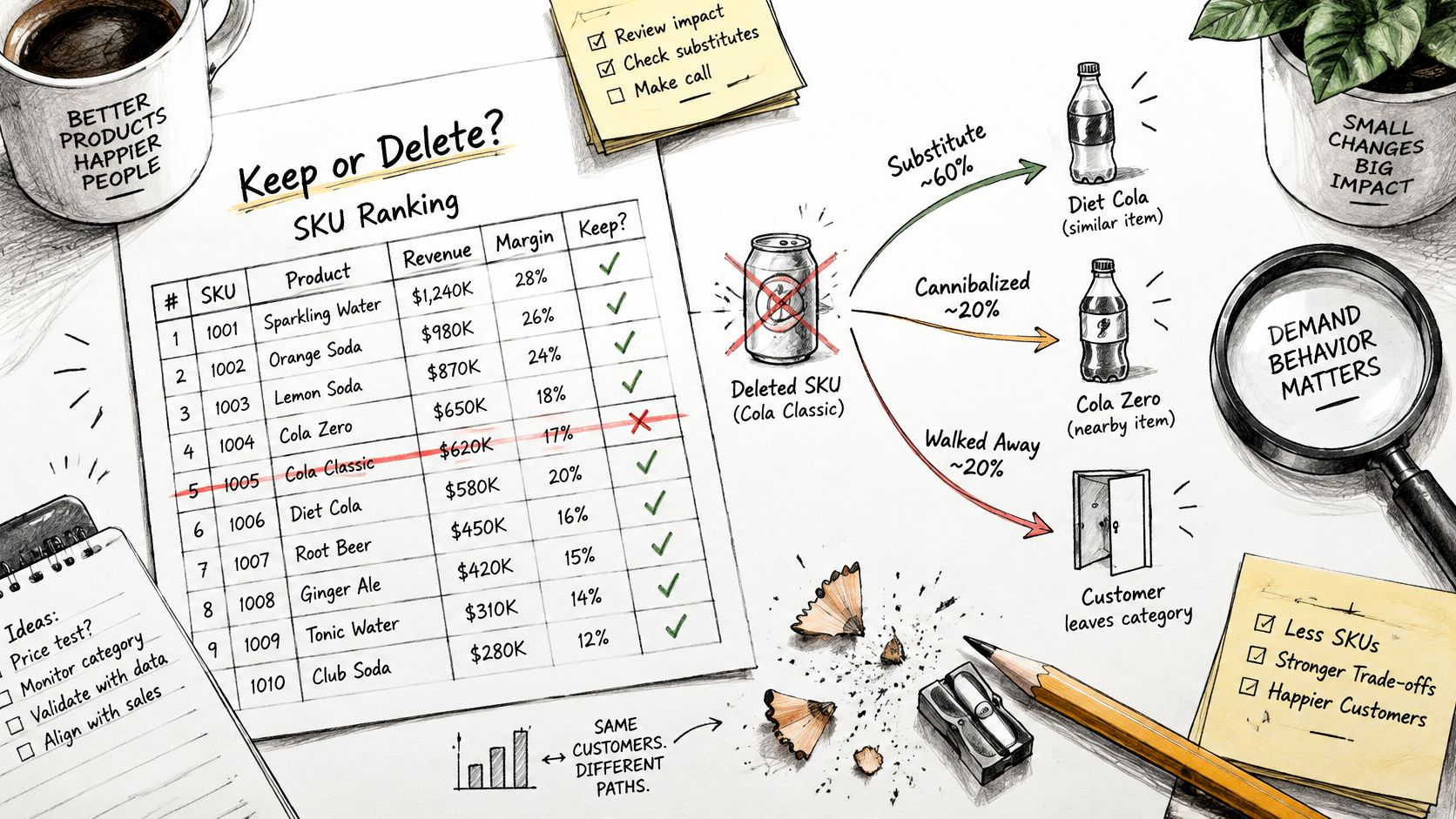
McKinsey frames the missing number as a walk rate: the share of a delisted item's demand that transfers to substitute products and the share that leaves the retailer entirely. Its analysts argue that delisting decisions should also weigh uniqueness, customer value, cost to serve and strategic role rather than financial performance alone, as set out in the McKinsey retail analytics brochure. Those two shares behave differently. Demand that transfers is captured almost intact. Demand that walks is gone, and the customer who leaves over one missing item rarely leaves the rest of their basket behind.
What a Stockout Tells You Before You Delist
A delist is a permanent stockout, and stockouts spill over. A large-scale field test found that an unavailable item cut its own sales, purchases of other items in the same order and purchases in future orders, and that offering customers discounts to encourage backorders was the least profitable mitigation among those evaluated (field study published in Management Science).
That makes an ordinary stockout a useful rehearsal. The way customers respond when an item is briefly unavailable is the closest evidence a merchandiser gets of what a permanent delist will do. For a fashion or beauty range, that spillover is the whole argument for caution. A low-volume colorway may complete a size, shade or styling story, and pulling it can push a customer to another brand even when its own margin looks poor.
A slow SKU that shares baskets with your best seller isn't a weak SKU. It's a quiet one.
Before any exit, document four things for the candidate:
- The named substitute, by style or shade code, not "something similar".
- Substitute stock on hand, because a replacement that's out of stock converts nothing.
- Expected effect on basket size, including attachment items sold alongside it.
- Repeat-order risk, for products customers buy on a cycle.
The substitution math is also where the upside sits. An assortment model that mapped customer preferences and substitution patterns at store level was estimated to increase retailer profit by 37.3 percent, rising to 43.7 percent when SKU prices were optimized at the same time, according to a Marketing Science study on assortment optimization.
The question for each candidate isn't whether it sold enough. It's whether it's redundant, or whether it protects the rest of the range.
What Does a Rationalization Look Like in Practice?
Take a knit top sold in four colors and five sizes. That's 20 SKUs, each with its own barcode, inventory position and forecast (all numbers in this example are illustrative). One design, twenty operational obligations, which is the arithmetic Bleckmann's analysis of fashion logistics complexity describes when it notes that a garment multiplied across sizes, colors and fits can produce dozens of individual SKUs.
At the fast end of the market the same math runs at a different scale: the same analysis reports Zara producing several hundred thousand SKUs a year and Shein adding roughly 2,000 new items daily, with calendars moving from two or four seasons toward as many as 52 micro-seasons annually.
Now score the twenty. Sand sells steadily in S and M but sits in XS and XL, so days of supply run long in those two sizes. That's a modify decision: reduce buy depth at the shoulders of the size curve instead of exiting the color. Navy is slow in every size but is the only color with a matching accessory bundle, so its months-without-sales figure has to be read next to its bundle role. Retain it until the next line review, with the bundle data attached.
Read the Variant Architecture, Not the Style
Rust is a near-duplicate of a terracotta in another line, so two variants serve one customer need. Consolidate, after confirming which one customers reach for when both are on the shelf. A lipstick range behaves the same way, because near-identical shades get merged only once you know which shade a customer switches to. A candle in three scents across two sizes gives six SKUs, and every size-scent pair has to earn its own inventory position.
Both failure modes cost money. Too many options create surplus and markdown exposure; too few raise stockouts and lost sales. A study of fashion retail assortment planning that fed historical sales forecasts into a nonlinear integer-programming model found the optimized selection cut markdowns from surplus stock and lost revenue from stockouts, increasing profits by at least 40 percent (European Journal of Operational Research study).
The savings and the risks both sit in the variant architecture, so review it separately from the parent product and find where color, size, fit or finish duplication creates avoidable complexity.
Which Tools Support a Rationalization Review?
A review can start in a spreadsheet. It rarely stays there, because the evidence lives in separate systems: sales and returns in commerce or ERP, margin in finance, development history in PLM, and the customer-facing range in whatever the sales team shows buyers. Sprello is our product, and it's described below at the same category level as the alternatives.
| Option | Best for | Role in the review | Trade-off |
|---|---|---|---|
| Spreadsheet or BI dashboard | Small assortments and one-off reviews | Scores SKUs from exported sales and cost data | Manual data joins and a weak link to visuals and line sheets |
| PLM system | Tech packs, BOMs, sampling and approvals | Holds the development record for each style | Not built to show a visual assortment to buyers |
| Demand planning or assortment optimization suite | Forecasting and open-to-buy decisions | Models demand and substitution against range constraints | Needs clean historical data and specialist setup |
| Sprello (our product) | Visual line review and buyer assortments | Keeps visuals, product details and line sheets in one shared catalog with separate buyer assortments | Complements PLM and planning suites and doesn't replace them; no tech packs, BOMs, pattern making, forecasting or open-to-buy |
The right row depends on which evidence the delisting decision needs. Sales and margin data tell you what a SKU earned. The visual assortment tells you what a buyer sees once it's gone, and whether the named substitute appears on the line sheet it hands demand to. A shared catalog also shows which products have approved visuals and which still need them, so a consolidation doesn't strand a survivor without sellable imagery.
Sprello is AI for product development and merchandising, taking a concept from first sketch to a buyer-ready collection. Its Canvas turns sketches, CADs, materials and references into photoreal visuals and colorways with saved workflows, and those visuals flow into one shared product catalog, line review, wholesale line sheets and a separate assortment for each account or channel.
Ask any vendor this first: where does the product record live, and can you export it without a services project?
Four questions worth putting to every provider:
- Where product data is stored, and who can reach it.
- Whether customer designs train models, yours or anyone else's.
- How access is controlled, and what an administrator can restrict.
- Which security certifications apply, and whether the report is current.
Sprello is SOC 2 compliant and never uses customer designs, sketches or uploads to train its models or anyone else's. Teams that already run planning or PLM keep those systems and add Sprello for the visual and commercial layer; if you're mapping which layer does what, our guide to merchandise planning software covers the planning side of the stack.
Choose the tool that holds the evidence the review needs, and be suspicious of any option that keeps that evidence in someone else's format.
How Do You Run a Review Before Cutting a SKU?
Run it as a sequence with a named owner for each step, because the analysis isn't the hard part. Agreement is.
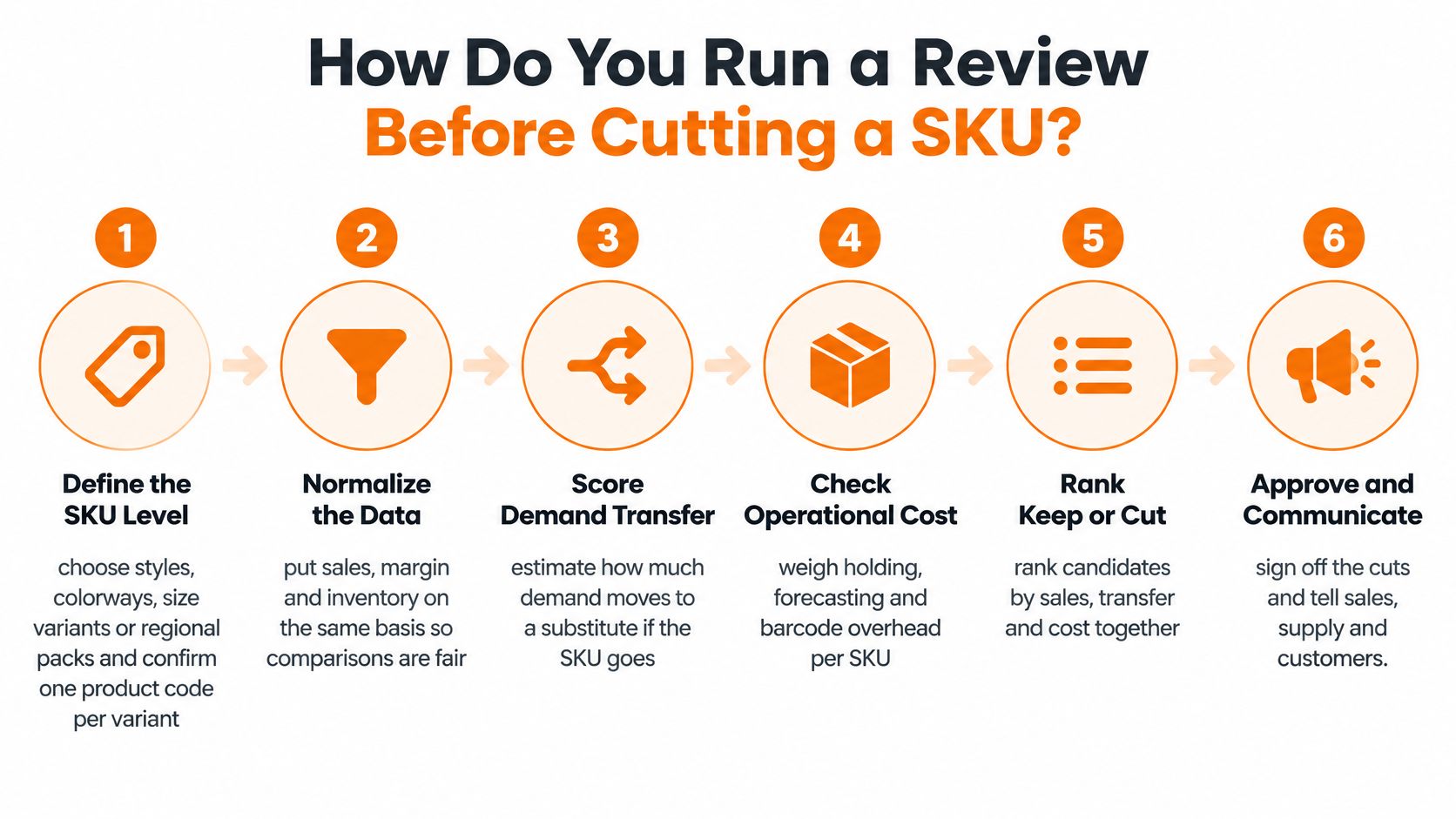
- Define the SKU level. Decide whether the review covers styles, colorways, size variants or regional packs, and confirm one product code per variant. Without that, you're comparing a marketplace listing to a master style.
- Normalize the data. Put product identity, attributes and channel codes on one basis, so a duplicate listing can't masquerade as a second SKU.
- Pull the metrics. Use the eight review fields for every candidate and its parent style, from the same trading period.
- Assign an action. Retain, monitor, modify, consolidate or exit, with the trigger written next to the label.
- Name the substitute. For every exit or consolidate candidate, record the replacement, check its stock and estimate the demand transfer.
- Test the scenario. Compare the baseline assortment against delist, successor, bundle and market-specific options before anything is signed off.
- Log and track. Record the evidence behind each decision, then measure realized demand transfer, availability and margin after the change.
Cutting SKUs can add risk when the catalog is inconsistent. A recent study indexed in Wiley's online library on SKU definition and efficiency measurement notes that SKU definitions vary between retailer and customer perspectives and that inconsistent definitions distort efficiency measurement. Fix the naming conventions and the variant hierarchy before you score anything, or the model will compare unlike records.
Assign one owner per step, set the date of the next review before the meeting ends, and record it in the same place as the decisions. Our 4-square chart workflow is one way to see where styles land before committing a range.
Frequently Asked Questions About SKU Rationalization
Is SKU rationalization the same as discontinuing products?
No. Discontinuation is one of five outcomes. A review also covers keeping an item, monitoring it through another cycle, modifying its price, material, fit or pack, and consolidating it into a near-duplicate.
How often should a brand run a review?
At every line review, plus a full pass each season for seasonal ranges. Seasonal items drift out of date faster than core items, and a once-a-year sweep lets a weak summer style sit through its whole selling window before anyone decides.
How do you tell a redundant SKU from a low-volume one that protects the range?
Run the substitute and demand-transfer check before deciding. The sales ranking answers the wrong question on its own; what matters is where demand goes if the listing disappears. A SKU that completes a size, shade or outfit usually earns a retain or modify decision rather than an exit, even when its own volume looks thin.
Does a small catalog need this process?
Yes, with the same logic and a lighter data set. A spreadsheet holding the eight review fields for every SKU is enough to start, and the discipline matters more than the tooling.
How should the review handle inconsistent product identity across channels?
Govern the taxonomy and the variant rules first, and confirm one product code per variant before scoring anything. Otherwise a channel-specific listing inflates the SKU count and a regional duplicate reads as a distinct product.
Demos work best on your own range: share your catalog size and use case, and the walkthrough is matched to the workflows your team runs.
Every style, its visuals and its buyer-ready line sheet sit in one shared catalog in Sprello, so the assortment you just reviewed is the assortment your sales team presents, with a separate buyer assortment per account, region or channel. Because every assortment starts from the same product information, a delisted SKU drops out of each line sheet at once instead of surviving in one rep's deck. Sprello delivers a 50% reduction in excess inventory and 3x fewer physical samples. Book a walkthrough on one of your own product categories at Sprello.
Related
More to explore
Fresh reads
What Is a Line Sheet for Wholesale Buyers
What is a line sheet? The wholesale fields, prices, minimums, and ship windows a buyer needs to order a seasonal line.
Creating a Workflow for Product Lines
Creating a workflow means named roles, triggers, templates, QA and iteration for fashion, beauty, jewelry and home lines, with Sprello beside PLM.

What Is a Digital Asset Management System? a Brand Guide
What is a digital asset management system? A plain guide to core features, versioning, metadata and governance for fashion and beauty brand teams.