November 13, 2026
What Is a Line Sheet for Wholesale Buyers
What is a line sheet? The wholesale fields, prices, minimums, and ship windows a buyer needs to order a seasonal line.
A line sheet is a wholesale ordering document that turns a collection into buyer-ready purchasing information, not a lookbook or consumer catalog. Sprello connects approved visuals and a shared product catalog to wholesale line sheets and separate buyer assortments.
Published 16 March 2026
Could a buyer complete every field on your line sheet and still submit an order you can't fulfill? Yes, if the opening minimum, style minimums, case packs, and shipping commitments don't work together. For merchandisers, designers, and product development leads, that's the difference between presenting a collection and making it orderable.
What Is a Line Sheet
A line sheet gives a wholesale buyer the information needed to select products and propose an order. The central entry is a style or SKU, connected to its image, available variants, prices, minimums, and delivery terms, as the Nation line-sheet guide explains.
Say a specialty boutique buyer likes a jacket in your seasonal collection. The buyer needs to identify the jacket, confirm which colors and sizes are offered, compare wholesale price with suggested retail, and understand the inventory commitment before selecting quantities. A beautiful image gets the buyer interested; the commercial details make that interest actionable.
A lookbook carries brand mood and editorial storytelling. A line sheet carries the terms of the buy.
The distinction is easier to see when the document is treated as an ordering reference rather than a presentation layout.
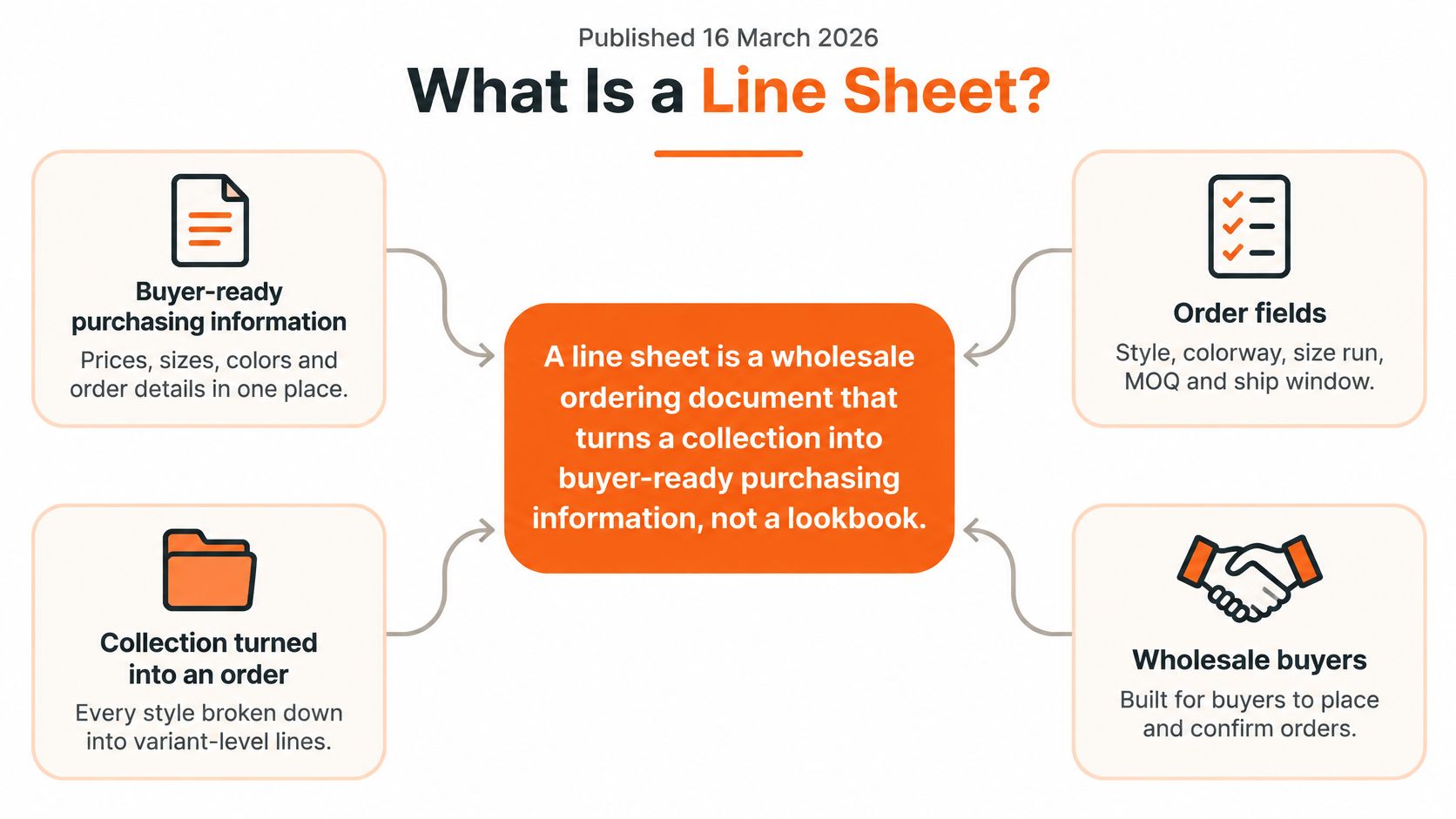
What the buyer should be able to do
For a merchandising team, the practical test isn't whether the page looks finished. It's whether someone outside the brand can use it without asking for basic product information.
- Compare the assortment: Understand how individual styles fit into the seasonal range.
- Evaluate the purchase: Read wholesale and retail references alongside minimums and terms.
- Choose valid variants: Select colors, sizes, or configurations that are offered.
- Communicate the order: Refer to product identifiers that your team can recognize without interpretation.
Designers and product developers contribute to that clarity. The visual must represent the product being offered, not an abandoned concept, and the material description must match the commercial specification.
Format is not the definition
Printed sheets, PDFs, and digital pages can all serve this purpose. A digital document isn't automatically useful, and a printable file isn't automatically outdated.
What matters is the connection between the collection and an executable purchase. A buyer should be able to move from “I like this style” to “I understand what I'm ordering” without rebuilding the product record through email.
Which Fields Belong on a Line Sheet
Line sheet fields a buyer uses to order
| Field | What the buyer reads | If it is missing or inconsistent |
|---|---|---|
| Product image | Which style is being offered | Buyer cannot match the line to the sample or showroom |
| Style number or SKU | The identifier used on the order | PO, invoice, and inventory can record a different product |
| Product name | The commercial name of the style | Internal nicknames get copied onto the order |
| Colorways | Which colors are actually for sale | A parent style is ordered as if every color exists |
| Size run or pack size | Apparel sizes, beauty pack size, or home dimensions | Variant demand is guessed |
| Material or composition | Fiber, formula, metal, or material callout | Claims and care questions bounce back to the brand |
| Wholesale price | The price the retailer pays | Margin cannot be estimated |
| Suggested retail price | The brand's MSRP reference | Gross-margin potential is invisible |
| Minimum order quantity | Commitment per style, color, pack, or opening order | An apparently valid order still fails the brand's minimum |
| Case pack | Units that must be bought together, including fixed size mixes | The buyer under-orders a required pack |
| Ship window | Start and end dates when the brand ships | A ship date is treated as an arrival date |
| Order deadline and cancel date | Last day to place or amend, and when cancellation is allowed | Late changes are argued after the fact |
| Payment, freight, and returns | Who pays, which terms apply, and return conditions | Landed cost and risk stay undefined |
Build each style record around the image and identifier first, then attach the variant and commercial information. The Kobo Labs guide to line sheets emphasizes stable identifiers, explicit minimums, and structured product data as the foundation for reliable wholesale ordering.
Make identifiers unambiguous
The style number must match the purchase order, invoice, and inventory record. If sales uses a showroom nickname while operations uses a different identifier, someone has to interpret the buyer's choice during order entry.
The parent style alone isn't enough when the buyer is choosing a particular color and size. Keep the relationship clear: the style identifies the design, while the variant identifies the sellable configuration. Don't show a color in the imagery without making its ordering status explicit.
Explain the commitment beside the price
Wholesale price tells the buyer what the product costs before other applicable charges. Suggested retail price provides a reference for evaluating gross-margin potential, not a guarantee of the retailer's eventual margin.
Minimums need equally careful labels. State whether the commitment applies per style, per color, per pack, or across the opening order, and separate opening-order requirements from reorder requirements. A field labeled only “minimum” leaves the buyer to guess the scope.
Payment terms, freight responsibility, order deadlines, cancellation conditions, and returns belong in readable commercial terms. Don't hide the rules that determine whether an order is acceptable in a separate document the buyer hasn't received.
Practical rule: If sales must explain a field differently to each buyer, rewrite the field or its accompanying rule.
For enterprise assortments, generate sheets from structured product records rather than editing each page independently. A change to price, pack quantity, or ship timing should be controlled at its source, with exports refreshed from that approved record.
Treat product catalog management as the discipline behind the document, not merely a place to store images. Before release, check that every orderable variant has an identifier and a clear availability state, including variants that are unavailable or still awaiting approval.
How Minimums and Ship Windows Change an Order
A sheet can list every field and still fail. Completeness doesn't prove that the buyer's selected quantities satisfy the commercial rules.
The minimum mechanics operate at different levels. Omiren Styles' buyer-information guide distinguishes MOQ per style, MOQ per colorway, and a total opening-order minimum expressed in value or units. A per-colorway rule can require a larger commitment than a style-level rule when the buyer wants several colors.
The interaction matters more than the labels.
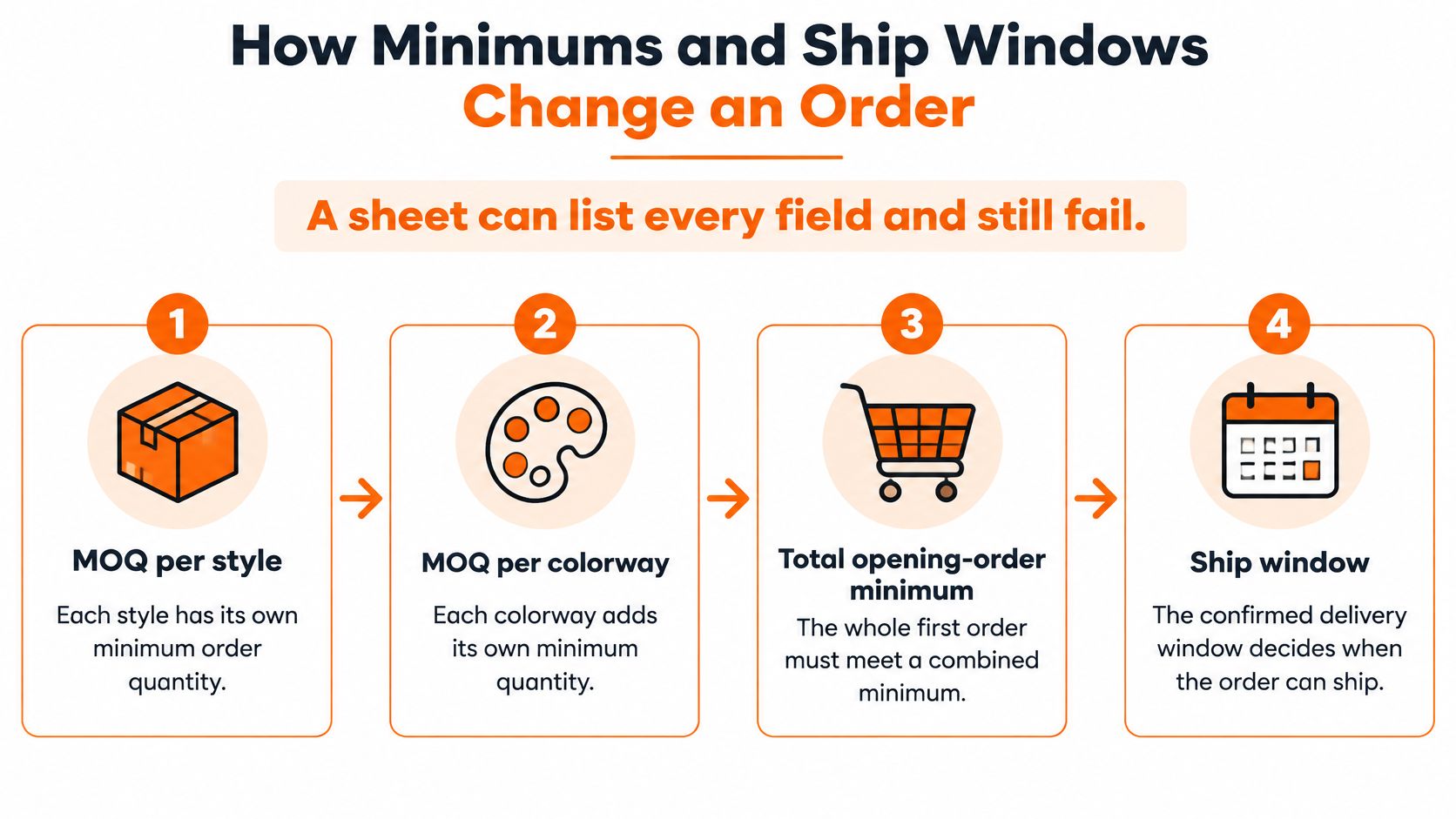
Follow an order through the constraints
Consider a retailer whose selected styles clear a $5,000 opening minimum but still fall short of a per-style MOQ, the example described in Brandboom's line-sheet guide. The total commitment passes, but the order isn't acceptable as written.
The buyer must increase the under-minimum style, replace it, or remove it and rebuild the selection. If the buyer increases it, the wholesale subtotal changes. If the buyer removes it, the remaining assortment must still satisfy the opening requirement.
Now apply the case pack. The buyer wants a size distribution weighted toward the boutique's strongest sizes, but the brand sells that style in a fixed assortment. Buying enough units isn't sufficient if those units don't form the required packs.
For jewelry teams evaluating upstream production commitments, HonHo Wholesale Jewelry's guide to OEM jewelry minimums for startup brands offers useful manufacturing context. Keep supplier production minimums distinct from the wholesale minimums you offer retailers.
Test timing after quantities
A ship window describes when the brand ships, not when the retailer can sell the inventory. Freight, customs clearance, and the retailer's distribution process all sit between dispatch and availability on the shop floor.
If the buyer needs the collection for a launch, work backward from that requirement. An acceptable ship window may still produce an unacceptable arrival expectation.
Review the proposed order as a connected decision:
- Selection and quantities: Show chosen styles and units by color and size after pack rules are applied.
- Commercial commitment: Identify the applicable minimums, wholesale subtotal, currency, and price-effective date.
- Landed responsibility: Specify who pays freight and duty rather than treating wholesale subtotal as total cost.
- Timing and exit: Record expected arrival and the cancellation deadline alongside the shipping commitment.
Use assortment planning in fashion to examine the resulting mix, not just the original wish list.
If separate rules are satisfied but the combined order still can't ship as written, the sheet isn't finished.
How Fashion Beauty Jewelry and Home Brands Use Line Sheets
The ordering model stays consistent across categories. What changes is the information required to distinguish the sellable product.
A cross-category review makes those differences visible.
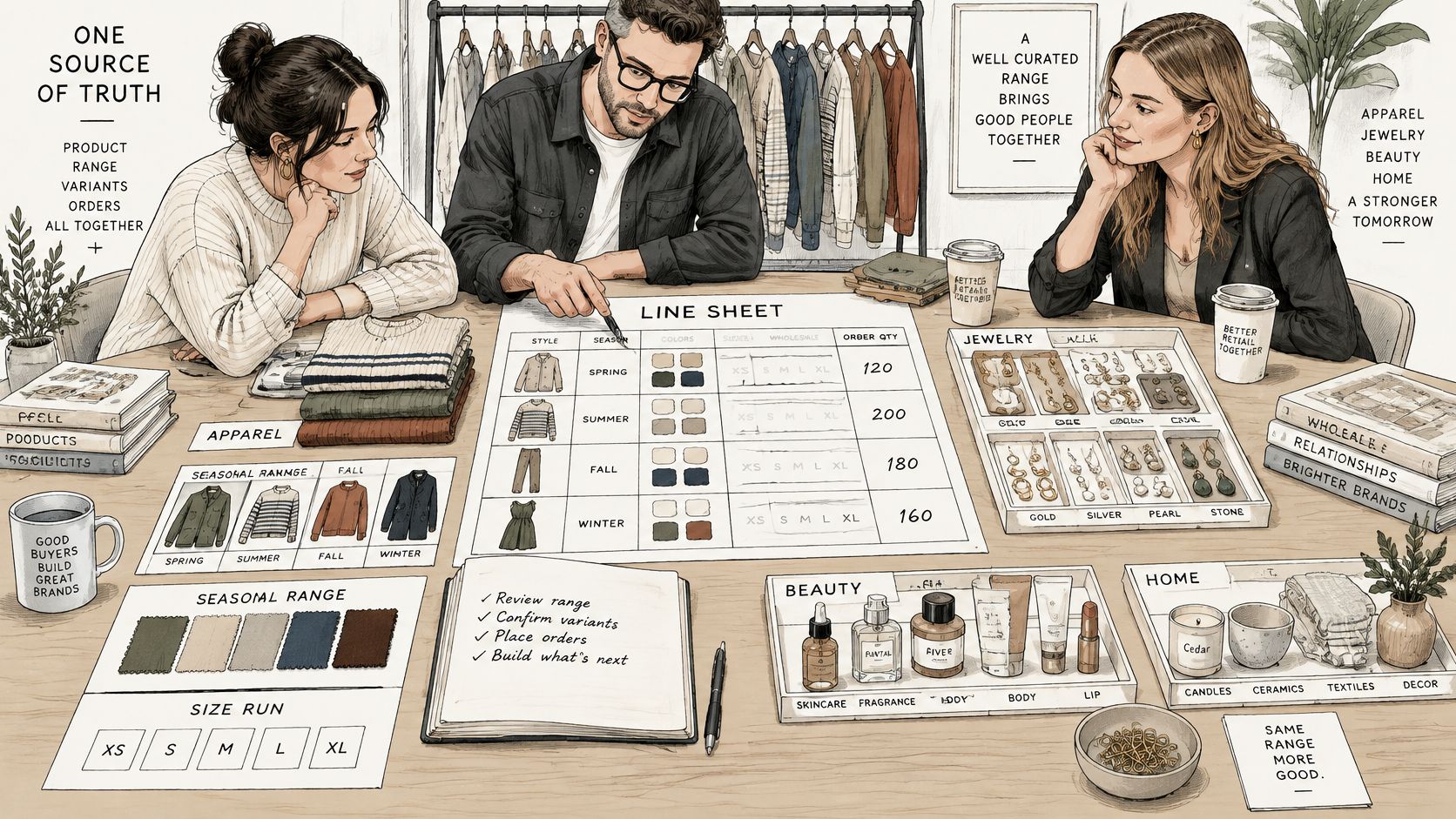
The Genpire guide to fashion line sheets describes a common product-and-terms framework that can accommodate apparel sizes, beauty pack sizes, and home-goods dimensions while preserving a consistent SKU architecture. Channel-specific presentation should change the selection, not create conflicting product truths.
Apparel and beauty need different variant detail
For fashion and apparel, a seasonal jacket range might share a silhouette while offering different colorways and sizes. The buyer should see the range as an assortment but select the actual order at variant level. A regional version can offer a narrower selection without inventing a new identifier for an unchanged product.
Beauty and cosmetics require a different reading. A lipstick image may establish the product family, but the order needs the shade and pack size being sold. Hero claims and ingredient storytelling don't replace wholesale price, suggested retail, minimums, and shipping terms.
A department store and a specialty boutique may receive different beauty assortments. Both should draw their product details from the same approved records.
Jewelry and home need precise distinctions
Jewelry and accessories can be visually similar while differing commercially. A finish, ring size, or pair-versus-single configuration must be identifiable in the record. A lifestyle photograph gives context, but it doesn't establish which configuration the buyer selected.
For home and lifestyle, dimensions or capacity can perform the role that a size run performs in apparel. A decorative vessel shown in a room setting still needs a clear orderable size. A seasonal refresh can change the offered assortment without changing the logic used to identify the underlying styles.
The same collection can support department stores, specialty boutiques, flagship stores, and own retail. These are different assortments of a line, not permission to maintain incompatible specifications.
Use the video alongside a category review to consider how product presentation supports the buying conversation.
When reviewing category-specific merchandising use cases, keep the approval test concrete:
- Identity: The style number stays consistent across account and regional versions.
- Variants: Category-specific fields distinguish exactly what can be purchased.
- Terms: The buyer can calculate the inventory commitment and assess timing.
Which Tools Should Own the Line Sheet
Sprello is our product. This comparison describes the jobs different systems perform rather than ranking them as interchangeable alternatives.
Where a line sheet sits among brand systems
| System | What it is for | Role in the line sheet | What it does not replace |
|---|---|---|---|
| Sprello | AI visuals, one product catalog, line review, and per-account assortments | Selected visuals and product details flow into wholesale line sheets and buyer assortments | PLM, tech packs, BOMs, pattern making, demand forecasting, and open-to-buy |
| PLM and planning suites | Product record, calendar, costing, and planning across their respective functions | Source data a line sheet should stay aligned with | Dedicated buyer-ready visual and account-assortment workflows where those capabilities aren't provided |
| Wholesale showroom software | Buyer access and order capture | Publishes a digital line and records the order | The design and merchandising work that creates the visuals and the line |
| PDF or spreadsheet | A file a buyer can save or print | A point-in-time export for a season, region, or account | A single current record when prices, packs, or ship windows change |
Separate creation, approval, and ordering
Sprello is AI for product development and merchandising, from product concept to buyer-ready collection. Canvas takes in sketches, CAD files, materials, and references and uses them to create and refine product visuals, including colorway and material directions that can be explored before the next physical sample. A canvas workflow can be saved and run again on the next style. Those visuals sit with product details in one shared catalog, which also shows which products have approved visuals and which still need them. From there, selected visuals and details flow into wholesale line sheets and buyer assortments.
PLM and planning suites carry different operational responsibilities, and their capabilities vary by system. Keep approved specifications, costing, calendars, and planning decisions with the systems and teams responsible for them. The useful question is which record is authoritative for each field. Whether a given application can display that field is secondary.
Wholesale showroom software addresses the buyer-facing transaction: presenting an available line and capturing selections or orders. Developing the assortment and producing the visuals used to review it are separate jobs that happen earlier.
Keep saved files without creating competing masters
Printed sheets and PDFs remain useful records of an offered collection. As the RepSpark digital line-sheet guide explains, brands historically distributed these documents through showrooms, trade shows, sales representatives, and email before digital wholesale systems made updates and sharing easier.
The revision problem starts when a sales representative updates a local file for one account while another buyer still holds the previous version. Both documents can look approved while the commercial terms differ. That matters because a buyer reads a sheet as a single order: opening minimums, per-style minimums, case packs, and ship windows combine into one inventory commitment. A stale ship window or an outdated case-pack quantity changes the math even when every other field is correct.
A saved export should preserve what was offered. It shouldn't become an independent place to maintain the offer.
For enterprise evaluation, review governance alongside the workflow:
- Data protection: Designs, sketches, and brand IP are encrypted at rest and in transit, with strict data isolation between workspaces.
- Customer-data policy: Customer designs, sketches, and uploads are never used to train Sprello's models or anyone else's.
- Outcome scope: Evaluate sample-development results separately from order accuracy. Faster concept-to-sample work is a different claim than cleaner wholesale orders, and the evidence for each should be weighed on its own.
Choose according to the actual gap: product data, order capture, or buyer-ready visuals and assortments. Whatever the format, style numbers, prices, packs, and ship windows must come from a current approved record. A line sheet can be complete on every field and still produce a bad order if the record behind it has moved.
Book a Demo on Your Own Category
If your team already maintains product truth in PLM or a planning suite, don't evaluate another system as though that work needs replacing. Evaluate the missing path from approved product information to visuals, collection review, and buyer-specific presentation.
That path may involve different assortments for North America, Europe, department stores, specialty boutiques, flagship stores, or own retail. The useful test is whether your team can review those selections while keeping the underlying products consistent.
Bring a category and a use case
Our sales demos are personalized walkthroughs after your team shares its catalog size and use case. A demo can show the catalog, Canvas, line sheets, and assortments using a product category your team works with.
- Inspect the product record: Review the details and visuals associated with a style.
- Follow the presentation: See selected visuals and catalog details used in a buyer-facing sheet.
- Check the fields: A line sheet can show style or variant codes, material, wholesale price, and retail price.
Sprello doesn't replace PLM or take over tech packs, BOMs, pattern making, forecasting, or open-to-buy. Your designs and uploads aren't used to train models.
Book a demo at sprello.ai to evaluate that workflow against your own category and merchandising needs.
What Else Do Merchandisers Ask About Line Sheets
Does a line sheet replace the purchase order?
No. The line sheet is the reference the buyer selects from; the purchase order records the buyer's proposed commitment. Both should use matching style identifiers, with acceptance governed by the agreed commercial terms.
Who approves a sheet before a buyer sees it?
Merchandising should own assortment and commercial approval, with design confirming the product being represented. Sales should distribute the approved version rather than edit a private copy that operations can't verify.
Can a style appear on several account sheets?
Yes. Each account can receive a different selection while the underlying product identity remains consistent. Account-specific terms should be explicitly approved, not introduced through undocumented edits.
What should a global buyer check beyond unit price?
Confirm currency and the date the price takes effect. Then examine freight and duty responsibility, expected arrival, and cancellation conditions before treating the wholesale subtotal as the full buying commitment.
When is a PDF enough?
A PDF is useful when the buyer needs a saved reference for a frozen offer. It's a poor master record while prices, colorways, availability, or cancellation conditions are still changing.
Sprello connects product visuals and a shared catalog to line review, wholesale line sheets, and buyer-specific assortments. Visit Sprello to book a demo using your own product category and see how approved product information becomes a buyer-ready collection.
Related
More to explore
Fresh reads
Creating a Workflow for Product Lines
Creating a workflow means named roles, triggers, templates, QA and iteration for fashion, beauty, jewelry and home lines, with Sprello beside PLM.

What Is a Digital Asset Management System? a Brand Guide
What is a digital asset management system? A plain guide to core features, versioning, metadata and governance for fashion and beauty brand teams.

Product Photography Style Guide: Specs, Shots and Rules
Build a product photography style guide with shot types, file specs, lighting rules, AI disclosure and channel alt text for fashion, beauty and home brands.