October 6, 2026
Virtual Try on Technology: A Practical Guide for Brands
Learn how virtual try on technology works, why it matters for fashion and beauty brands, and how to plan, measure, and scale it across your catalog.

A shopper stands in a fitting room with a phone in one hand and a blazer on a hanger in the other. On the screen, the same blazer appears over their reflection. They aren't asking whether the image looks impressive. They want to know whether the shoulders will sit correctly, whether the sleeve length will work, and whether the product they receive will match the expectation created on the product page.
That moment captures both the promise and the difficulty of virtual try on technology. It can help shoppers judge appearance before checkout, but appearance confidence isn't the same as fit prediction. For a brand team, the serious questions are broader: which shopper uncertainty are you solving, what product data does the system require, how will you measure quality, and can your creative and merchandising workflows support the experience across a large catalog?
What Virtual Try On Technology Actually Changes for Shoppers
The first change is psychological. Traditional online shopping asks customers to make a prediction from a product image, a size chart, and perhaps a model whose proportions don't resemble their own. A virtual try-on experience gives them another piece of evidence. The shopper can see how a color, frame, silhouette, or garment placement might read on their face or body before deciding.
That evidence can shorten the decision window. A customer comparing two sunglasses may reject one immediately because the frame shape doesn't suit their face. Someone viewing a jacket may notice that the visual balance feels wrong before adding it to the basket. The tool doesn't need to answer every question to be useful. It needs to surface important objections earlier, while the customer can still make an informed choice.
Practical rule: Treat the rendered image as decision support, not as a promise that the physical product will feel exactly as shown.
The distinction matters because shoppers often use the phrase “will it fit?” to mean several different things. They may mean, “Will this color and silhouette look right on me?” They may mean, “Will the waistband accommodate my measurements?” Or they may be asking whether the fabric will stretch, drape, compress, or restrict movement. A single interface can blur these questions unless the brand labels its capabilities clearly.
From fewer guesses to better evidence
The second behavioral change is that VTO moves some style and fit objections upstream. Instead of waiting for delivery to discover that a shade, shape, or proportion feels wrong, shoppers can test the visual proposition before purchase. That can improve expectation alignment, particularly for products where appearance drives the decision.
The third change concerns returns. A return shouldn't be viewed only as a customer-service event. It can also be a signal that the product page, size guidance, imagery, or recommendation logic failed to answer a question. Virtual try-on creates another source of behavioral and quality data, provided the brand connects try-on use with product selection, size choice, and return reasons in a privacy-conscious way.
Teams beginning their research can use Wonderment Apps' virtual try-on collection to review common retail applications and terminology. The useful lesson is that “try-on” describes a family of experiences, not one standardized capability. An enterprise decision should therefore start with the shopper problem, then work backward to the required technology stack.
The Core Concept Behind Virtual Try On Technology
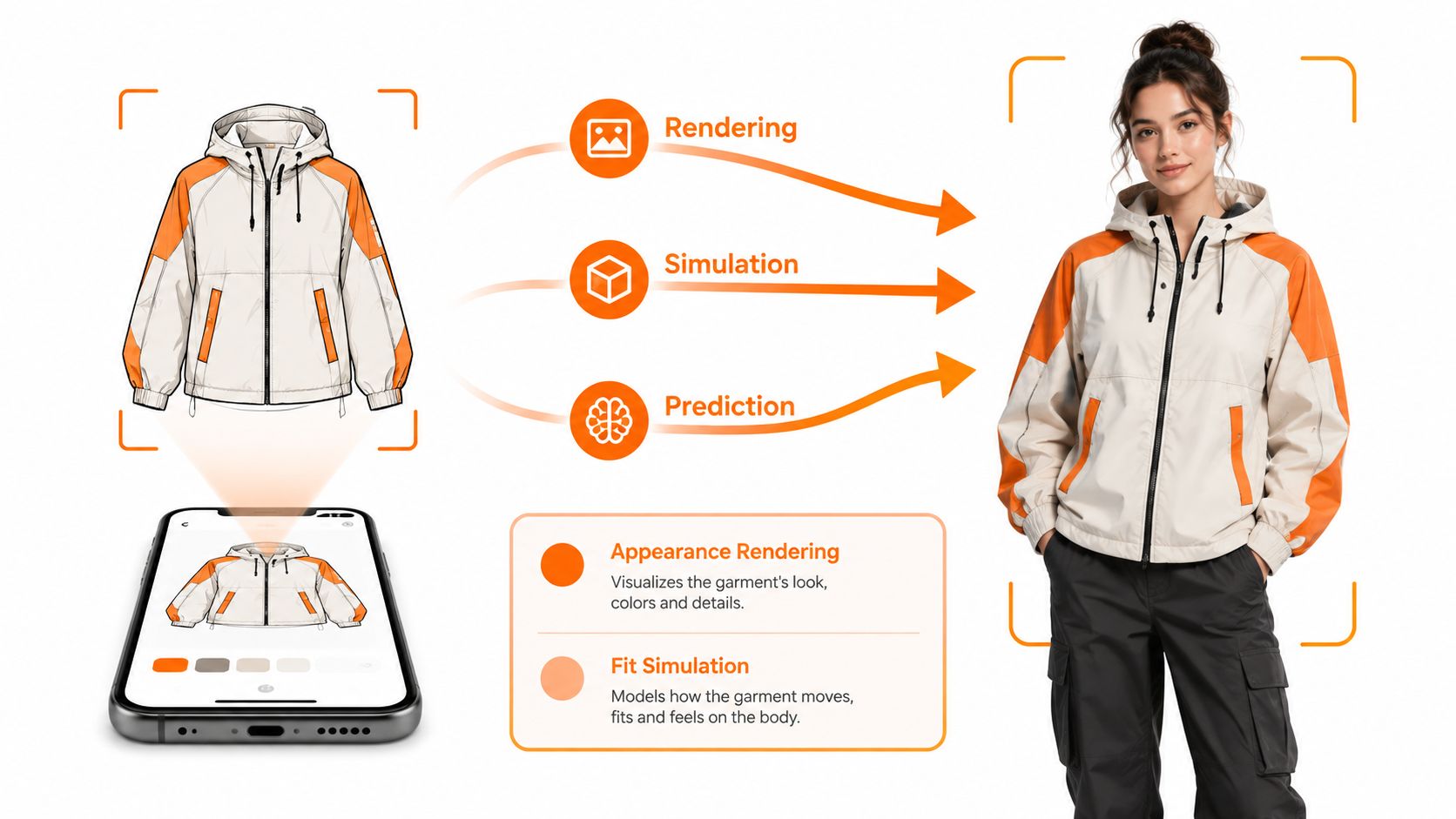
Virtual try-on is a family of techniques that renders, simulates, or predicts how a product may appear or fit on a shopper. Some systems place a flat image over a photograph. Others track a live camera feed, build a body model, simulate a garment on an avatar, or recommend a size from measurements and shopping history.
A simple analogy is a test drive at a car showroom. The first part of the test drive is visual and experiential. Does the vehicle look right? Can you see yourself using it? The second part is practical. Does the seat position work, do you have enough room, and does the vehicle behave as expected? VTO also has these two separate layers:
- Appearance rendering shows how a product may look on a person, face, body, or scene.
- Fit simulation or measurement prediction estimates how a product may align with body dimensions and behave physically.
A system can perform the first task without performing the second. A lipstick overlay may help a shopper judge color placement while saying nothing about garment measurements. A photorealistic shirt render may preserve a logo and pattern but still fail to predict shoulder pressure or sleeve tightness.
Inputs and outputs
Most implementations use one or more of four inputs:
- A 2D shopper image, usually a selfie or full-body photograph.
- A live camera feed, which allows the system to track movement and landmarks.
- A body or face model, built from measurements, photographs, or an avatar workflow.
- A questionnaire or purchase history, which can support size recommendation without image rendering.
The outputs vary just as much. A shopper may receive a rendered overlay, a generated image, a recommended size, a fit map, or a combination of these. The brand must tell customers which output they are seeing and what it can reasonably support.
The technical field has developed from early augmented-reality and virtual-fitting-room research into retail systems using 2D overlays, markerless AR, 3D garment simulation, and AI-generated visualization. A systematic review of 69 academic studies identified recurring adoption factors including usefulness, enjoyment, interactivity, trust, privacy, and confidence in the digital representation in its review of virtual try-on research. Those factors point to a practical conclusion: a beautiful interface won't compensate for a representation that shoppers don't trust.
The Main Types of Virtual Try On Technology
Enterprise teams usually choose among four operational approaches. They overlap in the market, but they don't carry the same asset requirements, hardware demands, or accuracy ceiling.
| Type | Core Method | Best Fit For | Catalog Readiness Burden | Accuracy Ceiling |
|---|---|---|---|---|
| 2D overlay | Composites a flat product image onto a shopper photo | Beauty, eyewear, simple accessories, color exploration | Lower, if clean product and face or body images exist | Stronger for placement and appearance than physical fit |
| Markerless AR | Uses a live camera feed and body or facial landmarks | Eyewear, makeup, watches, selected accessories, interactive previews | Moderate, with tracking-ready product assets and device testing | Good for real-time visual alignment, limited for cloth behavior |
| 3D garment fitting | Drapes a digital garment over a body model using geometry or cloth simulation | Dresses, outerwear, structured apparel, fit-sensitive products | High, because patterns, measurements, materials, and grading must be prepared | Highest potential for geometry and fit, but dependent on source data |
| Size estimation engine | Recommends a size from measurements, questionnaire answers, or behavioral data | Footwear, basics, denim, and catalogs with reliable size information | Moderate to high, depending on size-chart and product-data quality | Can address size choice without producing a visual render |
What each approach asks of the brand
A 2D overlay is often the fastest way to test shopper engagement. It can place a product image on a face or body photograph, but the result remains dependent on the source image and the system's ability to preserve proportions. For lipstick, eyewear, and other products with relatively constrained placement, that may be enough. It becomes less dependable when a garment needs to bend, stretch, layer, or drape.
Markerless AR removes markers or printed tracking targets and uses camera-based landmark detection instead. The shopper gets a more immediate experience, which makes latency and mobile browser performance important. The trade-off is that a live preview must make rapid approximations. It shouldn't be described as a measurement engine because the garment follows the shopper's movement.
3D garment fitting demands more preparation but offers the most credible path toward body-aware simulation. The brand needs more than a front-facing product photograph. It may need garment geometry, pattern information, material behavior, size grading, and a body representation. If those inputs are incomplete, an advanced renderer can still produce a confident-looking but unreliable result.
Size estimation doesn't need to show the shopper wearing the product. It solves a narrower problem, choosing a likely size. For many basics and footwear categories, that narrower answer may be more valuable than an attractive image. The right choice depends on whether the catalog's primary uncertainty is visual appearance, physical fit, or both.
Virtual Try On and the Fit Prediction Problem
A virtual try-on image can look convincing and still provide weak fit information. That isn't a minor technical caveat. It is the central distinction brand teams need to preserve when they evaluate vendors.
Consider a beauty overlay. The system may align a shade to lips or eyes and help the shopper judge the visual effect. It doesn't need to infer the shopper's body measurements. A clothing system faces a different problem. It must account for body geometry, garment dimensions, ease, stretch, drape, compression, layering, pose, and occlusion. A shader can make fabric look realistic without knowing whether the waistband will sit comfortably.
The measurement gap
Available evidence shows why teams should separate appearance confidence from fit prediction. Reported 2D overlay systems produce average size-prediction errors of 1.5 to 2.5 centimeters in critical measurements, while 3D-avatar systems reduce reported errors to roughly 0.7 to 1.2 centimeters, with greater implementation and computational demands as described in this analysis of VTO fit limitations. These figures aren't universal guarantees. They are a warning against treating every rendered image as a sizing result.
| Dimension | Appearance Confidence, AR and Looks | Fit Prediction, Size and Measurement |
|---|---|---|
| Primary question | How might the product look on me? | Will this product and size align with my body? |
| Main inputs | Photo, camera feed, product image, facial or body landmarks | Body measurements, garment measurements, pattern data, size chart, fit rules |
| Typical failure modes | Lighting, occlusion, pose, texture, logos, image artifacts | Wrong size, poor ease modelling, missing stretch, incorrect grading, unmodelled body shapes |
| Shopper signal | Visual preference and confidence | Measurement confidence and purchase-risk reduction |
| Required disclosure | Explain that the image is a visualization | Explain coverage, assumptions, confidence, and unsupported categories |
A brand should be especially cautious with false reassurance. If the model is calibrated only on standard body shapes, a shopper outside that data distribution may receive a polished image and an unjustified sense of certainty. Loose silhouettes, layered outfits, textured fabrics, unusual poses, and partially hidden body regions can all expose this weakness.
Questions for a vendor
Ask for the evidence behind the claim, not just a demonstration:
- Dataset coverage: Which body shapes, sizes, poses, skin tones, garments, and regions appear in validation data?
- Measurement definition: Does “accuracy” refer to visual similarity, landmark placement, size recommendation, or garment-to-body distance?
- Category boundaries: Does the system support fitted denim, loose dresses, outerwear, layering, and stretch fabrics equally?
- Calibration process: Can the brand adjust recommendations using its own size charts, garment measurements, and return outcomes?
- Uncertainty display: Does the customer see a confidence level or an explanation of what the system cannot determine?
A photorealistic result is not evidence of physical fit. Require separate acceptance criteria for visual realism and measurement alignment.
The Business Case and ROI of Virtual Try On Technology
A brand team is preparing to launch virtual try on technology across a large catalog. The commercial question is not whether a polished image can attract attention. It is whether the experience creates enough additional margin to justify content preparation, integration, service, and ongoing quality control.
VTO can improve appearance confidence, but that does not automatically mean it predicts physical fit. Those outcomes belong in separate parts of the business case. A shopper may feel more certain about a color, silhouette, or styling choice while remaining unsure about size. Measuring both outcomes together can make a feature look more effective than it is.
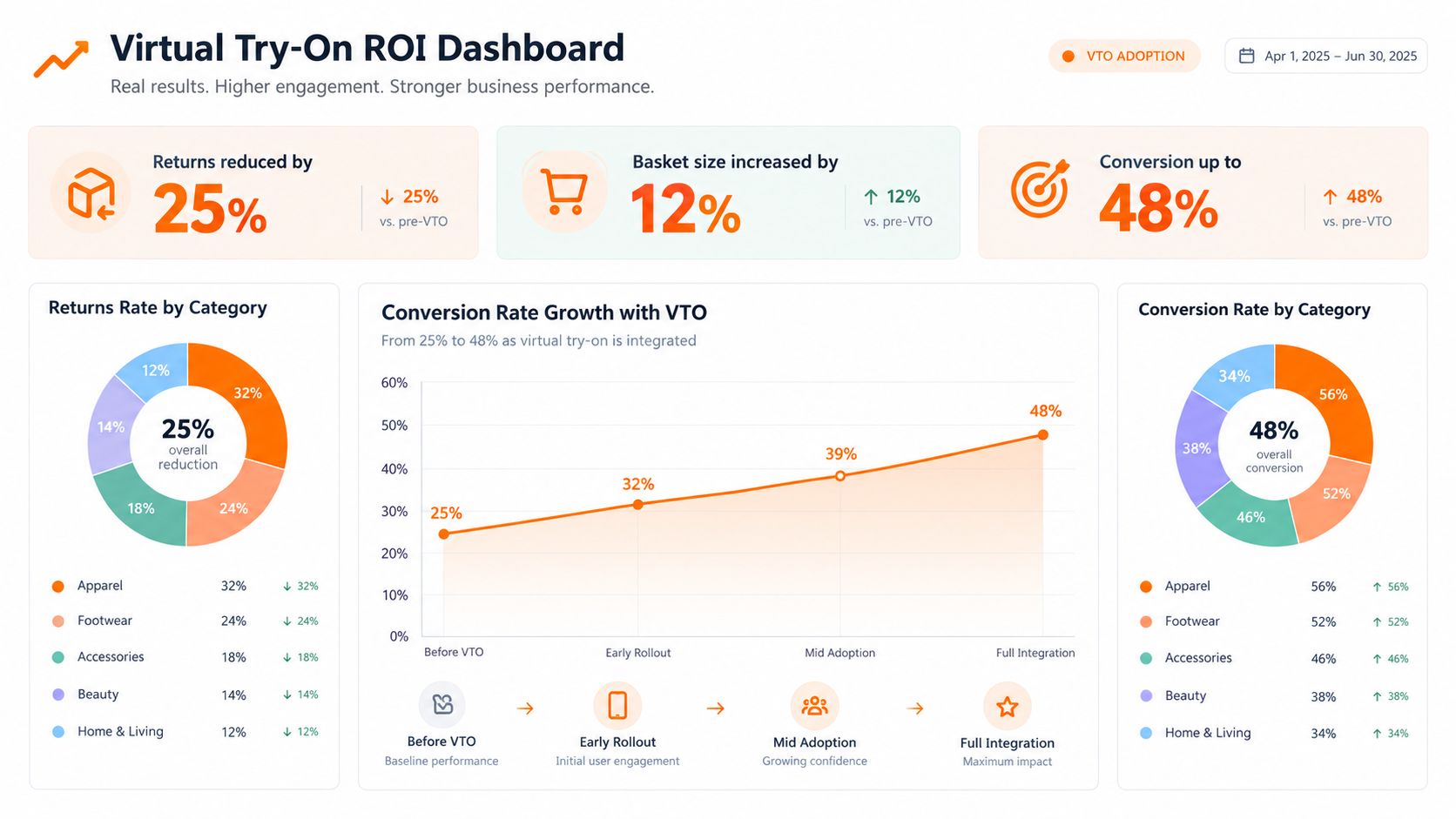
The reported commercial signals are still useful. In a study covering more than one million luxury-fashion shoppers, users who engaged with VTO reportedly added products to cart at roughly three times the rate of non-users and converted 50% more often. Industry reporting also describes one marketplace test in which try-on users converted at twice the rate of standard shoppers, alongside a fashion-marketplace experiment showing 52% more add-to-cart activity and 35% higher conversion among try-on users in the industry report summarizing these results. Treat these results as behavioral associations unless the test design separates VTO's effect from the intent of shoppers who choose to use it.
Build the calculation around the catalog
ROI varies by category. Beauty and accessories may gain mainly through visual confidence and engagement. Apparel may gain from lower uncertainty around appearance and size, provided the system can support the relevant garments. A simple overlay may suit a product with little shape variation, while complex construction requires better source data before the brand makes a performance claim.
Use a model that includes:
- Incremental gross margin: Additional orders attributed to qualified exposure, rather than to feature usage alone.
- Recovered margin from returns: Avoided shipping, processing, markdown, and inventory costs when the experience addresses a documented return reason.
- Content production: Capture, cleanup, 3D preparation, variant management, and quality assurance for each supported SKU.
- Integration cost: Product information, commerce systems, analytics, consent flows, and client-side delivery.
- Inference and service cost: Processing, storage, support, monitoring, and capacity during peak periods.
A vendor's strongest conversion result is not your baseline. Start with your own return reasons, category margins, mobile behavior, image quality, and the share of SKUs where appearance or size affects purchase decisions. The comparison should resemble an accounting ledger: record the measurable gain, then subtract every operating cost required to produce it.
Returns deserve a separate test. Industry analyses commonly report potential return reductions in the 25% to 40% range when fit or appearance uncertainty is addressed before checkout, but treat that range as a hypothesis for a controlled experiment segmented by category and shopper cohort.
Retail teams comparing adjacent workflows can also review AI tools for retail. Apply the same discipline to each tool: define the baseline, isolate exposure, track margin, and inspect where the experience fails.
The following video provides a visual introduction to the type of retail experience teams may be evaluating:
Integrating Virtual Try On into Brand Workflows
The VTO engine is only one component of the operating model. A brand can license capable rendering technology and still fail to launch because product assets arrive late, variants aren't mapped correctly, or no team owns the quality threshold.
Creative production
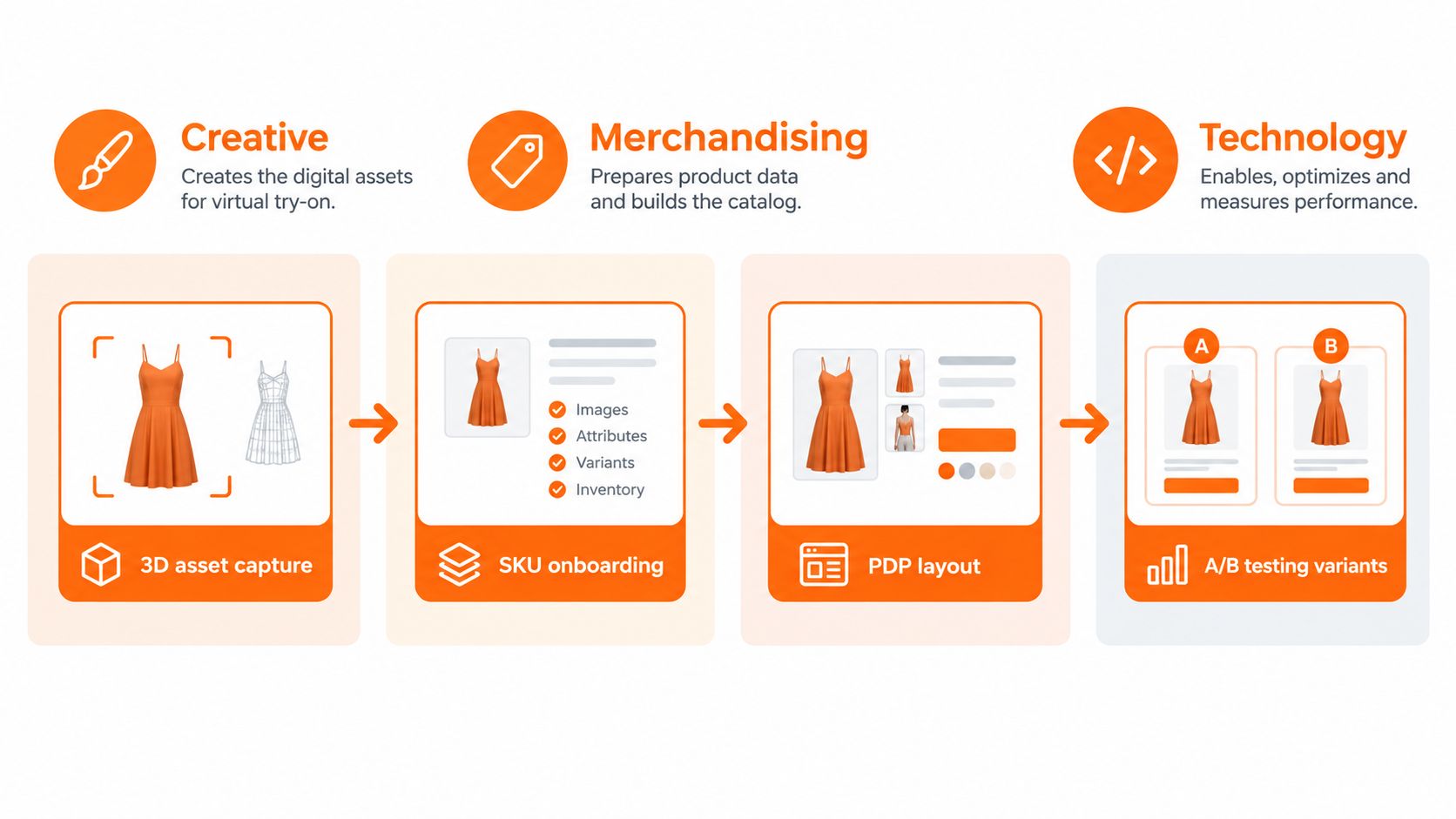
Creative teams need a defined route from product concept to try-on-ready asset. Depending on the implementation, that may include clean product photography, segmentation masks, transparent layers, 3D geometry, material descriptions, garment patterns, or structured measurements. Each colorway and size range must be connected to the correct product record.
This changes the role of photography. On-model images may remain important for editorial confidence, while virtual assets can extend the range of bodies, poses, or environments represented in a catalog. The brand shouldn't treat generated output as automatically approved. Human review still needs to check logos, prints, seams, hems, proportions, and brand styling.
Merchandising decisions
Merchandisers decide where the feature appears and what it promises. A button labelled “See how it looks” sets a different expectation from one labelled “Find your size.” Product detail pages should make the distinction visible, especially when a shopper can access both a visual render and a size recommendation.
Variant selection also matters. The shopper needs to try the exact color, finish, and product version they intend to buy. Cross-sell logic can use try-on behavior to suggest complementary items, but the recommendations should respect the limitations of the underlying visualization.
Production and technology
The production pipeline should connect the PIM, commerce platform, asset repository, client-side SDK or WebAR layer, consent management, and analytics taxonomy. The brand needs to know which SKU was rendered, with which asset version, for which shopper interaction, and what happened afterward. Without that lineage, teams can't distinguish a model problem from a catalog-data problem.
A useful workflow includes explicit gates:
- Asset QA: Confirm product identity, variant mapping, geometry, transparency, texture, and size data.
- Merchandising review: Decide whether the output meets the brand's appearance threshold and whether the customer-facing language is accurate.
- Experience testing: Check loading, camera permissions, fallback behavior, accessibility, and mobile performance.
- Measurement loop: Connect try-on exposure with clicks, size choices, purchases, exchanges, returns, and stated reasons.
Brands evaluating adjacent content pipelines can also examine AI product photography workflows. The operational principle is the same. Scale comes from repeatable asset preparation and ownership, not from adding a feature to a product page and hoping the catalog maintains itself.
Evaluating Quality, Latency, and Inclusivity at Scale
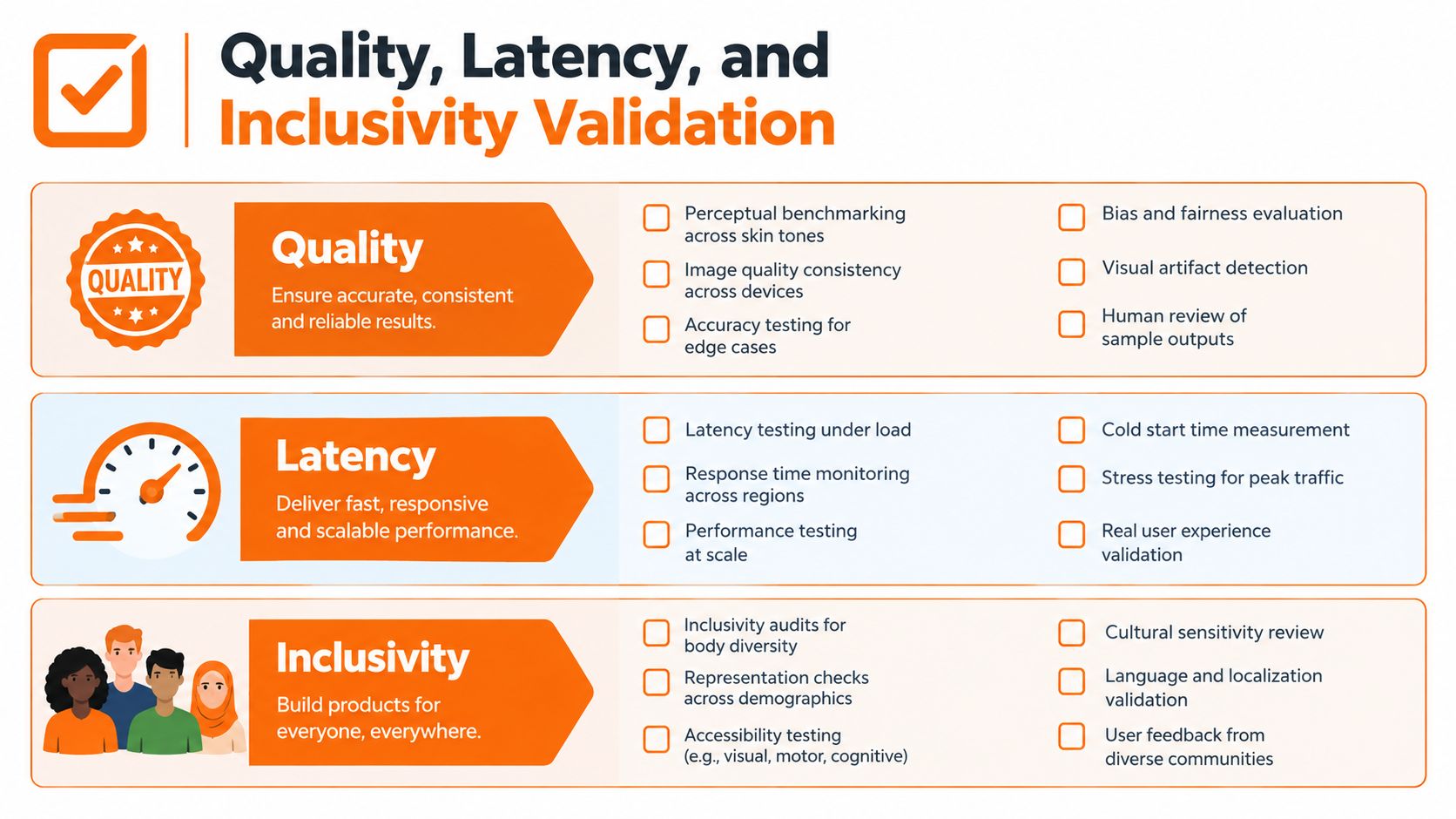
A camera preview can look convincing on a new phone under studio lighting and still fail for shoppers using older devices, weak connections, unfamiliar poses, glasses, head coverings, or body shapes absent from the benchmark set. Evaluate quality, latency, and inclusivity as one system, because a realistic image that arrives too late, or works only for a narrow customer group, is not a dependable shopping experience.
Build an evaluation set that reflects the catalog and the people who will use it. Segment results by pose, garment category, size range, skin tone, and occlusion level, rather than reporting one average score. Technical reviews identify Chamfer Distance for geometric similarity, LPIPS for perceptual similarity, SSIM and PSNR for structural and pixel-level fidelity, and FID for distribution-level realism in this review of VTO quality evaluation. These measures help engineering teams compare outputs. Shopper research must also assess whether the result looks credible and helps the customer decide.
Measure the experience customers receive
A reported real-time prototype achieved 30 to 50 milliseconds per frame, or roughly 20 to 33 frames per second, with alignment errors of about plus or minus 2 pixels at the shoulders and plus or minus 3 pixels at the chest and torso on off-the-shelf hardware in the reported real-time pipeline. Higher-fidelity generative approaches have reported inference ranges from 40 to 55 milliseconds, 67 to 125 milliseconds, and 500 to 1,000 milliseconds per frame, depending on architecture and processing mode, with some systems operating around 10 to 15 frames per second, as reported in the same technical report.
These figures support two service levels. Use a lightweight path for a responsive camera preview, then reserve a slower, higher-fidelity render for an asynchronous product-page result. Measure p95 latency across devices, network conditions, poses, and garment types. Track time to first frame, retry rate, camera failure, abandonment, and fallback usage as well.
Inclusivity requires testing the underlying interaction, not only adding diverse avatars. A recent review found that more than 70% of research samples use standard body types with BMI 18.5 to 23.9, while higher-BMI groups, diverse ethnicities, and special populations remain scarce in the review of VTO inclusivity evidence. Validate landmark detection, garment alignment, skin-tone rendering, lighting consistency, pose handling, and perceived realism across cohorts. Record internal error rates and sample sizes before presenting the experience as dependable.
Teams assessing the wider visual pipeline can review product visualization software alongside VTO. It can support catalog operations, but category-specific testing still determines whether the complete experience works for the people who will use it.
What Brand Leaders Should Decide Next
Brand leaders don't need to begin with the most ambitious version of virtual try-on. They need to choose the uncertainty they want to reduce first: appearance confidence, fit prediction, or both.
Start with one or two categories where the shopper problem is clear. Choose an AR overlay for a visual question such as eyewear or color, or choose size recommendation when measurement confidence matters more than a generated image. If apparel fit is the priority, budget for better garment and body data, not only a more photorealistic interface. Set baselines for conversion, returns, exchanges, support contacts, usage, latency, and failure rates before launch.
The investment compounds only when the brand can feed reliable assets into the system, validate performance across customer groups, and connect results back to merchandising decisions. A polished pilot is not proof of catalog readiness.
Sprello helps fashion, beauty, and lifestyle teams build production-ready creative workflows across SKUs, channels, regions, and seasons, including catalog-scale product visualization and repeatable asset operations. Visit Sprello to see how your team can organize the content pipeline that a serious virtual try-on program requires.
Related
More to explore
Fresh reads

Product Visualization Software: Guide for Fashion Brands
Compare product visualization software for fashion and lifestyle brands. Learn how to choose the right tool for quality, scale, and seamless integration.

Ecommerce Content Production: The Enterprise Playbook
Master ecommerce content production for fashion and beauty brands. Learn enterprise workflows, AI acceleration, and scaling strategies for catalog growth.

Enterprise Content Production Platform: Strategy and Guide
Explore the enterprise content production platform for fashion and beauty brands. Learn core capabilities, vendor selection, and ROI implementation strategies.