November 16, 2026
9 Types of Fashion Silhouettes for Merchandisers in 2026
Nine types of fashion silhouettes explained with defining shapes, styling uses, and how each affects fit, sampling, and collection design.
A fashion silhouette is the outline a garment forms around the body, and a simple outline doesn't guarantee simple fit: 91% of surveyed US and UK consumers said their clothing size changes by brand, according to the Vogue Business consumer sizing survey. The main types of fashion silhouettes are A-line, sheath, empire, fit-and-flare, shift, column, trapeze, mermaid or trumpet, and oversized or boxy. Published in 2026. For merchandisers and product developers, those labels are useful only when they describe repeatable proportions across the size run, not just an attractive sample.
Shape sets the sell before fabric and color because it determines where a garment touches the body, where it needs ease, and which adjustments deserve physical sampling. Fabric still matters: use breathable fabric advice from The Fabric Company when shortlisting summer materials, then assess whether each candidate holds the intended outline. Read every silhouette through the same practical questions: what defines its shape, what does it demand from fit and fabric, and what role does it serve in the collection? A useful line review makes those differences visible without letting styling, camera angle, or inconsistent body references disguise them.
1. What Defines an A-Line Silhouette?
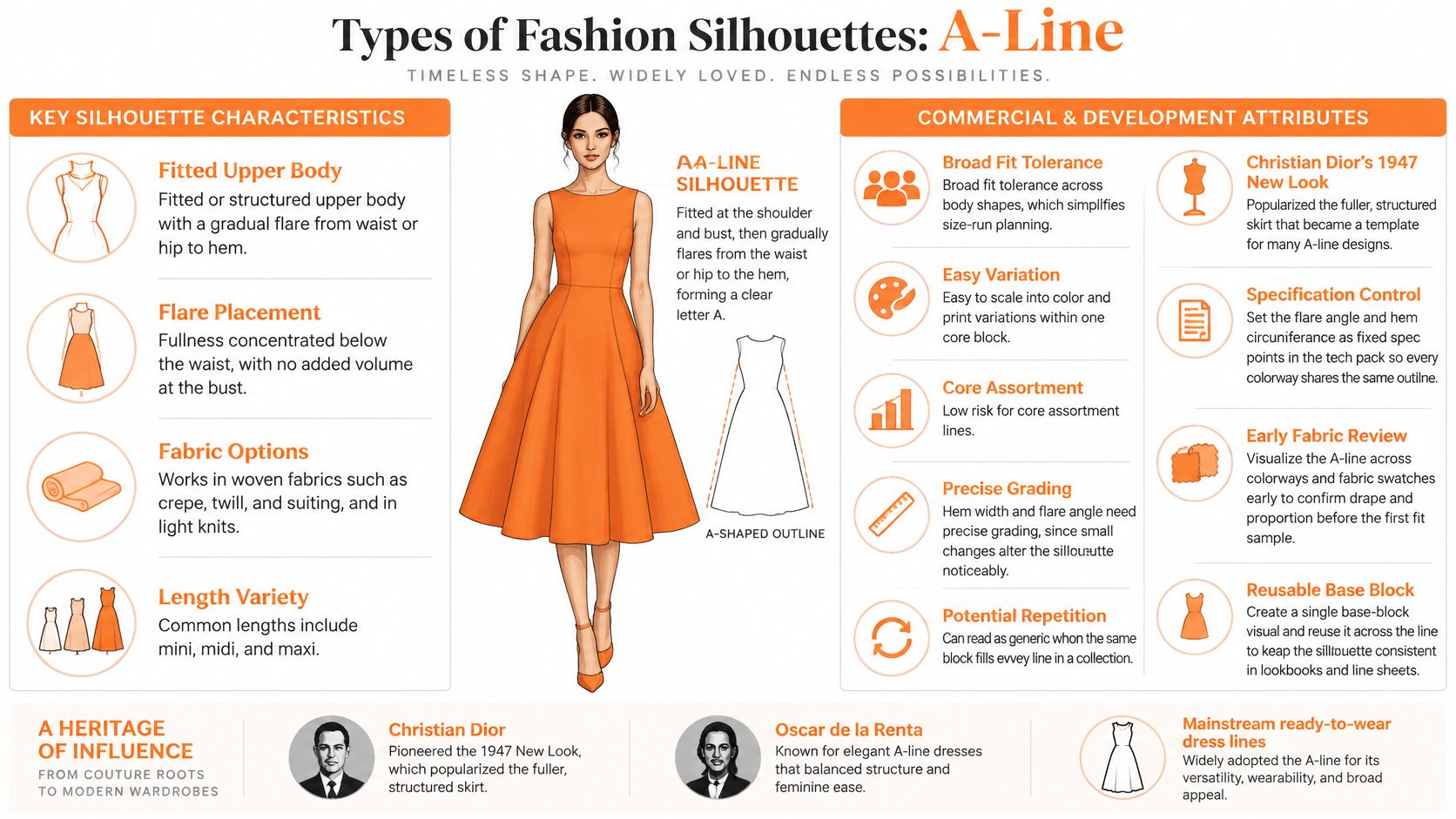
An A-line silhouette is controlled through the shoulder or bust and widens progressively toward the hem. The flare can begin near the upper torso or waist, but the outline should read as gradual expansion rather than a fitted bodice attached to a gathered skirt.
For a day-dress program, an A-line can provide hip clearance without removing upper-body definition. That makes it a useful base, not a promise of universal fit: bust shaping, armhole balance, and waist position still need attention.
Control the Flare Across Variants
Specify hem circumference, garment length, and flare distribution together. Increasing the hem without checking length can turn a restrained dress into a noticeably wider proposition, particularly at the ends of the size run.
- Grade the relationship: Check bust-to-hem expansion across sizes rather than adding identical width everywhere.
- Sample the material change: A crisp woven may hold the outline; a fluid fabric may collapse toward the legs.
- Review the same base: Compare colorways with consistent stance, scale, and camera position.
Christian Dior's 1947 New Look provides a historical reference for coordinated waist definition and skirt volume, rather than an exact synonym for A-line, as the Metropolitan Museum of Art explains.
For a coordinated dress-and-coat offer, keep each garment's intended flare visible in your product and concept development. Reusing a base visual helps comparison, but it doesn't replace sampling the actual fabric.
2. Why Does a Sheath Silhouette Demand Precise Fit?
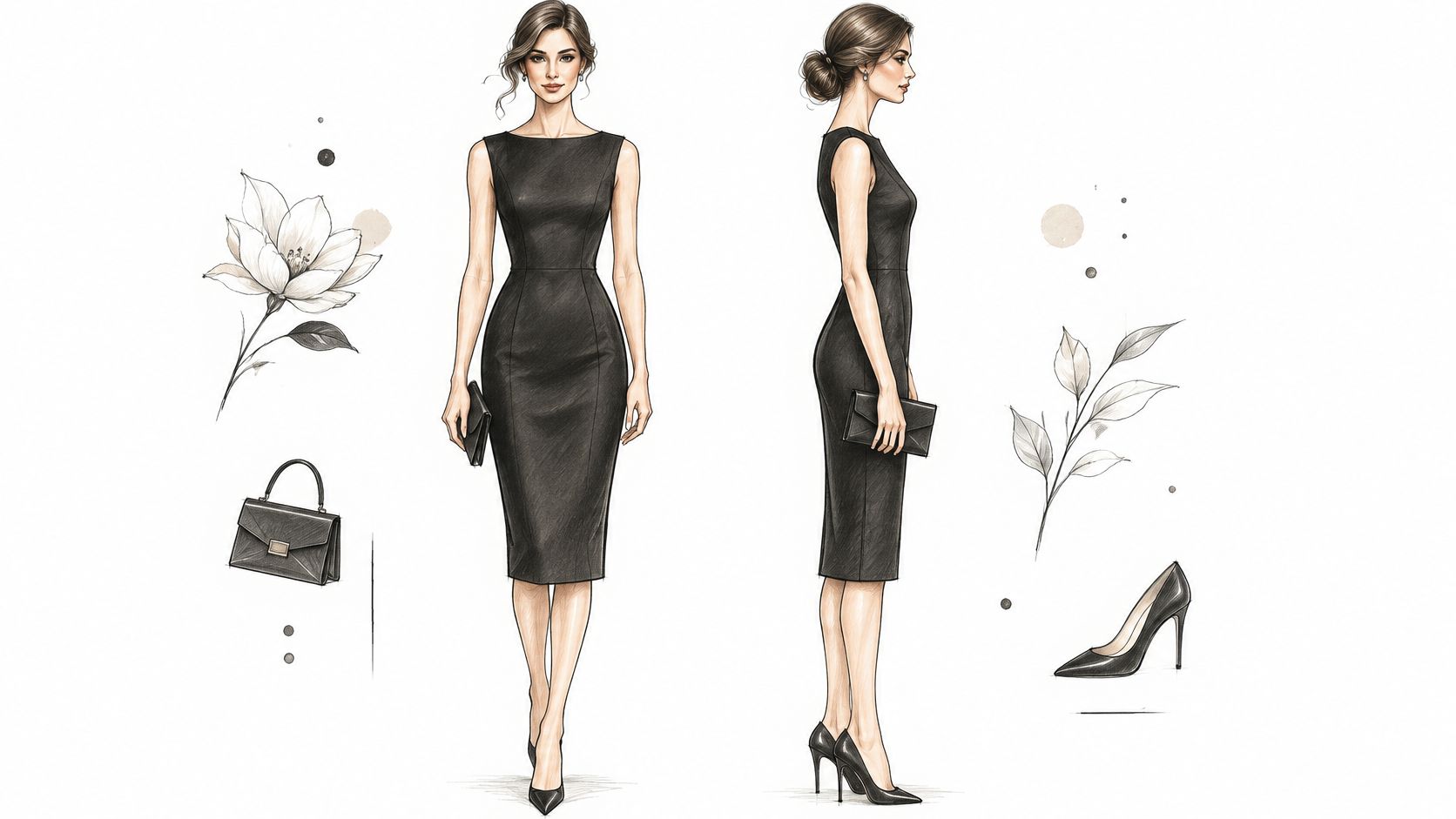
A sheath follows the body's contours from shoulder through waist and hip, with limited ease. Unlike a straight column, it depends on deliberate shaping rather than a largely uninterrupted vertical fall.
Consider a workwear dress offered with sleeveless and sleeved options. The same body block may be a useful starting point, but adding a sleeve changes movement requirements at the armhole and upper back.
Record Ease by Garment Zone
Document bust, waist, and hip ease separately, alongside back length, bust position, and shoulder balance. A single description such as close fitting won't tell a fit partner whether drag lines reflect insufficient circumference or misplaced shaping.
A garment-design study in the Journal of Textile Engineering & Fashion Technology identifies seams, darts, pleats, and tailoring as structural contributors to silhouette. For a sheath, these mechanisms are especially visible: changing dart intake or seam placement can alter the contour without changing the nominal size.
Sampling priority: Approve the body relationship before extending the sheath into multiple necklines, sleeves, and fabrications.
Test sitting, reaching, and walking, not just a front-view standing pose. Stretch can improve mobility, but it won't correct an incorrectly positioned waist or bust.
At line review, place variants side by side with consistent body references. Buyers should be able to distinguish a fabric-driven change in contour from an actual change in fit.
3. Where Should an Empire Silhouette Sit?
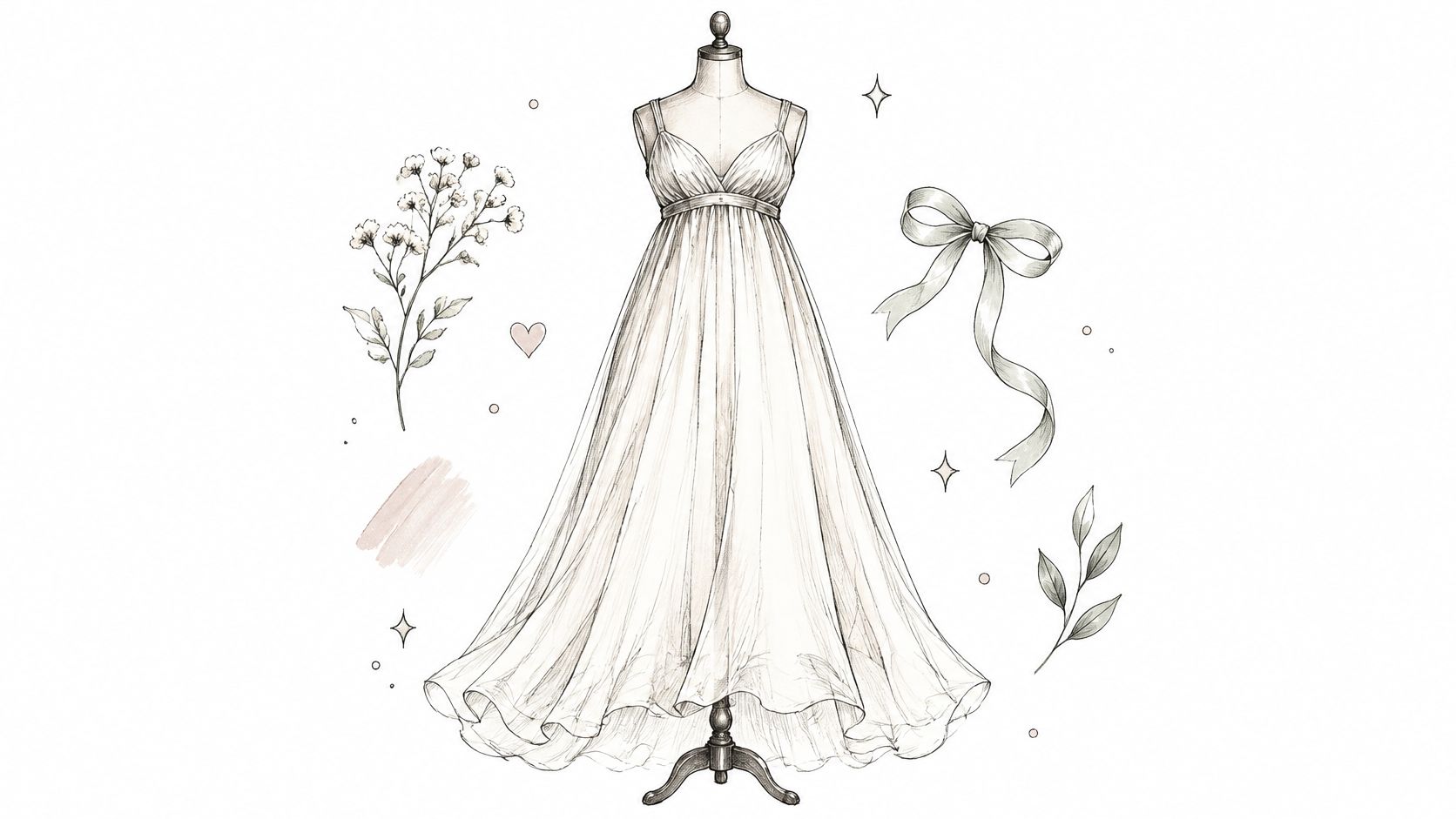
The empire silhouette places its waist seam immediately below the bust, with the lower garment falling straight or flaring from that raised position. Fashion Informed's silhouette guide distinguishes this construction from A-line, where widening is progressive rather than defined primarily by an under-bust seam.
The development decision is seam placement against bust volume, not the seam's apparent height on a sketch. Specify the seam from the shoulder, then check it against bust depth, bodice length, and the intended underbust position. Grade bodice length as a variable, because a fixed horizontal line will drift across a size run.
Measure the Raised Seam
On casual jersey, a short bodice can pull the seam up onto the bust. On woven occasion dresses, the same shortage can compress above the seam and leave excess fabric below it. Both failures read as bust-line problems in fit review, yet the correction belongs in bodice length and seam position.
- Check bust coverage: Assess front length as well as circumference.
- Compare fabric behavior: Soft jersey and crisp cotton distribute fullness differently.
- Approve skirt balance: Confirm whether front fullness projects outward or falls as intended.
I would budget the first fit round around bodice length and bust depth. Skirt changes can follow once the seam is stable, and that order keeps sampling from chasing two variables at once.
Early nineteenth-century Neoclassical womenswear positioned the waist below the breasts to create a long, column-like line, according to the Metropolitan Museum of Art's history of silhouette and support. That reference explains the line, not the grade rule.
For bridal direction, goddess-inspired looks for Australian brides can inform styling references. Keep those references separate from the measurable seam placement that determines fit.
4. How Does Fit-and-Flare Balance Definition and Volume?
Fit-and-flare pairs a fitted bodice and defined waist with a skirt that opens outward. For daywear and cocktail development, record exactly where the flare begins. Bridal teams may use the term for a shape fitted farther through the hips.
A collection can reuse a bodice concept across restrained and fuller skirts. Treat the skirt as an engineered component: its weight, attachment, and fullness change how the waist and bodice sit.
Separate Bodice Fit From Skirt Engineering
A historical Dior garment in the Victoria and Albert Museum collection shows how a cinched waist and full skirt depend on construction, not outline alone. Waist stay, underpinnings, seam placement, and skirt support all shape the final proportion.
For a contemporary occasion capsule, compare a paneled skirt with a pleated alternative while holding the approved bodice intent constant. Check whether the heavier option pulls down the waist or requires different support. Grade the bodice and skirt as separate blocks, then review them together, because a fuller skirt can mask a waist fit problem in a static fitting photo.
- Specify the opening point: Record where fitted shaping ends and skirt expansion starts.
- Record fullness separately: Distinguish finished hem circumference from fullness gathered into the waist.
- Check movement: Use walking views and physical wear tests to assess skirt clearance and recovery.
Keep bodice and skirt variants visibly related in collection review. Plan views that show waist placement, skirt opening point, and hem volume side by side. A photograph can document the look, but it cannot prove comfort or balance; use fit tests for that.
5. What Makes a Shift Different From a Sheath?
A shift hangs from the shoulders with little waist definition and a generally straight, unfitted body. A sheath follows the waist and hips more closely; a shift allows those areas to remain comparatively independent of the garment.
That makes a shift a practical starting point for a print-led capsule. The front panel offers a clear surface for evaluating motif scale, placement, and visual density without prominent waist shaping interrupting the design.
Don't Confuse Loose With Unspecified
The shoulder, upper chest, and armhole still determine whether the garment hangs correctly. Extra body width won't fix a tight armhole, a neckline that pulls backward, or insufficient room across the upper back.
A US study combining surveys and body scans found that 52.27% of participants agreed they could easily find well-fitting clothing, while 36.36% disagreed. An unfitted label should never substitute for regional fit checks.
A shift removes waist suppression, not the need for a fit strategy.
For a transitional woven dress, approve shoulder width, chest ease, hip clearance, and hem width before adding pockets or contrast panels. Check pocket loading too: a pocket bag can pull a lightweight side seam out of its intended line.
Show solid and printed versions together during review. The solid helps expose balance and drag lines; the print reveals placement issues and whether the garment's width supports the motif. Don't approve the printed version solely because its surface disguises fitting problems.
6. How Do You Keep a Column Silhouette Straight?
A column silhouette creates a long, predominantly vertical outline with restrained waist shaping. It differs from a sheath because the garment doesn't need to trace every change in body circumference.
For an evening capsule, a column can provide a quieter alternative to a full skirt. The development challenge is maintaining that vertical fall while allowing enough hip room and walking clearance.
Fabric and Pattern Must Agree
A weighty crepe may support a clean fall, while a thin, clingy fabric can reveal body contours and move the result toward a sheath. Record the intended drape, opacity, stretch, and recovery alongside the pattern specification.
Don't assume more fabric weight automatically improves the result. A heavy skirt can distort a lightly supported neckline or pull an inadequately stabilized shoulder.
- Check the side view: Confirm the garment clears the seat without tipping forward or backward.
- Test walking clearance: Evaluate a vent, slit, or additional sweep where the design requires it.
- Review lining behavior: A restrictive lining can undermine an otherwise workable outer garment.
Say the same column is proposed in matte woven and stretch jersey. Treat them as related concepts, not automatically equivalent fit approvals, because their contact with the body will differ.
At line review, use consistent lighting and full-length views so buyers can assess the vertical outline. Cropped imagery and changing poses can make similar styles appear different, or conceal meaningful differences in waist shaping and hem width.
7. How Much Flare Makes a Trapeze Silhouette?
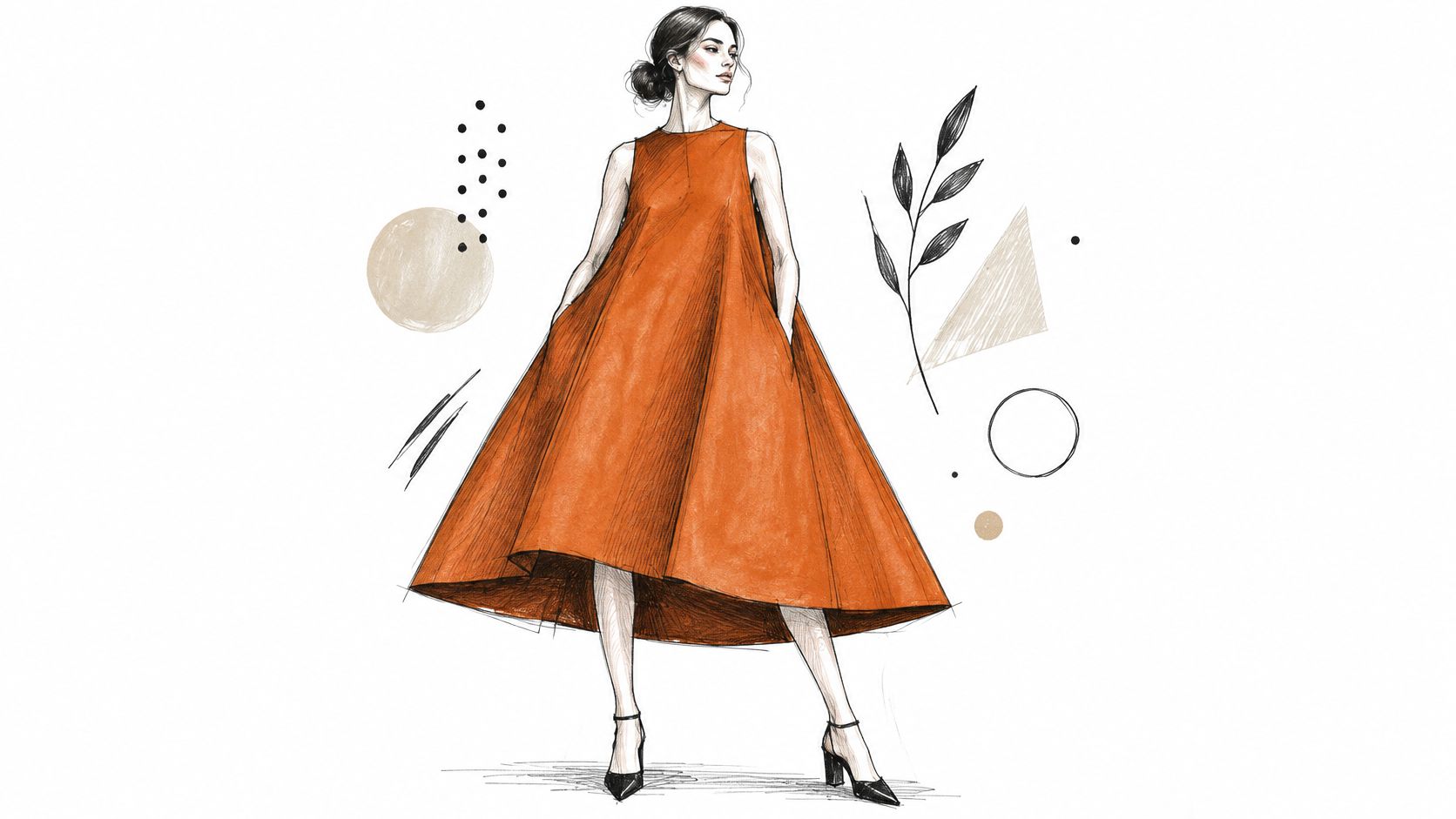
A trapeze silhouette is narrow through the shoulder or upper chest and widens strongly toward the hem, without relying on a defined waist. Compared with a restrained A-line, its expansion generally starts higher and creates a more pronounced triangular outline.
For a coat or statement dress, the commercial question is how much volume the assortment needs. A striking front view can conceal side bulk, sleeve interference, or an impractical hem.
Grade the Triangle, Not Just the Width
Record upper-body width, garment length, hem circumference, and flare distribution. If grading adds width without checking the relationship between these points, the larger sizes may lose the intended shape.
For a structured coat, test a fabric with enough body to hold the flare, then assess its weight at the shoulder. For a softer dress, decide whether collapsed folds are intentional or evidence that the material doesn't support the concept.
Line-review rule: Compare trapeze options from the side as well as the front. Hem width alone doesn't describe where the volume sits.
Check reaching and seated wear before approving the sample. A high, narrow upper section can restrict movement even when the lower garment is generous.
Present length and neckline options against a consistent base reference. This lets buyers judge whether the collection needs a different silhouette or a revised proportion within the same shape.
8. Why Do Mermaid and Trumpet Silhouettes Need Different Fit Checks?
Mermaid and trumpet silhouettes both fit closely through the torso and hips before opening into a flared skirt. They shouldn't be treated as identical specifications: a mermaid generally opens near or below the knee, while a trumpet opens higher and more gradually.
That distinction affects movement, seam design, and the position of tension through the thigh. A label alone won't tell a pattern team where to release the fitted section.
Locate the Flare on the Body
For a bridal or evening gown, record the flare start relative to both garment length and the intended wearer's anatomy. A flare that sits correctly on the base reference can fall awkwardly on a different height proportion.
- Fit the hip and thigh first: Excess tension can lift the skirt and change where the flare appears.
- Check transitions: Review panel joins, godets, and seam smoothness where the shape opens.
- Test real movement: Include walking, turning, sitting, and the wearer's ability to manage the hem.
Say a buyer requests the same gown in a heavier embellished material. Recheck support, lining, and flare behavior rather than treating the change as a surface update.
Plan early physical sampling around the fitted lower body. Digital visuals can communicate flare placement and volume, but they can't verify walking comfort, seam stress, or support.
Use full-length front, side, and back views in the occasion assortment. Keep body references consistent so buyers can distinguish a higher trumpet release from a lower mermaid flare.
9. How Do You Make Oversized and Boxy Shapes Look Intentional?
An oversized silhouette uses deliberate additional ease, often with dropped shoulders and increased body width. Boxy describes a squarer relationship between width and length; a garment can be boxy without being extremely oversized.
For a unisex top program, enlarging a fitted block won't reliably create the intended result. Neckline size, shoulder drop, sleeve pitch, body length, and cuff position need coordinated decisions.
Grade the Intended Proportion
Define shoulder drop, chest width, sleeve length, and hem length as separate measurements. Keep the design relationship consistent across sizes rather than freezing every measurement or applying uniform enlargement.
Research on trouser classification uses geometric categories and angular measurements to distinguish silhouettes, as described in the Textile Research Journal study. The useful development principle is that shape can be described through relationships, not just subjective labels.
- Test several body references: Confirm the smallest and largest intended wearers still get deliberate volume.
- Check sleeve control: Added width shouldn't leave cuffs or sleeve openings unmanaged.
- Review complete outfits: Pair wide tops with proposed bottoms to assess the collection's proportion.
For knitwear, choosing a ladies' brown cashmere pullover can provide a styling reference, but yarn behavior and recovery still need physical assessment.
Use consistent fashion e-commerce photography to show shoulder position and garment length clearly. Don't use a tucked hem in every image if buyers need to understand the actual boxy outline.
How the nine fashion silhouettes compare on shape, fit sensitivity, and typical use
| Item | Defining Shape | Fit Sensitivity | Typical Categories | Best Use in a Line |
|---|---|---|---|---|
| A-Line | Fitted upper body; gradual flare from waist or hip | Broad fit tolerance; flare and hem grading need precision | Dresses, skirts, coats | Reliable core silhouette across sizes, seasons, and variations |
| Sheath | Close-fitting column with a straight or slightly tapered hem | High; small fit changes are visible and can restrict movement | Workwear, evening wear | Polished hero style for professional or occasion collections |
| Empire | Seam below the bust; loose skirt falls from that point | Seam placement strongly affects proportions | Maternity, occasion, casual | Comfortable, distinctive option alongside fitted styles |
| Fit-and-Flare | Fitted bodice and waist; full skirt flares from waist or hip | Moderate; skirt volume needs control | Day dresses, occasion wear | Versatile style with reusable bodice and varied skirt fullness |
| Shift | Straight, unfitted body hanging from the shoulders | Broad fit tolerance; shoulder and hem proportions matter | Casual, transitional wardrobes | Simple base for showcasing fabric, print, or detailing |
| Column | Straight vertical outline with minimal shaping | High; fabric quality, fit, and posture are clearly visible | Evening, tailored | Minimalist premium style that scales efficiently across colorways |
| Trapeze | Narrow at the shoulder or bust; widens steeply toward the hem | Forgiving through the midsection; taper and hem need consistency | Dresses, coats, statement occasion wear, outerwear | Distinctive statement shape for a collection |
| Mermaid (Trumpet) | Fitted through the thigh; flares below the knee or mid-thigh | High; complex fit and construction require careful sampling | Evening, bridal, red carpet | High-impact anchor for occasion or bridal collections |
| Oversized (Boxy) | Dropped shoulders, wide body, and extra ease | Broad fit tolerance; proportions must look intentional | Tops, jackets, shirts, outerwear | Relaxed, versatile option for streetwear or unisex assortments |
How Do You Move From Silhouette Choice to a Buyer-Ready Line?
Lock the defining measurements, explore material and color directions before the first fit sample, and keep the silhouette visible during line review. Visual exploration helps teams choose what to sample. Physical fitting decides whether the proposed shape survives grading.
Assign each silhouette a clear role in the assortment. A core shift, a fitted sheath, and a statement trapeze should each solve a different fit need; a new name on a similar outline does not create breadth.
Match the Tool to the Decision
- Sketching and CAD tools: Communicate design intent and technical views.
- Pattern and fitting tools: Develop construction, grading, and physical fit.
- Planning and development systems: Track commercial plans and product records in the systems your team already uses.
Sprello, an AI workflow canvas for fashion, beauty, and lifestyle brands, lets teams explore colorways and material directions with AI before a physical sample. A saved canvas workflow can run again on the next style. From one shared product catalog, teams can build wholesale line sheets for accounts across North America and Europe, including department stores, specialty boutiques, flagship stores, and own retail. Those line sheets can show style or variant codes, material, wholesale price, and retail price, while selected visuals and product details flow into buyer assortments.
Keep approvals explicit. A preferred visual direction is not an approved fit. A successful base-size sample does not prove the full size run preserves the intended proportions.
Which Silhouette Is Easiest to Grade Across a Size Run?
A relaxed shift or moderate A-line is often a practical starting point because neither requires close waist-and-hip contouring. Neither is automatically easy: shoulder balance, bust accommodation, length, and intended ease still need size-specific checks.
Why Can a Sheath Need More Fit Sampling Than a Shift?
A sheath exposes small mismatches in contour and shaping because it sits closer to the body. A shift allows more clearance, although its shoulder and armhole fit can still require revision.
What Is the Difference Between a Trapeze and an A-Line?
Both widen toward the hem, but a trapeze typically expands more strongly from the upper body without waist emphasis. An A-line usually has a more controlled, gradual flare, so specify where expansion starts rather than relying on the name alone.
How Should Teams Show Silhouette Differences to Buyers?
Use consistent body references, camera angles, image scale, and full-length views. Include side and back views where volume placement matters, and identify the measurements that distinguish related variants.
Which Silhouette Suits a Core Assortment?
Choose the shape your team can fit consistently in the intended materials and size range. A moderate A-line or shift can anchor daywear, while a validated sheath or column may better suit a polished or occasion-led offer.
Sprello is AI for product development & merchandising. From product concept to buyer-ready collection. Explore colorways and material directions before making the next physical sample, then book a demo at Sprello to see the shared catalog, line sheets, and buyer assortments using one of your own product categories.
Related
More to explore
Fresh reads
How to Create Fashion Mood Board: A Step-by-Step Guide
Learn how to create fashion mood board files that guide design, merchandising and buying, with steps, a translation table and a review checklist.

What Is SKU Rationalization? a Practical Guide for 2026
What is SKU rationalization? A structured review of every SKU to keep, modify, consolidate or exit it, with criteria for fashion, beauty and home brands.

What Is a Line Sheet for Wholesale Buyers
What is a line sheet? The wholesale fields, prices, minimums, and ship windows a buyer needs to order a seasonal line.