November 8, 2026
Product Design Process: Stages and Handoffs Explained
The product design process explained for fashion, beauty and home brands: stages, handoffs, approval gates and scalable workflow patterns for multi-SKU teams.
Published 8 November 2026
The product design process turns a brief into an approved, costed, buyer-ready collection through owned stages and selective decisions, a discipline illustrated by the historical Booz, Allen & Hamilton benchmark in which approximately seven ideas produced four development projects, 1.5 launches and one successful product, as summarized in the Journal of Industrial Engineering and Management review. For merchandising, design and product development teams, those stages are research, ideation, prototyping, sampling and approval, with Sprello fitting the visual concepting and merchandising work that connects concepts to buyer-ready collections.
What Are the Five Stages of the Product Design Process?
The stages describe a sequence of commitments, not a calendar of creative activities. Each stage should reduce a specific uncertainty before someone authorizes the next expense.
For fashion, beauty, jewelry and home brands, the practical endpoint is more than an attractive design. It's a product with an agreed buyer, a commercial role, tested requirements and approved information that sales can present without inventing missing details.
Product design stages, outputs and gate owners
| Stage | Main input | Output at the gate | Gate owner |
|---|---|---|---|
| Research | Customer, channel and price evidence | Brief with buyer and assortment gaps | Merchandising lead |
| Ideation | References, sketches and material directions | Concept set for line review | Design director |
| Prototyping | Fit samples and technical specifications | Prototype with measured tolerances | Product development lead |
| Sampling | Pre-production and market samples | Samples tested against requirements | Merchandising and sales |
| Approval | Costed line and specification pack | Released SKUs ready for production | Head of product |
Treat screening as design work
A concept shouldn't progress merely because the team has spent time on it. Merchandising needs to establish whether it fills a line gap; design needs to explain its distinction; product development needs to identify what makes it feasible.
Keep rejected directions with a short reason, such as duplicate assortment role, unsuitable construction or an unworkable price position. Otherwise, teams can reopen the same discussion when someone encounters an old render.
Digital artifacts need acceptance criteria too. If the prototyping route includes transferable geometry, Sculpty's guidance to prepare product models for reliable export is a useful companion to defining what the receiving team must be able to open and inspect.
Working rule: A stage is finished only when its output is recorded and its gate owner has signed it.
Map the current development calendar against the table. Look for sample orders, costing requests or buyer presentations that start before the preceding sign-off. Those are the places where the team is committing money against an unresolved decision.
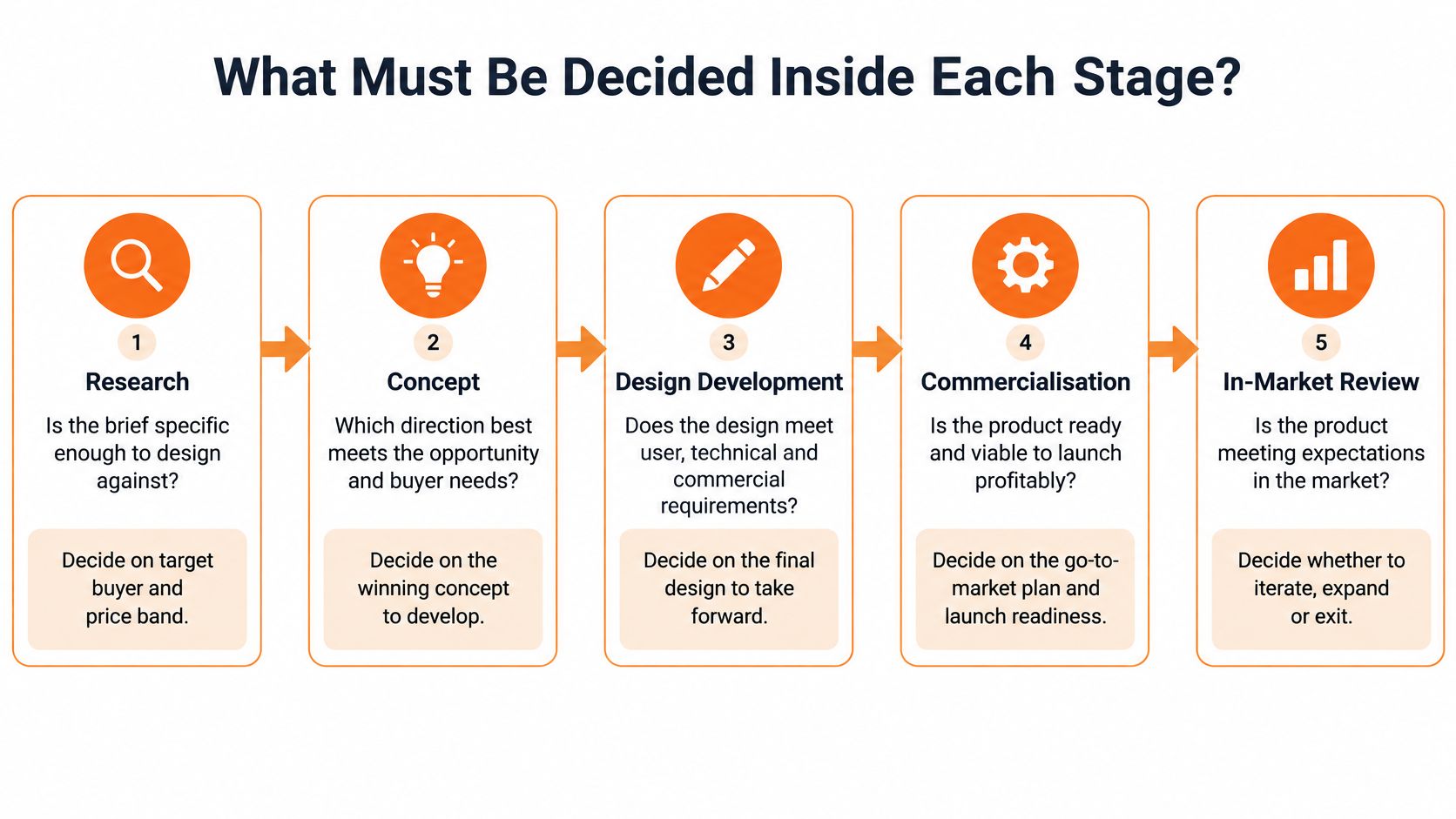
What Must Be Decided Inside Each Stage?
Each stage closes with a decision, not a declaration that the work looks finished. The gate owner needs enough evidence to say proceed, revise or stop.
A study summarized in the South African Journal of Industrial Engineering article reported 32% higher NPD success rates among companies with a well-articulated new-product strategy than companies without one, while organizations devoted an average of only 7% of project funding to critical up-front homework. That imbalance is a reason to protect brief development, not squeeze it between concept presentations.
Close the brief before opening the concept set
Research asks whether the brief is specific enough to design against. Name the target buyer, price band, channel and gap in the current line. A product requirement document template can help turn those commercial intentions into requirements the team can review.
The common slip is writing the brief after ideation has started. Designers then defend a direction while merchandisers are still deciding who it's for.
Ideation asks which concepts deserve line review. For a hypothetical capsule, shortlist three to five directions and record why each earns a place. Compare assortment role, visual distinction, material feasibility and likely cost exposure rather than letting the loudest person choose.
A rejected concept needs a reason, not a polished presentation. Dropping it now is cheaper than commissioning it to avoid disappointing its sponsor.
Commission evidence, not samples by habit
Prototyping asks whether the proposed product fits the intended wearer or use. Approve against measurements and requirements, not appearance alone. A beautiful jewelry clasp that's difficult to operate hasn't passed a functional review.
Sampling asks whether a physical market sample is needed for the outstanding decision. A digital visual can settle an early colorway comparison or collection balance question. It can't establish fabric hand, closure reliability or the way a dispenser performs.
The common failure is commissioning market samples by default. Write the question on the sample request: what must this sample prove, and who will decide whether it has proved it?
Approval asks for a go or no-go on costed SKUs. Don't approve a collection with unresolved commercial assumptions hidden in comments. Product development should identify the costing basis, outstanding exceptions and effect of any requested change.
Before signing, the gate owner should be able to answer:
- Decision: What exactly am I approving, and which version?
- Evidence: What demonstrates that the acceptance criteria have been met?
- Exceptions: What remains unresolved, and who owns it?
- Commitment: What spend or downstream work does this approval authorize?
- Recipient: Who needs the approved output next?
A conditional approval should name the condition and prohibit the work it doesn't yet authorize. Otherwise, teams hear permission where the gate owner intended caution.
Who Owns Each Handoff Between Teams?
Handoffs are a common source of avoidable delay because the sender assumes the receiver has the latest version. A designer updates a material, creative renders the previous reference, and merchandising presents a mixture of both.
The University of Florence review describes development as connected activities spanning design, modelling and prototyping, detailed engineering, material sourcing, and production and distribution. It treats assortment planning separately, with historical sales information supporting planning decisions.
Handoffs between teams in the product design process
| Handoff | From | To | Artifact passed | Sign-off |
|---|---|---|---|---|
| Brief to concept | Merchandising | Design | Buyer brief, price band, line architecture | Merchandising lead |
| Concept to visuals | Design | Creative | Approved sketches, materials and references | Design director |
| Concept to specification | Design | Product development | Tech pack, bill of materials, pattern | Product development lead |
| Samples to line review | Product development | Merchandising | Samples, costing and visuals | Merchandising lead |
| Approved line to buyers | Merchandising | Sales and marketing | Line sheets and buyer assortments | Head of sales |
Make the receiving team acknowledge the version
At brief to concept, merchandising signs the commercial intent. Design should flag contradictions before developing options, such as a premium material requirement paired with a price position that leaves no room for it.
At concept to visuals, the design director identifies approved source material. Creative shouldn't need to infer whether a reference supplies the silhouette, finish or lighting direction. Those are different instructions.
At concept to specification, product development checks completeness and buildability. Technical artifacts belong with the appropriate technical specialists and systems; a polished visual doesn't replace construction information.
A swim lane chart helps expose tasks sitting between departments without a named recipient. Use roles rather than personal names so the process survives staffing changes.
Separate commercial acceptance from technical readiness
When samples return to line review, merchandising needs costing and current visuals alongside them. A revised sample without a revised cost can produce an approval that nobody can execute.
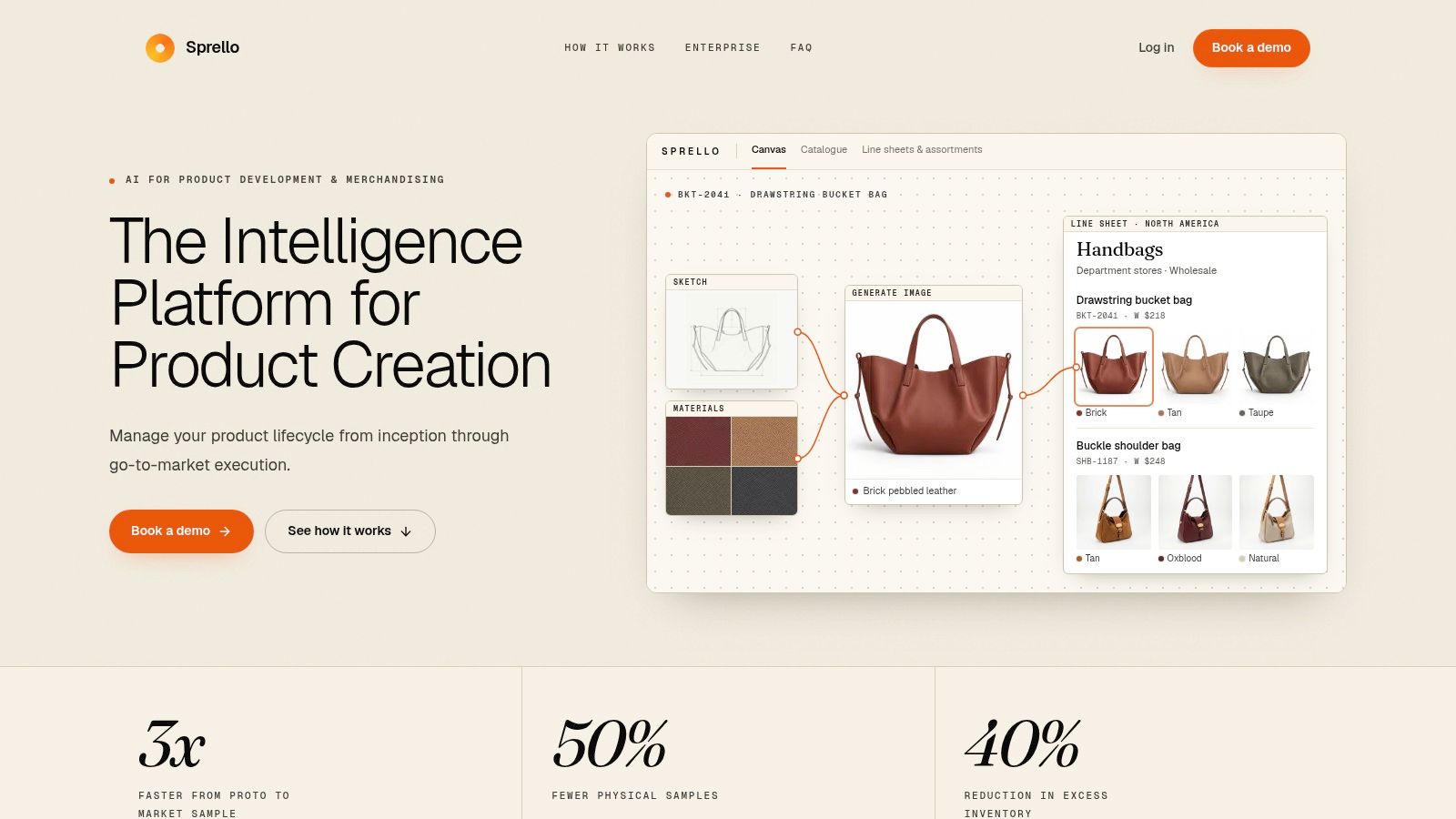
For the approved line to buyers, sales needs a controlled collection, not a folder of every option the team explored. In Sprello, selected visuals and product details flow from the catalog into line sheets and buyer assortments. Each buyer's assortment starts from the same product information, while the account or channel mix can be reviewed as a whole.
Sending a file isn't a completed handoff. The receiving team must confirm the artifact version and accept responsibility for the next action.
Record that acknowledgment with the product identifier, revision and intended use. An approved visual for internal line review isn't automatically approved for a buyer presentation.
How Do Tolerance and Release Gates Prevent Rework?
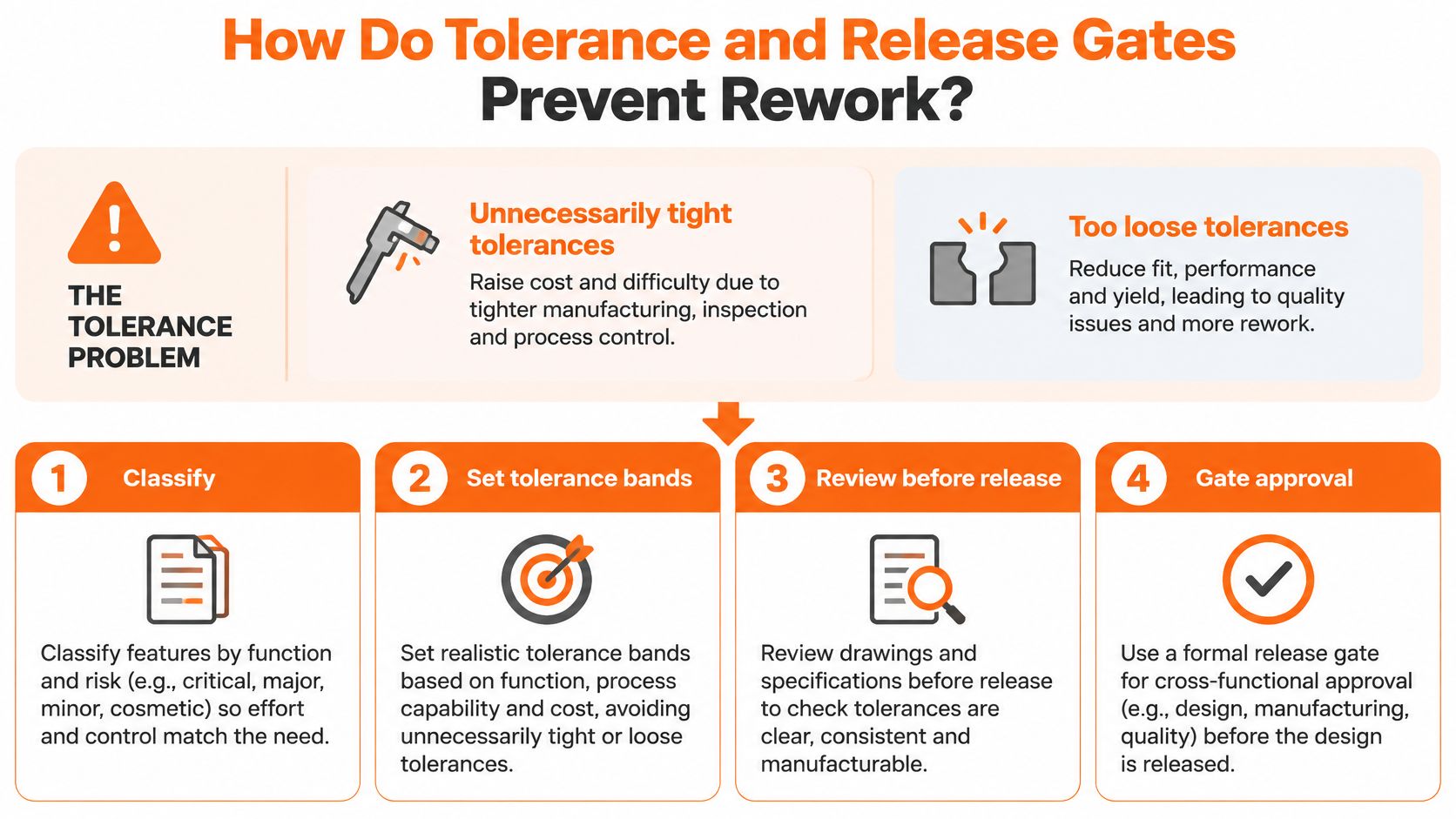
Unnecessarily tight tolerances raise manufacturing difficulty and cost. Excessive variation can reduce fit, performance, reliability and yield, which is why NIST's tolerance-cost optimization guidance treats allowable variation as a design decision rather than merely an inspection issue.
The product development lead should resolve that trade-off before releasing specifications. Asking a supplier to hold every dimension equally tightly is not a substitute for identifying what matters.
Set tolerances around function
- Classify each dimension by functional importance. Identify closure fit, component alignment, dispensing interfaces, seams, hardware placement and package-panel registration. Separate features that affect function from preferences that only affect appearance.
- Set an acceptable failure probability for critical features. Agree the performance risk the team will accept, then establish tolerance bands that support it. Don't copy a previous specification without checking the new materials and construction.
- Calculate stack-up behavior before release. Use worst-case or statistical tolerance analysis as appropriate. Individually acceptable components can still create an unacceptable assembly when their variations combine.
- Match each tolerance to a capable production process. Product development and sourcing should confirm how the supplier will achieve and measure it. Approve tighter requirements only when their quality benefit justifies the cost.
Say a beauty package combines a bottle, pump and cap. Reviewing each component separately won't establish whether the finished assembly aligns, seals and dispenses properly. The release review needs to consider the interfaces.
Keep verification and validation separate
Verification asks whether outputs meet specified inputs. Validation asks whether the product fulfills its intended use, a distinction set out in ISO's design and development auditing guidance.
Verification can include dimensional reviews, material checks, calculations and laboratory tests against requirements. Validation uses representative prototypes, pilot runs, wear tests or customer-use scenarios under intended conditions.
A closure can meet its drawing and still be awkward for the intended customer. That's why passing verification doesn't remove the need for validation.
Keep a release record containing:
- Requirement mapping: Each released output connects to an input requirement.
- Verification evidence: Results, methods and the version tested.
- Corrective actions: Failures, changes made and retest outcomes.
- Validation evidence: Intended-use conditions and the product's performance.
- Stage completion: Named reviewers and their release decisions.
For the later shipment checkpoint, Supply Automate's pre-shipment inspection guide is a useful resource for organizing inspection preparation. Shipment inspection should confirm agreed requirements, not become the first occasion on which the team defines them.
How Do Teams Scale One Workflow Across Many SKUs?
A growing catalog exposes weak process definitions. Teams begin copying briefs, renaming files locally and inventing approval paths for regional requests.
The disconnected workflow below illustrates what happens when each department maintains its own working record.
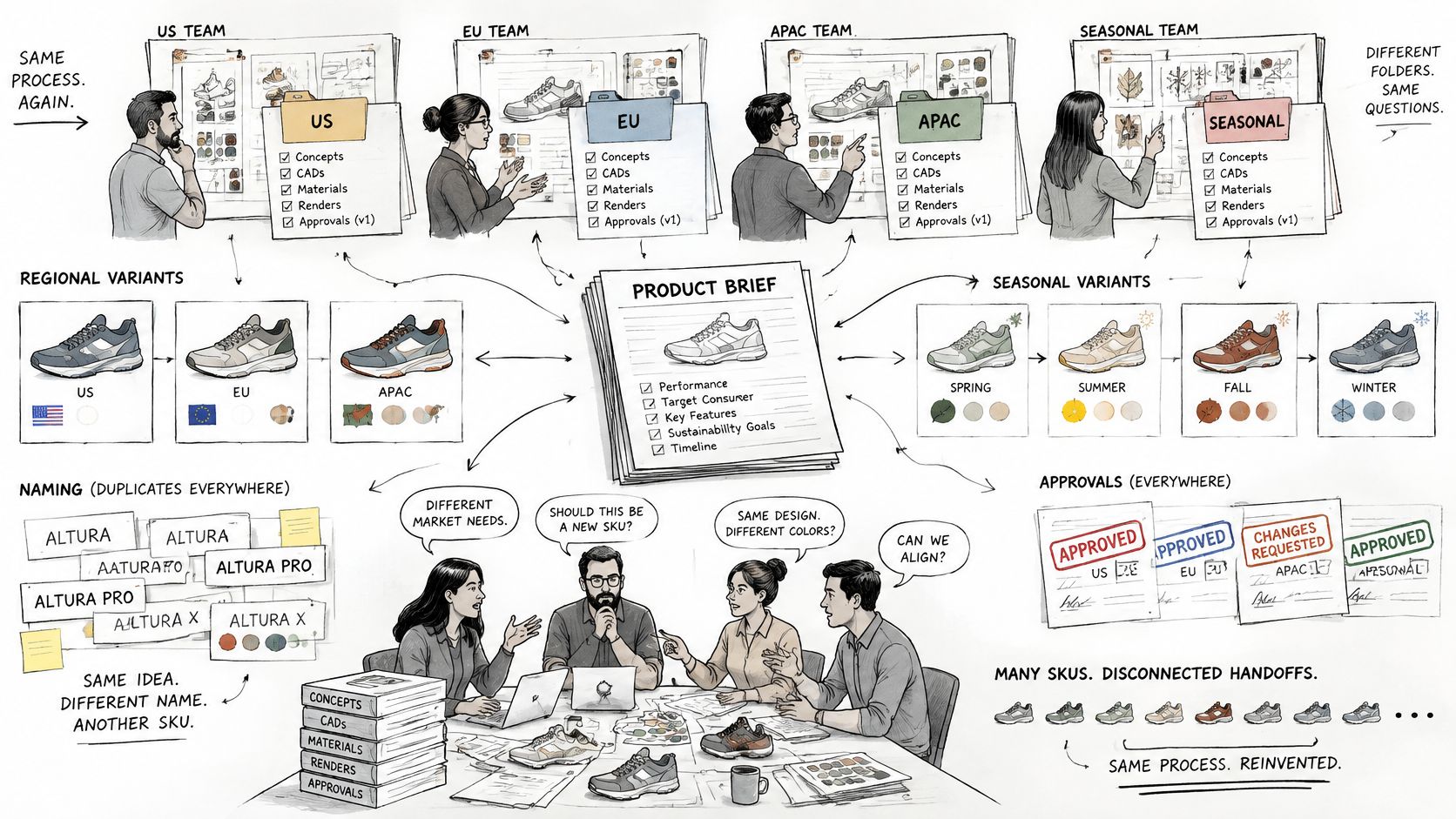
Choose a reuse pattern based on what remains stable. A seasonal capsule needs a lighter structure than a repeated category with regional packaging and material variants.
Workflow patterns for scaling the product design process
| Pattern | Best for | Reuse level | Main risk |
|---|---|---|---|
| Single-season template | Small line in one market | Low | Brief and naming drift between seasons |
| Saved workflow per category | Multi-SKU brands with repeat categories | High | Templates kept after the brand rules change |
| Regional variant layer | Brands selling in several markets | Medium | Local variants drifting from the core specification |
| Catalog-scale run | Large variation sets, such as a hypothetical 100-colorway range | High | Volume output without a human approval gate |
Reuse the method without freezing the decisions
Keep category templates under an owner who reviews changes to materials, brand rules and approval responsibilities. A template that nobody maintains becomes a fast way to reproduce an outdated decision.
A Sprello Canvas workflow can be saved and run again on the next style. If a step isn't right, the team can fix that step without regenerating everything. That supports selective correction, but the reviewer still needs to identify which downstream outputs the change affects.
Use the walkthrough below alongside a real category workflow, rather than judging generation in isolation.
Govern approved AI output
The 2025 Telerik survey of 225 designers, developers and leaders found that four in five teams use AI somewhere in their workflow, yet 38% still spend time fixing inconsistent AI output. Generating more options won't help if reviewers can't identify the approved result.
Separate exploratory work from production-approved assets. Assign a human approval owner, retain model and input-asset provenance, and check outputs against product and brand rules, including construction details, materials, color intent and unsupported visual claims.
Customers' designs, sketches and uploads are never used to train Sprello's models or anyone else's models. Privacy controls and design approval are separate responsibilities; neither substitutes for the other.
Track:
- Rework rate: Outputs returned for correction, with reasons.
- Approvals per SKU: Review cycles needed to reach acceptance.
- Brief-to-approved-visual time: Elapsed time including queues and corrections.
Measure the time required to reach an accepted decision, not just the time required to generate an image.
Which Tools Cover Which Stages of the Process?
Sprello is our product, and its role is the visual and merchandising layer rather than technical development or demand planning.
Most brands need several tool categories. Decide which system owns each artifact before comparing feature lists, or teams will maintain competing product records.
Tool categories compared by process stage
| Option | Best at | Falls short on | Stages covered |
|---|---|---|---|
| Sprello (our product) | AI visuals, shared catalog, line review, buyer assortments | Tech packs, bills of materials, pattern making, forecasting and open-to-buy | Ideation, visuals, line review, buyer assortments |
| PLM systems | Technical specifications, bills of materials, change control | Early visual concepting and colorway exploration | Prototyping through release |
| Demand planning suites | Forecasting and open-to-buy | Design-stage visuals and concept review | Assortment planning |
| Spreadsheets and shared drives | Low-cost, flexible working documents | No unified cross-team version control or audit trail without additional controls | Any stage, with weak traceability |
| Generic design software | Sketching, CAD and rendering | Catalog and buyer line sheets aren't inherently connected | Ideation and prototyping |
Put visual exploration before unnecessary physical work
McKinsey reports that companies using 3-D design and virtual sampling shortened sampling by two weeks or more and often reduced required samples and related costs by 50%. That supports resolving suitable visual questions before commissioning physical samples, not eliminating physical testing.
Sprello's positioning is AI for product development & merchandising. From product concept to buyer-ready collection. Canvas takes sketches, CAD files, materials and references into photoreal product visuals and colorways, allowing teams to explore material directions before the next physical sample.
Every style lives in one shared product catalog with its details and created visuals. The catalog shows which products have approved visuals and which still need them.
Respect the boundaries between categories
Sprello supports fashion and apparel, beauty and cosmetics, jewelry and accessories, and home and lifestyle. It connects visual development to line review, wholesale line sheets and separate buyer assortments per account or channel.
It doesn't produce tech packs, bills of materials or patterns, and it doesn't handle demand forecasting or open-to-buy. PLM, technical-development tools and planning suites retain those responsibilities.
For a narrower design-tool evaluation, use the fashion design software guide. If the unresolved problem is establishing the opportunity before design starts, compare product discovery services from Creators Toolbox rather than expecting rendering software to define the brief.
Pick the tool by the decision and handoff it supports. A feature matters only if the responsible team can use its output to close a stage.
What Do Teams Still Ask About Running the Process?
How long does a product take from brief to market?
There isn't a single reliable collection calendar. A 2024 Protolabs survey of 767 engineers and designers found that the typical product-development journey lasts about 22 months; plan your gate dates backward from launch using your category's sourcing, testing and production requirements.
Treat that broad benchmark as context, not a promised fashion or beauty lead time. Reserve explicit time for decisions and corrective work instead of allocating the entire calendar to making things.
Do all five stages apply to every product?
No, not every change needs the same execution path. A color-only change in a home range may skip new prototyping when construction and use remain unchanged, but it still needs material suitability checks and costed approval.
Record why a stage is waived. A waiver is an accountable decision, not an empty calendar cell.
When is a physical sample necessary?
A physical sample is necessary when the remaining fit, function or tolerance question can't be settled digitally. Closures, seams, material behavior and packaging registration may require physical evidence that a render can't supply.
Commission the sample against a named test question. Otherwise, reviewers may approve its appearance while leaving the actual uncertainty unresolved.
Who signs the final release?
The head of product owns final product release, supported by the responsible gate owners. Product development supplies the costed line and technical evidence, while commercial reviewers confirm the buyer-facing collection.
Keep product release distinct from permission to circulate exploratory visuals. Sales should know which status allows an item into a buyer assortment.
How do small brands start without a full PLM?
Start with a shared brief template and a dated sign-off log for each gate. Use consistent product identifiers and a clearly designated location for approved artifacts.
Add a shared catalog as the SKU count and account-specific assortment work become harder to manage. Buy more system capability when a named control becomes difficult to maintain, not because the line has grown.
How Do You Test the Process on Your Own Catalog?
Test the handoff that creates the most rework. Before the demo, identify missing artifacts, disputed versions, and decisions without sign-off. Then choose a product category that makes those gaps visible.
Sprello tailors a sales demo to your team's workflows after you share your catalog size and use case. Ask to walk through the catalog, canvas, line sheets, and buyer assortments using one of your own product categories.
Bring operational and security questions
- Workflow fit: Can the team distinguish exploratory concepts from approved product information?
- System boundaries: Where should visual workflows connect with your PLM and planning responsibilities?
- Security: Designs, sketches, and brand IP are encrypted at rest and in transit, with strict data isolation between workspaces. Customer uploads are never used to train Sprello's models or anyone else's.
- Adoption: Enterprise customers receive hands-on onboarding, workflow setup, and training suited to their production needs.
Use your own baseline to assess the opportunity. Pay particular attention to whether sample requests begin before visual decisions are settled, and whether the handoff makes approval status clear.
Sprello connects AI-created product visuals with a shared catalog, where each style's details and visuals live together. Selected visuals and product details can flow into line sheets and buyer assortments, giving teams a way to test how approved decisions carry through to buyer-ready materials. Visit Sprello to book a demo, and bring your catalog size, product category, and most troublesome handoff.
Related
More to explore
Fresh reads
How to Make a Lookbook: Step-by-Step Production Guide
Learn how to make a lookbook in six steps: shot lists, page layouts, image specs, line sheet fields and the SKU data that keeps it accurate.
What Is a Capsule Collection? a 2026 Brand Guide
What is a capsule collection? A small, edited product group whose pieces combine across looks, channels and seasons. Learn how brands plan one.

Creative Asset Management Software: A Practical Guide
Creative asset management software keeps product visuals, SKUs and approvals in one governed system. Compare it with DAM and PIM tools, and learn how to choose.