November 1, 2026
Swim Lane Chart Guide: Roles, Handoffs and Audits
Learn what a swim lane chart is, how merchandising and creative teams map roles and handoffs, and how to audit workflows. Includes a tool comparison.
A swim lane chart is a process map that places each workflow step in the lane of the role or team that performs it, so readers see both what happens next and who owns each step. It's an accountability tool for creative handoffs, not a substitute for a schedule or a product system of record.
If everyone knows the launch deadline, why does nobody know who can approve the final colorway? That's the gap worth mapping before you draw another production timeline.
Published July 13, 2026
What Is a Swim Lane Chart?
A swim lane chart organizes a process around the people performing the work. As Atlassian's swimlane diagram guide explains, lanes can run horizontally or vertically, with tasks inside them and arrows showing sequence and movement between participants.
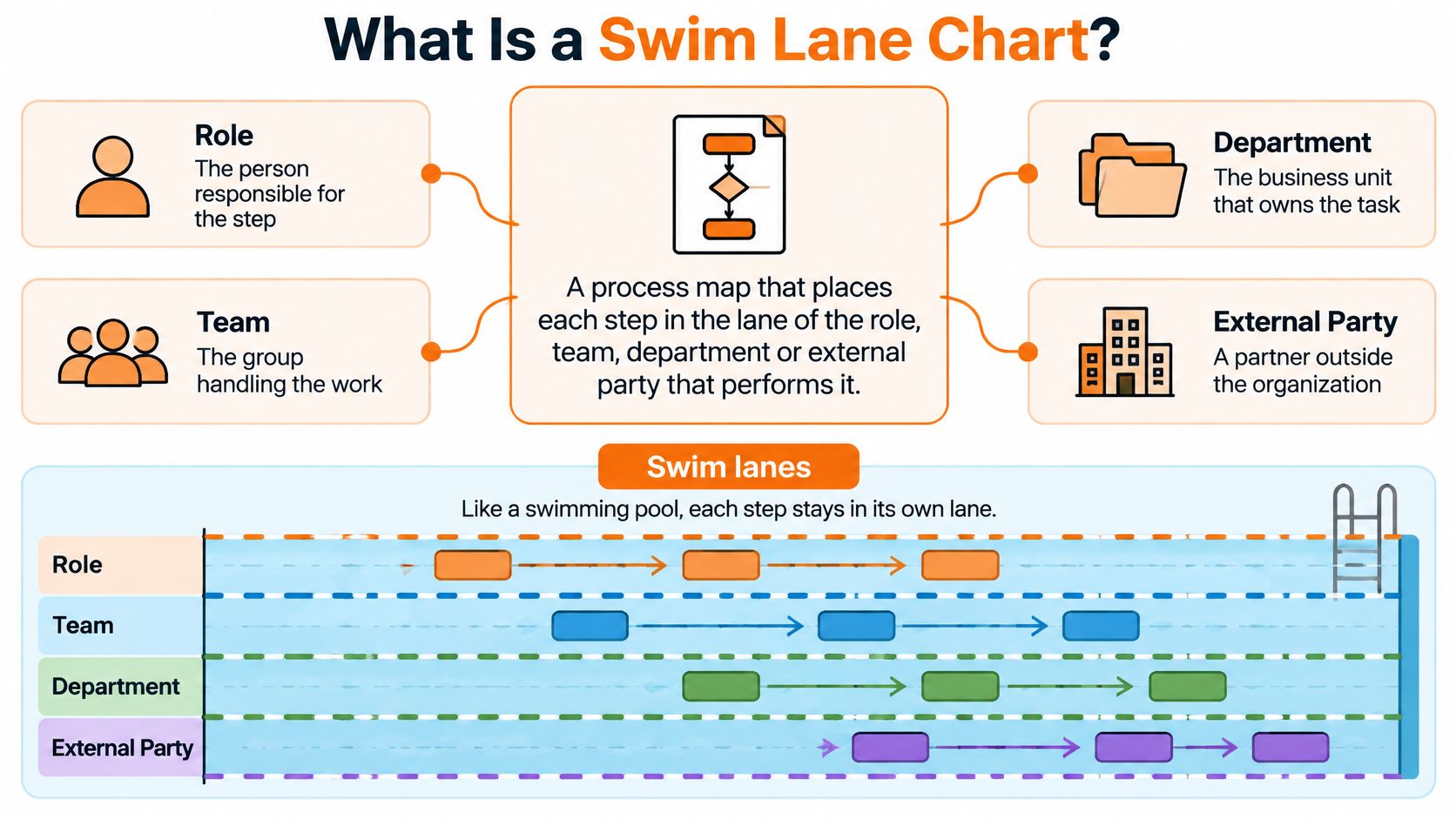
The swimming pool analogy is useful: each swimmer stays in a lane, but everyone follows the same course. In a collection workflow, Design, Merchandising and Content Operations retain distinct responsibilities while contributing to the same launch.
The diagram below shows how responsibility areas fit around a shared process.
Follow a colorway through the chart
Say Design develops a new colorway for a spring collection. The brand's pool contains its internal workflow, and the Design lane contains the activity that creates the visual.
An arrow takes the approved design file to Merchandising, where the assortment decision happens. If Merchandising rejects the colorway, a gateway routes it back for revision; if approved, Content Operations prepares the catalog assets.
Swim lane chart notation and what each element answers
| Element | What It Shows | Example in a Seasonal Launch |
|---|---|---|
| Pool | A whole process participant, such as the brand or an outside factory | The brand's internal workflow, with the mill as a separate pool |
| Lane | An internal role, team or function | Merchandising, Design, Content Operations |
| Task | An activity performed by the lane owner | Approve colorway |
| Sequence arrow | The order in which steps happen | Concept approved, then assets generated |
| Handoff arrow | Responsibility passing to another lane | Design file sent to Merchandising |
| Gateway | A decision that changes the route | Approved, or sent back for revision |
A handoff arrow is a practical description of a connection, not a separate formal BPMN symbol. Within the brand's process, sequence flows can cross internal lanes; communication with an independent supplier uses message flows.
Reader test: Point to any task and name its performing owner without asking the person who drew the chart.
If that takes a discussion, improve the task label or lane assignment. A polished diagram with ambiguous ownership isn't ready to guide a collection.
Why Do Creative Teams Map Workflows With Swim Lanes?
Use swim lanes when handoffs cross several teams, rework starts with unclear briefs, or approvals disappear between functions. These are ownership problems before they're drawing problems.
A workshop works best when participants map what they send and receive, not just their department names.
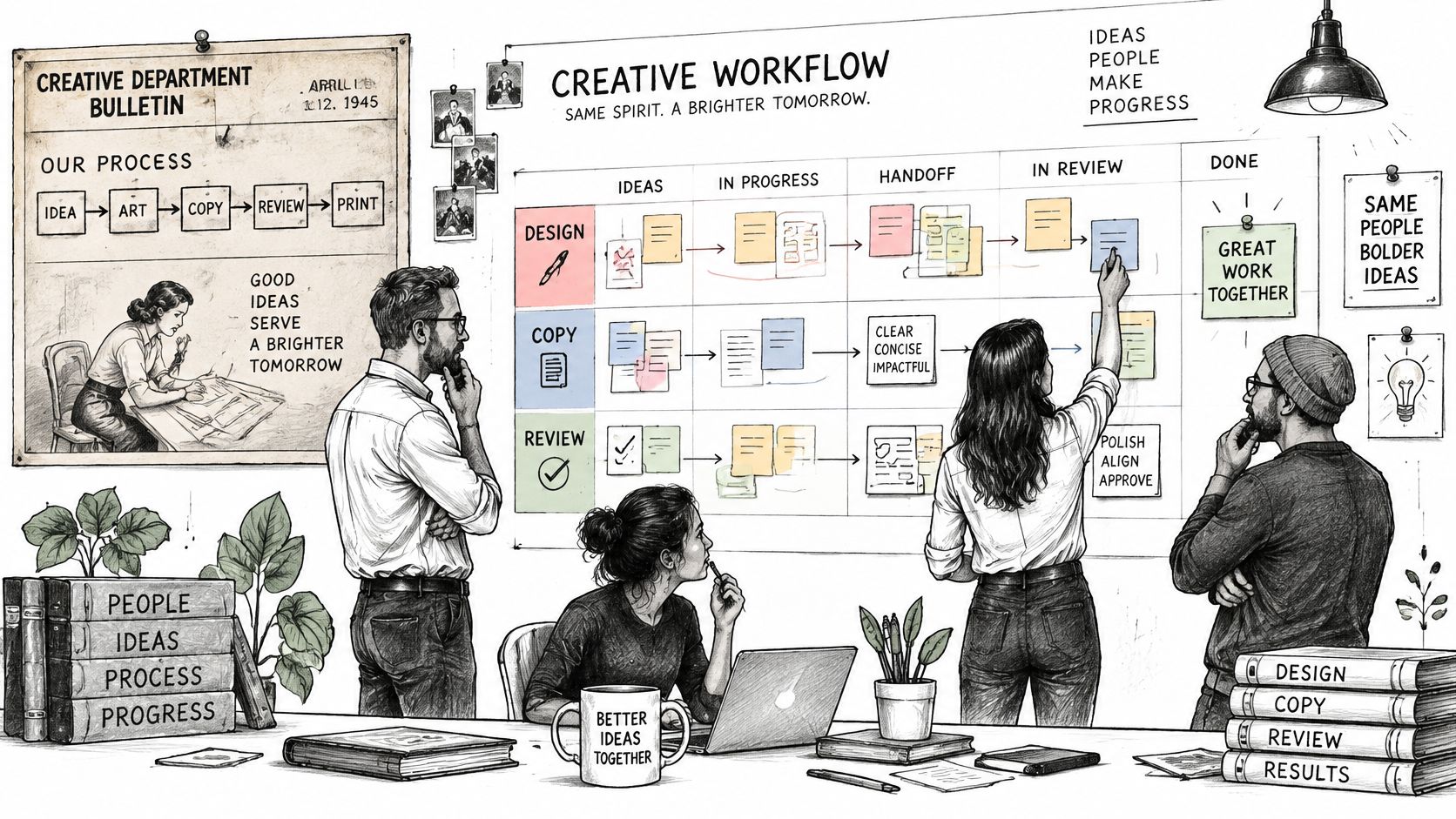
The format has practical roots: multicolumn process charts appeared in the 1940s, including a 1945 U.S. Bureau of the Budget bulletin, while Geary Rummler and Alan Brache helped popularize its modern management framing in their 1990 book, according to the history of swimlanes. The enduring principle is to separate responsibility areas while showing movement between them.
For a spring drop, Merchandising may define the assortment, Design develop the visuals, Brand approve naming, and Regional Marketing adapt the release. A conventional task list can conceal who authorizes the move between those activities.
Map the decision, not just the delivery
- Unclear briefs: Show who confirms that Design has enough information to begin.
- Missing approvals: Place the decision with the approver, rather than with the recipient of the approved asset.
- Repeated revisions: Identify which team can resolve the disagreement instead of routing the file through every stakeholder.
A broader creative production workflow also needs usable inputs and acceptance criteria. Lanes make the responsible team visible; they don't make an incomplete brief sufficient.
Use this walkthrough as a discussion aid before reviewing your own approval path.
The practical benefit is straightforward: a missing approval becomes a visible gap, not a debate after release.
Which Lanes Belong in a Seasonal Collection?
Choose lanes by who performs the work, not by who receives its output. Start with the roles needed for the specific launch, rather than copying the entire organization chart.
Microsoft's BPMN guidance distinguishes a pool, representing a participant, from lanes that divide responsibilities within that participant. An outside supplier belongs in a separate pool; internal functions belong in lanes, with message flows used for communication between independent participants.
Lanes for a seasonal fashion or beauty launch
| Lane | Owns | Typical Tasks | Handoff Out |
|---|---|---|---|
| Merchandising | Assortment and line architecture | Define assortment, set size runs, approve buy plan | Concept brief to Design |
| Design and Product Development | Silhouettes, materials, colorways | Concept sketches, material selection, prototype review | Approved visuals to Merchandising |
| Brand | Guardrails and naming conventions | Check style guide and naming rules | Approved assets to Content Operations |
| Regional Marketing | Local variants | Localize imagery and copy per market | Localized assets to channel release |
| Content Operations | Catalog assets and line sheets | Generate and QA catalog imagery, build line sheets | Final assets to e-commerce |
| External supplier (separate pool) | Production samples | Make samples, return measurements | Sample feedback to Product Development |
Treat these assignments as a starting model, not a universal operating policy. At a jewelry brand, Product Development might own material feasibility while Design owns the silhouette; a home brand might need a separate packaging role.
Keep meaningful distinctions
Combine roles only when the same performing group handles the work and no important decision boundary disappears. Two departments working consecutively isn't, by itself, a reason to merge them.
Split a broad lane when it conceals different authorities. For example, regional copy adaptation and final market approval may need separate role labels even if both sit within Marketing.
A lane should explain a responsibility boundary, not merely repeat a department name.
Keep software names in task annotations unless the system acts as an independent participant in the model. Otherwise, a lane labeled with a platform can obscure which person is responsible for reviewing its output.
How to Build a Swim Lane Chart in Six Steps
Start with boundaries, not boxes. The NHS Wales swimlane diagrams toolkit places activities with the role performing them and locates start and end triggers in their responsible roles' lanes.
Use this sequence to draft the map before adjusting its appearance.
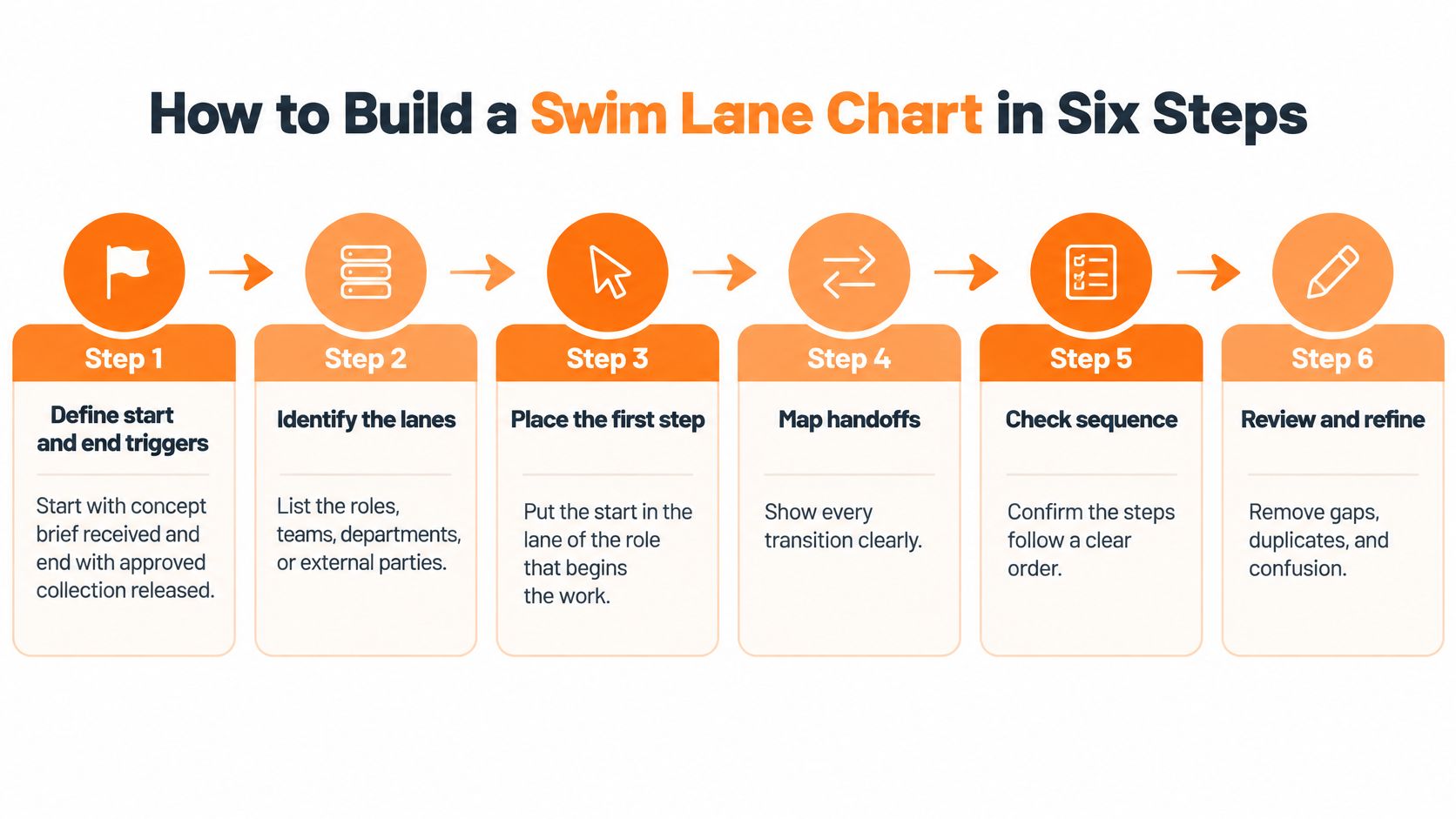
Define the start and end triggers. For a spring-drop example, begin with concept brief received in Merchandising and end with line sheets released to wholesale accounts in Content Operations. Common slip: using a vague endpoint such as launch complete, which leaves participants mapping different scopes.
Identify the performing roles. Create internal lanes and separate external pools, including anyone who makes a release-critical decision. Common slip: leaving out an occasional approver because they don't produce an asset.
Place activities with their executors. Put colorway sketching in Design and the assortment decision in Merchandising; line-sheet preparation belongs to Content Operations. Common slip: assigning preparation to the person who receives the finished document.
Connect the normal route and decision branches. Arrange sequence arrows left to right, then add gateways for approval, exceptions and revisions. Common slip: drawing a return arrow without stating what causes the return.
Label what changes hands. Use concrete labels such as approved colorway sketches to Merchandising or buy-plan decision returned to Design. Mermaid's swimlane guidance recommends labeling handoffs that depend on a document, decision, message or condition; the common slip is a bare arrow that explains neither the input nor the condition.
Walk the draft with each lane. Ask participants what interrupts them, what they wait for and what they send, then distinguish the happy path from exceptions. Common slip: approving the chart with managers alone when the people executing the work haven't checked it.
Make the spring-drop route readable
Keep the approved route moving forward across the page. Place the Merchandising revision branch beneath it, returning to Design with a reason for revision rather than a generic feedback label.
Use the flowchart construction guide for basic drawing choices. Spend review time on routing and acceptance criteria before color, spacing or icons.
How Do You Audit Handoffs in a Swim Lane Chart?
Audit lane boundaries first. That's where another person must accept an input, understand a decision or take over unfinished work.
Visual Paradigm's responsibility-modeling guidance supports assigning a primary lane to each activity rather than spreading a task across lanes. This keeps ownership explicit while communication is represented separately.
Use the visual checklist to orient the review, then examine the actual transfers.
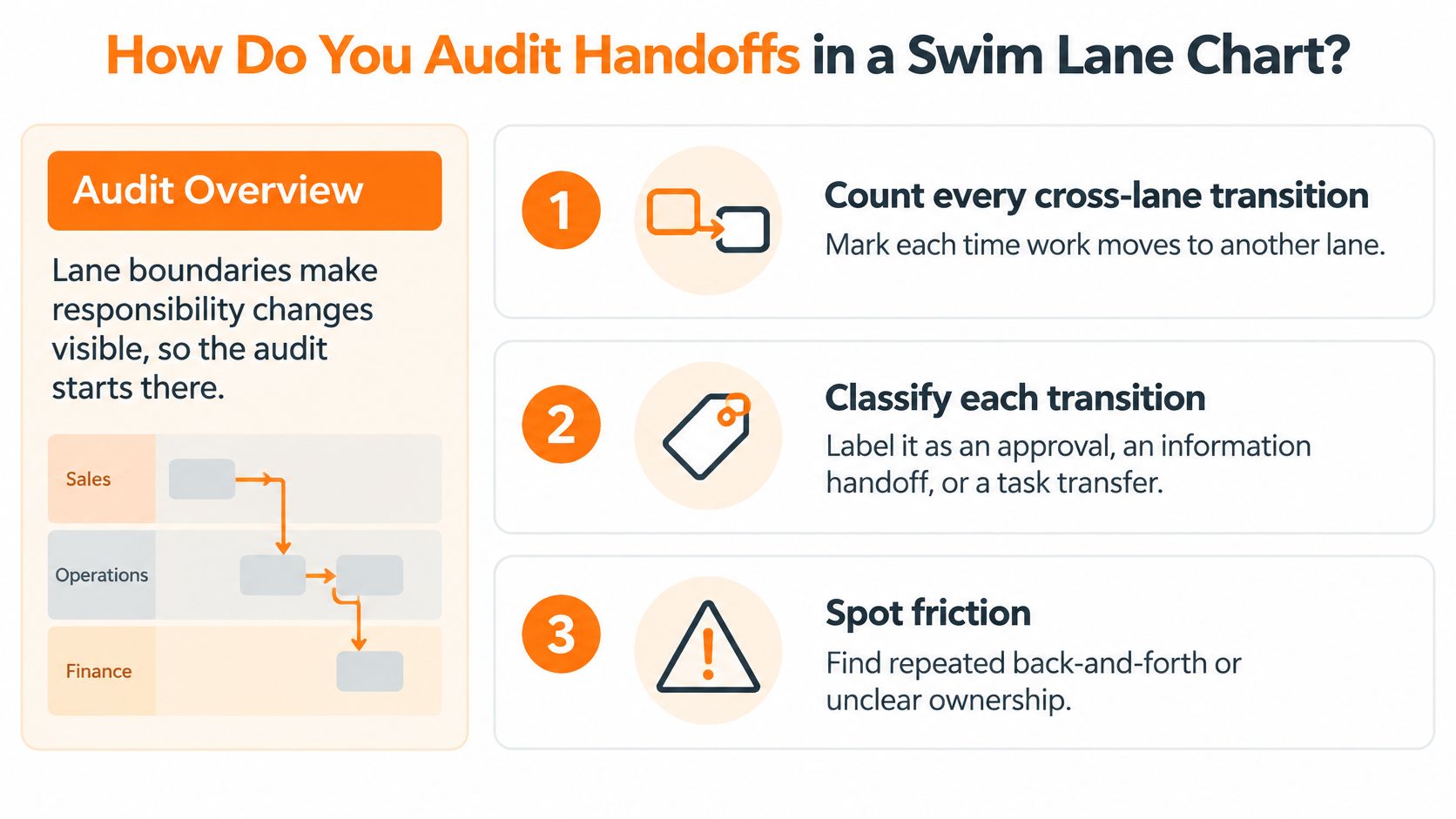
Count every cross-lane transition. Include returns, not just forward movement. A Design-to-Merchandising transfer followed by a revision request creates coordination in both directions.
Classify the transfer. Mark it as approval, information transfer, data transformation or work transfer. This distinguishes a necessary authorization from a file conversion that might not require another human handoff.
Resolve shared task ownership. Replace a task spanning Design and Brand with a primary executor and a separate review activity where appropriate. Don't use message flows between ordinary internal lanes in a formal BPMN model; reserve them for communication between participants.
Inspect the input and acceptance condition. A visual review needs an identifiable version, relevant references and a clear decision request. If the receiver must reconstruct missing product information, record that work rather than hiding it inside review.
Trace approval and rework branches. Count returns to earlier lanes and check who can close each exception. A revision loop without a decision owner can repeat without anyone being authorized to release the result.
Measure the boundary, not just the task
High transition density warrants investigation, especially when recipients reinterpret briefs or recreate data. Don't remove a quality check merely to reduce the arrow count; remove unnecessary reconstruction and duplicate routing.
Track queue time, rework frequency and approval latency against identifiable handoffs. Our process audit steps can help turn those observations into review actions.
When the improvement must support a measurable business objective, The OKR Hub's guidance on how to streamline workflows to achieve your OKRs provides useful context for choosing outcomes rather than counting diagram edits.
When Is a Swim Lane Chart the Wrong Tool?
A swim lane chart is a communication artifact, not a complete operational model. It can show that Brand approves an asset, but the arrow's length doesn't tell you how long Brand takes.
Miro's swimlane guide discusses the format's limitations for timing, live status and complex processes. Adding departments and boxes doesn't solve those limitations; it can make the ownership view harder to read.
Decision need and the companion view to pair with a swim lane chart
| Decision Need | Swim Lane Fit | Pair It With |
|---|---|---|
| Elapsed time and queue duration | Weak | Timeline or Gantt view |
| Accountability for each deliverable | Strong for task ownership | Responsibility matrix |
| Actual behavior versus documented process | Cannot show it alone | Process mining or sampled event logs |
| System-generated events and exceptions | Often omitted | System boundary notes or event log |
| Executive overview of one launch | Strong | Keep lanes to a readable number |
Match the evidence to the decision
For a sample deadline, use a schedule with dependencies and dates. Before choosing that companion view, freispace's guide to Gantt chart trade-offs is useful for understanding what a schedule adds and what maintaining it requires.
For a capacity decision, inspect arrivals, waiting work and completion evidence. An interview-based map may show the intended route while employees bypass it when regional requests arrive late.
More diagram detail isn't the same as more operational evidence.
Keep the executive map focused on the launch's major responsibilities. Link exceptions and system behavior to supporting records instead of compressing every possible route onto the same page.
For compliance work, don't treat a box labeled approved as proof that approval occurred. Retain the relevant record, responsible identity and applicable version outside the diagram.
Which Tool Fits Your Swim Lane Chart?
Match the tool to the job the chart has to do: a discussion diagram, a formal process model, a product system of record or a working creative canvas. Those categories solve different problems, so this comparison is a matching exercise, not a ranking.
Sprello is our product. The distinction that matters is between drawing how work should move and connecting the product information that work runs on.
Swim lane chart tool categories compared
| Tool Category | Best For | Main Strength | Main Limit |
|---|---|---|---|
| General diagramming and whiteboard tools | Drawing a swim lane for discussion | Templates, simple sharing | The diagram alone holds no governed product catalog or AI product-visual workflow |
| BPMN modeling tools | Formal process models with pools and message flows | Strict notation | Steeper learning curve; less focus on creative production |
| PLM suites | Product records, tech packs and BOMs | System of record for product data | Heavy to set up for one workflow map |
| Sprello (our product) | Mapping and running creative and merchandising workflows on one canvas | AI product visuals, a shared catalog, and line sheets and buyer assortments generated from it | Scoped to creative and merchandising work, so governed technical records still belong to PLM |
Separate diagramming from product work
Miro and general diagramming tools suit workshop drafts. Microsoft Visio supports formal notation. PLM suites fit when the underlying requirement is governed technical product information rather than a discussion map.
Sprello is an AI workflow canvas for fashion, beauty and lifestyle brands, running from product concept to buyer-ready collection. Selected visuals and product details flow from the catalog into line sheets and buyer assortments. Line sheets can be built for wholesale presentations to every account, covering North America, Europe, department stores, specialty boutiques, flagship stores or your own retail, and they show style or variant codes, material, wholesale price and retail price. Every input and instruction stays visible on the canvas, so you can change one reference and compare the result.
The practical test for this category is simple. Does the map only need to assign each handoff an owner, or does every lane need live collection data behind it? Diagramming tools handle the first. A creative canvas handles the second.
Keep downstream publishing distinct from collection development, too. If your channel team needs to build product listicle pages, Landra is a separate resource to evaluate for that publishing task, not a substitute for defining product-development ownership.
What Do Teams Still Ask About Swim Lane Charts?
Maintaining a trustworthy map
How often should a swim lane chart be updated?
Version it for each season and revise it whenever an owner, approval or release requirement changes. Record assumptions and retain the previous version so participants can distinguish a process change from a drawing correction.
Can AI generate a swim lane chart?
AI can accelerate drafting, but representatives from the performing lanes must review the result. Check approval authority, regional variants and exception routing before using it to direct work.
How do you validate a chart against what people do?
Walk the process with its participants and check high-risk activities against sampled work or event logs. The Minnesota Department of Health's swim lane mapping guidance recommends examining interruptions, handoffs, waits and missing information; record conflicting accounts rather than choosing one.
Choosing the right level of rigor
Can a swim lane chart support capacity or compliance decisions?
Only as an overview, not as sufficient evidence on its own. Add duration information for capacity questions and actual execution records for control checks.
Do you need a dedicated tool to draw one?
No, a simple drawing tool is enough for discussion. Use a BPMN modeler for formal notation, or a product-work platform when participants need to act on shared collection information.
Sprello connects AI product visuals with a shared catalog, line review, wholesale line sheets and buyer assortments, giving creative handoffs a common product context. Visit Sprello to book a demo and see how a shared canvas can map your seasonal workflow from concept to buyer-ready collection.
Related
More to explore
Fresh reads
How to Make a 4x6 Photo Template for Print
Build a 4x6 photo template at 1200×1800 px and 300 PPI, with bleed, a safe zone, and export settings for lab, inkjet, and retail print.
4 Square Chart Guide for Fashion Line Reviews
A 4 square chart sorts fashion styles into four decisions. See axes, scores, quadrant actions, and a line-review template.

What Is a Context Diagram? Notation, Examples and Uses
Learn what is a context diagram: its system boundary, external entities and labeled flows, notation rules, and a fashion product-development example.