November 17, 2026
Jewelry Line Sheet Template: Fields, Steps and Compliance
Build a jewelry line sheet template with the fields, imagery, minimums and compliance details wholesale buyers check before they order.
A jewelry line sheet earns its space when a buyer can identify a style, distinguish its variants and place an order without chasing missing details. Build the product information first. Design the page around it.
The global wholesale sales figure for non-costume jewelry was estimated at $162.9 billion across 195 countries in a 2025 market report from Kentley Insights. For an individual line sheet, the practical test is simpler: can a buyer find the style, material, price and delivery information needed to make a decision?
Sprello connects product visuals created from sketches, CAD files, materials and references with a shared product catalog, wholesale line sheets and buyer assortments. Selected visuals and product details flow from the catalog into line sheets and assortments, so each buyer's assortment starts with the same product information and can be reviewed as a whole.
Published 17 November 2026
What Is a Jewelry Line Sheet Template and Which Build Method Fits?
A jewelry line sheet is an ordering document, not a lookbook. It gives the buyer and sales team a shared reference for the styles, variants, visuals, and commercial details available to order. The Fitinline guide to preparing line sheets for buyer meetings describes that role in the context of buyer meetings.
A template makes the document repeatable across seasons and accounts. For jewelry, the product record should distinguish details such as metal, karat or plating, stone type and size, chain length, clasp, and finish. A generic apparel layout may not leave room for these distinctions, while a crowded layout can make them hard to scan.
Two approaches commonly fail: a polished page that leaves buyers unable to place an order, and a dense spreadsheet that is accurate but difficult to read in a meeting. The right build method balances readability with reliable product information.
| Build method | Best for | Main strength | Main limit |
|---|---|---|---|
| Spreadsheet (Excel or Google Sheets) | Small collections and first line sheets | Fast to set up and easy to edit | Manual SKU checks and no link to product images |
| Design tool (InDesign, Illustrator or Canva-style layout) | Brands that want a polished PDF | Full control over layout and typography | Product data is re-keyed for each season and account |
| PLM or ERP line-sheet module | Brands already running PLM or ERP | Product data stays with the product master | Layout and imagery options can be limited |
| Sprello | Brands building line sheets and buyer assortments from a shared catalog | Selected visuals and product details flow from one catalog into line sheets and buyer assortments | Complements PLM and planning suites; does not replace them |
In Sprello, each style lives in one shared product catalog with its details and the visuals created for it. Selected visuals and product details can flow into line sheets and buyer assortments, including style or variant codes, materials, wholesale prices, and retail prices.
For example, a buyer reviewing a pendant should be able to distinguish its metal and stone variants and identify the corresponding codes and prices. The line sheet should make those distinctions easy to scan, not bury them in decorative copy. Shivora Candles on contract manufacturing duties
The test: if two team members can find different prices for the same style in the same file, the template needs a clearer source of product information.
A spreadsheet can suit a small first collection and a limited number of accounts. A design tool offers more control over presentation, but repeated manual entry makes it harder to keep versions aligned. As the catalog and number of buyer accounts grow, a shared product catalog can reduce duplicate entry and keep line sheets and assortments tied to the same product details.
Which Fields Must Every Jewelry Line Sheet Show?
A jewelry line sheet needs enough detail for a buyer to identify the exact product and place an order without guessing. Start with one authoritative product record for each style and variant, then carry the relevant fields into the layout: product image, style and variant codes, buyer-friendly product name, metal and stone details, dimensions, wholesale price, suggested retail price, minimum order, pack size, ship window, order deadline, cancellation date, payment and freight terms, returns policy, care notes, and account contact.
Split parent-style information from variant information. A pendant may share a design name, while vermeil, sterling silver, and 14k gold versions each need their own SKU, material details, price, and availability. Put variants on separate rows when buyers need to order them separately.
| Field | Jewelry-specific detail | Why the buyer needs it |
|---|---|---|
| Style number and variant code | One parent design ID, with a distinct SKU for each metal and stone version | Matches orders and reorders to the intended item |
| Product image and scale reference | Product view plus a worn or scaled image | Helps buyers assess the item's proportions |
| Metal and finish | Karat, plating type and thickness, or sterling silver | Clarifies the material being ordered |
| Stone details | Stone type, size, origin, and treatment, when applicable | Supports accurate product descriptions and claims |
| Dimensions | Chain length, ring sizes, and pendant size | Helps buyers assess fit and merchandising |
| Clasp and surface finish | Clasp type and finish name | Identifies details that may affect product selection |
| Wholesale price | Per unit, with tax treatment stated | Gives buyers the cost basis for their order |
| Suggested retail price | Per item, or by colorway if prices differ | Provides a retail reference |
| Minimum order and pack | State whether the minimum applies by style, variant, or pack | Defines what the buyer can order |
| Ship window and deadlines | Delivery window, order deadline, and cancellation date | Sets expectations for the buying timeline |
| Care notes and brand contact | Care instructions and the account or sales contact | Gives buyers product guidance and a route for questions |
Keep one authoritative internal code for each SKU, but make the customer-facing sheet readable: pair the code with a clear product name and identify the variant in plain language. A product naming convention can help teams apply names consistently across styles and variants.
For example, if a pendant comes in vermeil, sterling silver, and 14k gold, a single row labeled “gold” leaves the buyer guessing. Show each version and its material clearly, with the matching code and price. Before sending the sheet, check that every orderable variant has the details a buyer needs; blank cells invite follow-up and can lead to the wrong item being ordered.
How Should Jewelry Be Photographed for a Line Sheet?
A jewelry line sheet fails when buyers cannot judge a piece's scale, finish, or distinguishing details. Set a repeatable photography brief so each style is shown consistently, whether the images come from a studio or a phone.
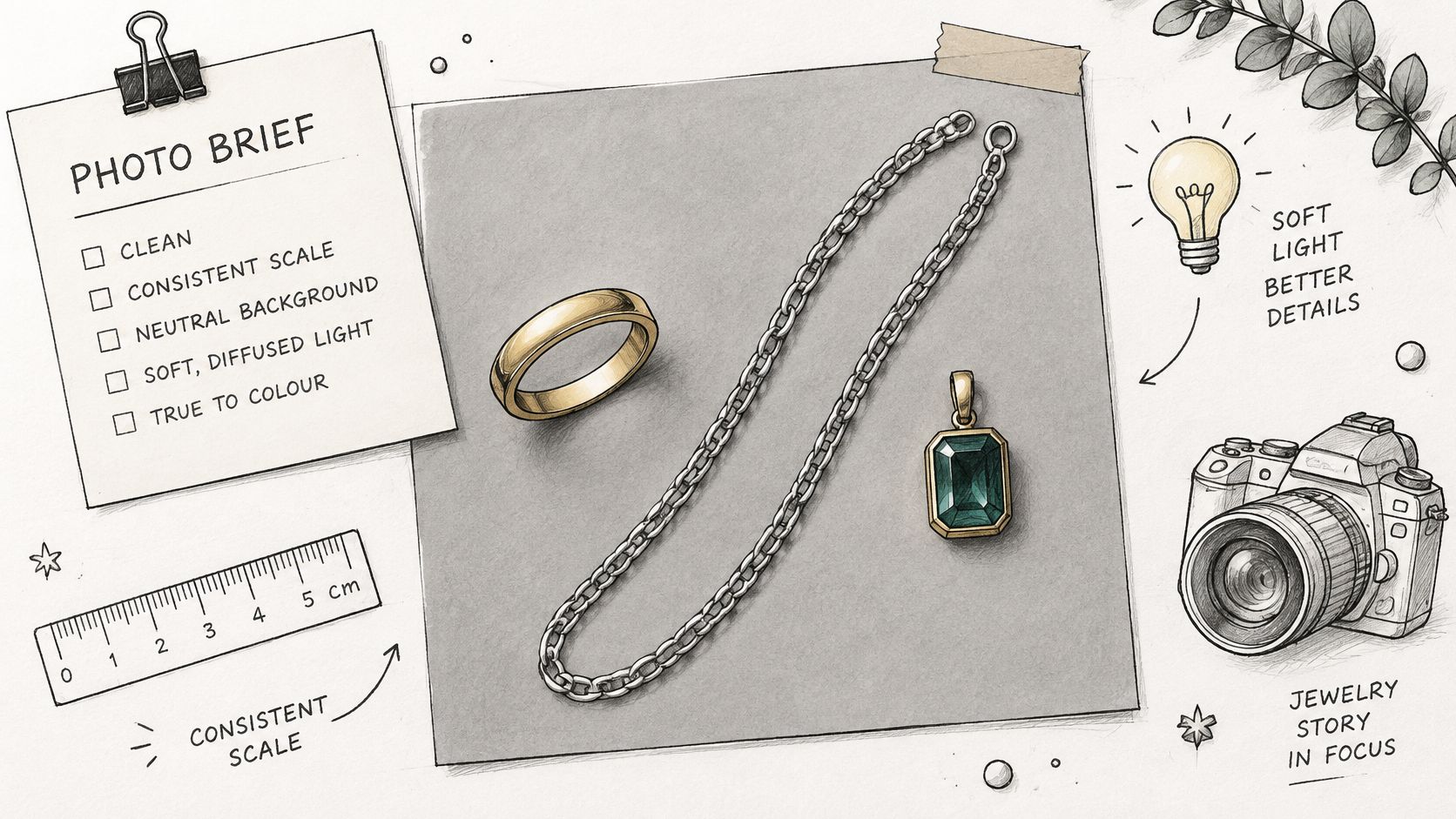
The brief a photographer can follow
- Background and crop: Set a neutral background, crop, and aspect ratio. Keep a chain at a consistent relative size across pages.
- Scale and angle: Fix the camera angle and product scale so buyers can compare pieces rather than changes in perspective.
- Lighting: Specify the light direction and shadow treatment, then repeat them across the set.
- Reflective metals: Use diffused light and white and black cards to manage reflections on polished gold and silver.
- Sharpness: Use a tripod and enough depth of field, or focus stacking, to keep the whole piece crisp from clasp to drop.
- Scale reference: Include a worn or scaled image for pieces whose size is hard to judge from a product-only view.
- Export: Set a color profile and keep edited deliverables separate from master files.
A product photography style guide can hold these standards for both line-sheet images and other product photography, helping teams keep a consistent visual treatment.
The controls apply to phone photography, too. A smartphone photos of estate jewelry example can help with practical choices for backgrounds and lighting when a studio shoot is not available.
Match each file to one SKU using a consistent naming rule, then check it against the product record. Look for color shifts, cropped clasps, obscured stones, and variants that are difficult to distinguish.
If an image cannot be matched to exactly one SKU, leave it off the line sheet.
How Should Minimums and Pricing Be Stated on a Line Sheet?
A minimum only works when the buyer can tell exactly what counts toward it. Separate the whole-order dollar minimum from per-style quantities and fixed packs, then state whether each rule applies to first orders, reorders, or both.
Scope must be explicit. “Six pieces” could mean six per style, color, size, or pack, or six across the order. Write the rule beside the minimum. For example, state that styles may be mixed to meet the order minimum, or that each style must meet its own quantity minimum.
Show wholesale and retail prices alongside the terms. List the wholesale price per unit and the retail price for each style or variant, and identify differences by material, color, pack, or pricing tier. State applicable taxes and payment terms, such as prepaid, deposit plus balance, or net 30 or net 60.
| Item | What to state | Example |
|---|---|---|
| Order dollar minimum | Whole-order value and whether it applies to first orders | $500 minimum for first orders; $250 for reorders |
| Per-style quantity | Units per style, often in sixes or dozens | Six pieces per style |
| Pack increment | Fixed packs and what each pack contains | One pack of six assorted ring sizes |
| Scope of minimum | Per style, color, size, pack or total order | Six pieces per color for a chain offered in two metals |
| Mixing styles | Whether styles combine to reach a minimum | Styles may be mixed to meet the $500 order minimum |
| Wholesale and retail price | Wholesale per unit and retail price on each line | Show separate wholesale and retail prices for plated and solid versions |
| Payment terms | Prepaid, deposit plus balance, or net 30 or net 60 | Prepaid for first orders; net 30 for established accounts |
| Freight and duty | Incoterm such as EXW, DAP or DDP | DAP to the named destination |
Freight belongs in the terms, not a footnote. State who pays freight and duty, and identify the applicable Incoterm. Buyers need those costs to assess landed cost and the margin on an assortment.
Which Jewelry Claims Need Evidence on the Line Sheet?
A polished, claim-heavy line sheet is riskier than a plain one, because it puts a sustainability or material statement in front of a buyer with a purchase order attached. Most guidance treats jewelry as a generic accessory and stops at SKU, material, measurement, wholesale price, MSRP, MOQ and delivery window, leaving the legal-risk questions exposed (Brandboom's line sheet resource).
Material is not a field. It's six or seven of them. A buyer approving a product for several markets may need base-metal composition, plating thickness, stone dimensions, treatment disclosure and substantiation status, and a generic "material" cell answers none of that.
| Claim | Field to record | Evidence to attach |
|---|---|---|
| Karat and plating | Exact fineness, plating type and thickness | Supplier certificate or test report with date |
| Nickel or allergen | Test result and test method | Lab test reference with date |
| Recycled-metal percentage | Stated percentage and its basis | Supplier documentation |
| Gemstone treatment | Treatment type on each stone line | Grading or treatment report |
| Lab-grown versus mined | Stone origin stated explicitly | Grading report or supplier declaration |
| Country of origin | Origin per style or variant | Origin documentation |
| Responsible sourcing | Program or policy statement | Certification or audit reference with date |
Then draw the line between a marketing claim and a verifiable specification. "Recycled silver" is marketing until the field beside it holds a percentage, a basis and a document. "14k" is a specification the moment a test report with a date sits behind it, and the buyer can see which is which.
Stones work the same way. A retailer selling certified diamonds for engagement rings relies on a grading report as the substantiation, and a wholesale sheet should carry the report reference rather than the word "certified" standing alone.
Two more controls close the loop. Keep approved claim language per market, so a regional version of the sheet never carries wording that isn't permitted there, and give the compliance owner a sign-off before publication. If the evidence field is empty, the claim comes off the sheet.
How Do You Build the Template Step by Step?
- Create one record per style and one per variant, using your ERP codes. Build from the product master rather than from last season's PDF. The slip: variant rows added at the end of the process, after prices and images are already in, which is how a vermeil SKU inherits a 14k price.
- Map the fields into the layout with parent and variant blocks kept apart. Parent rows carry design intent, variant rows carry orderable facts. The slip: one flat grid where it's unclear whether a price applies to the design or to the metal.
- Attach approved images to each SKU under a file-to-SKU naming rule, and keep edited files away from masters. The slip: a resized export replaces the master and the next crop is built from a compressed file.
- Enter wholesale and retail prices, then state the minimum level and pack for every style. Do this in the source data, never in a second document. A price typed into a separate buyer file drifts out of date within one season.
- Run a preflight check. Missing prices, duplicate identifiers, inconsistent material claims and images that don't match the approved product record. This is a fifteen-minute pass that prevents a renegotiation.
- Export one version per account, region or channel from the same source, and save the layout so the next collection starts from it. Each buyer's mix should be a view of one catalog, not a fresh file with its own numbers.
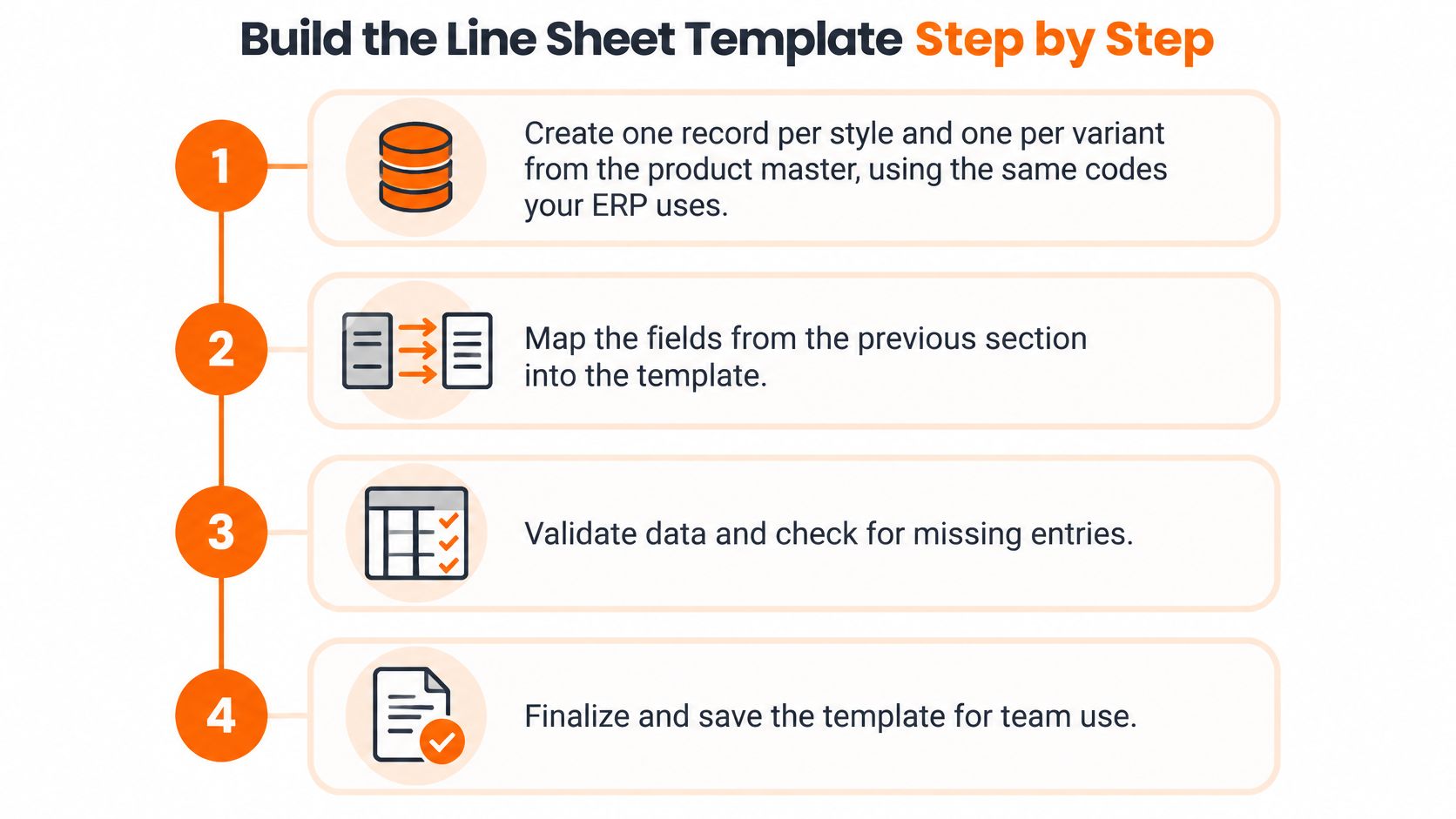
Steps three through six are the ones that repeat every season, which is why they're worth capturing as a saved workflow that runs again on the next collection rather than as a document of instructions someone has to remember.
The handoff test: give one finished style to a sales rep cold and watch. If they can place an order without asking a question, the template holds. If they ask which price applies, the parent and variant split has failed.
What Do Buyers Ask About Line Sheet Templates?
How many sheets should one collection have?
Use one shared product catalog, then build line sheets for each account, region, or channel. A buyer-specific assortment can draw from the same product information, so the chosen styles and their details stay consistent. Rebuilding each sheet by hand makes it harder to track which version is current.
Should a line sheet show retail prices to every buyer?
Show wholesale and retail prices when they are relevant to the account and market. State the pricing basis clearly, and use the appropriate market version for North America, Europe, department stores, specialty boutiques, flagship stores, or your own retail.
How often should the template be updated?
Update line sheets when product details or approved visuals change, and before sharing them with buyers. Check that each style, variant, price, and image matches the current catalog. A stale sheet can show a discontinued colorway or outdated price.
Can a template replace PLM?
No. A line sheet presents product information commercially; it is not a substitute for systems used to manage product development or planning.
A demo can show how a workflow fits your catalog and team. Sprello tailors sales demos to your workflows after you share your catalog size and use case. The walkthrough can cover the catalog, canvas, line sheets, and assortments using one of your product categories.
Sprello is an AI workflow canvas for fashion, beauty, and lifestyle brands. Selected product visuals and details can flow from the catalog into line sheets and buyer assortments. If your team rebuilds the same materials by hand each season, book a demo with Sprello and bring one product category to explore.
Related
More to explore
Fresh reads
9 Types of Fashion Silhouettes for Merchandisers in 2026
Nine types of fashion silhouettes explained with defining shapes, styling uses, and how each affects fit, sampling, and collection design.
How to Create Fashion Mood Board: A Step-by-Step Guide
Learn how to create fashion mood board files that guide design, merchandising and buying, with steps, a translation table and a review checklist.
What Is SKU Rationalization? a Practical Guide for 2026
What is SKU rationalization? A structured review of every SKU to keep, modify, consolidate or exit it, with criteria for fashion, beauty and home brands.