
Think of a brand messaging framework as your company's strategic playbook for communication. It’s the single source of truth that makes sure every email, ad, and social media post sounds like it comes from the same brand, building the kind of consistency that earns trust.
Why Your Brand Is Talking but Nobody Is Listening
Does this sound familiar? You’ve got a killer product, but your marketing just seems to disappear into the void. Social posts get a few pity likes, emails go unopened, and your ads just don't seem to land. More often than not, the problem isn't what you're selling—it's how you're talking about it.
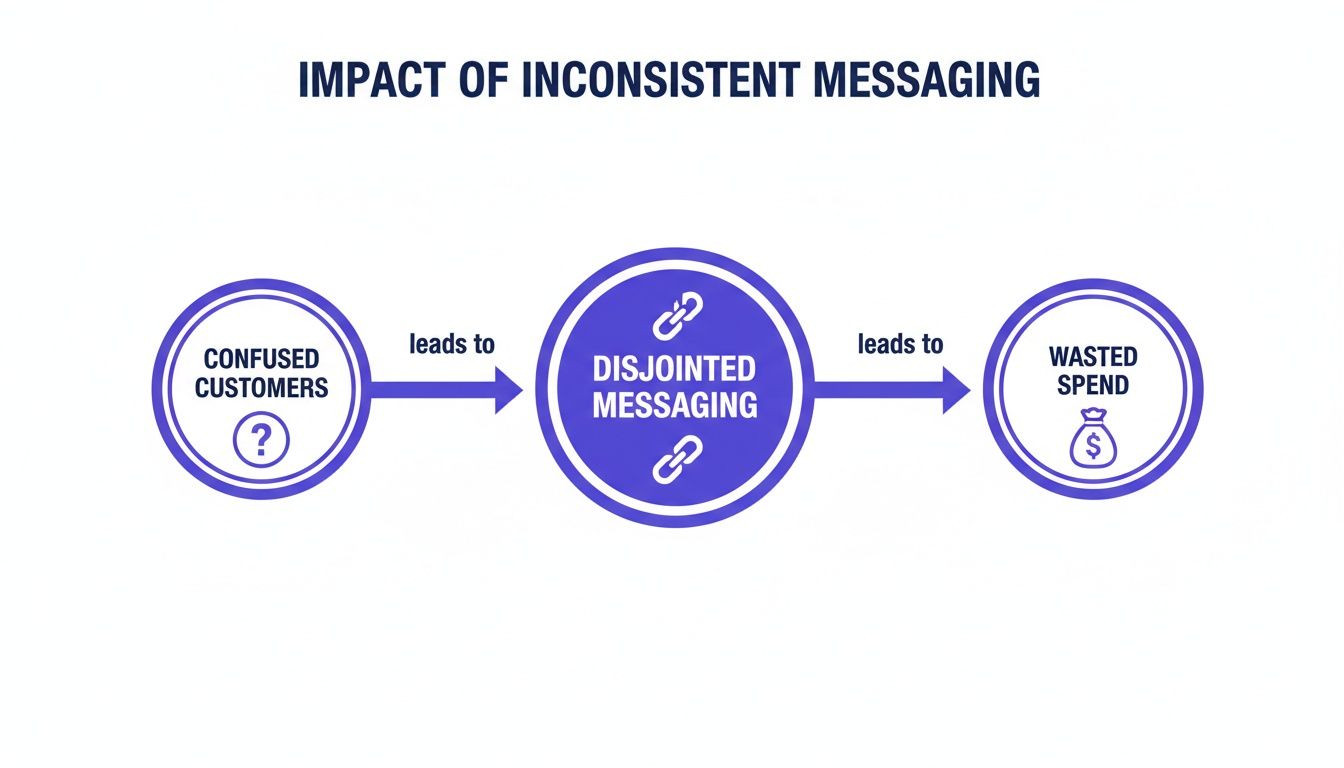
When your messaging is all over the place, customers get confused. Maybe your website is buttoned-up and corporate, but your Instagram is full of playful memes. That kind of disconnect creates a subtle friction that chips away at trust. People can't get a clear read on who you are or what you stand for, which makes it incredibly easy for them to just keep scrolling and click on a competitor with a message that makes sense.
The Real Cost of Inconsistent Messaging
This isn't just a branding problem; it's a financial one. Every off-brand piece of content is a wasted opportunity and squandered marketing dollars. You're pouring time and money into communications that don't build your brand or connect with the right people. Over time, that fragmented approach dilutes your impact, making it tougher to build a loyal following or justify premium prices.
This is where a brand messaging framework comes in. It’s not about creating a bunch of rigid rules that kill creativity. It's about building a solid foundation that empowers everyone—from marketing and sales to customer support—to communicate with confidence and clarity.
A strong brand messaging framework is your brand's North Star. It guides every word, every video, and every interaction to ensure customers get a consistent, memorable experience no matter where they find you.
Turning Confusion into Clarity
Building this framework is your first real step in turning communication chaos into coherence. A great way to get started is by following a detailed guide to clear branding and messaging that can walk you through the nuances. This document quickly becomes one of your most powerful tools, driving team alignment, making content creation faster, and ultimately, boosting your bottom line.
And the financial return is real. With 90% of customers now expecting consistent interactions across every channel, a unified brand voice is table stakes. Research even shows that brand consistency can lead to a 23% increase in revenue, and countless companies have seen major growth after getting their messaging in order.
The 7 Building Blocks of a Powerful Messaging Framework
Think of your brand messaging framework as the blueprint for every word your company writes and says. It’s less about abstract marketing theory and more about a deliberate, strategic construction project. When you get it right, you build a brand voice that’s not just consistent, but powerful.
Without one? You end up with mixed messages that confuse customers, create disjointed team efforts, and just plain waste money. It’s a direct hit to your bottom line.
Let’s walk through the seven essential components that will turn your scattered ideas into a brand voice that truly connects.
1. Pinpoint Your Audience
You can’t hit a target you can’t see. To craft a message that actually lands, you have to know exactly who you’re talking to. This goes way beyond basic demographics. You need to get into their heads and understand their psychographics—what are their real goals, deep-seated fears, and day-to-day frustrations?
Build out detailed customer personas, but don't just fill in a template with facts. Give them a name and a story. What keeps them up at night? What does a truly successful day look like for them? This kind of empathy is the bedrock of messaging that works.
A Look at "Momentum" (Our Fictional SaaS)
- Persona: "Startup Sarah"
- Her Story: She’s the founder of a 10-person e-commerce startup, juggling social media, customer service, and inventory. Her biggest fear is that she's so bogged down in manual tasks that she’s missing out on the big growth opportunities.
- Her Goal: Sarah wants to automate the repetitive work so she can finally have time for big-picture strategy. She dreams of feeling in control of her business, not constantly putting out fires.
2. Nail Down Your Core Brand Promise
What is the single most important thing you want people to associate with your brand? That's your brand promise. It’s the core value you deliver, distilled into one clear, compelling statement. This isn't just a tagline for your website; it's an internal North Star that guides every single decision.
Think about the transformation you provide. What problem do you solve better than anyone else? Your promise should feel ambitious but be entirely achievable, setting a crystal-clear expectation for your customers.
Momentum's Brand Promise:
- We give small business owners their time back by automating their most repetitive tasks, so they can focus on growth.
3. Build Your Supporting Brand Pillars
If your brand promise is the roof, your pillars are the load-bearing walls holding it up. These are usually three or four key themes that directly support your core promise. Think of them as the main topics you'll hit on again and again in your marketing, content, and sales calls.
These pillars are your guardrails for consistency. Anytime you’re brainstorming a blog post or a new ad, you can check it against your pillars. Does it fit? If not, it's probably off-message.
- Pillar 1: Simplicity — Our tools are so intuitive you don't need to be a tech whiz.
- Pillar 2: Efficiency — We streamline workflows to save you hours every single week.
- Pillar 3: Growth — By handling the small stuff, we empower you to scale your business.
4. Define Your Voice and Tone
Your brand voice is your personality—it should stay consistent. Your tone is the mood or attitude you use in different situations—it adapts. Are you witty and a bit irreverent? Or are you more authoritative and reassuring? The key is to find a voice that’s authentic to your company and resonates with your audience.
Once you’ve defined your voice, map out how your tone flexes. For instance, your voice might always be "empowering," but your tone will be more "celebratory" in a customer success story and more "supportive" in a help article. For a deeper dive, check out our guide on how to create brand guidelines.
Momentum's Voice and Tone:
- Voice: Empowering, clear, and encouraging. We’re a helpful partner, not a cold tech company.
- Tone in Action:
- Onboarding Email: Welcoming and simple ("Let's get your first workflow set up in 5 minutes.")
- Blog Post: Educational and inspiring ("Here are three ways to automate your marketing and win back your weekend.")
- Error Message: Reassuring and helpful ("Oops, that didn't work. Let's try this instead.")
5. Gather Your Proof Points
A promise is just hot air without proof. Proof points are the tangible, undeniable evidence that you can deliver on what you say. We're talking hard facts, glowing testimonials, and compelling case studies that build trust and make your claims believable.
Start collecting these and organize them by brand pillar. This makes it incredibly easy for your team to grab the perfect statistic or quote to back up their message in an email, a social post, or a sales deck.
A great brand messaging framework is a collection of promises backed by undeniable proof. It moves your brand from making claims to demonstrating value.
Momentum's Proof Points:
- For the "Efficiency" Pillar:
- Statistic: "Our average customer saves 10 hours per week."
- Testimonial: "Momentum cut our order processing time in half. I can't imagine running my store without it." - Startup Sarah
- Case Study: How an online boutique used Momentum to automate inventory management and increase sales by 30%.
- For the "Simplicity" Pillar:
- Feature: "One-click integration with Shopify, WooCommerce, and Squarespace."
- Social Proof: "Rated 4.9/5 stars for ease of use on G2."
6. Craft Your Positioning Statement
Your positioning statement is an internal, strategic document that carves out your unique spot in the market. In a sentence or two, it clearly defines your target customer, the problem you solve, what makes your solution different, and why you’re the best choice.
This statement is your anchor. It ensures everyone, from marketing to sales to product, is on the same page about who you are and why you matter. It's the elevator pitch for your entire company.
Momentum's Positioning Statement:
- For small e-commerce founders who are overwhelmed by manual operations, Momentum is an automation platform that simplifies repetitive tasks. Unlike complex enterprise tools, Momentum offers an intuitive, no-code solution that helps them save time and focus on scaling their business.
7. Create Your Messaging Matrix
The final step pulls everything together into a practical, day-to-day tool: the messaging matrix. This is where the rubber meets the road. It’s a simple grid that maps specific messages to different audience segments across various channels, turning your high-level strategy into tangible talking points.
This is the cheat sheet your team will use every day to make sure the right message gets to the right person on the right channel. It eliminates the guesswork. To get started, you can even lean on a solid brand messaging framework template to structure your own.
Here's how a messaging matrix brings your framework to life, turning abstract ideas into a clear action plan.
Sample Messaging Matrix for a SaaS Company
| Audience Segment | Channel | Core Message | Key Proof Point |
|---|---|---|---|
| Startup Sarah (New Founder) | Instagram Ads | "Stop drowning in busywork. Get your time back." | "Automate your first task in under 5 minutes." |
| Scaling Steve (Experienced Owner) | LinkedIn Blog | "Scale your operations without scaling your headcount." | "Our platform helps businesses grow 30% without hiring." |
| Agency Alex (Marketing Partner) | Email Outreach | "Offer your clients powerful automation without the complexity." | "Join our partner program and get dedicated support." |
As you can see, this simple table gives your team immediate clarity on what to say, where to say it, and who to say it to.
By building out these seven blocks, you create a comprehensive and truly usable brand messaging framework. This isn't a dusty document that lives in a forgotten folder—it’s a dynamic tool that empowers your entire organization to communicate with clarity, consistency, and confidence.
Translating Your Messaging Framework Into Video Content
A brand messaging framework on paper is just a plan. The real magic happens when you bring it to life, and right now, video is the best way to do that. With 82% of all internet traffic expected to be video, turning your framework into motion isn't just a good idea—it's essential for staying relevant. This is where your strategy document becomes a practical guide for creating content that people actually connect with.
Your framework acts as the guardrails for your creative team. It ensures that every video, whether it's a 15-second TikTok or a 10-minute YouTube tutorial, feels like it came from your brand. It stops you from just chasing random trends and helps you create with purpose.
Let's dig into how each piece of your framework directly shapes your video production.
Turning Pillars into Video Themes
Think of your brand pillars as the foundational themes for your entire content strategy. Instead of staring at a blank calendar and wondering what to post, just look at your pillars. They are the perfect source for recurring video series and social media content buckets.
Let's say your brand pillars are "Simplicity," "Efficiency," and "Growth." Here’s how you could turn those into a real video content plan:
- Pillar: "Simplicity": This could inspire a YouTube series called "5-Minute Fixes." Each video shows how to solve a common customer problem with your product in under five minutes. The look and feel? Clean visuals, minimal on-screen text, and a calm, clear voiceover.
- Pillar: "Efficiency": This is prime material for short, punchy social media ads. You could create a series of TikToks showing "before and after" scenarios, visually demonstrating how much time your solution saves. Fast cuts and energetic music would drive home the message of speed.
- Pillar: "Growth": This pillar is all about customer success stories and case study videos. These could be more cinematic, focusing on the emotional journey of a business owner and using powerful testimonials as proof.
By grounding your video ideas in your brand pillars, every single piece of content reinforces what you stand for, building a much stronger brand over time.
Letting Your Tone of Voice Guide Creative Choices
Your brand's tone of voice is basically the creative director for all your video content. It goes way beyond the words in a script—it influences every single aesthetic choice, from the background music and color grading to the editing pace and even the person you put on screen.
Your tone of voice is the difference between a video that just shares information and one that makes someone feel something. It’s how you make your audience feel your brand, not just hear it.
Imagine how different these would be:
- A "Witty and Irreverent" Tone: This calls for upbeat, quirky music, fast-paced editing with jump cuts, and maybe some funny animated text overlays.
- An "Authoritative and Reassuring" Tone: This suggests a slower editing style, a more serious or ambient soundtrack, and a stable, confident camera presence. The colors might be cooler to convey trust.
This guidance also helps you choose the right talent. An "empowering" tone might need an energetic host, while a "nurturing" tone works better with someone who has a calm, gentle demeanor. Filter every creative decision through your defined tone.
Weaving Proof Points Into Your Scripts
Your proof points are the secret weapon for video scripts. They turn vague claims into believable stories. Video is the perfect medium to show, not just tell, so don't just say you save customers time—show it.
Here are a few simple ways to bake proof points into your videos:
- On-Screen Stats: When the narrator mentions a key data point like, "Our users save an average of 10 hours a week," make that statistic pop up on the screen in bold, animated text. It makes the number stick.
- Testimonial Cutaways: In the middle of your video, cut to a short, authentic clip of a real customer sharing their experience. Hearing it from a peer is always more powerful than hearing it from the brand.
- Visual Case Studies: Use B-roll footage and screen recordings to walk the viewer through a customer's success story. Show their messy process before your solution and contrast it with the streamlined workflow after.
Using AI to Ensure On-Brand Consistency
Keeping your brand message consistent across dozens or even hundreds of videos is a huge challenge, especially for lean teams. This is where AI tools can act as a brand guardian, making sure every video aligns perfectly with your framework.
Platforms like Sprello can take your framework's guidelines—your pillars, tone, and proof points—and use them to generate on-brand video scripts automatically. By feeding the AI your core messaging, you can create scripts for ads and social posts that sound like your brand from the very first draft.
You can also generate realistic AI avatars and voices that match your defined tone, whether you need a high-energy host or a calm, authoritative narrator. This approach to social media video creation helps you scale up production without losing the consistency you worked so hard to build.
How to Test and Validate Your New Messaging
You’ve built your brand messaging framework. That’s a huge win, but right now, it’s still just a very well-educated guess. Before you roll this out across the entire company, you need to see if it actually works in the wild. This is where you move from theory to reality, making sure your new voice connects with actual people and gets them to take action.

Don't think of this as a pass/fail test. The whole point is to gather real-world feedback and fine-tune your approach. You want to confirm that the messaging isn't just clear and consistent, but that it’s compelling enough to hit your business goals.
Start With Internal Feedback
Before this new messaging ever faces a customer, take it to your front-line teams. Your sales reps and customer support specialists have a treasure trove of unfiltered insight into what customers really think, say, and complain about.
Sit down with them and present the new framework. Walk them through the brand pillars, the tone of voice, and the core messages you’ve developed. Then, hit them with some direct questions:
- Does this sound like the conversations you’re already having?
- Do our proof points tackle the biggest objections you hear every day?
- Would this positioning statement make it easier for you to close a deal or solve a problem?
This is your first reality check. If the people talking to customers all day don’t buy it, that’s a massive red flag. Their feedback will tell you if you’re on the right track or need to head back to the drawing board.
Move to External Validation With Small-Scale Tests
Once you’ve got the internal thumbs-up, it’s time to test your messaging with your actual audience. The good news is you don’t need a massive budget for this. The goal is to run small, controlled experiments that deliver clean, actionable data.
A fantastic place to start is A/B testing your core value proposition on a landing page. Create two versions of the page, each with a different headline—one using your old messaging and one featuring a headline from your new framework. Send a little traffic to both and see which one converts better. You can learn more about this in our deep dive on what is split testing.
Another surprisingly effective tactic is running small, targeted social media ad campaigns. Test a few ad variations, with each one focused on a different brand pillar or messaging angle. For just a few hundred dollars, you’ll quickly see which message gets the best click-through rate (CTR) and engagement.
Validation isn't a one-time event; it's the beginning of a conversation with your market. The data you collect is your audience telling you exactly what they want to hear.
Customer surveys are also a direct line to your audience’s brain. Send a quick survey to a segment of your email list asking them to choose which of two or three taglines best describes what you do. Their gut reactions are pure gold.
Analyze, Iterate, and Evolve
As the results start rolling in, look for the patterns. Did one messaging pillar consistently crush the others in your ads? Did one specific headline drive a way higher conversion rate on your landing page? Use that data to sharpen your framework.
This process transforms your messaging framework from a static document into a living, breathing asset. It’s important to remember that markets shift and customer needs change. Some of the best in the business recommend reviewing your framework every quarter or year to make sure it's still sharp and relevant.
By constantly testing, listening, and adjusting, you ensure your brand’s voice never goes stale. It stays powerful, relevant, and ready to connect.
Your Actionable Brand Messaging Checklist
Alright, we've walked through the theory and looked at some real-world examples. Now it's time to roll up our sleeves and build this thing.
Think of this section as your quick-reference guide for putting together a solid brand messaging framework from the ground up. It’s your map for turning scattered ideas into a clear, consistent voice that actually connects with people. You might want to bookmark this page—it’s a great one to come back to.

I've broken the whole process down into three essential stages. Follow them in order, and you'll cover all your bases, from the initial research deep-dive to the final documentation your team will use every day.
Phase 1: Research and Discovery
This first part is foundational. It’s all about listening before you even think about speaking. If you don't truly understand the landscape, you can't craft a message that will land. Get this right, and everything else clicks into place so much more easily.
- Audit Your Existing Content: Grab your last 10-20 pieces of content—think emails, social posts, blog articles. Now, read them out loud. Seriously. Do they sound like they came from the same brand? Jot down the inconsistencies you want to iron out.
- Define Your Audience Personas: Don't just stick to demographics. What really keeps your customers up at night? What are their deepest motivations and biggest goals? Give these personas names and backstories. Make them feel like real people you know.
- Analyze Your Competitors: Take a hard look at how your top three competitors communicate. What’s their tone like? What specific promises are they making? Your goal here is to find the gaps—the places where your brand can stand out with a unique and much more compelling voice.
Phase 2: Definition and Strategy
Now that you've done your homework, it's time to make some key decisions. This is where you actually define the personality and promise of your brand. These core components will become the North Star for every piece of communication you create from here on out.
- Craft Your Core Brand Promise: In one single, powerful sentence, what is the most important transformation you deliver to your customers? Boil it down to its absolute essence.
- Establish Your 3-4 Brand Pillars: What are the key themes, values, or ideas that hold up your brand promise? These will become the main topics you talk about, again and again.
- Define Your Voice and Tone: Is your brand’s voice witty and playful? Or is it more authoritative and serious? Document that core personality, and then provide a few examples of how your tone might shift for different situations (e.g., a fun social media post vs. a serious support ticket).
Your framework isn't a set of rigid rules meant to stifle creativity. It's a strategic toolkit designed to empower your team to create better, more consistent content, faster.
Phase 3: Creation and Documentation
Okay, let's turn that strategy into practical assets your team can grab and use every single day. The goal is to build a single source of truth that’s easy for everyone to find and understand. No more guesswork.
- Gather Your Proof Points: For each brand pillar, make a list of tangible evidence. This includes things like hard statistics, glowing customer testimonials, detailed case studies, or industry awards. This is the arsenal you'll use to build trust and back up your claims.
- Write Your Positioning Statement: This is a concise internal statement that gets everyone on the same page. It should clearly spell out who your target audience is, the problem you solve for them, and what makes you genuinely different from anyone else out there.
- Build Your Messaging Matrix: This is the ultimate playbook. Create a simple table that maps specific messages and proof points to different audience segments across all your channels (your website, social media, ads, etc.). This is how you translate high-level strategy into day-to-day action.
Got Questions About Brand Messaging? We’ve Got Answers.
When you roll out a new brand messaging framework, questions are a good thing. It means your team is actually digging in and thinking about how to bring it to life in their day-to-day work. Let's tackle a few of the most common ones that always seem to come up.
Getting these answers straight helps everyone see the framework as a useful, living tool—not just another document collecting dust. The whole point is to create clarity and consistency, not to enforce a bunch of rigid rules.
How Often Should We Update Our Brand Messaging Framework?
Your framework shouldn't be set in stone. Think of it more like a living guide that evolves with your business. A deep-dive review at least once a year is a great rule of thumb to keep everything sharp. But sometimes, bigger changes mean you need to revisit it sooner.
You'll want to trigger an immediate review if you're:
- Launching a major new product or service.
- Expanding into a totally new market.
- Noticing a real shift in what your target audience wants or how they behave.
- Going through a full rebrand.
Beyond that big annual check-up, I'm a big fan of a quick quarterly refresh. It's the perfect time to make sure your proof points are still solid, your tone feels fresh, and your messaging pillars still line up with the company's main focus. The market moves fast, and your messaging should keep pace.
What’s the Difference Between Brand Voice and Brand Tone?
This one trips people up all the time, but the difference is actually pretty simple—and incredibly useful. Think of it like this: your brand voice is your core personality. It’s who you are at your heart, and that stays consistent. Your brand tone, however, is the emotional inflection you use in a specific situation.
Voice is your personality. Tone is your mood. Your personality doesn’t change day-to-day, but your mood definitely adapts to the situation.
Let's say your brand voice is "empowering and witty."
- Tone for a Product Launch: When announcing a new feature, your tone would be energetic and bold. You'd use exciting language to get people hyped up.
- Tone for Customer Support: If you're responding to a customer's problem, your tone would shift to be reassuring and supportive, using patient, clear, and helpful language.
The core personality is the same, but the tone changes to fit the audience and the moment. This is what makes your communication feel authentic and effective.
Can a Small Business Really Benefit from a Messaging Framework?
Yes, 100%. In fact, it might be even more important for a small business or a solo founder. When you’re working with a tiny team (or you’re a team of one), every single customer interaction counts. You can't afford any mixed signals.
For a small business, a messaging framework is a secret weapon. It helps you:
- Save Time: No more staring at a blank page wondering what to say. It makes writing copy for your website, social posts, and ads so much faster because the core ideas are already there.
- Stay Consistent: It ensures every touchpoint, from an email signature to a sales pitch, is hammering home the same message. This is how you build brand recognition without a huge budget.
- Build Trust: Consistency makes you look professional and reliable. It’s a powerful way to build trust and compete with the bigger players in your space.
Ready to make every video feel perfectly on-brand? Sprello helps you turn your messaging framework into high-converting video content in minutes. Generate AI scripts that capture your unique voice and produce polished social ads and content that consistently connects with your audience. Start creating with Sprello today!


