
Split testing, at its heart, is a straightforward experiment. You take two versions of something—a webpage, a social media ad, an email subject line—and pit them against each other to see which one performs better. It’s often called A/B testing, and it’s the single best way to stop guessing what works and start letting your audience’s actions tell you what they actually want.
This isn’t about big, sweeping changes. It’s about making smarter, data-driven improvements that lead to real results.
Why Split Testing Is a Marketing Superpower

Think of it like an eye exam. The optometrist shows you two lenses and asks, "Which is better? Number one... or number two?" They keep switching out one lens at a time until your vision is crystal clear. Split testing does the same for your marketing. You isolate one variable, test it, and find the clearest, most effective option for your audience.
You’re not just throwing ideas at the wall; you’re running a controlled experiment to see what truly connects.
From Old-School Mail to Modern-Day Clicks
This idea isn't some new-fangled digital trend. It actually got its start in the old world of direct mail, where marketers would send out different versions of sales letters to test which headline or offer pulled in the most orders. The process was slow and expensive, but the principle was the same.
The real game-changer came with the internet. Suddenly, testing became fast, cheap, and accessible to everyone. The modern era of split testing kicked off in 2000 when Google engineers ran a simple test to determine the optimal number of search results to show on a page. Fast forward to 2011, and Google was running over 7,000 A/B tests a year, proving that constant, small-scale testing is a cornerstone of digital growth.
The Core Idea: Isolate one change. Measure the impact. Let the data pick the winner. Repeat. This simple loop is the engine of continuous improvement.
How It Powers Your Growth
By testing your ideas systematically, you can unlock some serious gains in your performance. Properly executed split testing is the foundation of effective Campaign Optimization because it allows you to fine-tune everything from your ad copy to your button colors based on hard evidence, not just a hunch.
Here’s why it’s so critical:
- Ends the "Guessing Game": It replaces "I think this will work" with "I know this works," grounding your strategy in objective data.
- Creates Better Experiences: By figuring out what your audience responds to, you naturally build more engaging and intuitive ads, pages, and emails.
- Drives Higher Conversions: Seemingly minor tweaks discovered through testing can lead to huge lifts in sign-ups, sales, or whatever goal you’re chasing.
- Lowers Your Risk: Instead of betting the farm on a massive redesign, you can test individual changes with a small slice of your audience first to see if you’re on the right track.
Breaking Down the Jargon
Before we dive deeper, let's get a handle on the basic terms. These concepts are the building blocks of any successful test.
Core Split Testing Concepts Explained
| Concept | Simple Explanation | Example |
|---|---|---|
| Control | This is your "original" version. It’s the baseline you're testing against to see if your new idea is actually better. | Your current, live landing page headline. |
| Variation | This is the new version you're testing. It should have one key difference from the control. | A new, benefit-focused headline for the same landing page. |
| Conversion Rate | The percentage of users who complete your desired goal (e.g., click a button, fill out a form, make a purchase). | If 5 out of 100 visitors sign up, your conversion rate is 5%. |
| Statistical Significance | This tells you if your results are due to the changes you made or just random chance. A 95% confidence level is the standard. | If your new headline gets more clicks with 95% significance, you can be confident it's a real winner. |
Understanding these four terms is the first step. Once you've got them down, you're ready to start building a testing framework that gets results.
A/B vs. Multivariate Testing: What’s The Right Call?
Split testing isn't just a single tactic; it's a discipline with a few different flavors. The two you’ll hear about most are A/B testing and multivariate testing. Picking the right one really boils down to what you’re trying to achieve, how much traffic you have to work with, and just how big of a change you’re thinking about making.
Think of it like this: A/B testing is a straightforward duel. You have two versions of something—let’s say, one landing page with a blue background and another with a red background. You send traffic to both and see which one wins. It’s clean, it’s simple, and it's perfect for testing big, bold ideas.
Multivariate testing is a bit more like a scientist trying to find the perfect chemical formula. Instead of just testing one big change, you're testing multiple smaller ingredients all at once to find the absolute best combination.
When to Use A/B Testing
A/B testing is your best friend when you need clear, decisive answers about a single, significant change. It’s the go-to when you want to know if one big idea is better than another.
This approach works wonders even with lower traffic levels because you’re only splitting your audience between two distinct options. This makes it much easier to get enough data to be confident in your results.
You’d use an A/B test to answer questions like:
- Does a video testimonial get more sign-ups than a written one?
- Will our totally redesigned homepage get people to stay on the site longer?
- Does switching our ad’s entire color palette from dark to light improve click-through rates?
Because it produces such a clear winner, A/B testing is fantastic for making high-impact decisions without getting lost in the weeds.
When to Choose Multivariate Testing
Multivariate testing (MVT) is what you turn to for fine-tuning and optimization. It really shines when you have a high-traffic page and you want to see how different, smaller elements work together to influence what your users do.
Here's the catch: this method needs a lot more traffic than a simple A/B test. Why? Because you're splitting your audience into many different groups.
Let's say you want to test three headlines, two button colors, and two hero images at the same time. To test every possible combination, you'd be running 3 x 2 x 2 = 12 variations all at once. The upside is that you can discover not just the best headline, but the single most powerful combination of all the elements.
This method is perfect for refining high-stakes pages like checkout flows or main landing pages where small, incremental gains can lead to significant revenue increases.
Key Differences at a Glance
So, how do you make the call? It really depends on the situation. Below is a quick comparison to help you decide which path to take. And if you're curious about how this applies to more complex assets, you can explore detailed strategies for using multivariate testing for video creatives.
A/B Testing vs Multivariate Testing
Use this side-by-side comparison to quickly decide which testing method aligns with your goals, traffic, and the complexity of your proposed changes.
| Feature | A/B Testing | Multivariate Testing |
|---|---|---|
| Primary Goal | Compare two distinct versions to find a clear winner. | Find the best combination of multiple elements on a single page. |
| Complexity | Simple; easy to set up and analyze. | Complex; requires careful setup to test multiple combinations. |
| Traffic Needs | Works well with both low and high traffic. | Requires very high traffic to achieve statistical significance. |
| Best For | Testing radical redesigns, new layouts, or major changes. | Optimizing existing pages by testing headlines, images, and CTAs. |
Ultimately, A/B testing helps you make big leaps, while multivariate testing helps you perfect what's already working. Both are incredibly valuable tools in any creator or marketer’s toolkit.
Your 5-Step Split Testing Workflow
Alright, enough with the theory. Let's get our hands dirty. Running a solid split test isn't rocket science, but it does need a clear process to make sure the results you get are actually reliable. Think of this as your roadmap—a way to move past guesswork and start gathering clean, actionable data.
This five-step framework will walk you through the entire process, from that first spark of an idea to rolling out a proven winner. It's the recipe for making smarter, data-driven decisions every single time.
Step 1: Formulate a Strong Hypothesis
Every great test starts with a solid hypothesis. This is just an educated guess about what you think will happen if you change something. A weak hypothesis is vague, like, "Maybe a new button will work better." A strong one is specific, measurable, and testable.
The best ones follow a simple formula: "If I change [X], then [Y] will happen, because [Z]."
Here's an example: "If we change the call-to-action button text from 'Sign Up' to 'Get My Free Guide,' then we predict our form submission rate will increase by 10% because the new text is more specific and instantly shows the value."
Step 2: Create Your Variations
With your hypothesis locked in, it's time to build out your versions. Version "A" is your control—the original ad, landing page, or email you’re already using. Version "B" is your variation, which includes the one single change you outlined in your hypothesis.
And that's the golden rule of A/B testing: change only one thing at a time. If you test a new headline, a different image, and a new button color all at once, you’ll have no clue which change actually made the difference. Keep it simple and isolate your variables to get clear answers.
This graphic really breaks down the difference between a straightforward A/B test and a more complex multivariate test.
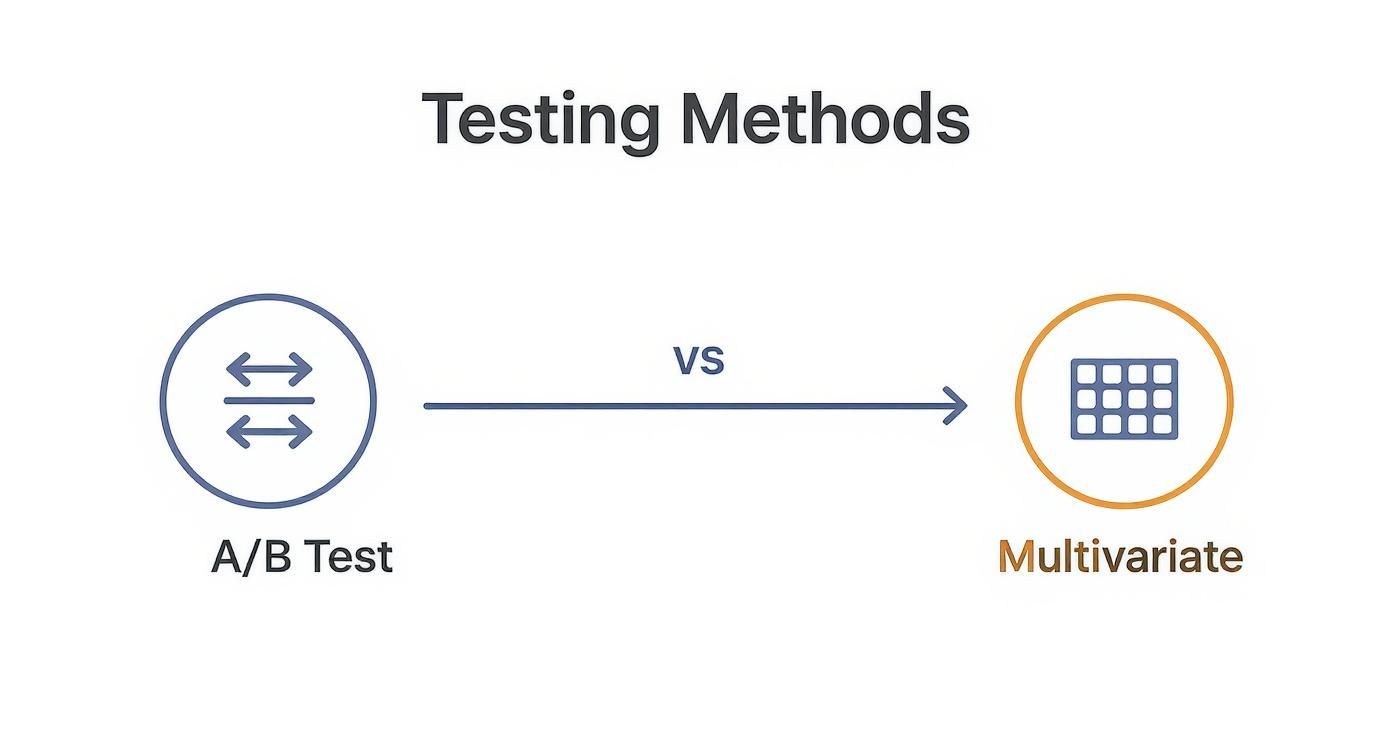
The main takeaway here is to pick the right tool for the job. Are you doing a simple head-to-head comparison (A/B), or are you trying to find the perfect mix of several different elements (multivariate)?
Step 3: Launch the Test
Now for the fun part. It's time to use your testing tool to get the experiment live. Most platforms, from website builders to ad managers, have split testing features baked right in. During setup, you'll define who sees the test and how the traffic is divided—typically 50/50, so half your audience sees the control and the other half sees the variation.
You also need to set your main conversion goal. This is the specific action you’re measuring to see which version wins, just like you defined in your hypothesis. It could be a button click, a form submission, or a purchase. For video, newer platforms are now offering some powerful tools for automated creative testing that can handle a lot of this heavy lifting for you.
Step 4: Let the Data Collect
This is where patience becomes your best friend. One of the biggest mistakes people make is calling a test too early just because one version shoots ahead. Random luck can easily create misleading results in the first few hours or even days.
Let your test run long enough to reach statistical significance, which is usually a 95% confidence level. This simply means you can be 95% sure the results aren't a fluke. As a rule of thumb, plan to run your test for at least one full week to smooth out any weirdness from daily traffic fluctuations.
Step 5: Analyze and Implement
Once your testing tool gives you the green light and declares a winner with high confidence, the experiment is officially over. But don't just look at the winner and loser. Dig a little deeper. Did the winning version perform how you thought it would? Did you learn something unexpected about what your audience responds to?
If you have a clear winner, great! It's time to make it the new default. But if the test was a wash or your variation lost, don't sweat it. That's not a failure. You’ve just learned something valuable about what doesn't work, which is crucial information for building an even smarter hypothesis for your next test.
Making Sense of Your Test Results
So, you've run your test, and now you’re staring at a spreadsheet full of numbers. This is where the real work begins—turning that raw data into a smart, decisive action. It’s less about crunching complex formulas and more about grasping a few key ideas that will point you in the right direction.
You’ll obviously look at core metrics like conversion rate (how many people did the thing you wanted them to do?) or click-through rate (CTR). But hold on. Just because Variation B edged out the original by a tiny margin doesn't mean you should pop the champagne. The real question you need to answer is, "Is this difference real, or did I just get lucky?"
The Coin Flip Test: What Is Statistical Significance?
This is where the idea of statistical significance saves the day, and it's not as scary as it sounds.
Think of it like this: if you flip a coin 10 times and get seven heads, you probably wouldn't think the coin is rigged. It's a small sample, and weird streaks happen. But what if you flipped that same coin 1,000 times and got 700 heads? Now you’d be pretty certain something is up. That’s the core of statistical significance. It’s a gut check to confirm that your results aren't just a random fluke.
The gold standard in marketing is a 95% confidence level. All this means is that you can be 95% sure the winning version is actually better, not just a result of random chance. Thankfully, most testing tools handle this calculation for you.
Getting to this level of confidence is a huge part of understanding what makes a split test a winner and separates informed decisions from hopeful guesses.
What This Actually Means for Your Strategy
When your testing platform flags a winner with 95% confidence, you can roll out the change knowing it will almost certainly deliver better results for your wider audience. This takes the guesswork out of the equation and lets you build your marketing strategy on a foundation of solid proof.
Getting comfortable with your numbers is a massive step toward consistent growth. If you want to go deeper, our complete guide to conversion rate optimization is a great next step.
Here’s a quick checklist for analyzing your own results:
- Statistical Significance: First things first, did your test hit that 95% confidence threshold? If not, you need to let it run longer. Don't call it early!
- Conversion Lift: How much better did the winner perform? A 2% lift on a high-traffic homepage can be a massive win, while a 20% lift on a smaller campaign is a clear signal you're onto something big.
- Other Metrics: Did the change have any ripple effects? Look at secondary metrics like bounce rate or time on page to see the full picture.
In the end, analyzing your results is all about finding real, repeatable value. By focusing on statistical confidence, you ensure every tweak and change you make is moving the needle in the right direction.
Real-World Split Testing Ideas You Can Use

It’s one thing to talk about split testing in theory, but seeing it in action is where things really click. And the best part? You don't need some massive, complicated setup to get started. You can launch simple but powerful tests today on the channels you're already using.
Think of these examples as a launchpad for your own ideas. Let them spark your curiosity and get you thinking about what makes your specific audience tick. Remember, every test—whether it "wins" or "loses"—gives you a new piece of the puzzle.
Email Marketing Tests
Email is still a workhorse for most businesses, and tiny changes can make a huge difference in opens and clicks. The subject line is the perfect place to start because it's so easy to test and often has the biggest impact.
Hypothesis: A subject line personalized with the subscriber's first name will boost open rates by 15% because it cuts through the noise of a generic inbox.
- Version A (Control): "Save 20% On Our New Collection"
- Version B (Variation): "Alex, Save 20% On Our New Collection"
If Version B wins, you’ve just learned that your audience responds to a personal touch. That's a valuable insight you can immediately apply to future campaigns, and it might even encourage you to test personalization inside the email itself.
Social Media Ad Tests
On social media, your creative does all the heavy lifting. The image or video is what stops the scroll, making it the most obvious element to test.
Hypothesis: A video ad that shows our product in action will get a higher click-through rate (CTR) than a static photo because it’s more dynamic and demonstrates value instantly.
- Version A (Control): A high-quality static image of your product.
- Version B (Variation): A 15-second video showing someone using and enjoying that same product.
If the video ad comes out on top, it's a strong signal that your audience craves movement and context. That one test could reshape your entire creative strategy, telling you it's time to invest more in video.
Landing Page Tests
Your landing page is the moment of truth. This is where a visitor decides to convert or bounce, and even the smallest bit of friction can kill your conversion rate. The sign-up form is a classic friction point and a fantastic candidate for a test.
Hypothesis: Slashing the number of fields in our sign-up form from five to just two will increase submissions because it makes the process faster and easier for the user.
- Version A (Control): A form asking for Name, Email, Company, Phone, and Role.
- Version B (Variation): A much simpler form asking for just Name and Email.
A win for Version B sends a clear message: your audience wants a quick, painless experience. This helps you figure out the sweet spot between gathering detailed lead info and getting the most conversions possible.
Common Split Testing Mistakes to Avoid
A bad split test is worse than no test at all. Why? Because it tricks you into making confident decisions based on faulty data, which can send your entire strategy in the wrong direction. To make sure your experiments actually give you trustworthy insights, you need to sidestep a few common—and costly—mistakes.
The single most tempting error is ending a test too early. You launch it, and after just a few hours, one version rockets into the lead. It's so easy to call it a winner and move on. Don't fall for it. Early results are often just random noise, and that "clear winner" can easily fizzle out once you have enough data.
Always wait for your testing tool to confirm a result with at least 95% statistical significance. Anything less is just an educated guess, not a real conclusion.
Another classic blunder is testing too many things at once in a simple A/B test. If you change the headline, the button color, and the main image in your new variation, you'll have no idea which of those changes actually made a difference. The key is to isolate one variable at a time so you get clean, actionable results.
Overlooking Outside Influences
It's easy to get tunnel vision and forget your test doesn't exist in a bubble. External factors can sneak in and completely wreck your data, making your results useless. Always be on the lookout for these kinds of things:
- Ignoring Seasonality: Running a test during a major holiday or a massive sales event like Black Friday is a recipe for disaster. People behave completely differently during these times, which will contaminate your results.
- Forgetting Other Campaigns: Did your team just launch a huge email blast that’s sending a flood of specific traffic to your test page? That's a huge variable you didn't account for, and it can easily bias the outcome.
- Not Defining a Goal: Starting a test without a clear hypothesis—"I believe changing X will cause Y"—is like setting sail without a map. You need to know what you're trying to prove before you even think about hitting "launch."
Finally, get comfortable with the idea that not every test will deliver a show-stopping winner. In the travel industry, for instance, only about 40% of test variations actually beat the original. This just proves how important it is to be rigorous and to learn from every outcome—even the ones that don't win. You can dig into more A/B testing benchmarks on VWO.com to see how different industries stack up.
Got Questions? We’ve Got Answers.
Alright, you’ve got the basics down. But a few practical questions always come up before you hit "launch" on that first experiment. Let's tackle the most common ones so you can start testing with confidence.
How Much Traffic Do I Actually Need for a Split Test?
This is the big one, and the honest answer is: it depends. There isn't a magic number, but you need enough visitors to get a statistically significant result without waiting forever.
If you’re working with a smaller audience, forget about testing tiny tweaks like changing a button from light blue to a slightly darker blue. You’ll never get a clear signal. Instead, go for big, bold changes—think a complete headline overhaul or a totally new page layout. The bigger the change, the easier it is to spot a meaningful difference.
Most testing tools have built-in calculators that can help you estimate this. They’ll ask for your current conversion rate and how much of an improvement you’re hoping to see, then give you a ballpark traffic figure.
What Are the Best Free Tools to Get Started?
You don't need to break the bank to start split testing. In fact, you might already have access to some great tools without even realizing it.
- Email Marketing Platforms: If you use a service like Mailchimp, you can easily A/B test your subject lines to see what gets more opens. It's built right in.
- Website Builders: Many platforms like HubSpot or Wix include features for testing different versions of your landing pages or call-to-action buttons.
When you're ready to level up, you can look at more specialized platforms. Tools like VWO and Optimizely are the industry standard and often have free trials or entry-level plans to get you going.
How Long Should a Split Test Run?
The goal isn't to run a test for a specific number of days, but to run it long enough to trust the results.
A good rule of thumb is to let a test run for at least one full week. This ensures you capture the different traffic patterns of weekdays versus weekends. Don’t just stop the test the second one version pulls ahead. Wait until your tool tells you it has found a winner with high confidence—usually 95% or higher. Patience is key here.
Ready to create high-converting video ads without the guesswork? Sprello's AI-powered suite helps you generate scripts, build scenes, and produce professional-quality social content in minutes. Test more ideas, ship more videos, and discover what truly works. Start creating with Sprello today!


