September 26, 2026
What Is Merchandise Planning in Retail? a Practical Guide
What Is Merchandise Planning in Retail. Learn what merchandise planning in retail really means, how it drives sales and margin, and the steps teams use
You're staring at a new season workbook. Last quarter's sell-through is 62%, returns are climbing, and a buyer wants to know how many units to commit to next month's drop. The question sounds simple, but the answer depends on demand, margin, delivery timing, store capacity, and the amount of cash already tied up in stock.
That is the practical starting point for understanding what merchandise planning in retail means. It's the discipline that turns customer demand into four connected decisions: what to buy, how much to buy, when it should arrive, and where it should be sold. The plan isn't just a spreadsheet of unit counts. It's a financial operating layer that links sales targets, gross margin, inventory investment, and open-to-buy before individual purchase orders are placed.
The Question Every Retail Planner Asks at the Start of a Season
A new planner may begin with last season's results, reviewing sales by category, store, channel, and item. The harder moment comes when a buyer asks for a buy recommendation before the full picture is clear. Sales may show demand, but they do not explain every effect of promotions, returns, missing sizes, delivery timing, or stock availability.
A sound recommendation turns that evidence into a controlled commercial commitment. Merchandise planning connects demand forecasting to actual buying decisions. It estimates the sales opportunity, sets the inventory required to support it, protects the planned margin, and leaves room to adjust once the season provides new evidence.
The four decisions behind the plan
A useful plan answers four questions in sequence:
- What should we carry? Select the categories, styles, colors, sizes, and price points that match the customer and commercial strategy.
- How much should we buy? Set depth by product and location, balancing availability with the risk of excess stock.
- When should it arrive? Match receipts to the selling calendar, launch moments, lead times, and seasonal demand.
- Where should it land? Allocate inventory across stores, distribution centers, websites, and other channels according to local demand.
The financial layer governs these choices. Merchandise financial planning sets sales, gross margin, inventory, and open-to-buy targets before the team selects styles and SKUs. Assortment planning then builds a product range within those boundaries. A range can look compelling and still fail commercially if it ties up too much cash, misses the launch window, or leaves demand unsupported. Independent retail planning guidance describes assortment planning as a way to reduce overstock and stockouts while improving inventory turnover.
Practical rule: A buy works only when the product, quantity, timing, location, and financial commitment support one another.
The plan also needs governance. Merchandising, design, and marketing must agree on the commercial boundaries, ownership, and timing of decisions. Without that shared operating rhythm, a forecast can remain a spreadsheet while teams make separate choices about products, campaigns, and commitments. The discipline therefore combines financial control with a repeatable process that keeps the plan connected to daily action.
How Merchandise Planning Became a Discipline
Retailers didn't always have a dedicated planning function. Buyers once relied heavily on experience, handwritten notes, and spreadsheets that became harder to control as ranges expanded. As customer demand became more difficult to predict, retailers needed a repeatable way to connect product choices with inventory and financial outcomes.
Merchandise planning became a distinct, technology-supported discipline in the late 1980s in the United States, when retailers were looking for automation beyond spreadsheets. One industry history describes the function as “just emerging” more than 25 years earlier and says it began gaining traction in the US in the late ’80s as retailers needed better tools for inventory, assortment, and demand planning. The retail planning timeline from Da Vinci Retail also records that a 2016 survey found 91% of retailers surveyed had a formalized merchandise planning process, evidence that planning had become mainstream by the mid-2010s.
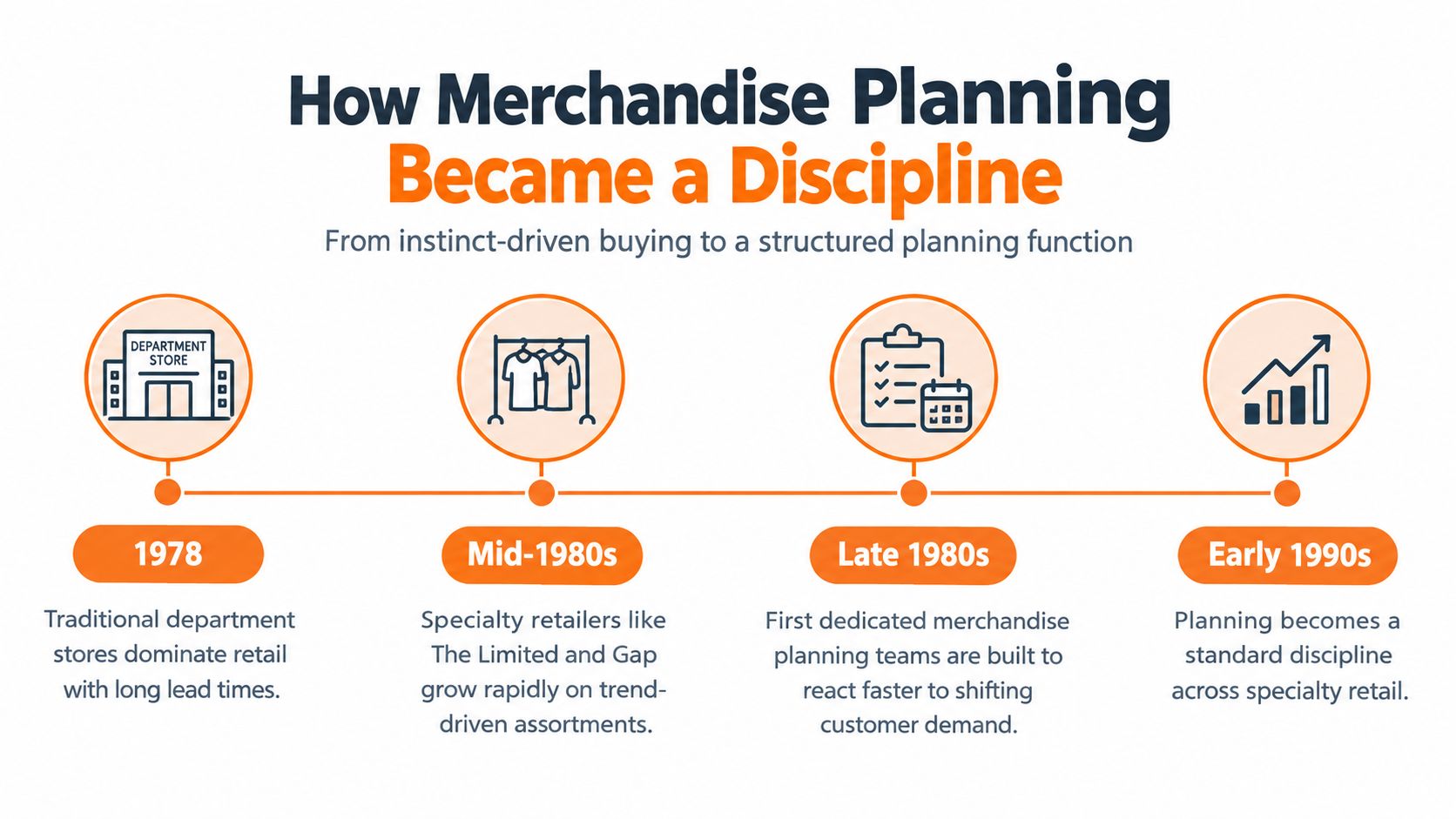
The technology changed in stages. Teams moved from isolated spreadsheets to centralized systems, then to platforms that could model scenarios, compare store groups, and support more detailed forecasts. The underlying job stayed recognizable, but the scale changed. More products, longer supply chains, and multiple selling channels made instinct alone too risky.
Why the role moved beyond the buying office
A buyer may know which silhouette feels commercially right. Finance may know how much inventory investment the business can support. Supply chain may know which delivery dates are realistic. Merchandise planning brings those perspectives into one operating view.
That's why the planner now works closely with category management, allocation, replenishment, finance, design, and marketing. The discipline combines financial control with customer and product insight. A planner doesn't replace the buyer's judgment. Instead, the planner gives that judgment a framework, a budget, and a way to test consequences before commitments become difficult to reverse.
The result is a role that sits at the intersection of finance, analytics, and buying. Planning systems make the work faster, but the discipline still depends on people agreeing what the numbers mean and what action follows from them.
The Four Numbers Every Plan Has to Hit
A seasonal merchandise plan works like a household budget. Sales are income, gross margin is what remains after product cost, inventory is the stock funded before customers buy it, and open-to-buy is the spending capacity still available.
These figures form one financial operating layer between demand forecasts and buying decisions. A higher sales target needs enough inventory to support demand. More inventory can improve availability, yet it also increases exposure when the forecast is wrong. A promotion can raise sales while reducing margin. Open-to-buy determines how much the team can spend on new commitments or chase a product that is selling faster than expected.
| KPI | What It Measures | Retail Lever | Risk If Missed |
|---|---|---|---|
| Sales | Expected net sales revenue by period, category, channel, or location | Demand forecast, price, assortment, and availability | Missed revenue, weak productivity, or lost customer demand |
| Gross margin | Value retained after product cost, managed through margin dollars and margin rate | Cost, retail price, promotions, and markdown timing | Sales may grow while profit quality deteriorates |
| Inventory | Stock investment needed to support the selling plan, often monitored through sell-through or weeks of supply | Buy depth, receipt timing, allocation, and replenishment | Stockouts when too low, overstock and clearance when too high |
| Open-to-buy | Purchasing capacity remaining after planned sales, reductions, ending inventory, on-hand stock, and on-order commitments | New orders, reorders, cancellations, and receipt timing | Cash gets committed too early, leaving no room to respond |
The common OTB relationship is:
Planned sales + planned reductions + planned ending inventory - on-hand inventory - on-order inventory = open-to-buy.
Retailers may define each component differently, but the purpose remains consistent. OTB shows how much purchasing capacity remains after current commitments and planned inventory movements. It gives buyers room to act without treating every new opportunity as an exception to the plan.
Why the numbers must be read together
A category may be selling above plan, but raising the sales target alone will not create more product. If the buyer cannot secure additional stock, key sizes can disappear and expected demand becomes lost sales. If the team buys too much without checking the quality of demand, leftover units may require markdowns and reduce margin.
The same logic applies in the opposite direction. A lower sales outlook may call for fewer receipts, but cutting inventory too quickly can create stock gaps if demand recovers. Each decision changes the other three measures, so planners must review them as a connected set rather than optimize one KPI in isolation.
That connection places merchandise financial planning before SKU selection. Retail planning guidance from RELEX distinguishes the financial layer, which establishes targets, from assortment planning, which selects the products that work within those targets. The planner keeps sales, margin, inventory, and open-to-buy aligned as forecasts become buying actions.
Inside the Merchandise Planning Cycle
Merchandise planning repeats through three connected phases. The first sets the commercial direction, the second adjusts it against real selling, and the third manages the value of stock that remains.
Pre-season strategy
Several months before delivery, the planner turns company targets into a category plan. The work includes setting sales and margin expectations, defining inventory boundaries, reviewing the previous season, and deciding how broad or deep the assortment should be.
The spreadsheet is only one part of the job. You're also reviewing the product calendar, supplier lead times, store clusters, price architecture, and planned marketing moments. Initial orders must be large enough to support the launch but not so large that the business loses flexibility before demand becomes visible.
In-season trading
Once products arrive, the plan becomes a weekly management tool. You compare actual sell-through with the expected curve, review stock by store and channel, and investigate exceptions. A strong seller may need a reorder or a transfer. A weak seller may need a reduced receipt, a different allocation, or a clearer product story.
SAS describes modern merchandise planning as using detailed item-level forecasts that can run weekly and incorporate history and calendar effects, including holiday timing and back-to-school dates. Its retail assortment research explains why timing matters: a small shift in demand can move product from full-price selling into clearance.
For teams building a broader data foundation, it can also help to browse enterprise data insights when reviewing how disconnected systems affect planning decisions. The relevant question is always operational: can the planner trust the sales, inventory, returns, and receipt data in the same decision?
Markdown
Markdown is not merely a last-minute discount. It is a controlled decision about price, timing, stock cover, and margin. The planner uses point-of-sale performance, on-hand inventory, future receipts, demand signals, and the remaining selling window to decide whether to hold price, reduce it, or widen the promotion.
That logic works best when markdown decisions are made early enough to preserve options. Teams can learn more about the practical side of merchandising examples while comparing how different product stories, price positions, and assortment structures affect execution.
From Assortment Plans to Buy Plans and SKU Orders
A category strategy becomes useful only when it can guide a purchase order. The planning hierarchy narrows the decision at each level, moving from financial intent to product detail.
At the top, the category receives a sales, margin, and inventory target. That target is divided across departments and subcategories. The team then groups stores or channels into clusters based on factors such as volume, climate, price sensitivity, and customer profile. A cluster lets planners avoid treating every location as identical.
The cascade from category to SKU
The assortment plan decides which styles and variants belong in each cluster. It establishes the range's width, the number of product choices, and its depth, the quantity of each choice. The buy plan then converts those choices into unit commitments. Size profiles determine how units are distributed across sizes, while allocation rules decide where the products should land.
Consider a women's knitwear category. The category budget supports three store clusters. Each cluster receives four color stories, and each color story contains 15 SKUs across five sizes. That creates 300 line items from one category-level decision.
The example shows why upstream accuracy matters. If the cluster logic is wrong, the color stories may be wrong for the customer. If the size profile is wrong, the store can have stock on hand but still miss sales because the needed sizes are absent. If the buy plan ignores delivery timing, the right products may arrive after the commercial moment has passed.
Assortment and merchandise planning aren't the same
Merchandise planning is the wider discipline. Assortment planning is the product and location decision inside it. The financial plan sets the boundaries, the assortment plan selects the range, and the buy plan creates the unit-level commitment.
For a practical view of how product selection, colorways, size runs, and store-specific ranges fit together, see this guide to assortment planning in retail. The important habit is to preserve the connection between each level. Don't let a SKU order become detached from the category target that justified it.
How Merchandising, Design, and Marketing Hand Off the Plan
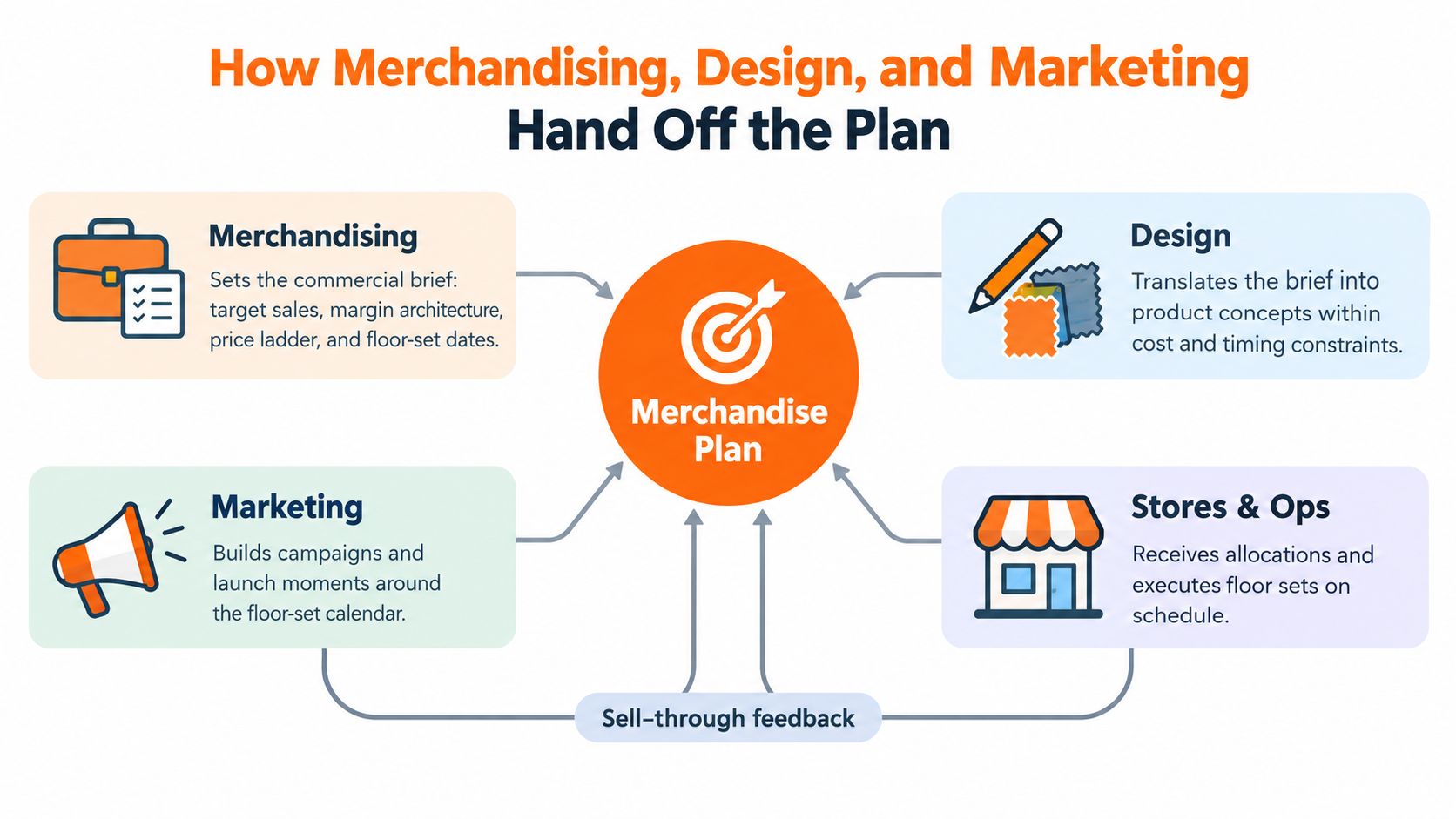
A merchandise plan can be financially sound and still fail because the teams executing it work from different calendars. Merchandising may set the range and floor-set date, design may still be resolving samples, and marketing may be preparing a campaign for products that won't arrive in time.
Merchandising starts with the commercial brief. It defines the target sales opportunity, margin architecture, price ladder, product count, and key delivery moments. Design translates those constraints into silhouettes, materials, colors, and construction choices. The creative answer must fit both the customer proposition and the cost and timing requirements.
Each handoff creates a commercial dependency
Marketing turns the seasonal product plan into a customer-facing story. It decides which products receive attention, which channels carry the launch, and how campaign timing relates to the floor-set calendar. Stores and operations then need accurate allocations, product information, signage, and delivery instructions.
The failure modes are familiar:
- A late design sample compresses the buying window and leaves less time for supplier decisions.
- A cost change forces merchandising to revisit the price ladder or margin plan.
- An unannounced promotion changes expected demand and can weaken planned margin.
- An under-funded campaign leaves a well-bought product without enough customer attention.
- A late receipt makes marketing assets and product availability tell different stories.
The remedy isn't another meeting with no decision record. Teams need a shared planning calendar, a single source of truth for product and performance data, and explicit approval points. A pre-season alignment review should confirm the assortment, commercial targets, sample status, delivery dates, campaign windows, and owners for unresolved risks.
One calendar is better than three
The most effective operating rhythm gives every team visibility into the same milestones. Design sees when product decisions affect the buy. Marketing sees when inventory will be available. Merchandising sees which campaign commitments could change demand or margin.
This coordination also improves feedback. Store and e-commerce results should return to the central plan in a form that design, marketing, allocation, and buying can use. The purpose isn't to eliminate judgment. It's to ensure that judgment is based on the same version of the product, calendar, and numbers.
Why Plans Break and How to Make Them Actually Work
Many retailers assume a better forecast will fix merchandise planning. Forecast quality matters, but a strong model can't rescue fragmented data or a workflow that people don't trust.
Sales history may sit in one system, inventory in another, returns in a third, and marketing attribution somewhere else. If those records use different product names, dates, or location definitions, the planner can't tell whether weak sales reflect poor demand, missing stock, late delivery, or an untracked promotion. The forecast then inherits the confusion.
The adoption gap is measurable
A 2025 BCG survey of 350 retailers found that merchants estimated around one-third of the data they use is inaccurate, while about 40% of available technology goes unused. The same survey reported that 49% lack time to use tools, 50% lack training, and 40% lack access. BCG's research on the future of merchandising points to a practical conclusion: adoption and governance are planning capabilities, not side issues.
A plan also breaks when teams override it without recording why. A planner may increase units because a buyer believes a trend will accelerate. Design may commit to an expensive fabric before assortment breadth is agreed. Marketing may launch a campaign before the buy is confirmed. Each decision can be reasonable in isolation, but the combined plan loses coherence.
Make execution easier to trust
Use four controls:
- Create one trusted data layer: Align product, sales, inventory, returns, channel, and receipt definitions before building forecasts.
- Document overrides: Record the owner, reason, expected effect, and review date whenever someone changes the plan.
- Report exceptions quickly: Flag meaningful deviations from plan so teams act while reallocation, reordering, or cancellation remains possible.
- Connect calendars: Link product development milestones, purchase commitments, receipts, floor sets, and campaigns in one shared schedule.
Governance shouldn't slow the business. It should make decisions visible, reversible where possible, and easier to learn from.
What Good Merchandise Planning Looks Like in Practice
A mature planning function feels less like a seasonal spreadsheet exercise and more like a controlled trading rhythm. The pre-season strategy flows into category targets, assortment depth, and SKU-level buys without repeated manual reconstruction. During the season, the team spends its time on exceptions and decisions rather than searching for basic facts.
A typical week might look like this:
| Day | Activity | Owner | Output |
|---|---|---|---|
| Monday | Review last week's sales, sell-through, stock, and deviations from plan | Planner and allocation lead | Exception list by category, channel, and location |
| Wednesday | Refresh the in-season forecast and review receipt or reorder options | Planner, buyer, and supply partner | Updated demand view and recommended actions |
| Friday | Decide markdowns, transfers, cancellations, and new commitments within OTB | Merchandising, finance, and marketing | Approved trading actions and owner assignments |
The weekly trading meeting works when every participant sees one scorecard. Merchandising brings commercial priorities. Planning brings the forecast and financial implications. Allocation brings location-level availability. Marketing brings campaign timing and demand context. Finance checks that the actions fit the wider margin and cash plan.
Discipline creates the result
Software can centralize data, automate calculations, and make scenarios easier to compare. It can't decide whether a late receipt is worth accepting, whether a product needs a better story, or whether an override is supported by evidence. Those decisions still require accountable owners.
For teams evaluating planning tools, merchandise planning software can provide a useful comparison point, especially when reviewing collaboration, assortment visibility, and handoff requirements. Sprello, for example, provides assortment visualization and workflow capabilities for fashion, beauty, and lifestyle teams that need to coordinate product variants, creative production, and campaign work across channels.
The working definition is simple: merchandise planning is the financial and operational discipline that turns demand into coordinated product commitments. Strong teams keep the plan alive through a consistent review habit, compare actual performance with intended performance, and act before stockouts, excess inventory, or markdown pressure remove their options.
Sprello helps fashion, beauty, and lifestyle teams visualize assortments and coordinate production-ready workflows across merchandising, design, and marketing. If you're building a more connected merchandise planning process, visit Sprello to see how its canvas can support SKU, channel, regional, and seasonal workflows.
Related
More to explore
Fresh reads

8 Product Concept Examples for Brand Teams
Explore 8 product concept example ideas across fashion, beauty, and lifestyle, with strategic analysis and workflows for scaling concepts into production.

Product Image AI Generator: How Brands Use It at Scale
Learn what a product image AI generator does, how it works, and how fashion and beauty brands use it for catalog-scale content without losing brand quality.

How to Create Storyboards for Campaigns That Scale
Learn how to create storyboards that move from concept to campaign-ready, with tips on framing, sequencing, templates, and clean handoffs to production teams.