September 18, 2026
Assortment Planning in Retail Explained for Growth
Learn assortment planning in retail from core process to SKU strategy, KPIs, and seasonal best practices for fashion and beauty teams.
The seasonal line review starts with a familiar promise: a stronger collection, a clearer story, and enough choice to satisfy every customer. Then the product list grows. Design is still waiting on final samples, merchandising is comparing spreadsheets, marketing has campaign images for only part of the range, and regional teams are asking which colors and sizes they can sell. By the time everyone agrees, the buying window is closing.
That situation isn't usually caused by a lack of creative ideas. It comes from treating assortment planning as a product-selection task instead of a connected operating workflow. A good SKU can still underperform when its story isn't visible, its market fit is unclear, or the teams responsible for taking it to customers work from different versions of the plan.
Introduction to Smarter Assortment Decisions
Assortment planning in retail sits between creative direction and commercial execution. It helps a team decide what belongs in a collection, how much variation the range needs, where each product should appear, and how the story will reach customers across stores, e-commerce, campaigns, and regions.
For a fashion brand, that might mean deciding whether a new jacket deserves several fabric options or whether one strong silhouette should receive more depth. For a beauty team, it could mean balancing core shades, seasonal color, complementary products, and the visual assets needed to explain how they work together. The question isn't just, “Can we add another SKU?” It's, “What job will this SKU perform, and can the organization support it?”
Practical rule: A product belongs in an assortment only when the team can explain its customer role, commercial purpose, operational requirements, and route to market.
This guide follows the decisions planners make in sequence. It starts with the formal meaning of assortment planning, then moves through the working process, the difference between SKU depth and category breadth, and the effects of seasonality and regional variation. It also addresses the part many guides skip: the handoffs between merchandising, design, marketing, product development, and regional teams.
The strongest assortment isn't necessarily the largest one. It has a deliberate architecture, useful variation, appropriate depth, and a visual system that lets people make decisions together. That combination gives creative teams room to build a distinctive collection while giving commercial teams enough clarity to buy, allocate, present, and measure it.

The practical takeaway is simple. Treat the assortment as a shared visual and commercial plan, not a final spreadsheet handed from one department to another.
What Assortment Planning Really Means
Start with a capsule wardrobe. You don't create one by placing every garment you own on a rack. You choose pieces that work together, cover different situations, reflect the person wearing them, and fit the available space. Assortment planning applies the same logic to a retail range, but with commercial and operational constraints added.
A widely cited Wharton review of assortment planning defines the discipline around selecting a product mix that maximizes sales or gross margin while working within real-world limits such as budget, shelf space, vendor requirements, and category coverage. Those constraints matter because a product isn't valuable in isolation. It competes for money, capacity, attention, and physical or digital space.
The core idea: Assortment planning is the disciplined curation of a product mix, not the accumulation of products.
From judgment to optimization
Merchants have always used judgment. They know when a color completes a story, when a hero item needs accessories around it, and when a category feels empty despite having enough units. Modern assortment planning adds formal analysis to that experience. It considers demand, substitution, space, customer needs, and strategic objectives together.
The research summarized in the Wharton material also shows why planners shouldn't reduce the work to consumer preference alone. In U.S. supermarket research, ownership and store size explained roughly 25% to 48% of the variation in assortment composition, while clientele-related variables explained 3% to 4% and competition-related factors 1% to 4%. These findings indicate that format, footprint, and retailer control shape the range alongside shopper demand. The same literature highlights that assortment can matter more than price in influencing where shoppers choose to buy, which helps explain why assortment planning became a core retail capability.
Keep the terms separate
Buying turns a planned range into purchase commitments. Range planning usually defines the broader architecture, such as categories, roles, and seasonal stories. Allocation distributes inventory to locations or channels after the product and quantity decisions have been made.
Assortment planning connects those activities. It determines which products and variants should exist in the commercial mix, then gives buying, allocation, design, and marketing a common set of decisions to execute. Stocking a warehouse means storing what is available. Planning an assortment means selecting what deserves a place.
A useful test is to ask what would disappear if the team removed a product. If nothing important changes in the customer story, category role, or commercial plan, that SKU may be adding complexity without adding enough value.
How the Assortment Planning Process Works
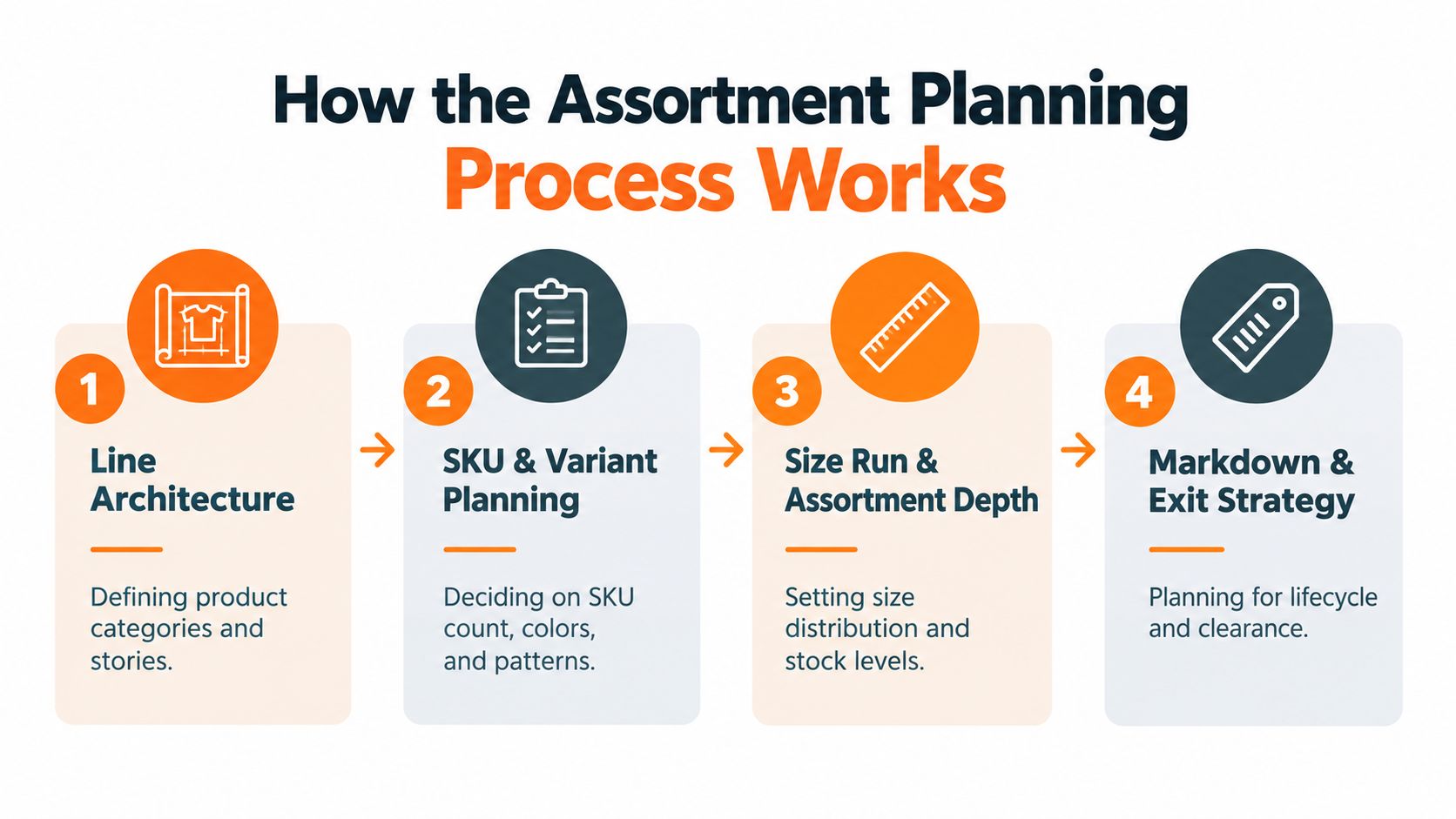
The process works best as a chain of decisions. Each stage produces an input for the next, so a late change to the line architecture can affect variants, imagery, buy quantities, regional plans, and campaign production.
Start with line architecture
Merchandising and design first define the collection's structure. They decide which categories, product families, price positions, usage occasions, and visual stories need representation. A beauty line might include complexion, color, tools, and care. A fashion collection might organize around outerwear, knitwear, tailoring, footwear, and accessories.
The output is a line architecture, not a finished SKU list. It gives every category a role and prevents the range from becoming a collection of attractive but disconnected products.
Translate stories into variants
Next, teams define styles, colors, patterns, finishes, materials, and size runs. This process transforms a creative idea into a manageable assortment. A silhouette may need a core neutral, a seasonal color, and a statement option. A lipstick family may need a shade range that reflects the intended market rather than every shade the lab can produce.
Design, merchandising, and product development should review these decisions together. A variant that looks compelling in isolation may duplicate another option, require a separate production path, or lack a clear place in the campaign narrative.
Plan depth, clusters, and scenarios
Once the variants are visible, planners decide where depth should sit. They can compare store groups, channels, regions, and customer missions, then test scenarios such as a tighter range, a wider color offer, or a stronger investment in core products.
Clustering helps teams group locations or markets with similar needs. Localization then adjusts the assortment without abandoning the central brand story. Forecasting supports quantity decisions, but it shouldn't replace judgment about strategic products, visual anchors, and complementary items.
Align the buy and the handoffs
The buy plan needs to reflect the approved assortment, variant logic, size distribution, channel role, and exit approach. Marketing needs the same source of truth to create launch assets. Regional teams need a clear record of what can vary and what must remain consistent.
A practical audit asks four questions at every stage:
- Inputs: What approved data, product concepts, images, constraints, and market assumptions are entering the decision?
- Decision: Who can approve, reject, revise, or escalate the choice?
- Output: What exactly moves forward, such as a line sheet, variant map, size run, or campaign brief?
- Traceability: Can another team see why the decision changed and which downstream work it affects?
Workflow orchestration is the hidden driver. Shared visualization makes the handoff concrete because teams can see the collection, not just discuss rows in a file.
SKU Level and Category Level Strategies Compared
Planners often ask whether they should add more styles or deepen the styles already working. That choice becomes clearer when you separate SKU-level productivity from category-level coverage.
At the SKU level, the question is whether a particular product, color, size, or finish earns its place. At the category level, the question is whether the overall mix covers the customer missions and strategic roles the retailer needs. A fashion brand may have productive dresses but too little footwear to complete the outfit story. A beauty brand may have strong complexion products but weak tools and care categories that support routine building.
The distinction matters because removing a low-volume SKU isn't always correct. A product can support a hero item, provide a needed color anchor, or make a collection feel complete. The decision should combine performance evidence with the item's role.
| Decision Lens | SKU Level Focus | Category Level Focus |
|---|---|---|
| Primary question | Is this product or variant productive enough to keep, repeat, replace, or retire? | Does the category have the right role, space, and strategic coverage? |
| Typical lever | Rationalize colors, sizes, patterns, or duplicate items. | Expand, reduce, reposition, or rebalance a category. |
| Fashion example | Keep a core black trouser while removing a weak duplicate color. | Add accessories if the collection needs a complete styling story. |
| Beauty example | Review shade overlap or underused finishes. | Rebalance complexion, color, care, and tools around the customer routine. |
| Warning sign | Many variants compete for the same demand. | A strong category is surrounded by missing complementary categories. |
| Best evidence | Sell-through, margin, substitution, attachment, and inventory behavior. | Category role, space productivity, customer mission, and channel strategy. |
When to rationalize
Rationalization makes sense when the range contains products with overlapping jobs and weak differentiation. The University of Groningen's research on optimizing retail assortments provides a strong demonstration of the upside of systematic analysis. In a liquid laundry detergent application, an optimized assortment increased retailer profit by 37.3%, rising to 43.7% when SKU prices were optimized at the same time. The method used store-level scanner data and accounted for substitution patterns, customer preferences, and cross-marketing effects.
Industry evidence also shows why a long tail deserves attention. In U.S. pet care, 83% of SKUs contributed to less than 2% of category sales, according to the same verified research summary. Across the most underperforming categories in emerging and developing markets, an average of 75% of SKUs contributed to less than 2% of sales. Those figures don't mean every low-selling product should disappear. They do mean planners need a reason for keeping each one.
When to expand
Expansion is justified when a category has a clear unmet role, not just when the team wants more choice. Add a trend capsule when it creates a distinct customer story. Add a complementary accessory when it helps customers complete a look. Before expanding, make the relationship visible and optimize your product catalog with PIM so attributes, imagery, naming, and relationships remain usable across channels.
Seasonal and Region Aware Assortment Considerations
A single assortment can tell different stories in different places. A winter collection may emphasize insulated fabrics, layering, and darker tones in one market while another region needs lighter weights and transitional pieces. Beauty teams face a similar challenge when shade ranges, skincare routines, climate needs, and cultural preferences change by market.
The planner's job isn't to create a completely separate collection for every location. It's to define the core brand system and the areas where local teams can adapt. Core silhouettes, packaging rules, naming conventions, and campaign codes may stay fixed. Fabric weight, color emphasis, accessory mix, shade availability, and channel presentation can vary.
Build the seasonal story first
Begin with the customer moment. Is the collection for cold-weather layering, resort travel, gifting, festival dressing, daily workwear, or a replenishment need? That decision shapes category priority, color architecture, material choices, and the assets marketing needs.
Drop cadence then determines how much of the story launches together and how much arrives in waves. A seasonal plan should show the relationship between the first statement products, dependable core items, and later complementary pieces. Without that view, teams may launch isolated products that look attractive but don't form a coherent commercial story.
Localize with guardrails
Create a shared assortment dossier for each region or channel. It should show the approved global range, permitted substitutions, local product exclusions, timing, imagery requirements, and the reason behind each variation.
A shared digital asset workflow can support that operating model by making ownership, versions, approvals, and deliverables visible. The value isn't only faster file movement. It helps teams connect a regional assortment choice to the product story and the content that will present it.
For a beauty example, the global team might approve a complexion architecture and visual language, while regional teams determine which shades and supporting products deserve emphasis. For fashion, the same collection may use different hero looks, fabric stories, or accessory groupings by climate. The customer should experience relevance, not inconsistency.
KPIs Best Practices and Real World Examples
A KPI should help a planner make a decision, not merely fill a report. Sell-through shows how much of the available product has moved. Gross margin shows the financial contribution after product costs. SKU productivity compares a product's contribution with the inventory, space, or attention it consumes. Assortment efficiency asks whether the range delivers enough commercial and customer value for its complexity. Space productivity connects performance to the physical or digital area allocated.
Use the metrics together. A low-volume product may still support a hero SKU or complete an important story. A high-volume product may consume space that another category needs. A planner who reviews only sales can overreact, while a planner who combines performance with role can rationalize intelligently.
Turn measurement into a working review
A useful review connects each KPI to an action:
- Sell-through: Repeat, reduce, reposition, or investigate availability.
- Gross margin: Protect profitable demand while checking whether promotions are masking weak product economics.
- SKU productivity: Compare variants that serve similar customer needs.
- Assortment efficiency: Remove complexity when the product story doesn't justify it.
- Space productivity: Reconsider the physical or digital prominence given to each category.
The operational problem often sits outside the SKU itself. The IDC material on in-store retailing execution identifies lack of integration across merchandising operations, inability to localize SKU assortment, and unavailable actionable data as important execution problems. A strong range can lose value when the buy plan, product imagery, regional rules, and campaign attribution don't connect.
Use shared evidence, not separate versions
Suppose merchandising approves a collection with a hero coat, supporting knitwear, and accessories. Design has one view of the color palette, e-commerce has another naming structure, and marketing builds a campaign around products that a region won't receive. The range decision may be sound, but the execution is fractured.
A shared canvas can show the products, variants, market assignments, content status, and open decisions together. Standard templates make repeated seasonal reviews easier to compare, while traceable handoffs show who changed a product, why it changed, and which deliverables need revision.
For teams building a measurement framework that extends beyond the assortment itself, resources on launch success metrics can help connect commercial outcomes with launch readiness. The key is to keep the measurement loop practical. Every review should end with named actions, owners, and a visible impact on the next buy, campaign, allocation, or product decision. Examples of merchandising workflows can also help teams compare different ways to organize the work through merchandising examples.
Putting Your Assortment Plan Into Action
Start with an audit of the last range, but don't begin by asking which SKUs sold the most. Ask which products had a clear role, which variants duplicated one another, which categories lacked support, and where a handoff forced teams to recreate information.
Then create one shared seasonal view containing:
- Line architecture: Categories, product families, roles, and stories.
- Variant logic: Colors, shades, materials, patterns, and size runs.
- Market rules: Regional, channel, and climate adaptations.
- Execution status: Samples, imagery, copy, approvals, buy decisions, and campaign readiness.
- Review signals: Sell-through, margin, productivity, efficiency, and space questions.
Prioritize the decisions that remove the most uncertainty. That may mean rationalizing overlapping variants, clarifying a category's role, or giving regional teams a controlled way to adapt the global line. A documented production workflow example can help teams turn that logic into repeatable stages with clear owners and outputs.
The principle is easy to remember: choose deliberately, visualize early, localize with guardrails, and measure for action. When merchandising, design, and marketing work from the same plan, the assortment can scale across products, channels, regions, and seasons without losing its commercial or creative shape.
Sprello provides an AI workflow canvas for fashion, beauty, and lifestyle teams, including assortment visualization for lineups, colorways, size runs, and variants across channels, regions, and seasons. Visit Sprello to see how your team can connect merchandising decisions with production-ready creative workflows and clearer handoffs.
Related
More to explore
Fresh reads
AI Tools for Retail That Actually Scale Operations
Explore AI tools for retail from visual search to automation. Learn categories, use cases and how to evaluate enterprise-ready workflows.
Campaign Management Software for Enterprise Teams
Compare top campaign management software for enterprise teams. Evaluate creative workflows, DAM integrations, and multi-channel delivery at scale.

AI Content Workflow Explained for Fashion and Beauty Brands
Learn how an AI content workflow orchestrates models, governance, and brand guardrails to scale creative production for fashion and beauty teams.