

Let's think about a winning goal in a soccer match. Does the striker who scores get all the glory? Of course not. What about the defender who intercepted the ball, or the midfielder who made that perfect pass? Each player had a crucial role.
Attribution modeling is the exact same concept, but for your marketing. It’s how we figure out which marketing touchpoints deserve credit when a customer finally makes a purchase.
Why Attribution Modeling Matters to Marketers

If you don't have a way to assign credit, you're essentially flying blind. It's easy to assume the very last ad a customer clicked was the all-star. But what about the blog post they found a week ago, or that social media video that first piqued their interest? Each of those interactions nudged them closer to the finish line.
Attribution modeling pulls you out of the guessing game and gives you a real framework for understanding the entire customer journey. It helps you finally connect the dots between your ad spend and your revenue, uncovering the quiet influence of channels that work their magic early on. This data-first approach is the key to spending smarter and proving your marketing's worth. For a deeper dive into the basics, it's worth understanding what marketing attribution is and how it works.
Understanding Touchpoints in the Customer Journey
A touchpoint is simply any time a potential customer interacts with your brand. In our soccer analogy, these are the individual passes, tackles, and shots that lead up to the goal. These interactions can happen all over the place, both online and off.
Some of the most common digital touchpoints are:
- Page Views: When someone lands on your blog or checks out a product page.
- Ad Clicks: A click on one of your Google, Facebook, or LinkedIn ads.
- Form Submissions: When a lead hands over their info for an ebook or a demo.
- Email Clicks: A subscriber clicking a link in one of your newsletters.
- Social Post Engagement: A like, comment, or share on one of your posts.
Every one of these actions leaves a digital footprint. Attribution modeling takes all these footprints and applies a set of rules (the "model") to decide how much credit each one gets for the final sale.
By quantifying the impact of every paid, owned, and earned touchpoint, attribution replaces assumptions with evidence-based insights. It helps you understand which combination of interactions consistently leads to valuable conversions.
The end goal here is simple: get a clearer, more honest view of your marketing performance. Instead of wondering what works, you can see which channels are your top scorers, which ones are the reliable assists, and which ones might be warming the bench. That kind of clarity is what lets you make smart, strategic decisions and invest your budget where it will actually drive growth.
How Attribution Has Evolved Over Time

Attribution modeling might seem like a recent invention, but marketers have been trying to connect the dots between spending and sales for decades. Long before we could track a single click, the core question was the same: "Is this ad working?" The methods were just a lot less precise.
The story really starts back in the 1950s, the golden age of print, radio, and TV. Back then, the go-to method was what we now call Marketing Mix Models (MMMs). Think of this as looking at your marketing from 30,000 feet.
MMMs used high-level statistical analysis to find correlations between broad business results (like quarterly sales) and ad spend. For instance, a company might see that sales consistently went up by 5% every time they poured more money into their national TV campaign. It wasn't perfect, but it gave a fuzzy picture of what was generally moving the needle.
The Dawn of Digital and Single-Touch Models
Then came the internet in the late 90s and early 2000s, and it changed everything. Suddenly, marketers had a direct, trackable action to measure: the click. This new ability to follow a user’s trail online gave rise to the first digital attribution models, known as single-touch attribution.
These early models were incredibly simple because they focused on just one key moment. The two most popular approaches were:
- First-Touch Attribution: This model assigns 100% of the credit to the very first ad or link a customer clicked. It’s all about what got them in the door.
- Last-Touch Attribution: The opposite of first-touch, this model gives all the credit to the final interaction right before the sale. It’s focused purely on what closed the deal.
While these were a huge leap forward, they told a very one-sided story. It was like crediting a championship win entirely to the player who made the first pass or the one who scored the final goal, completely ignoring everyone else who played a part. As customer journeys got messier, stretching across different channels and devices, this blind spot became a major problem.
The Shift to Multi-Touch Attribution
The real breakthrough came when we started looking at the entire journey. Marketing attribution has come a long way since the 1950s. The arrival of multi-touch attribution (MTA) in the mid-2000s finally gave marketers a way to assign value to every interaction, not just the first or last one. If you're interested in digging deeper, you can explore the historical importance of marketing attribution on Growify.ai.
This evolution mirrors the change in customer behavior. Today's buyer might see a social media ad, read a blog post a week later, get a promotional email, and then finally make a purchase after seeing a retargeting ad. Single-touch models fail to capture this nuanced journey.
Modern attribution understands that all these touchpoints work together. The goal is to distribute credit more fairly across the entire customer path, giving you a much clearer and more honest view of what's actually driving results. This history is crucial—it shows why the simple maps of the past just aren't good enough to navigate the complex world of marketing today.
Breaking Down the Most Common Attribution Models
Think of attribution models as different ways to tell the story of a sale. Each model uses a unique set of rules to decide which marketing touchpoint gets the credit for a conversion. Some models give all the credit to a single hero moment, while others recognize the whole team of efforts that led to the win.
Picking the right model is all about understanding what question you're trying to answer. Are you trying to find out what brings new people in the door, or what finally convinces them to buy?
This infographic really drives home how choosing a more sophisticated model can dramatically change your perceived return on investment.
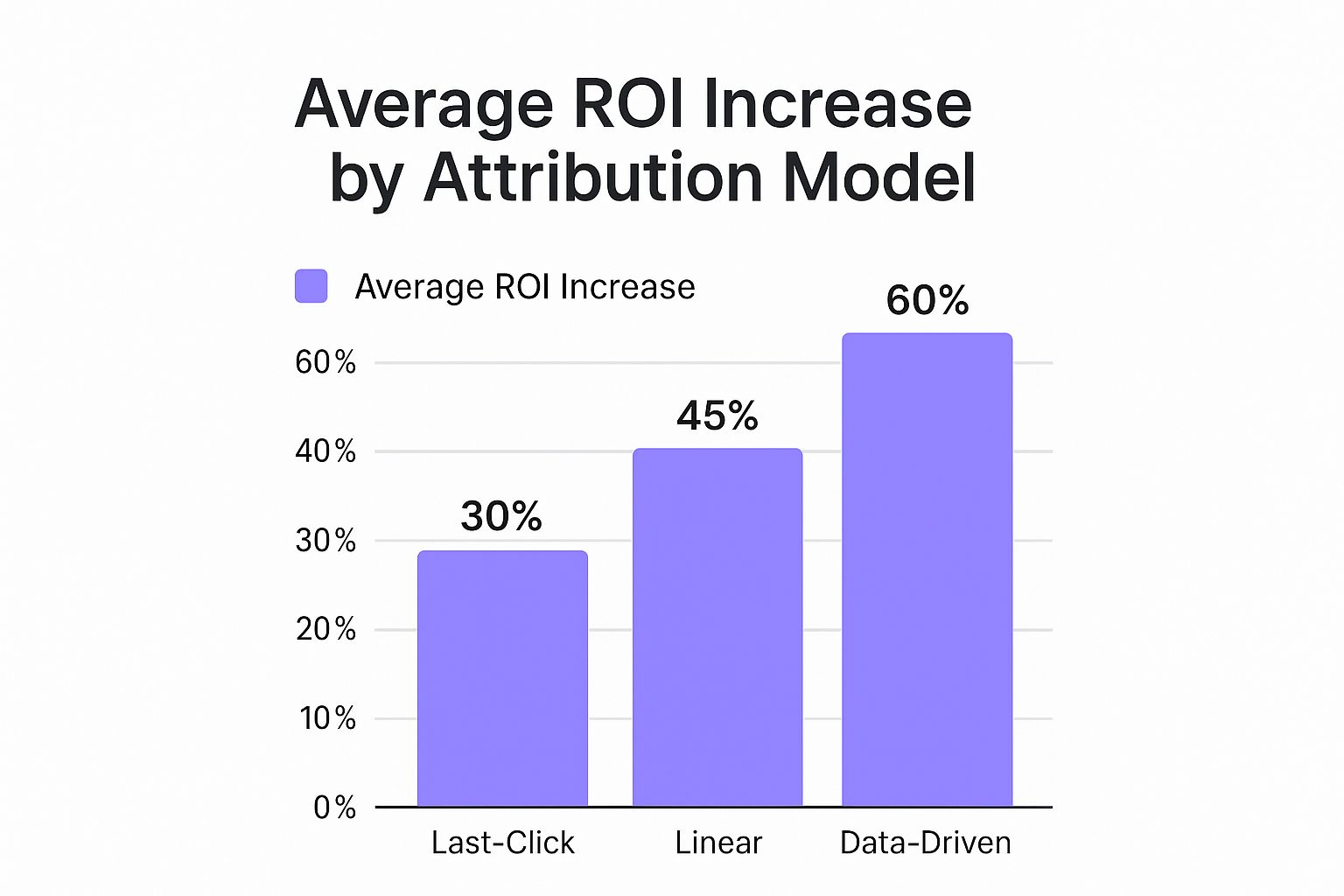
As you can see, sticking with a basic model like Last-Touch gives you a decent bump in ROI. But when you move to models that see the whole picture, like Linear or a Data-Driven approach, you unlock a much more accurate—and often much higher—return.
Single-Touch Models: The Simplest View
Single-touch models are exactly what they sound like: they give 100% of the credit for a sale to a single marketing interaction. They're simple to set up and understand, but they give you a very narrow, almost tunnel-vision, perspective of what's working.
First-Touch Attribution
This one is all about first impressions. It gives all the credit to the very first interaction a customer had with your brand, no matter what happened afterward.
Imagine someone clicks on a Facebook ad for your blog. They read a few posts, sign up for your newsletter, and a month later, they finally make a purchase after clicking a link in an email. With First-Touch attribution, that original Facebook ad from a month ago gets all the glory.
- Best For: Companies focused on top-of-funnel marketing and brand awareness. It helps you answer, "What's bringing new eyeballs to our brand?"
- Main Weakness: It completely ignores the entire journey that happens after that initial handshake, which is a huge blind spot for businesses with longer sales cycles.
Last-Touch Attribution
On the flip side, Last-Touch attribution gives all the credit to the final touchpoint right before the customer converted. It's the marketing equivalent of giving the game-winning shot to the player who scored, ignoring the assists that set it up.
If a customer clicks a Google search ad and buys something right then and there, that search ad gets 100% of the credit. This is the default model for many analytics platforms, including Google Analytics.
- Best For: Businesses with very short sales cycles, like an e-commerce store selling products people buy on impulse. It answers, "What's sealing the deal?"
- Main Weakness: It dangerously undervalues all the hard work your other channels did to introduce and warm up the customer.
Multi-Touch Models: A More Balanced Perspective
Multi-touch models operate on a more realistic premise: that most sales are the result of multiple interactions over time. Instead of giving all the credit to one touchpoint, they spread it out, giving you a much more complete and fair picture of your marketing ecosystem.
Linear Attribution
The Linear model is the ultimate team player. It divides the credit equally among every single touchpoint along the customer's path to purchase.
If a customer saw a social ad, read a blog post, clicked an email, and then converted through a retargeting ad, each of those four touchpoints would get exactly 25% of the credit.
- Best For: Marketers who want a simple, baseline view of all contributing channels without playing favorites.
- Main Weakness: Its biggest strength is also its weakness. It assumes every interaction is equally valuable, but a quick visit to your homepage is rarely as impactful as watching a full product demo.
Key Insight: Moving from a single-touch to a multi-touch model is like switching from a single photograph to a full-length movie of the customer journey. You finally get to see the whole story, not just the first or last scene.
Time-Decay Attribution
The Time-Decay model works on the assumption that the closer a touchpoint is to the sale, the more important it was. It still gives some credit to every interaction, but it gives more weight to the ones that happened most recently.
An email clicked yesterday would get significantly more credit than a blog post they read three weeks ago.
- Best For: B2B companies with long consideration phases or for short-term promotional campaigns where urgency is a major factor.
- Main Weakness: It makes an educated guess about timing. The "decay" rate is often arbitrary and might not match how your customers actually behave.
U-Shaped Attribution
Also known as Position-Based, the U-Shaped model gives special importance to two critical moments: the first touch (the introduction) and the lead conversion touch (the moment they showed serious interest).
A common setup is to assign 40% of the credit to that first interaction, 40% to the touchpoint that generated the lead, and then split the remaining 20% among all the other touchpoints in the middle.
- Best For: Businesses that are heavily focused on lead generation. It highlights what brings people in and what convinces them to raise their hand.
- Main Weakness: It can undervalue the crucial nurturing that happens in the middle of the funnel, which is often where the real relationship-building occurs.
W-Shaped Attribution
The W-Shaped model is an evolution of the U-Shaped, adding a third major milestone: the opportunity creation touch. This is typically when a lead becomes a sales-qualified opportunity.
In this model, the first touch, lead creation, and opportunity creation each get 30% of the credit. The last 10% is then distributed across the remaining touchpoints.
- Best For: Organizations with longer, more complex sales cycles where there's a clear handoff from the marketing team to the sales team.
- Main Weakness: This model requires pretty sophisticated tracking to accurately pinpoint all three of those key moments, making it a bit too complex for simpler business models.
To make it easier to see how these models stack up, let's put them side-by-side.
Comparison of Rule-Based Attribution Models
This table breaks down the most common rule-based models, showing how they assign credit, what they're good for, and where they fall short.
| Model Name | How Credit Is Assigned | Best For | Pros | Cons |
|---|---|---|---|---|
| First-Touch | 100% to the first interaction | Top-of-funnel analysis; brand awareness campaigns. | Simple to implement; highlights channels that generate initial interest. | Ignores all subsequent interactions and mid-funnel nurturing. |
| Last-Touch | 100% to the final interaction before conversion | Short sales cycles; understanding what closes deals. | Easy to measure; often the default in analytics tools. | Devalues awareness and consideration efforts; creates a last-click-wins mentality. |
| Linear | Credit is split equally among all touchpoints | Getting a baseline, holistic view of the entire customer journey. | Gives credit to all channels; fair and easy to understand. | Treats all touchpoints as equally important, which is rarely true. |
| Time-Decay | More credit is given to touchpoints closer to the conversion | Longer B2B sales cycles; promotional campaigns. | Emphasizes recent, impactful interactions. | The decay rate is arbitrary and may not reflect actual customer behavior. |
| U-Shaped | 40% to first touch, 40% to lead creation, 20% to middle touches | Businesses focused on lead generation. | Highlights two key moments: awareness and consideration. | Can undervalue the important nurturing that happens in the middle of the funnel. |
| W-Shaped | 30% to first touch, 30% to lead creation, 30% to opportunity, 10% to others | Complex sales cycles with a distinct marketing-to-sales handoff. | Values three critical milestones in a complex journey. | Requires advanced tracking and is overly complex for most businesses. |
Choosing a model isn't about finding one that's perfect—it's about finding the one that gives you the most useful and actionable insights for your specific business goals.
The Power of Data-Driven Attribution
While the other models give us a good starting point, they all have the same basic flaw: they’re built on assumptions. A Linear or U-Shaped model applies the exact same rigid formula to a local coffee shop as it does to a global software company. They can’t account for unique customer habits or industry differences.
This is where data-driven attribution comes in. It throws out the one-size-fits-all rulebook for a completely custom analysis.
Instead of working from a fixed formula, data-driven attribution uses machine learning to sift through your specific conversion data. It looks at the journeys of customers who buy versus those who don't. By finding the common threads and touchpoints that actually lead to a sale, the algorithm learns what each channel is truly worth to your business.
It’s a living, breathing model. It understands that a blog post might be the key for one audience segment, while a video ad is what convinces another. When your marketing strategy or customer behavior evolves, the model adapts right along with it.
How Does It Actually Work?
At the heart of many data-driven models is a concept from game theory called the Shapley Value. Don't let the name scare you; the core idea is actually pretty intuitive and fair.
Imagine four marketers work together on a project that lands a $1,000 bonus. Instead of just splitting it four ways, the Shapley Value figures out who really pulled the most weight. It does this by looking at every possible combination of team members and measuring how much value disappears when one person is taken out of the mix.
If taking Marketer A out of the equation consistently causes a huge drop in results, they get a bigger slice of the bonus. If Marketer B’s absence barely makes a dent, they get a smaller share. Data-driven attribution uses this same logic on your marketing channels, rewarding each touchpoint based on the real impact it had on the final conversion.
Why It's the Gold Standard
The biggest win for data-driven attribution is its accuracy. It strips away human bias and guesswork, giving you a clear-eyed view of what’s really working. This approach is fantastic at uncovering the quiet influence of channels that simpler, rule-based models would completely ignore.
For example, a data-driven model might show you that an early-funnel video ad, while rarely the last click, is 80% more likely to appear in the journey of your highest-value customers. That’s a game-changing insight a Last-Touch model would completely miss.
Thanks to the rise of AI, this sophisticated method is more accessible than ever. An industry survey revealed that 47% of major brands are now using algorithmic or data-driven attribution. That's a massive leap from just 18% five years ago.
Getting Started with Data-Driven Models
The one non-negotiable for data-driven attribution is, well, data. You need a good amount of it. For the algorithms to find meaningful patterns, they need a solid volume of conversions and user paths to analyze.
Platforms like Google Analytics 4 now offer a data-driven model by default, but there’s a catch. You need a minimum of 300 conversions and 10,000 user paths within a 30-day window for it to even turn on.
If you meet that threshold, the benefits are huge:
- Smarter Budget Allocation: You can confidently move money to the channels that are proving their worth.
- Improved ROI: Stop optimizing based on guesses and start using real performance data.
- Deeper Customer Insights: Finally understand which touchpoints move the needle at each stage of the buying journey. For a closer look at how data can shape strategy, it's worth exploring the wider world of B2B marketing analytics.
It's also crucial to understand how specific content formats, like video, fit into the picture. Our guide on video marketing analytics can help you drill down into the performance of your visual content. When you combine a powerful model with detailed analytics, you get a much sharper, more accurate view of your marketing success.
How to Choose the Right Attribution Model
Knowing the different attribution models is one thing, but actually picking the right one for your business? That's a whole different challenge. There’s no single “best” model out there—the most effective choice depends entirely on your goals, sales cycle, and how complicated your customer's journey really is.
Getting this right means you’ll get clear, actionable insights instead of just drowning in more confusing data.
Think of it like choosing a camera lens. A wide-angle lens is perfect for capturing a huge landscape, while a macro lens is built to get you up close to the tiny details. The right attribution model does the same thing: it brings your most important marketing moments into focus.
A B2B software company with a six-month sales cycle needs a lens that captures the whole winding path. On the other hand, a D2C brand selling t-shirts probably just needs to see what triggered that final, impulsive buy.
Aligning Your Model With Business Goals
The first and most important question you have to ask is, "What are we actually trying to do here?" Your main business goal should be your north star when you’re making this decision.
Different models are designed to answer different strategic questions.
Are you focused on filling the top of your funnel and building brand awareness?
Then First-Touch attribution is your go-to. It’s fantastic for figuring out which channels are best at bringing new people into your world for the very first time.Is your priority understanding what finally pushes qualified leads to become customers?
Last-Touch attribution will give you the clearest view of your closing channels. It’s perfect for optimizing those bottom-of-funnel tactics that seal the deal.Do you need a balanced view where every touchpoint gets some credit?
A Linear model gives you a fair, baseline assessment of every interaction. It's a great starting point if you want to value the entire customer journey equally without overcomplicating things.
Considering Your Sales Cycle And Journey Complexity
How long it takes for a customer to go from curious to converted is a huge factor. A short, simple journey needs a totally different kind of analysis than a long, complex one that spans months.
Key Takeaway: The longer your sales cycle, the more you need a multi-touch attribution model. Single-touch models will inevitably undervalue all the crucial nurturing and relationship-building that happens over weeks or months.
For businesses with long sales cycles, like those selling high-ticket B2B services or luxury cars, multi-touch models aren't just nice to have—they're essential.
- Time-Decay: This model works beautifully for long consideration periods. It gives more weight to the recent touchpoints that likely pushed a prospect over the finish line.
- U-Shaped or W-Shaped: These are perfect for journeys with distinct milestones, like when a lead is generated and later qualified by sales. They highlight what’s working at each key stage.
But if you have a quick, transactional sales process, simpler models often get the job done. An e-commerce store selling low-cost items might find that a Last-Touch model gives them plenty of actionable insight. Focusing on what triggers that final click can be a powerful lever for boosting sales, and understanding those drivers is a core part of any strategy for improving conversion rate optimization.
A Checklist for Making Your Decision
Before you lock in a model, run through these questions with your team. Your answers will light up the best path forward.
- Primary Goal: Is our main objective to generate new leads, close the ones we have, or just understand the full journey?
- Sales Cycle: How long does it usually take for a customer to buy after their first interaction? A few days, a few weeks, or several months?
- Customer Path: Is the journey pretty straightforward with just a couple of steps, or is it a complex, multi-channel maze?
- Data & Resources: Do we have the tracking and analytics setup to even support a more advanced model like W-Shaped or Data-Driven?
- Biggest Question: What's the single most important marketing question we need an answer to right now?
By thinking through these factors, you can pick an attribution model that actually provides clarity and helps you make smarter, data-backed decisions to grow your business.
The Messy Reality of Modern Attribution
Let's be honest: perfect attribution is a myth. It's not a destination you arrive at, but a moving target you're constantly trying to hit. While the models we’ve discussed give you a great framework, the real world of marketing is messy. A few major hurdles can trip up even the most carefully planned attribution strategy.
The biggest game-changer? The massive shift toward consumer privacy. With regulations like GDPR and CCPA now the norm, and browsers like Chrome phasing out third-party cookies, the old ways of tracking are dead. Marketers simply can't follow users around the web like they used to.
This creates huge gaps in the data, making it incredibly difficult to connect all the dots in a customer's journey. When you can't see every touchpoint, your attribution results will inevitably be incomplete or skewed.
Walled Gardens and a Fragmented Journey
On top of the privacy push, we have to deal with the "walled gardens" of tech giants like Meta, Google, and Amazon. These platforms are sitting on mountains of user data, but they’re not exactly keen on sharing it with outside tools. This creates data silos—you get a great view of what happens inside their world, but connecting it to the rest of the customer journey is a real struggle.
You end up trying to patch together reports from all these different sources, and it's a clunky, often inaccurate process.
The hard truth is that your attribution model is only as good as the data you feed it. When privacy rules and platform walls create blind spots, the accuracy of any model—from the simplest Last-Touch to the most advanced Data-Driven—takes a hit.
Think about it: third-party cookies once powered up to 85% of all digital attribution. As they disappear, we’re being forced to get creative. Marketers are now leaning on things like probabilistic models and contextual targeting to fill the void, which you can read more about in this deep dive on attribution's evolution from Clearcode.cc.
And we can't forget the classic headache: cross-device tracking. Someone might see your ad on their work laptop, browse your site on their phone during their commute, and finally buy from their tablet at home. Tying all those interactions back to one person without a solid identity resolution strategy is still one of the toughest nuts to crack.
How to Navigate This New World
So, what can you do? It's not about finding a magic bullet, but about adapting your strategy. Here’s where to focus:
Own Your Data: Building a strong first-party data strategy is no longer a "nice-to-have"—it's essential. Collecting data directly from your audience through email sign-ups, site activity, and purchases gives you accurate, privacy-friendly information you actually control.
Don't Put All Your Eggs in One Basket: Relying on a single model is just too risky now. Smart marketers are using a hybrid approach, blending the insights from platform-specific analytics (like what Meta provides) with broader models (like those in Google Analytics) to get a more holistic view.
Test for True Impact: Instead of just trying to give credit where it's due, shift your focus to understanding the real impact of your campaigns. This means running incrementality tests to see what’s actually driving results. Our guide on building a creative testing framework is a great place to start learning how to measure what truly moves the needle.
Answering Your Top Attribution Questions
As you start wrapping your head around attribution, a few questions always seem to surface. It’s totally normal. Getting these sorted out is key to using attribution models confidently, whether you're running the show solo or you're part of a bigger marketing team.
Let's dive into the questions I hear most often from marketers just starting their attribution journey.
Single-Touch vs. Multi-Touch: What's the Real Difference?
This is probably the most common starting point. The difference sounds simple, but it completely changes what you see in your data.
Single-Touch Attribution: This model is all-or-nothing. It gives 100% of the credit for a sale to just one moment in time—either the very first thing a customer ever did (First-Touch) or the absolute last thing they did before buying (Last-Touch). It's simple, for sure, but it often paints an incomplete, and sometimes downright wrong, picture.
Multi-Touch Attribution: This is where things get a lot more interesting and, frankly, more realistic. It spreads the credit across several different touchpoints. Think of models like Linear, Time-Decay, or even Data-Driven. They all acknowledge that it usually takes more than one interaction to convince someone to buy.
Think of it this way: single-touch gives you a single snapshot, but multi-touch gives you the whole movie of your customer's journey. And for most of us, the movie tells a much more useful story.
Is This Just a "Big Company" Thing?
Not at all. It’s a common misconception that you need a massive budget and a data science team to even think about attribution. While the really sophisticated data-driven models do work best with tons of conversion data, smaller businesses can get huge value from the simpler models.
You can start with a basic Last-Touch or Linear model right inside Google Analytics. Just seeing that initial data can be a game-changer, showing you which channels are actually moving the needle. The trick is to just start. Pick a model, understand its blind spots, and use what you learn to make smarter decisions. Don't let perfect be the enemy of good.
Okay, How Do I Actually Start?
The best place to begin is usually right where you already are: your analytics platform. For most people, that means Google Analytics 4 (GA4). It has a great "Model comparison" tool baked right in, which lets you see how your channel credit shifts when you look at it through different lenses.
Here’s a quick-start guide:
- Check Your Tracking: Before you do anything else, make sure your conversion tracking is solid. If your data is garbage, your attribution insights will be, too.
- Find the Reports: Head over to the advertising workspace in GA4. This is where the attribution reports live.
- Compare Two Models: A great first step is to compare the default Last-Click model to the Data-Driven model. You’ll probably be surprised to see how many of your early-funnel channels have been getting short-changed.
Ready to create high-impact video ads without the high cost? Sprello helps you produce social content and ads in minutes using AI—no filming required. Start creating with Sprello today.


