November 23, 2026
Production Pipeline Software: 10 Tools Compared in 2026
Compare 10 production pipeline software tools for fashion, beauty, jewelry, and home brands. Criteria for workflows, handoffs, and deliverables.
Production pipeline software coordinates how a style moves from first sketch to buyer-ready assortment, covering the visuals, approvals, handoffs, and deliverables along the way. In 2026 the honest answer for most fashion, beauty, jewelry, and home brands is a two-layer stack rather than one winner: a PLM suite for the technical record, plus a visual and merchandising platform such as Sprello, our own product, for concept visuals, line review, line sheets, and buyer assortments built from one shared catalog.
The sketch sits in a shared drive. The render lives in a chat thread. The line sheet is a spreadsheet someone rebuilt on Tuesday, and the buyer's assortment is a PDF sitting in an inbox. Every one of those gaps is a handoff, and handoffs are where launch dates slip. In 2024, 84% of surveyed graphics professionals experienced product-launch delays, according to CHILI publish's Brandwidth research.
This guide compares ten tools by how they handle the four handoffs that decide a season: sketch to visual, visual to reviewed line sheet, line sheet to buyer assortment, and assortment to final delivery. Sprello is our product and appears first for that reason. The other nine are grouped by what they're built to do, because ranking PLM suites against creative-production platforms on feature counts tells a merchandiser nothing useful.
Published November 23, 2026.
If your team still hands off flats as technical drawings, the garment template references at Zero Sports design resources are a practical starting point for standardizing what goes into that first handoff.
1. Sprello
Sprello is AI for product development and merchandising, built to take a product from concept to a buyer-ready collection. We publish this guide, so treat this entry as a disclosure as much as a description.
The canvas is where projects start, taking references and material direction into a visual range.
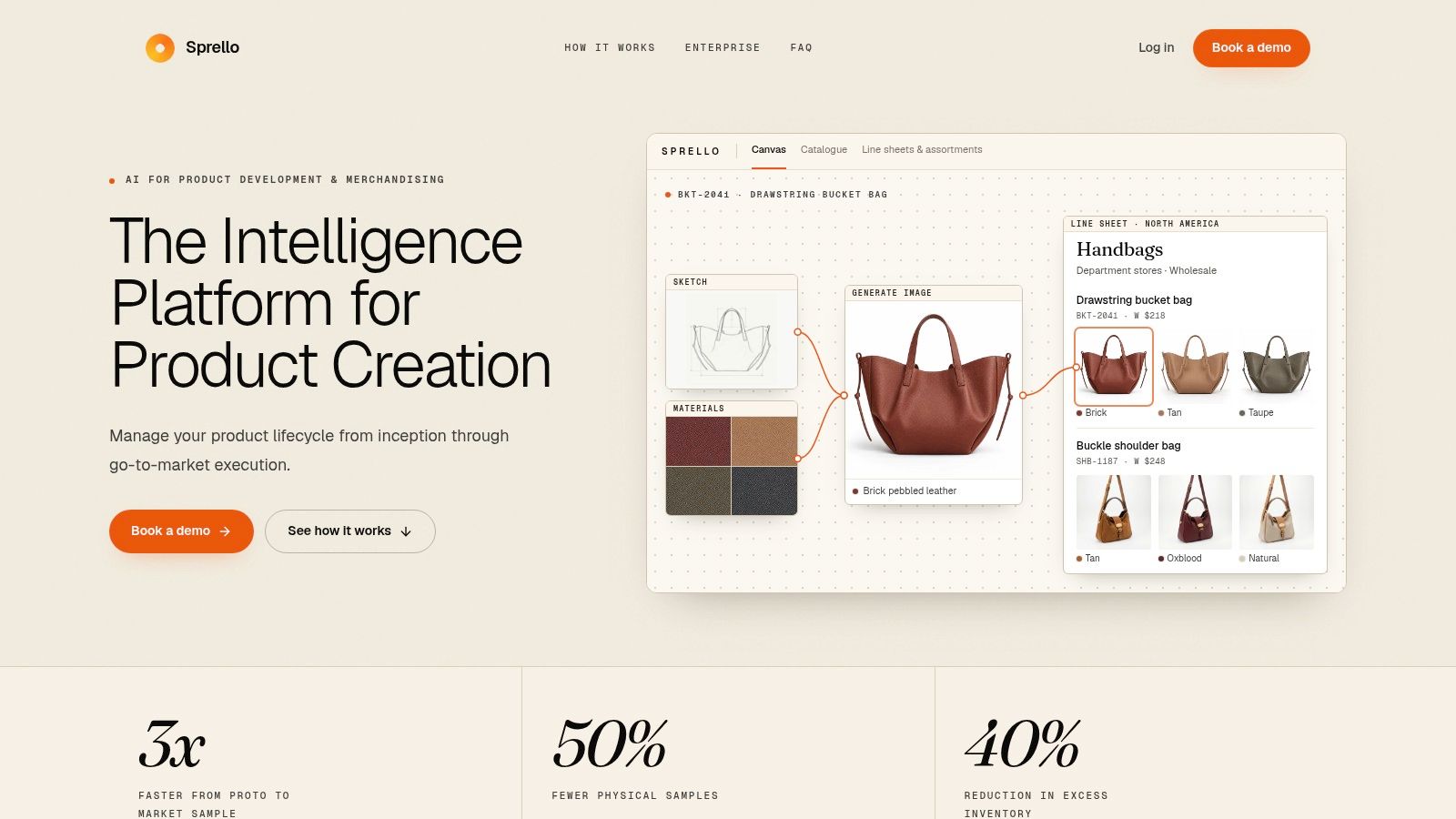
Where the sketch-to-assortment handoff happens
The canvas takes sketches, CADs, materials, and references and turns them into photoreal product visuals and colorways. Every input and instruction stays visible on the canvas, so you can change one reference and compare the result side by side. A workflow you've tuned once can be saved and run again on the next style, and if one step isn't right, you fix that step without regenerating everything. Through the Workflow API, any saved workflow also becomes a callable endpoint for teams that want it inside their own systems.
From there, every style lives in one shared product catalog with its details and the visuals made for it, and the catalog shows which products have approved visuals and which still need them. Line review draws on that catalog, line sheets are built for wholesale presentations by account and region, and each buyer's assortment starts from the same product information so the mix can be judged as a whole.
Category coverage runs wide: editorial campaigns across every SKU and colorway for fashion, hero shots and before-and-afters for beauty, detail-grade renders for jewelry, and room staging plus seasonal refreshes for home and lifestyle.
None of that makes Sprello a PLM. It complements PLM and planning suites and leaves tech packs, BOMs, pattern making, demand forecasting, and open-to-buy to the systems built for them.
What the results and controls look like
Teams running these workflows deliver 3x fewer physical samples and a 50% reduction in excess inventory. Once a workflow meets your standard, it runs at scale across ten, fifty, or a hundred variations with the quality decisions built in.
Enterprise reviewers want specifics. Role-based access controls let the right people reach the right accounts and data. Designs, sketches, and brand IP are encrypted at rest and in transit, with strict isolation between workspaces. Your uploads are never used to train Sprello's models or anyone else's.
What works
- One catalog, several outputs: the same product details feed line review, line sheets, and buyer assortments, so nothing gets rebuilt per account.
- Material and colorway exploration: AI visuals happen before the next physical sample, which is where the calendar usually slips.
- Account-level assortments: North America, Europe, department stores, specialty boutiques, and own retail each get their own mix from shared product information.
- Enterprise controls: role-based access, encrypted assets, workspace isolation, and no training on customer data cover the review most large brands run before a pilot.
What to weigh
- Demo-led sales: pricing isn't published, so budget and fit need a conversation with our team.
- Not a system of record for specs: teams that need tech packs or BOMs keep their PLM and connect it.
Website: sprello.ai
2. Centric Software and Visual Boards
Centric pairs a fashion PLM with Visual Boards, the closest thing in this list to a single surface where merchandising and product development review the same assortment. The PLM holds collection development, product data, and supplier collaboration; Visual Boards gives merchandisers a visual layer for range building and line decisions on top of it.
The handoff it solves
Centric's strength is the second handoff: visual to reviewed assortment. Instead of exporting a static line sheet to PDF, boards stay connected to product records, so a change in the record shows up wherever buyers and merchandisers review it. Related products extend the same data into planning, pricing, product information, and digital assets.
Where it stops
Two things to test. Breadth first: the suite spans several products, so configuration and integration planning matter more than the demo itself. Creative output second: boards organize and present product visuals, they don't generate them at catalog volume. A team that needs campaign imagery still buys a creative-production platform for that work.
Product-development stacks often split across PLM, DAM, and planning tools, and most brands end up running more than one system. Integration matters more than replacement. The key question is whether the board reads the same record the PLM writes.
What to verify
Ask how a style approved in PLM appears in a board without a manual export, and who owns the correction when the two disagree. Check which modules your contract includes, since the suite is sold in parts and the demo may show more than you're buying. Public list pricing wasn't available.
Ask this in the demo: "Show me what a merchandiser sees in a board two minutes after a cost change lands in the PLM."
For where PLM ends and visual work begins, PLM software for the fashion industry covers the boundary.
Website: Centric Software for fashion and apparel
3. PTC FlexPLM
FlexPLM is an enterprise retail PLM for apparel, footwear, fashion, and consumer products. It manages specifications, materials, samples, sourcing, and costing alongside sustainability data, and it's the option here most often chosen by companies carrying large, complex style counts and entrenched enterprise systems.
The handoff it solves
FlexPLM handles the technical record and the supplier exchange, from spec to sample to cost. Flex Boards adds visual planning and 3D assortment collaboration on top, and Flex Connect synchronizes data with other systems, so merchandising can review a range visually while BOM and costing data stay in the PLM.
Where it stops
Campaign and marketing asset generation isn't what it's built for, and teams usually add a creative-production tool for that work. Implementation is a program rather than a purchase, and pricing is quote-based. PTC has announced AI-powered tech-pack generation, worth asking about in the context of your own spec library rather than as a headline.
Ask this in the demo: "Show me a style whose cost changed after line review, and what the merchandiser sees in the board the next morning."
What to verify
Check whether Flex Boards can pull the product attributes your merchandisers use, how tech-pack data flows to suppliers, and what migration looks like for a season already in flight. For home and lifestyle brands with deep assortments, ask specifically how non-apparel categories are modeled.
Website: PTC FlexPLM for retail
4. Adobe Firefly Creative Production for Enterprise
This is a content-production platform, not a product-development system. It automates and governs high-volume creative work such as campaign variants, localized assets, and repeatable brand-governed output. If your bottleneck is producing 400 market-specific versions of an approved campaign, this is the category to examine.
The handoff it solves
Approved creative to channel-ready files. Visual authoring for reusable workflows, batch execution, and operational monitoring all aim at running one job across many assets with brand controls and permissions intact.
Where it stops
Nothing here manages a style's technical lifecycle, so it doesn't replace PLM or assortment planning. Access depends on eligible enterprise plans and entitlements, and pricing follows usage and contract terms rather than a public seat rate.
The automation reality to plan for
Automation is widespread but rarely hands-free. A 2025 industry statistics compilation citing Duke University and Gartner reported that around 60% of businesses had implemented automation in at least one workflow, while only 4% had fully automated operations. Design the pipeline so people approve subjective calls, including brand claims, model releases, and regional sensitivities, while naming conventions, resizing, routing, and checklist validation run unattended.
What to verify
Ask which steps can run without review, how an off-brand or prohibited output gets blocked, and whether the audit trail shows the input, transformation, and approver for each asset. For how that orchestration fits a creative pipeline, see creative production workflow.
Website: Adobe
5. CLO-SET
CLO-SET is a collaborative workspace built around 3D garment assets: cloud storage, sharing, web-based viewing and feedback, tech packs that draw BOM, measurement, and cost data from the 3D file, plus planning and workflow functions. It makes most sense if your team already designs in CLO 3D.
The handoff it solves
Sketch to first review without a physical sample. A designer uploads the 3D garment, a merchandiser or buyer opens it in a browser, comments land on the garment rather than in an email thread, and the tech pack draws from the same file.
Why that matters commercially
Digital review changes how many samples you commission, not just how you meet. McKinsey reports that companies using 3-D design and virtual sampling shortened the sampling process by two weeks or more and often reduced the number of physical samples required, along with related costs, by approximately 50%, per Measuring the Fashion World.
Where it stops
The value depends on having 3D assets good enough to review, which is a skill and software investment before it's a workflow one. It doesn't replace every ERP, PLM, or supplier-management function, and feature access varies by plan and organization.
What to verify
Ask how a comment becomes a change in the 3D file, whether external suppliers see the same version, and what happens to the tech pack when the garment changes after approval.
Website: CLO-SET
6. WFX Fashion PLM
WFX is a cloud PLM with fashion-specific structures: seasons, styles, colorways, size ranges, materials, tech packs, samples, and suppliers. It targets mid-market and enterprise brands that want a fashion data model rather than a generic product system they'd have to adapt.
The handoff it solves
Development to sourcing. Vendor portal collaboration sits beside the product record, so a supplier quote, a sample comment, and a tech-pack change live with the style instead of in three inboxes. Illustrator and ERP integrations keep design files and business systems in the loop, and AI features cover product-archive search and tech-pack data extraction.
The buying question most demos skip
Interoperability. A recent traceability tools report found supplier, product, material, and purchasing data commonly spread across multiple internal systems, with integration or interoperability appearing in roughly one-third of solution descriptions while more than 70% emphasized traceability itself. For a PLM buyer, that means asking what happens when WFX and your ERP disagree about a cost, and who resolves it.
Where it stops
Evaluation and implementation are vendor-led rather than self-serve, configuration depends on how tangled your existing workflows are, and public list pricing wasn't available.
What to verify
Run a full pass from style creation to supplier quote to sample approval, then inspect the field mapping between WFX and your ERP for cost and lead time.
Website: WFX Fashion PLM
7. Lifecycle
Lifecycle is a fashion PLM that organizes product records and supplier exchanges around each style: specs, samples, approvals, costs, purchase orders, and shipment tracking, with AI-assisted concept exploration on top. It suits teams moving off spreadsheets and email rather than replacing a highly customized enterprise system.
The handoff it solves
Development through to production follow-through. Sample and fit feedback link to the relevant product, supplier follow-ups and replies are grouped by style, and the record continues into orders and delivery rather than stopping at approval.
A note on AI-assisted concepts
Most creative teams already use generative tools. In 2024, 73% of respondents said they already used generative-AI design and production tools, according to Digiday's State of Ad Creative survey. The question for a PLM is whether generated concepts land in the product record with their inputs and approvals, or become orphaned files nobody can trace six months later.
Where it stops
Integrations, data migration, and workflow fit need testing against your own season. Vendor case studies aren't independent comparative evaluations, and public pricing wasn't available in the reviewed information.
What to verify
Import one live season, then check whether a fit comment, a cost change, and a supplier reply all attach to the right style without re-entry.
Website: Lifecycle PLM
8. Lectra Kubix Link
Kubix Link is a cloud product-data and workflow platform that can include PLM alongside PIM, digital asset management, visual boards, and forms. The combination is unusual: most systems stop at development or at marketing content, and this one is designed to carry structured product information into sales and e-commerce channels.
The handoff it solves
Development to downstream product content. A style's attributes can feed channel listings and marketing assets instead of being retyped by an e-commerce coordinator, and boards give creative teams a place to organize inspiration against the range.
Where it stops
Breadth is the risk. Module selection and implementation planning decide whether you end up with a connected pipeline or five partially configured tools. It isn't a replacement for creative authoring software, and public pricing wasn't listed on the reviewed pages.
What to verify
Ask for the field-level path from a PLM attribute to a channel listing, including who owns corrections. Then ask for the audit trail on a product information change. The vendor states Kubix Link has achieved a SOC 2 Type 2 attestation, which is worth confirming for your scope of use.
Orchestration is the point. A pipeline fails when a step has no named owner between systems, not when a feature is missing.
For how orchestration layers sit around PLM and PIM, see workflow orchestration platform.
Website: Lectra Kubix Link PLM
9. BlueCherry PLM
BlueCherry covers product and BOM management, costing, development workflow visibility, digital assets, supplier collaboration, and compliance for fashion, footwear, accessories, and home goods. It's part of a wider ecosystem that includes ERP, which is why many teams end up there in the first place.
The handoff it solves
Development to operations. BOMs, costs, and supplier context sit with the product record, and digital asset management keeps design files connected to the styles they belong to, with design-software connections that reduce manual file shuffling.
The governance question at catalog scale
Once a brand produces thousands of localized assets, speed isn't the constraint that hurts. Creative-operations guidance treats persistent asset identifiers, standardized metadata, taxonomy enforcement, and links between briefs, working files, approval records, published versions, and campaigns as foundational controls, alongside role-based permissions and audit logs, as Claravine's creative operations guidance sets out. Ask any vendor how an auditor reconstructs why an asset was approved and published.
Where it stops
Capability boundaries inside a proposed configuration need spelling out, the ecosystem pays off most when you adopt more than one product, and pricing isn't published on the product page.
What to verify
Confirm which DAM capabilities are included, how compliance data attaches to a style, and whether an approval that happened outside the system can be recorded with its evidence.
Website: BlueCherry PLM
10. Infor PLM for Fashion
Infor's fashion PLM is cloud-delivered and covers collection planning, design, product development, costing, samples, compliance, supplier collaboration, and critical-path tracking, with reusable materials, trims, colors, sizes, and cost elements. It fits organizations already using or evaluating Infor's broader fashion applications.
The handoff it solves
Calendar and critical path. Deadlines, samples, costs, and compliance sit alongside the style, and suppliers work through role-based access with reporting, so a slipped sample date is visible before it becomes a missed delivery. Adobe Illustrator integration and document management keep creative files attached to the record.
Why the lineage matters
This category descends from manufacturing planning, not design software. Material Requirements Planning emerged in the 1960s to calculate what materials were needed, in what quantities, and when they had to be available, then became MRP II in the 1980s with capacity and labor, ERP in the 1990s, internet-enabled and cloud ERP in the 2000s, and embedded AI in the 2020s, per NetSuite's ERP history. That's why PLM data structures feel like planning systems. They are.
Where it stops
Teams whose bottleneck is visual campaign production will need a separate creative tool, the broader suite can exceed a smaller team's needs, and pricing requires vendor discussion.
What to verify
Ask for the critical-path view across a live season and how Illustrator files stay linked to the style record after a spec change.
Website: Infor PLM for Fashion
How the ten options differ by primary focus, best use, and pricing visibility
| Item | Primary Focus | Best For | Pricing Visibility |
|---|---|---|---|
| Sprello | AI product development and merchandising | Fashion, beauty, and lifestyle teams building buyer-ready assortments | Not public; book a demo |
| Centric Software, Centric PLM and Visual Boards | Fashion PLM and visual assortment planning | Teams connecting merchandising decisions with product development | Not public; demo-led |
| PTC FlexPLM | Enterprise retail product lifecycle management | Large teams managing complex product portfolios | Quote-based |
| Adobe Firefly Creative Production for Enterprise | Governed, high-volume creative production | Enterprise teams creating campaign variations and localized assets | Usage- and contract-dependent |
| CLO-SET | Collaborative 3D fashion product development | Teams using CLO 3D assets for reviews and digital sampling | Plan- and organization-dependent |
| WFX Fashion PLM | Cloud-based fashion product development and supplier collaboration | Mid-market and enterprise fashion brands | Modular; not publicly listed |
| Lifecycle | Fashion PLM from concept through delivery | Teams organizing product records, supplier exchanges, and orders | Not publicly available |
| Lectra Kubix Link | Fashion PLM, PIM, and product-data workflows | Teams connecting product development with marketing and e-commerce | Not publicly listed |
| BlueCherry PLM | Fashion-focused PLM and supplier collaboration | Brands seeking product development linked to broader operations | Not publicly listed |
| Infor PLM for Fashion | Fashion PLM and supplier workflows | Teams connecting product development with broader business operations | Not publicly listed |
Matching Pipeline Software to the Handoffs That Cost Your Team Most
A line sheet rebuilt for the eleventh account is not a design problem. It is a handoff problem. For some brands the expensive gap is sample rounds, where every colorway waits on a physical prototype before anyone commits. For others it is the revision loop between merchandising and marketing, or the buyer assortment that drifts from the product record after the third spreadsheet export. Name that handoff in writing before you take a demo, then make every vendor run it on your data rather than on their demo catalog.
Measure the handoff, not the feature list
The DevOps Research and Assessment program gives a usable model for this, and it transfers to creative production once you rename the terms. In the 2024 research, elite teams deployed on demand, often multiple times per day, with lead times under a day, change-failure rates around 5%, and recovery under an hour, while low performers deployed monthly to every six months with change-failure rates around 40%, per the 2024 DORA report.
Translate those four measures into your week. How many styles reach buyer-ready per month, how many days pass from approved brief to final asset, what share of assets need rework after review, and how many hours it takes to pull a wrong asset from a channel. Track those before you sign and again ninety days in. A tool that shortens the visual loop but leaves the line sheet handoff intact has moved the bottleneck, not removed it.
Digital review changes sample counts, not just meetings
McKinsey's apparel sourcing research describes nonphysical sample approval as an established practice, reports cases of sample counts reduced to one and lead times cut by up to four weeks, and finds that only 13% of chief procurement officers surveyed used video-based approval for more than half of their products while virtual sampling was used at more than twice that level, per Revamping Fashion Sourcing. The pipeline decision is really a decision about when approval happens.
If approval waits for a physical sample, every upstream gain gets taxed at the courier step. If approval can happen on a trusted visual, the question shifts to which product details must stay locked so sales, merchandising, and suppliers are still looking at the same style.
Four questions for the demo
- Bring one live style, not a sample brief. Ask each vendor to carry it from sketch to line sheet to an account assortment, and watch where they switch to a prepared screenshot.
- Ask who owns the correction. When PLM and the visual layer disagree about a cost or a color, the answer tells you whether you bought integration or a new silo.
- Test the exception. A missing asset, a late approval, a buyer who wants a different mix: make the system show how that exception is found, assigned, and closed.
- Check the exit. Ask what you keep, and in what format, if you leave in two years. Asset metadata and approvals should survive.
A shortlist made of layers
The workable stack is a PLM for the technical record, a creative-production tool for campaign volume, and a shared catalog that carries product visuals into line review, line sheets, and buyer assortments. Sprello sits in that visual and merchandising layer: a canvas where inputs become outputs, a shared product catalog for each style, and selected visuals and product details flowing into line sheets and assortments. It complements PLM by handling the concept-to-presentation work that PLM was not built to polish.
CAD is just as category-specific upstream. Choosing CAD features for mattress factories is a different purchase from apparel pattern software, even when both sit before the first prototype.
To see the catalog, canvas, line sheets, and assortments on one of your own product categories, book a demo at sprello.ai.
Frequently Asked Questions
What is production pipeline software?
It is the system that coordinates how a product moves from approved concept to buyer-ready output: briefs, visuals, reviews, revisions, approvals, localization, and final deliverables. The useful ones make bottlenecks visible and keep one product record consistent across every stage, so a late change to a sketch or a colorway shows up in the line sheet before it reaches a buyer.
Do we need a PLM suite or a visual production platform?
Usually both, at different layers. PLM owns specifications, BOMs, costing, sampling, and supplier data. A visual and merchandising platform owns concept visuals, colorway exploration, line review, line sheets, and buyer-specific assortments. The expensive mistakes come from asking one layer to do the other's job: a PLM asked to produce campaign imagery ships weak visuals, and a canvas asked to hold specs drifts out of sync with the factory.
Should a smaller brand skip PLM entirely?
Sometimes, yes. If your technical development lives in spreadsheets your factory already understands and your real bottleneck is producing visuals and line sheets for buyers, fix that first. Add PLM when spec complexity, supplier count, or compliance requirements make spreadsheets risky. The trigger is usually the first season a spec error reaches production.
Can a visual canvas replace our PLM?
No. A canvas is a production and presentation layer; specs, BOMs, pattern making, and demand forecasting still belong to the system of record. In Sprello's case, a saved workflow can rerun on the next style, a single weak step can be corrected without regenerating the whole chain, and the Workflow API exposes any workflow as a callable endpoint. The workable pattern is a canvas that publishes approved visuals and product details into the catalog your PLM and sales channels already trust.
Which security controls should we verify before a pilot?
Ask each vendor for the audit reports and certifications it holds, how it handles single sign-on, whether role-based access is granular enough for agencies and partners, and a contractual commitment that your uploads never train anyone's models. Then ask where data sits, who can export it, and how access is revoked when a contractor leaves. Sprello provides role-based access controls, encrypts designs at rest and in transit, keeps each workspace isolated, and never uses customer designs, sketches, or uploads to train its models or anyone else's.
Sprello is AI for product development and merchandising, connecting a visual canvas for sketches, CADs, materials, and references to one shared product catalog. The catalog shows which products have approved visuals and which still need them, and the selected visuals flow into line review, wholesale line sheets, and a separate assortment for each buyer. Book a demo at Sprello.
Related
More to explore
Fresh reads
Wholesale Management Software: Tools Compared for 2026
Compare wholesale management software for fashion, beauty, and home brands, from order platforms to ERPs, and see where Sprello fits.
Mood Board Software for Fashion and Product Teams: 10 Tools
Compare 10 mood board software options for fashion, beauty, and home brands — features, collaboration, and how concepts move into production workflows.
Wholesale Ordering Platform: 10 Tools Compared for 2026
Compare 10 wholesale ordering platforms for fashion, beauty, jewelry and home brands: pricing, retailer reach and order workflow fit for 2026.