October 21, 2026
Product Concept Generation: Methods, Workflows, and Scale
Practical product concept generation methods for fashion and beauty teams, covering AI workflows, evaluation criteria, and how to scale concepts into SKU-ready
Published October 21, 2026
Product concept generation is the structured process of turning customer, market, and brand needs into product ideas that can be evaluated before development resources are committed. For fashion, beauty, jewelry, and home teams, Sprello connects AI-generated product visuals to shared catalog and merchandising workflows, while complementing rather than replacing PLM and planning suites.
A merchandiser has three mood boards open, twelve fabric swatches on the table, and an inbox full of buyer briefs. The challenge isn't finding inspiration. It's deciding which ideas are relevant, feasible, distinctive, and ready to move forward.
What Product Concept Generation Actually Means for Brands
Strong product concept generation starts with a defined opportunity, not a blank page. The team turns a brief, customer need, or market gap into several product directions, then records enough about each one to judge whether it deserves further investment. A sketch or attractive image can start a conversation, but it isn't yet a usable concept.
A practical workflow connects creative exploration to decision criteria:
- Define the opportunity. Specify the target customer, use occasion, channel, and assortment need. A brief for a travel-friendly skincare set, for example, calls for different packaging and price decisions than one for a prestige gift set.
- Generate distinct directions. Explore meaningful differences in materials, silhouette, finish, color, function, or packaging architecture, rather than making minor visual variations of a single idea.
- Record the evidence and assumptions. Keep references, customer requirements, price expectations, feasibility questions, and brand guardrails with each concept.
- Review before committing. Compare options against customer fit, market relevance, production feasibility, and the capabilities of the business.
That's the front end of development. It's separate from downstream technical work such as tech packs, bills of materials (BOMs), and pattern making. A concept may inform those activities, but it doesn't replace them.
Sprello positions itself as AI for product development and merchandising, from product concept to buyer-ready collection. Its Canvas turns sketches, CADs, materials, and references into photoreal visuals and colorways, with saved workflows that connect to a shared product catalog, line review, wholesale line sheets, and separate buyer assortments. It complements PLM and planning suites rather than replacing them.
For teams that want a simple starting point for exploring product ideas, Genpire's concept generator can help turn an initial prompt into a more developed direction. The important part is what follows: a concept needs clear inputs and review criteria before it moves toward sampling.
Why the Front End of Development Sets the Calendar
Concept choices affect more than the look of a collection. They shape the work that follows, including which products need samples, how many rounds are needed, and which decisions have to be revisited. That's why experienced teams treat the front end as a filter, not a free-form brainstorm.
A published apparel product-development analysis estimates average total lead time at about 167 days, with product development accounting for approximately 104 days, or roughly 62% of the timeline. Its working plan allocates approximately two to three weeks to concepting, three to four weeks to tech-pack preparation and the first prototype, four to six weeks to sampling rounds, and eight to twelve weeks to production (apparel product-development analysis). These are planning estimates, not a universal calendar. They illustrate why weak decisions made early can create rework in a long part of the schedule.
Predevelopment also has a measurable relationship with commercial outcomes. Research summarized by OpenStax on new-product success reports a 75% success rate for products supported by well-defined and well-executed predevelopment, compared with just over 31% when those activities were weak or absent. The underlying study examined 203 industrial product launches, and identified early screening and preliminary market and technical assessment among the factors strongly associated with outcomes.
For merchandisers and designers, the practical implication isn't that every concept needs a long report. It's that the concept pass must answer enough questions to avoid sending unsupported ideas into expensive development. A useful concept record names the target customer, explains the market opportunity, flags technical uncertainties, and states why the idea fits the brand and assortment.
Practical rule: Don't ask only whether the team likes a concept. Ask what evidence would make it worth sampling, and what unresolved assumption could make it fail.
Three Approaches to Concept Work Compared
Teams often combine three approaches: traditional mood boards and sample-based ideation, AI-assisted concept generation, and collaborative canvas-based workflows. Each can help. The trade-off is how well the process preserves the reasoning behind a decision as ideas multiply.
| Approach | Workflow structure | Audit trail | Scalability across SKUs | Fit with PLM |
|---|---|---|---|---|
| Traditional mood boards and physical samples | Designers gather visual references, sketch directions, and review materials or samples with colleagues. | Often depends on presentation files, email, and individual record-keeping. | Can work well for focused ranges, but manual updates become harder as variants grow. | Teams typically transfer selected outcomes into PLM or other development systems. |
| AI-assisted generation | Teams use prompts and reference inputs to explore visual directions quickly. | Depends on whether prompts, inputs, edits, and approvals are saved. | Can broaden exploration, but a larger output set also requires disciplined review. | Generated visuals can inform development, but don't substitute for technical product records. |
| Collaborative canvas-based workflow | Teams organize briefs, references, visual iterations, and review decisions in a shared workspace. | Can preserve the inputs, changes, and decisions when the workflow is deliberately documented. | A shared structure makes it easier to compare concepts and variants across an assortment. | Complements PLM by connecting early visual work to later product-development processes. |
| Sprello | Canvas connects sketches, CADs, materials, and references to photoreal visuals and colorways, then to a shared product catalog and line review. | Saved workflows and shared product records help keep concept inputs and review decisions visible. | Supports assortment views, wholesale line sheets, and separate buyer assortments. | Complements PLM and planning suites rather than replacing them. |
Sprello is our product. The comparison is between workflow categories, not a ranking of every tool available. Digital whiteboards and design software can support ideation and visual collaboration; AI image tools can expand the range of visual exploration. Neither automatically creates a dependable path from market evidence to an approved product concept. That depends on how the team records references, extracted attributes, prompt choices, and approval decisions.
Benchmarking is useful for identifying customer needs, product-performance gaps, and market opportunities. But relying too heavily on competitor references can steer a team toward incremental variations instead of distinct concepts. A useful safeguard is to generate from customer requirements and observed gaps first, then check the resulting concepts against the reference set for excessive overlap and feasibility issues.
Teams building a new clothing range may also find this clothing line design guide useful for grounding early ideas in practical collection decisions. The same principle applies beyond apparel: references should inform concept work, not dictate its outcome.
Building a Concept-to-Catalog Workflow on a Canvas
A canvas-based workflow helps a team see how an idea changes from brief to visual concept and how the final direction gets reviewed. It's useful when designers, merchandisers, and marketing colleagues need to work from the same inputs rather than passing disconnected files between teams.
Start with a brief and source material
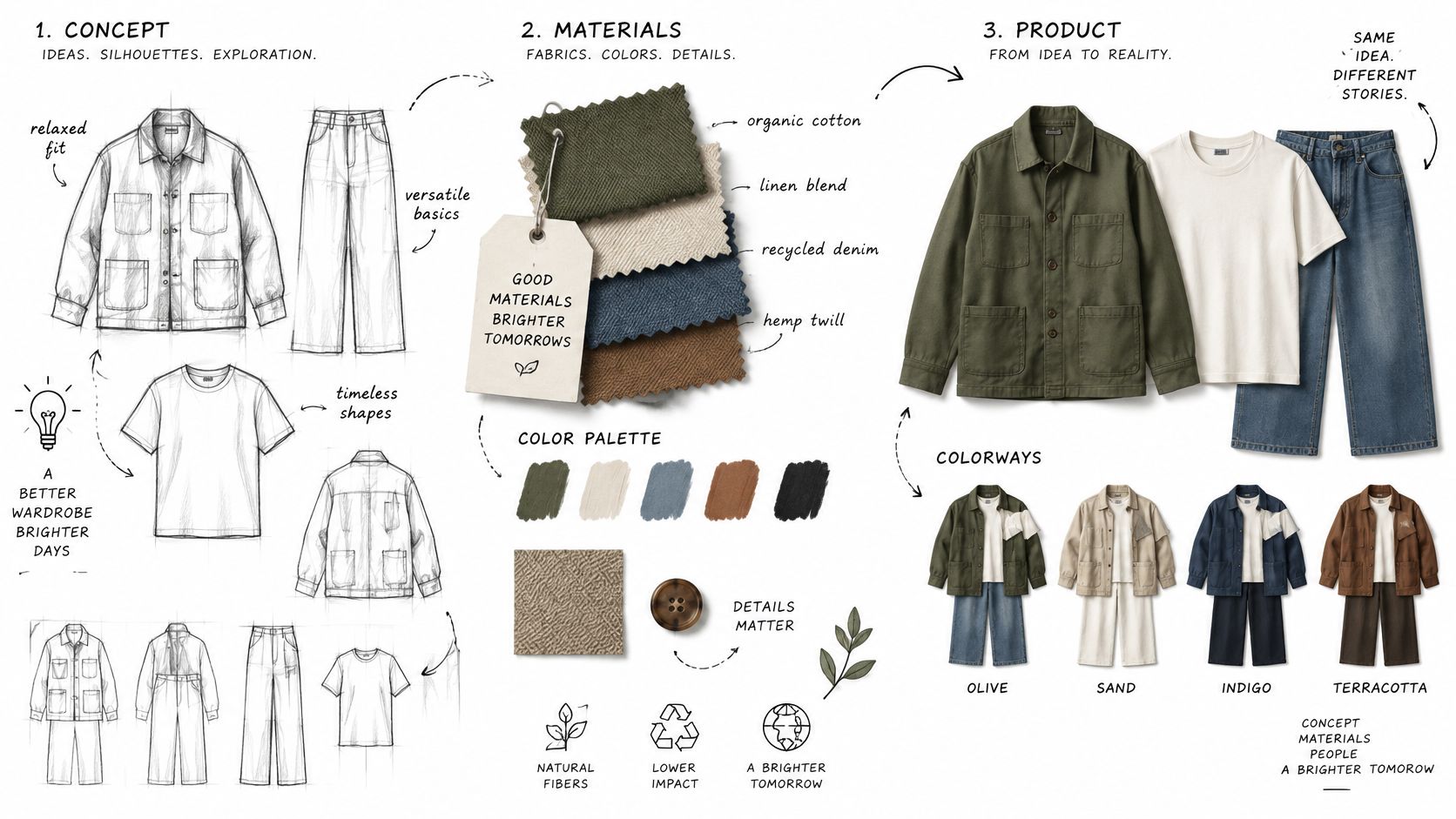
Bring the product opportunity into the workflow alongside sketches, CADs, material references, and relevant visual inspiration. Record constraints in terms the team can evaluate, such as the intended customer, use occasion, desired finish, palette, channel, and price tier. A clear brief gives later image generation a job to do beyond producing attractive options.
For teams refining their inputs, Sprello's guide to writing a sample design brief offers a relevant reference. A well-formed brief makes assumptions visible, which helps reviewers distinguish a deliberate creative choice from a gap in the information.
Generate and compare visual directions
Sprello's Canvas uses those sketches, CADs, materials, and references to create photoreal visuals and colorways. A saved workflow can retain how the team assembled the inputs and shaped its direction, making it easier to revisit a process rather than reconstruct it from scattered prompt text.
Review and organize the selected concept
Once the team has chosen a direction, place its visuals and product information in a shared catalog and bring the options into line review. Designers can assess visual direction, merchandisers can look at assortment fit, and marketing can see the same representation of the product rather than a separate interpretation.
A shared workflow doesn't make a concept production-ready by itself. It makes it easier to see which reference informed an output, what changed during iteration, and what reviewers approved. That record is more useful than a mood board when a decision needs to be explained or revisited.
For additional creative starting points, apparel design project ideas can offer inspiration for visual exploration. In a working development process, the next step is to connect that inspiration to the product brief and record why the team is using it.
Prompts, Iteration, and the Loop That Replaces Guesswork
A useful product-generation prompt translates the brief into visual constraints. Generic requests such as “make a modern bag” or “create a fresh skincare package” leave too much room for images that look polished but miss the actual product need.
Write prompts in product language
Describe the attributes that matter to the decision:
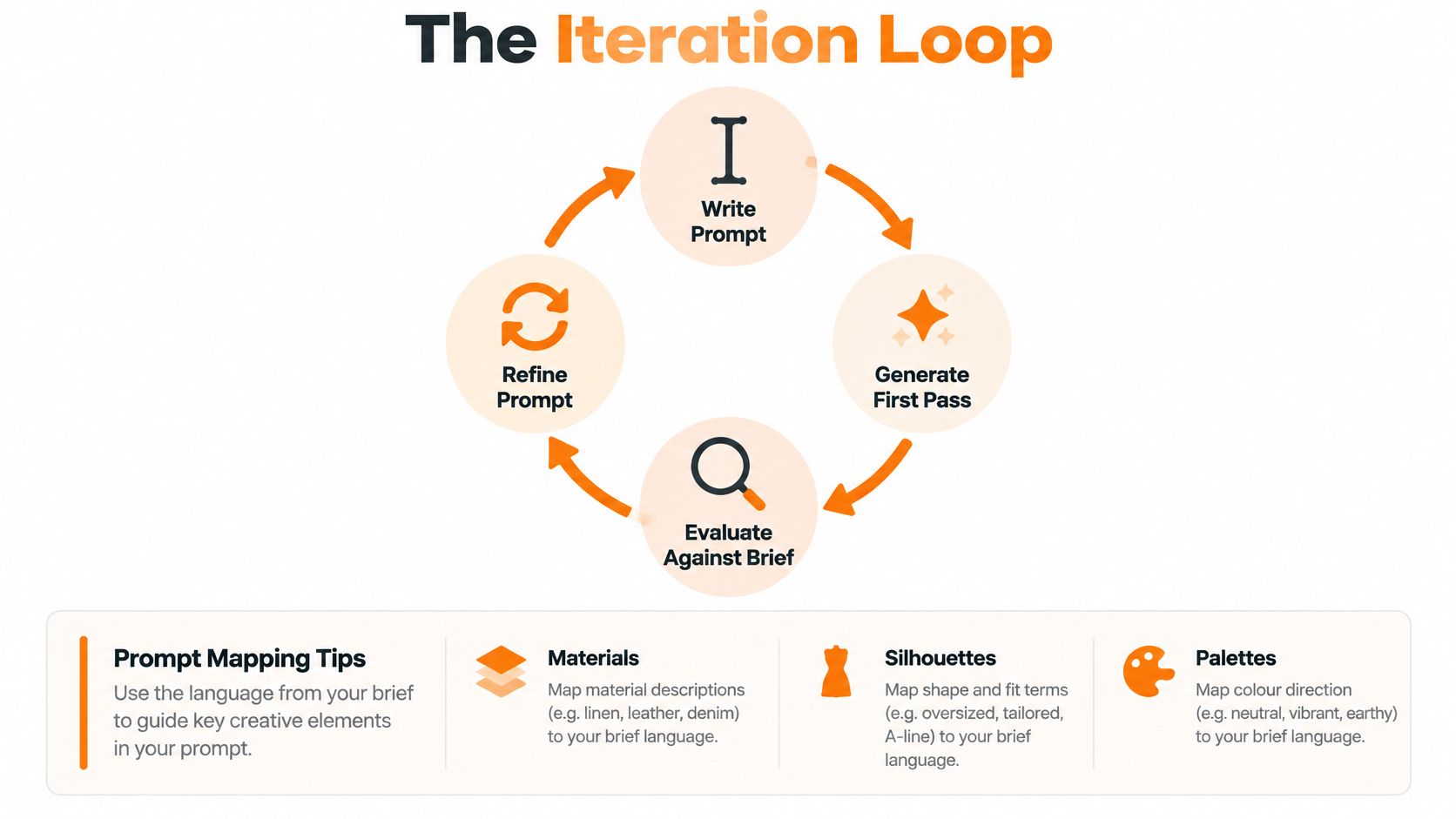
- Materials: Name the material or finish the team wants to explore, and distinguish a required specification from an inspirational reference.
- Silhouette: State the proportions, structure, and functional details that matter to the product category.
- Palette: Use the brief's color language, including which colors are fixed and which are open for exploration.
- Context: Include customer, use occasion, channel, and relevant brand guardrails.
A prompt for a home accessory should describe more than its color. It may need to specify the intended room, material impression, scale, and relationship to the existing range. The prompt is a working expression of the brief, not a substitute for one.
Keep the loop disciplined
Generate an initial set, then review each option against the brief and the reference set. Adjust the prompt when an output misses a required material, exaggerates a silhouette, or drifts outside the intended palette. Regenerate only after the team can explain what it's trying to correct. Lock a variant when it's a useful candidate for evaluation, not merely because it looks appealing.
McKinsey's fashion-industry research reports that companies using 3-D design and virtual sampling shortened sampling by two weeks or more and often reduced the number of samples required, and associated costs, by 50% (McKinsey's fashion-industry report). That finding concerns digital design and virtual sampling, not AI concept generation itself. It supports assessing digital workflows by their effect on development decisions and physical samples, not by image quality alone.
Saved workflows make the prompt-and-review loop reusable. Teams can preserve the instructions and constraints that produced a useful exploration, then adjust them for a new category or brief instead of relying on one-off strings that only the original creator understands.
Evaluation Criteria That Turn Concepts Into Decisions
A concept earns further development when the team can make a reasoned case for it. Attractive imagery is one input; it doesn't establish demand, technical feasibility, margin, or regulatory suitability. As concept volume rises, the team needs clearer review gates, not more options.
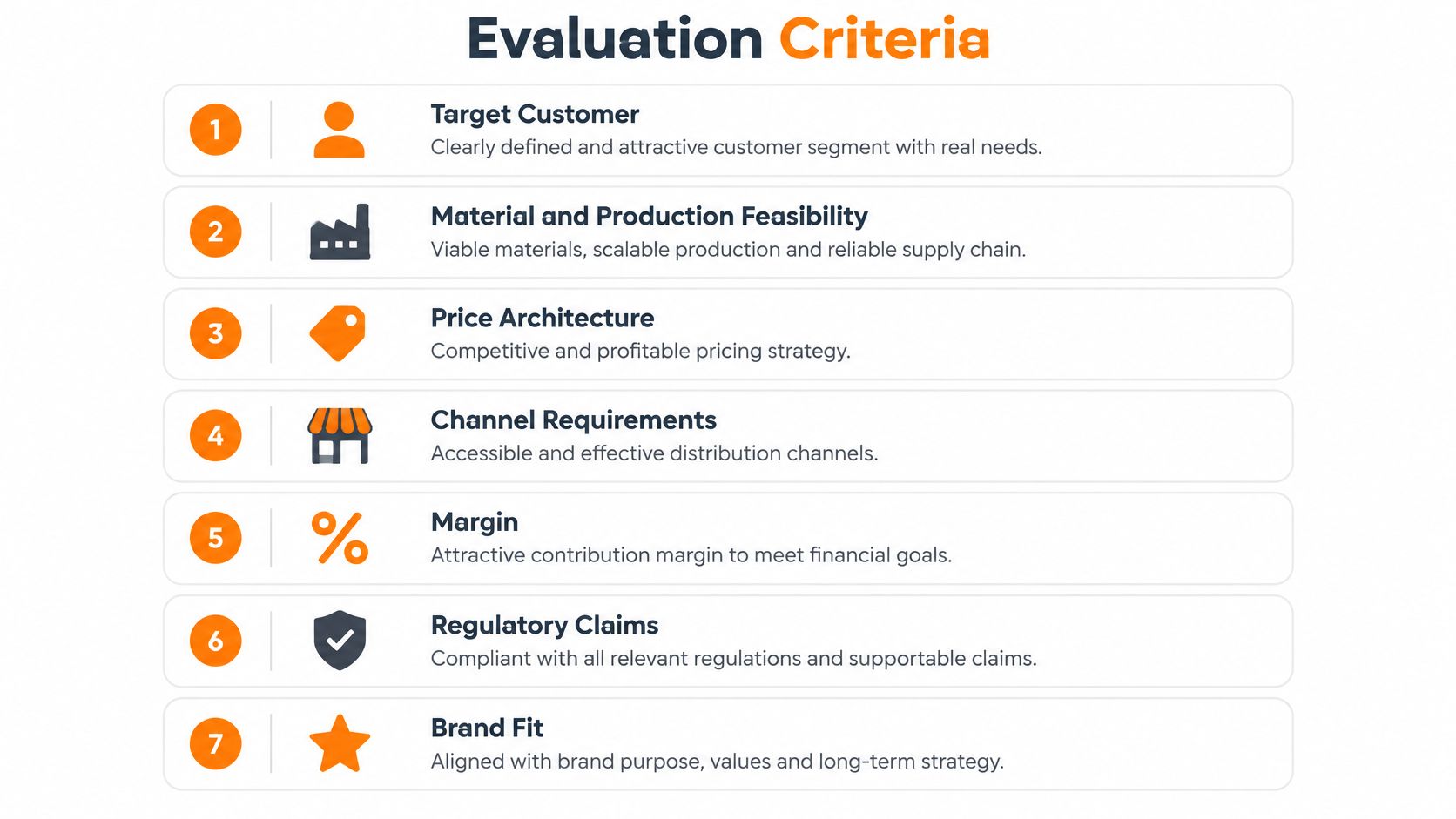
Use a checklist before moving a concept toward sampling:
- Target customer: Who is expected to buy it, and what need or use occasion does it address?
- Material and production feasibility: Can the proposed material, finish, construction, or packaging be sourced and produced within the project's constraints?
- Price architecture: Does the intended price make sense alongside the rest of the assortment?
- Channel requirements: Does the product work for the planned retail, wholesale, or digital channel?
- Margin: Does the commercial case fit the business's margin requirements?
- Regulatory claims: Are claims, including sustainability-related claims, supportable and appropriate for the relevant market?
- Brand fit: Does the idea reflect the brand's established codes without becoming a direct copy of another offer?
The evidence required depends on the risk. A visual direction might need a design review; an unfamiliar material may require input from technical or sourcing specialists. A claim with regulatory implications needs expert review, not confidence from an AI-generated image. Teams should also state their target-market assumptions and identify what evidence would change the decision.
Research discussed by BI Norwegian Business Review on AI and innovation highlights training-data bias, privacy concerns, and simplified representations of consumer behavior as risks. It recommends using AI to screen broad concept sets, then conducting targeted human validation and expert review. Treat generated feedback as a prompt for investigation, not proof that customers will buy.
Teams can formalize those gates with a product concept testing workflow. The critical practice is to record who reviewed the concept, what evidence they considered, and which questions remain open before approval.
Scaling Concepts Into SKU-Ready Assortments
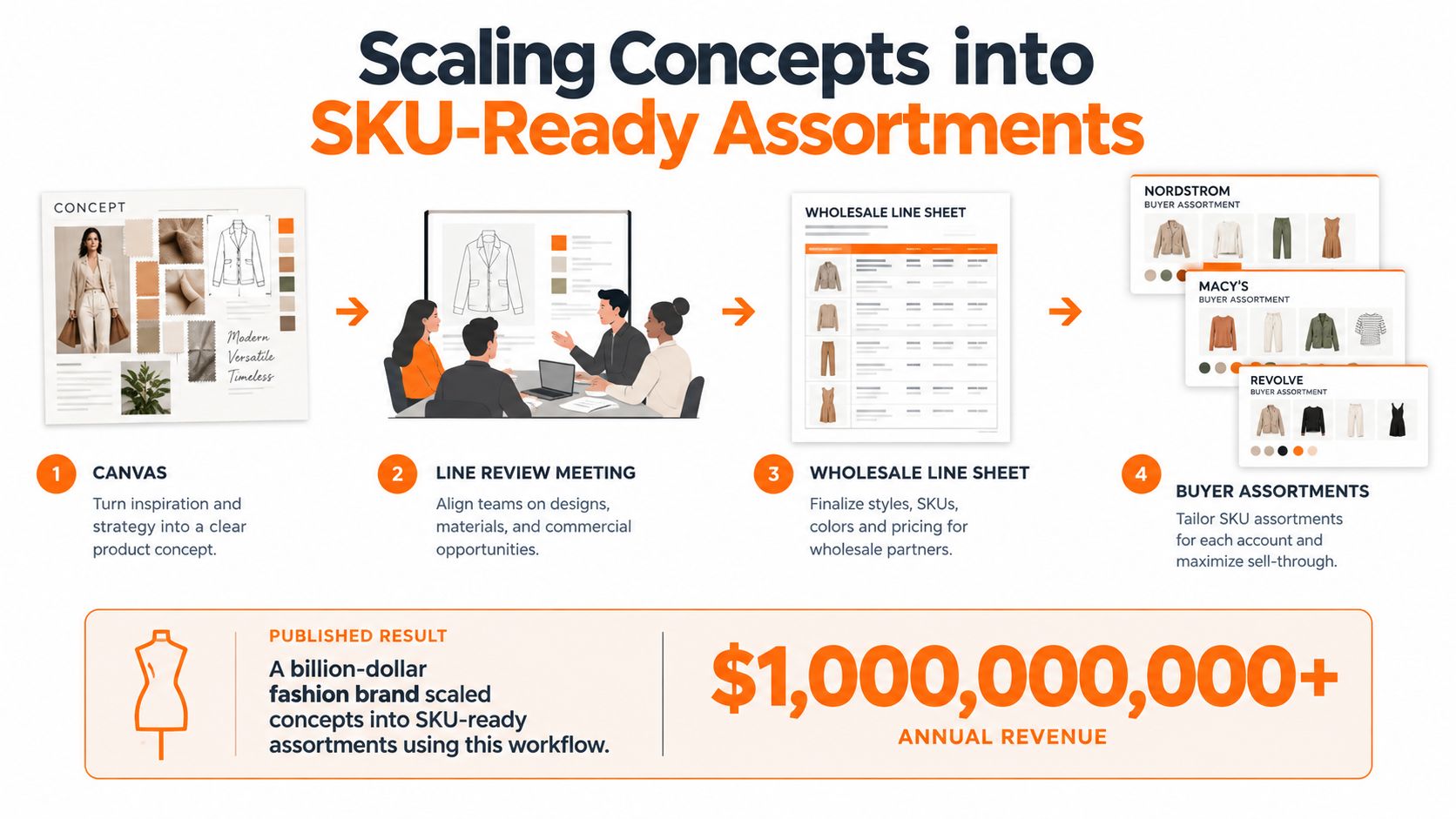
An approved concept still has to survive the handoff into the assortment, and that handoff is where front-end speed either pays off or stalls. A visual direction moves from Canvas into the shared product catalog, then into line review and wholesale line sheets. From there, the team builds separate buyer assortments for each account or channel instead of showing every buyer the same undifferentiated range.
Sprello describes customer results for a billion-dollar fashion brand that include shorter prototype-to-market-sample lead times and fewer commissioned market samples. Treat those results as indicative of what a compressed front end can achieve, not as guaranteed outcomes for every team. The honest test of any workflow is whether it changes real decisions and cuts avoidable sampling or revision rounds.
Scaling across accounts raises a different question: what is allowed to change? A buyer may need a channel-specific assortment. A regional team may need to adjust imagery, fit assumptions, materials, or product claims, and translating the copy is only one part of that work. The workflow should record which elements are fixed by brand guidance, which can flex locally, and who approved each deviation. That record matters months later, when a dispute surfaces about why one market's version differs from the original concept.
A Capgemini consumer survey found that trust in AI-written content had fallen to 58%, from 72% two years earlier. It also reported that 63% of consumers said AI should be tested with diverse groups before launch, with results explained plainly. For product teams, that argues for keeping source records, making review checkpoints visible, and bringing diverse human reviewers into market-specific approvals. These practices cannot guarantee trust, but they make every assortment decision easier to inspect and explain.
To plan a seasonal range around product groupings and buyer needs, teams can draw on Sprello's guidance for building a season lineup. A structured catalog with recorded approvals carries selected concepts into buyer-facing materials while keeping each assortment suited to its intended account or channel.
Enterprise Controls, the AI-Assisted Stance, and Next Steps
AI can broaden early exploration, but people should own the decisions that affect customer expectations, product feasibility, and regulated claims. The practical model is AI-assisted breadth followed by market-specific validation, expert review where needed, and documented approval gates.
For brand teams, access controls matter because product concepts, commercial assortments, and buyer views don't belong in one undifferentiated workspace. Sprello's stated enterprise controls include SOC 2, SSO/SAML, role-based access, and zero training on customer data. The platform is sold through a demo and complements PLM and planning suites. It doesn't replace tech packs, BOMs, pattern making, demand forecasting, or open-to-buy.
Frequently asked questions
What should a team do when reviewers disagree about a concept?
Record the disagreement as a specific open question, identify what evidence could resolve it, and assign a decision owner. Don't treat a vote on visual preference as proof of commercial or technical fit.
How can a team stop benchmarking from producing lookalike products?
Use reference products to identify attributes, needs, and gaps, then generate from those findings rather than copying a single reference. Review the final concepts for excessive overlap before selecting one.
What should a concept record preserve for later review?
Keep the brief, references, key product attributes, prompt or workflow inputs, major changes, assumptions, and approval decisions together. That gives future reviewers context for why the concept advanced.
When should a team move from visual exploration to physical sampling?
Move forward when the concept has a clear customer and assortment rationale, the main feasibility questions have owners, and the relevant reviewers agree it warrants further development. The precise gate depends on the product and the risks involved.
Sprello connects AI product visuals and saved workflows to a shared product catalog, line review, wholesale line sheets, and buyer-specific assortments. If you're working to make product concept generation more reviewable from first direction to buyer-ready collection, visit Sprello to book a demo.
Related
More to explore
Fresh reads
Season Lineup Planning for Visual Merchandising Teams
Plan a season lineup with clear architecture, colorways, size runs, regional variations, and visual workflows that align merchandising and buyers.
Product Concept Presentation That Wins Buy-In
Build a product concept presentation that earns sign-off from merchandising and leadership. Step-by-step structure, visuals, and workflows inside.
Product Concept Development That Actually Scales
A practical guide to product concept development across SKUs, regions, and seasons, covering ideation, validation, prototyping, and rollout governance.