October 17, 2026
Product Concept Testing: A Practical 2026 Playbook
Master product concept testing in 2026 with a practical playbook covering qualitative research, rapid prototypes, A/B tests, KPIs, and AI-assisted workflows
The merchandising room is split between three AI-assisted concepts for next season: a sculptural bag in a new material, a familiar silhouette in a bolder colorway, and a beauty set built around a sustainability claim. Each has an internal champion. The team has limited sample capacity, a fixed assortment to plan, and regional buyers waiting for a recommendation.
A quick survey could rank the concepts by purchase intent. But a ranking alone won't tell the team whether shoppers understood the proposition, noticed a meaningful difference, or would still choose it at the proposed price. Product concept testing works best as a portfolio decision system, linking early reactions to the next investment decision: refine, validate further, or stop.
The Decision Behind Every New Concept
A team reviewing a new product needs to decide what evidence would justify its next step. One concept may attract strong early interest but need clearer positioning. Another may appeal to a smaller audience while filling a specific assortment role. A polished concept may still lack a persuasive reason for customers to switch from what they already buy.
Concepts also compete for design time, sample development, photography, marketing attention, and assortment space. Decisions made early can shape later choices across regions, channels, and SKU variants, so the test should clarify what the team still needs to learn.
Treat concepts as staged bets
Early testing should reveal what customers understand and value. It does not need to answer every production question. As teams settle materials, prices, claims, and assortment, they need more realistic stimuli and sharper comparisons. The research should match the decision at hand, balancing rigor with the speed needed to keep development on track.
Set the decision rule before research begins:
- Move forward when the concept is clear, relevant, distinctive, and credible enough to justify the next investment.
- Revise when respondents see a potential benefit but misunderstand the proposition or identify a barrier the team can address.
- Stop when the concept lacks a clear audience or advantage after customers have seen a fair, understandable version.
This makes testing part of launch planning, not a standalone survey exercise. Teams connecting early validation to commercialization can also consult this resource on CPG new product launch strategy.
Evidence is useful when it guides effort across concepts, not only when it produces a single ranking. One idea may suit a core customer, another may have stronger regional relevance, and a third may need a different price or message before a fair comparison. That portfolio view helps teams decide where further qualitative work, quantitative trade-off testing, or AI-assisted simulation is worth the effort, and where a concept should wait. Set comparable decision thresholds across SKUs, regions, and channels, while allowing for differences in audience and market conditions.
Practical rule: Decide what the result will change before you ask customers to react.
Why Purchase Intent Is Not Enough
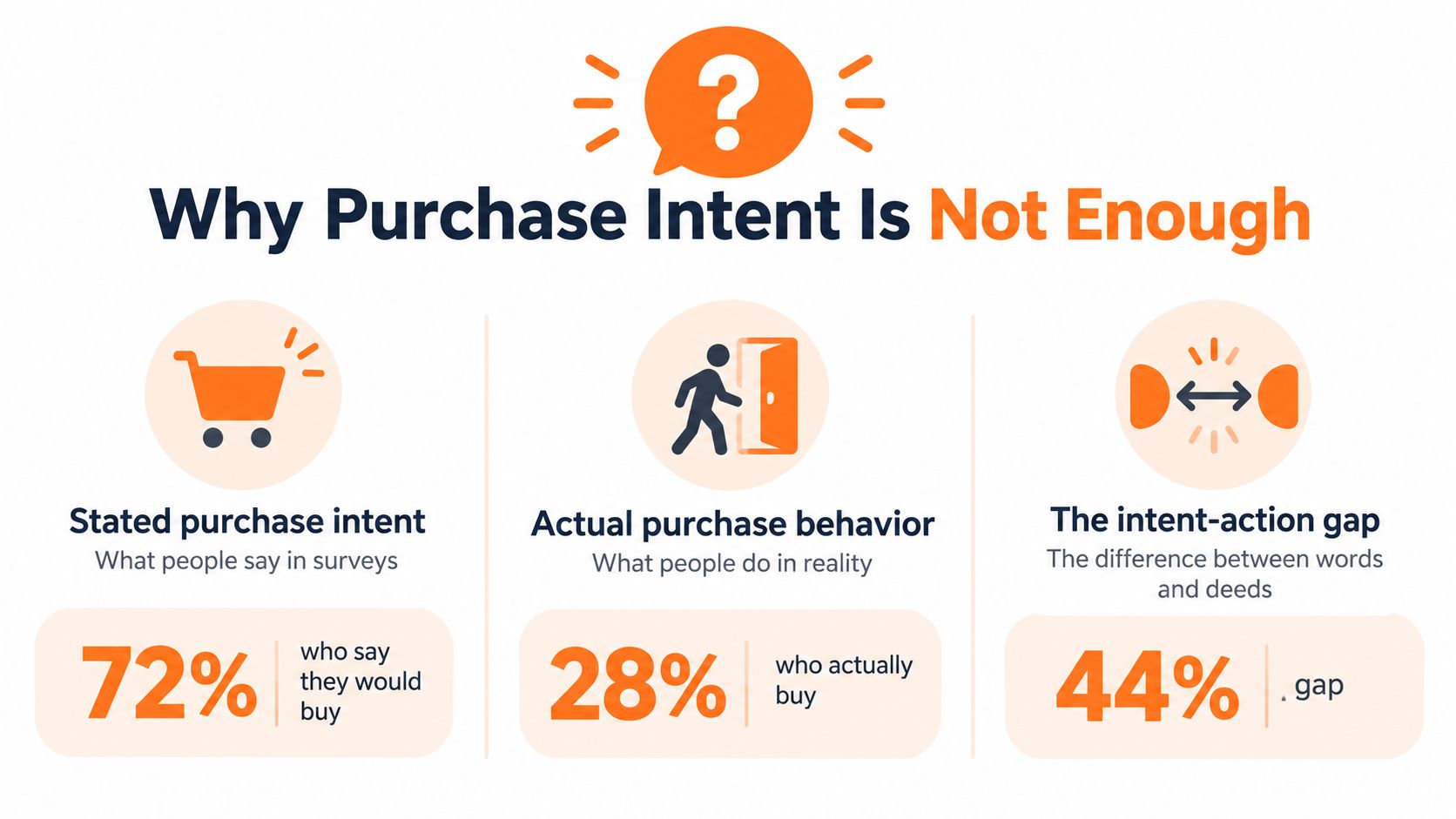
“Would you buy this?” is easy to ask and easy to misread. A positive answer can mean the concept sounds appealing, the respondent likes the image, or the question makes buying feel like the polite response. It doesn't prove that the person will choose the product when price, alternatives, availability, and real-life use enter the picture.
The evidence supports treating stated intent as a signal, not a forecast. A 2007 meta-analysis by Morwitz, Steckel, and Gupta examined 40 studies and found an average correlation of 0.49 between stated purchase intentions and subsequent behavior, with substantial variation across studies (summary in Sprig's concept-testing guide). In a separate analysis of comparable product tests, the correlation was 0.751 for 18 existing products, but -0.177 for eight new products. Familiar products give respondents something concrete to judge. New concepts ask them to imagine an unfamiliar product without the experience of owning, wearing, or using it.
Diagnose the response, not just the score
For fashion, beauty, and lifestyle concepts, a static visual can make this limitation more acute. A consumer may like a silhouette but doubt the fabric, respond to a skincare claim but question its credibility, or admire a colorway that doesn't fit their wardrobe or routine.
Pair purchase intent with diagnostics that explain the response:
- Comprehension: Can people describe the offer accurately?
- Relevance and expected usage: Does it fit a real need, occasion, or routine?
- Distinctiveness: Does it differ from current alternatives in a way customers notice?
- Credibility: Do the benefit, material, or claim feel believable?
- Price expectations: What price feels appropriate, and what seems too much?
- Competitive context: Would people choose it over what they already use?
A strong intent score alongside weak comprehension is a warning, not a pass. A concept that earns attention but lacks credibility needs different work from one that is clear and relevant but too similar to competitors. Don't let a single purchase-intent percentage decide production. Use the score to open the diagnosis, then judge whether the concept has a credible route to choice.
Qualitative Research That Actually Refines Concepts
Qualitative research is where teams find out what to change. Surveys can tell a team that a concept is unclear or unconvincing. A well-run interview can reveal which phrase confused people, what benefit they expected, or what detail would make the product feel worth considering.
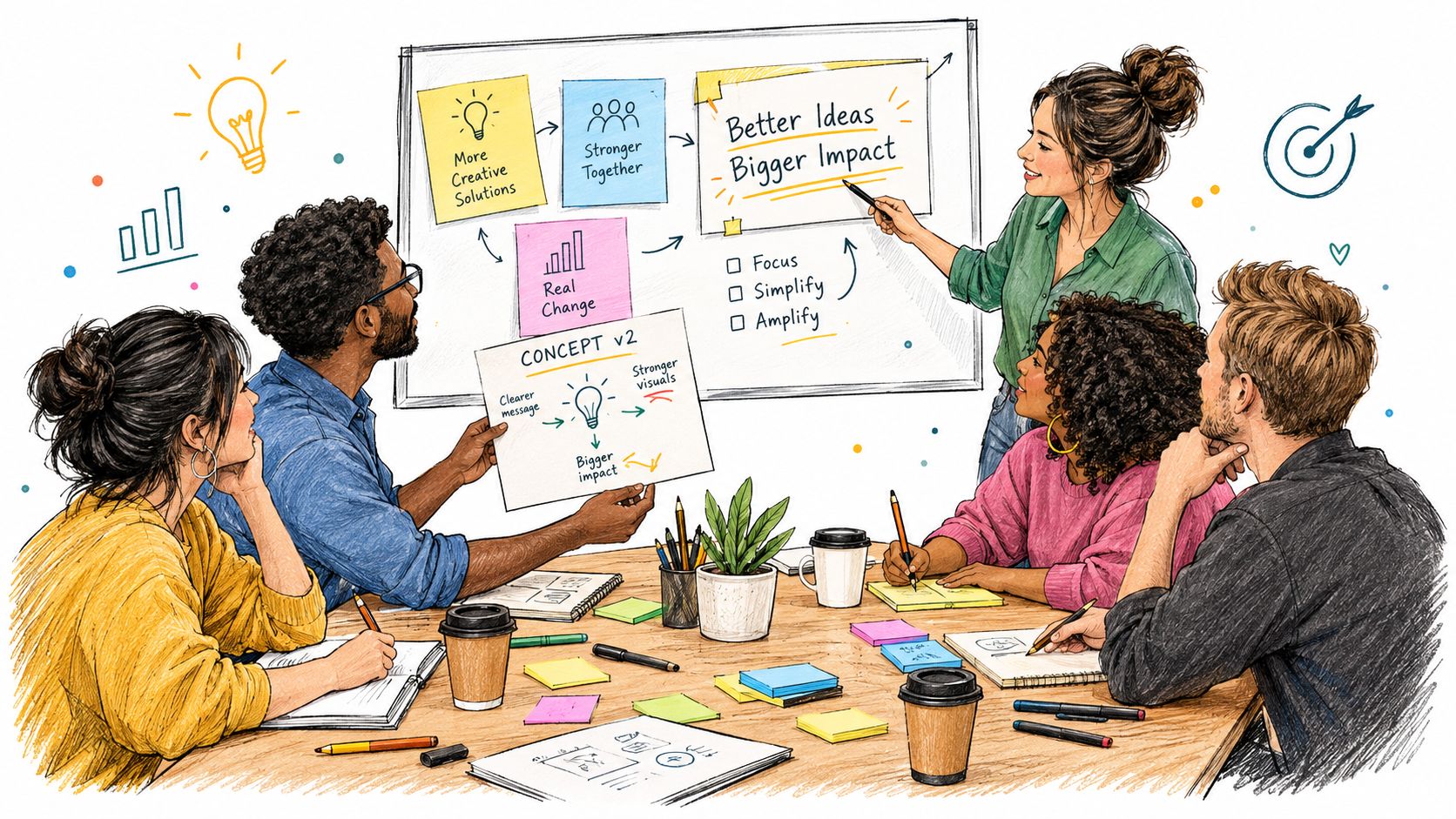
Choose the format to fit the question. In-depth interviews give each participant room to describe their own needs and reactions. Small focus groups surface shared language and contrasting interpretations, though dominant voices can influence the room. Co-creation sessions help teams explore possible revisions with consumers, but participants shouldn't be asked to design the product in place of the brand team.
Bring stimuli people can meaningfully assess
A text description may be enough to test whether a proposition makes sense. It won't answer whether a material looks premium, a color palette feels wearable, or a product image communicates the intended fit. Match the stimulus to the decision: use concept boards, AI-assisted visuals, fabric swatches, color references, packaging mockups, or a realistic price frame as needed. Keep the presentation consistent enough that participants react to the idea rather than differences in execution quality.
Brief moderators to start with open questions. Ask what participants think the concept is, what stands out, and what raises doubt before asking whether they like it. Avoid leading language that signals the team's preferred answer. Recruit category buyers and people with relevant usage occasions, not just convenient participants who happen to be available.
Consider a sustainability-led colorway. Participants may understand the environmental claim but describe the styling as dull or overly muted. That reaction doesn't automatically mean the claim failed. It may mean the palette undermines the product's appeal. Revise the styling, then carry the specific concern into quantitative testing as a diagnostic question.
For a practical framework on shaping the proposition before research, teams can review product concept design. The important handoff is from qualitative language to measurable questions: what people misunderstood, which alternative they compared it with, and what made it credible or not. Use this work to sharpen the concept before asking a large sample to evaluate it.
Quantitative Methods From Monadic to Conjoint
Choose the quantitative method around the decision the team needs to make. Monadic testing measures reactions to a concept on its own; MaxDiff prioritizes attributes; choice-based conjoint (CBC) estimates trade-offs between product features and price. Combining all three in one survey adds effort without improving the decision if the team has not defined what respondents need to choose.
Monadic testing gives each participant one concept to evaluate, capturing appeal, comprehension, and credibility without direct comparison. It suits early concepts that need explanation. Its limitation is comparative: a monadic result alone cannot show whether the concept wins against alternatives. To make that comparison, use separate groups or another design that puts options in competition.
MaxDiff helps teams prioritize a long list of candidate attributes. Choice-based conjoint (CBC) takes the shortlist and tests which combinations people prefer when features and prices compete. Conjoint has supported new-product decisions since the 1970s (background on concept-testing methods). For an assortment decision, its value is practical: estimates of trade-offs can show whether a colorway, material, claim, or price point earns its place, and which combination to carry across SKUs, regions, or channels. That is more useful than treating each feature's appeal score as an independent reason to launch.
Use a two-stage design for complex concepts
A fashion or beauty concept may combine silhouette, material, colorway, price, claim, and channel. Asking respondents to rate every feature can make the survey tiring and produce shallow answers. First narrow the attributes, then ask respondents to choose among realistic product combinations.
A workable starting design screens or prioritizes more than 8–10 candidate attributes with MaxDiff, then runs CBC with approximately five attributes, each set at two or three levels. Keep profiles believable, randomize them, and include an opt-out. Respondents commonly complete about 8–12 tasks; adding roughly five or six attributes can push people toward rushed choices and weaken the trade-off estimates. These are design guidelines for this method, not universal rules for every research question.
| Method | Best For | Typical Sample | Key Output |
|---|---|---|---|
| Monadic | Standalone appeal and diagnostics | Sample depends on the number of concepts and comparisons | Concept-specific reactions |
| MaxDiff | Prioritizing a long attribute list | Set by the decision and target segments | Relative attribute priorities |
| Choice-based conjoint | Comparing configurations, features, and prices | About 200–300 respondents for a single market; roughly 200 per subgroup for segment comparisons | Simulated choice, trade-offs, and willingness to pay |
The sample guidance above comes from conjoint analysis design recommendations. If the decision requires comparisons across regions, customer groups, or buyer types, recruit enough people for those subgroup reads before fieldwork. A total sample that supports an overall result may still be too thin for those comparisons. Use the model outputs to assess alternative assortments and market scenarios, then set clear thresholds for which concepts advance. The aim is a defensible portfolio choice, not a single winning feature score.
Rapid Prototypes, A/B Tests, and Desk Validation
Not every question needs a full survey. If the uncertainty is whether a material looks convincing, a prototype may answer it faster. If the question is whether one image earns more initial attention in a digital placement, a controlled A/B test can supply behavioral evidence. If the idea already resembles a product the brand has sold, desk validation can reveal whether the concept has a plausible place in the assortment.

Match the cheapest method to the uncertainty
Use rapid prototypes to pressure-test visual and sensory cues before paying for a broad study. A 3D render, an AI-assisted product visual, a fit sample, or a packaging mockup can help the team spot issues that a written description hides. For teams choosing how to build and iterate these early representations, this rapid prototyping guide for product teams offers useful context.
A/B tests need a clean comparison. Put the candidate concept against an incumbent or holdout, keep the audience and placement comparable, and decide in advance whether the useful signal is click-through, add-to-cart, or another behavior. A click indicates attention, not necessarily a purchase. Don't call an image a winner just because it drew curiosity if the team's actual decision concerns product demand.
Desk validation is the fast filter. Compare the concept with relevant existing products, sales patterns for analogous SKUs, current competitive offers, and the assortment role the item would fill. That won't validate a new product by itself, but it can show when a concept duplicates an existing option or lacks a clear reason to enter the range.
A team could use AI-assisted product photography and seasonal production dossiers to create channel-ready visuals for a capsule colorway. It could then test that presentation against the current hero product with a defined audience before expanding the work. The point is to choose the smallest credible test that resolves the next decision, then increase rigor as the commitment grows.
A short demonstration can help teams think through what a product workflow needs to communicate before testing. It should complement, not replace, evidence from target customers.
KPIs and Pass-Fail Thresholds Worth Defending
A test without agreed decision rules can become a search for the metric that supports someone's preferred concept. Before fieldwork, the team should define the commercial decision, the audience, the alternatives, and what evidence would trigger a move forward, a revision, or a stop. The thresholds should fit the stage and risk of the decision, not a generic benchmark copied from another category.
For example, a new category needs a different standard from a modest extension to a familiar line. A concept still being shaped may pass on comprehension and relevance, then face a stricter choice test once its materials, price, and use context are defined. A production decision should not rest on a directional early-stage response.
Build a decision rule around evidence
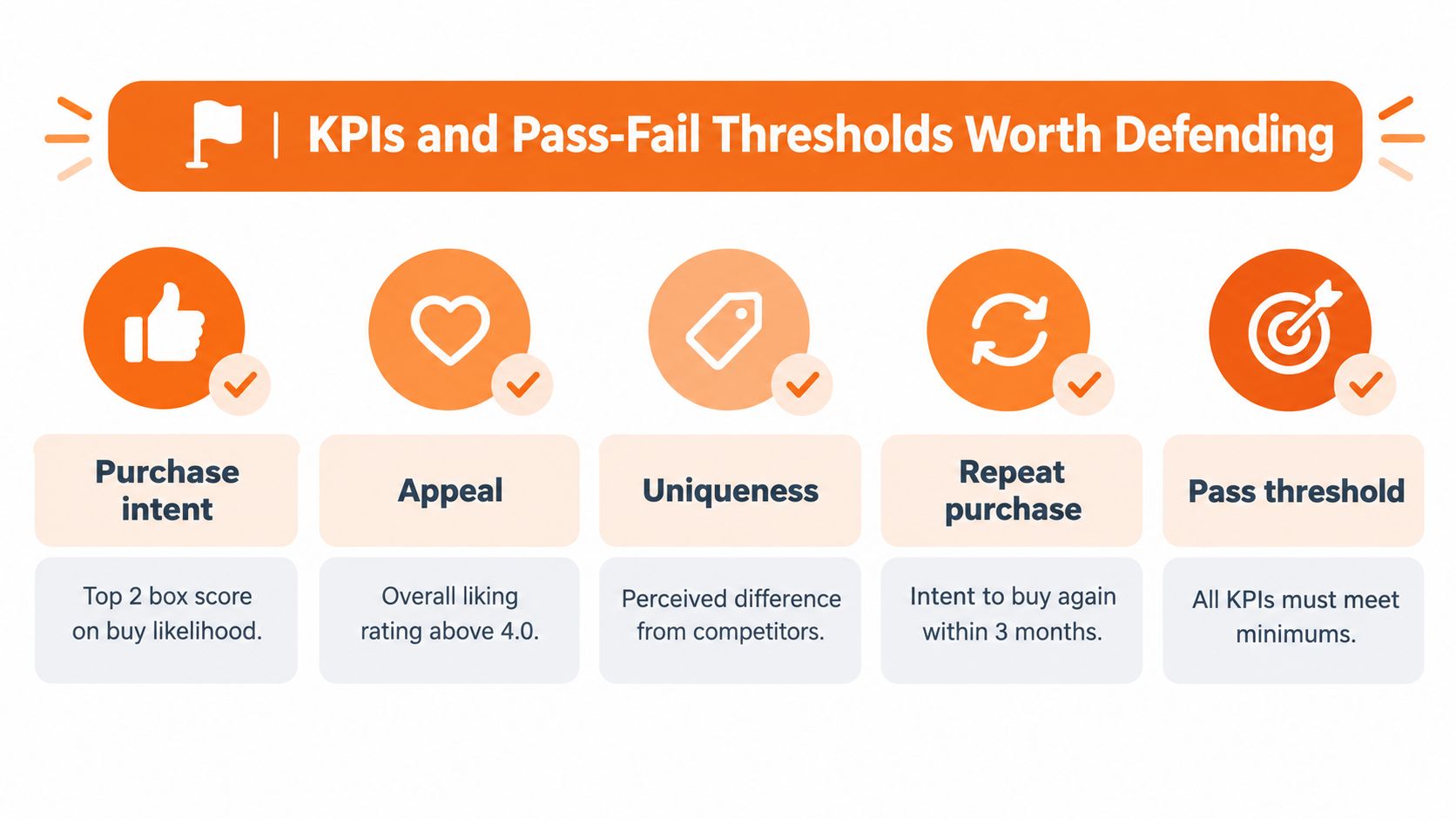
Choose KPIs that explain both attraction and commercial plausibility:
- Purchase intent: Treat it as a directional measure and compare it with the concept's stage and alternatives.
- Relevance and appeal: Check that the product fits a real customer need or occasion, not only that it looks attractive.
- Distinctiveness and credibility: A concept should offer a recognizable reason to choose it, and its claims should feel believable.
- Simulated choice and price sensitivity: Use these when the team needs to compare configurations or understand trade-offs.
- Forced-choice preference: Ask whether the concept beats a defined alternative, not an undefined competitor set.
Set minimums for the measures that matter, and decide whether each must pass or whether a strong result on one can compensate for a weaker result elsewhere. Don't introduce a numeric cutoff after seeing the data. If subgroup differences will change a regional buy, plan samples to support those comparisons and avoid overreading thin slices.
Survey execution can weaken a sound decision rule. Keep the questionnaire focused on the questions that affect the decision; a long list of nice-to-know items can tire respondents and obscure the signal. Record the concept version, audience, market, measures, and decision in a shared log. That record helps teams learn which early signals proved useful across seasons and which ones repeatedly misled them.
For a practical connection between consumer response and line decisions, teams can use assortment planning in fashion as a companion to the research readout.
AI-Assisted Workflows and Cross-Functional Templates
AI can help teams create and adapt concepts faster, but speed only helps if the versions remain comparable. Start with a shared brief that captures the proposition, audience, product details, price framing, channel, and decision to be made. Create a consistent global core for comprehension and relevance, then add targeted regional questions where local styling, sizing, claims, or color preferences could change the choice.
Use a concept canvas to keep stimulus versions and research decisions connected. A sample design brief can help teams standardize what each concept needs to communicate before it enters testing. For fashion, beauty, and lifestyle brands, Sprello's AI-assisted product concepting and assortment visualization workflows can help teams explore materials, silhouettes, and colorways and compare options before production.
The handoff matters as much as the test. Route validated concepts into the seasonal production dossier, with the chosen variants, audience findings, unresolved risks, and next decision visible to merchandising, design, marketing, and e-commerce. Before production, run a pre-mortem: what might customers misunderstand, which claim could fail to persuade, and what regional response could change the plan?
Don't test a beautifully polished execution when the team still needs to validate the underlying proposition. Keep the creative fidelity appropriate to the decision, and use AI to generate comparable alternatives, not to make one option look more finished than the rest.
Build your next product concept test around a real portfolio decision, with clear diagnostics and a defined path from idea to production. Sprello helps fashion, beauty, and lifestyle teams explore product concepts and visualize assortment options across SKUs, regions, and channels.
Related
More to explore
Fresh reads
Why Brand Consistency Is Important for Modern Brands
Discover why brand consistency is important for recognition, revenue, and operational efficiency. Learn practical guardrails to scale consistency across regions
Product Concept Design That Actually Ships
A practical guide to product concept design for fashion and lifestyle brands. Master ideation, moodboards, and production-ready briefs that scale.
7 Lookbook Examples for Fashion Brands in 2026
Explore 7 lookbook examples from Vogue, Behance, Canva and more, with layout tactics, merchandising notes and implementation tips for creative teams.