November 28, 2026
Apparel Product Development: A 2026 Step-by-Step Guide
Learn apparel product development from concept and line planning to sampling, production and launch, with timelines, sample stages and tools for 2026.
Published 28 November 2026
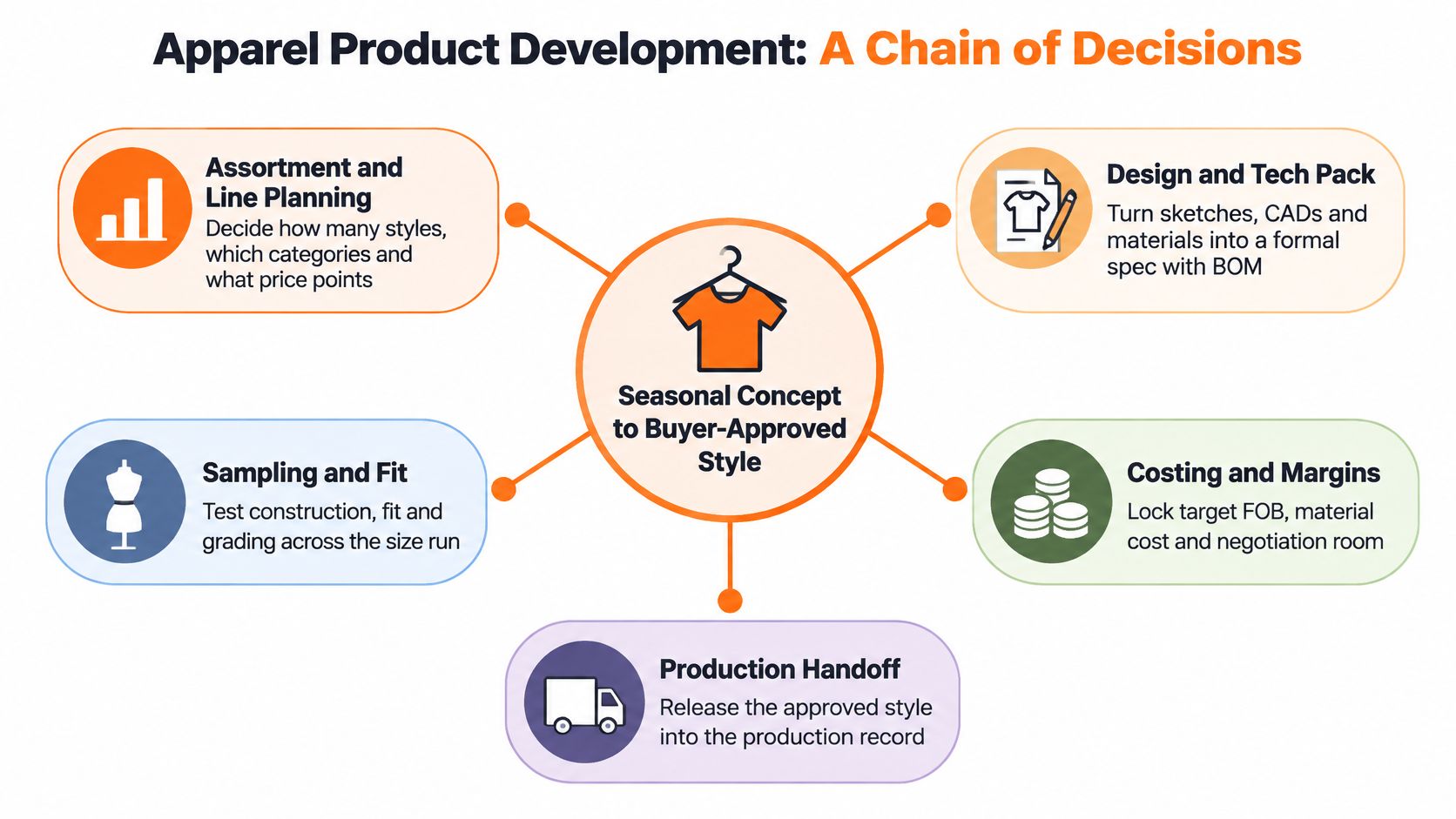
Apparel product development is the end-to-end process that turns a seasonal concept into a production-ready, buyer-approved style, spanning assortment and line planning, design and tech packs, sampling and fit approval, costing, production handoff and launch. It's also, by calendar, far more a decision problem than a sewing problem: a study of the UK apparel industry found the average product-development cycle ran 167 days, while the manufacturing portion accounted for only 39 days (Manchester Metropolitan University apparel research). That gap is the whole job. Sprello builds AI for product development and merchandising, from product concept to buyer-ready collection, and the reason we organize the work around decision gates is that the calendar is lost there, not on the factory floor.
What is apparel product development and why is it mostly a decision problem?
Five functions share one process. Merchandising sets the line, the price architecture and the size runs. Design draws into that frame. Technical design converts drawings into measurable specifications. Sourcing finds the material and the capacity. Marketing builds the launch around what survived. The asset that ties them together is the product record, a single version of a style's measurements, materials, construction, colorways, cost and approved visuals.
The same UK research behind the cycle-length benchmark also looked at how many developed styles ever reach a store, and how often a surviving style is redrawn before approval. Most of what a team develops never reaches a shelf. Styles that do make it are commonly revised several times between the first sample and final sign-off. Each pass adds sample cost, freight and another review meeting. Time is lost at those gates: assortment choices, approvals and sampling loops, not on the sewing line.
The reframe: apparel product development is a sequence of decisions and approvals, and most of the calendar is consumed before a factory touches the garment.
Three levers follow from that. I would measure a team against these before buying another tool.
- Visibility across stages: a merchandiser can see whether a style is stuck in fit, waiting on a fabric confirmation, or sitting in a costing queue without asking four people and waiting a day for answers.
- Fewer physical sample loops: silhouettes, materials and colorways get reviewed visually before sample-room time is booked, so the first physical sample answers a narrower question.
- Standardized approvals: the pass/fail rule for a measurement, a colorway or a trim is written down before the sample lands, which lets a review close in one round instead of three.
Two brands can share a factory, a fabric mill and a fit model and still land six weeks apart, because one of them decides faster. Specification discipline is what closes the gate. Seam type, tolerance and material behavior have to be written before anyone argues over a sample. That same habit of writing the standard shows up outside a fashion tech pack, including a guide to quality riding apparel, where performance still depends on how tightly construction is specified.
How long does each apparel development stage take and what sets the calendar?
The stage map below uses working ranges for a seasonal wholesale or direct-to-consumer line. Each stage closes on a named deliverable, not a date on a wall chart, which is the only way to know whether it's finished.
| Stage | Typical duration | Deliverable that closes the stage | Owner |
|---|---|---|---|
| Concept and market research | 2-3 weeks | Concept direction, material and silhouette shortlist | Design and merchandising |
| Line and assortment planning | 2-4 weeks | Line plan with style counts, colorways and size runs | Merchandising |
| Design and tech-pack preparation | 3-4 weeks | Locked tech pack and first prototype brief | Design and technical design |
| First prototype and review | 2-3 weeks | Prototype approved for fit or revised | Technical design |
| Fit and size-set sampling | 4-6 weeks | Fit-approved, size-set-approved samples | Technical design and sourcing |
| Pre-production and production | 8-12 weeks | Production-ready PO and approved pre-production sample | Sourcing and production |
| Launch and sell-in | Counted backward from the selling window | Buyer line sheets, assortment books and campaign assets | Merchandising and marketing |
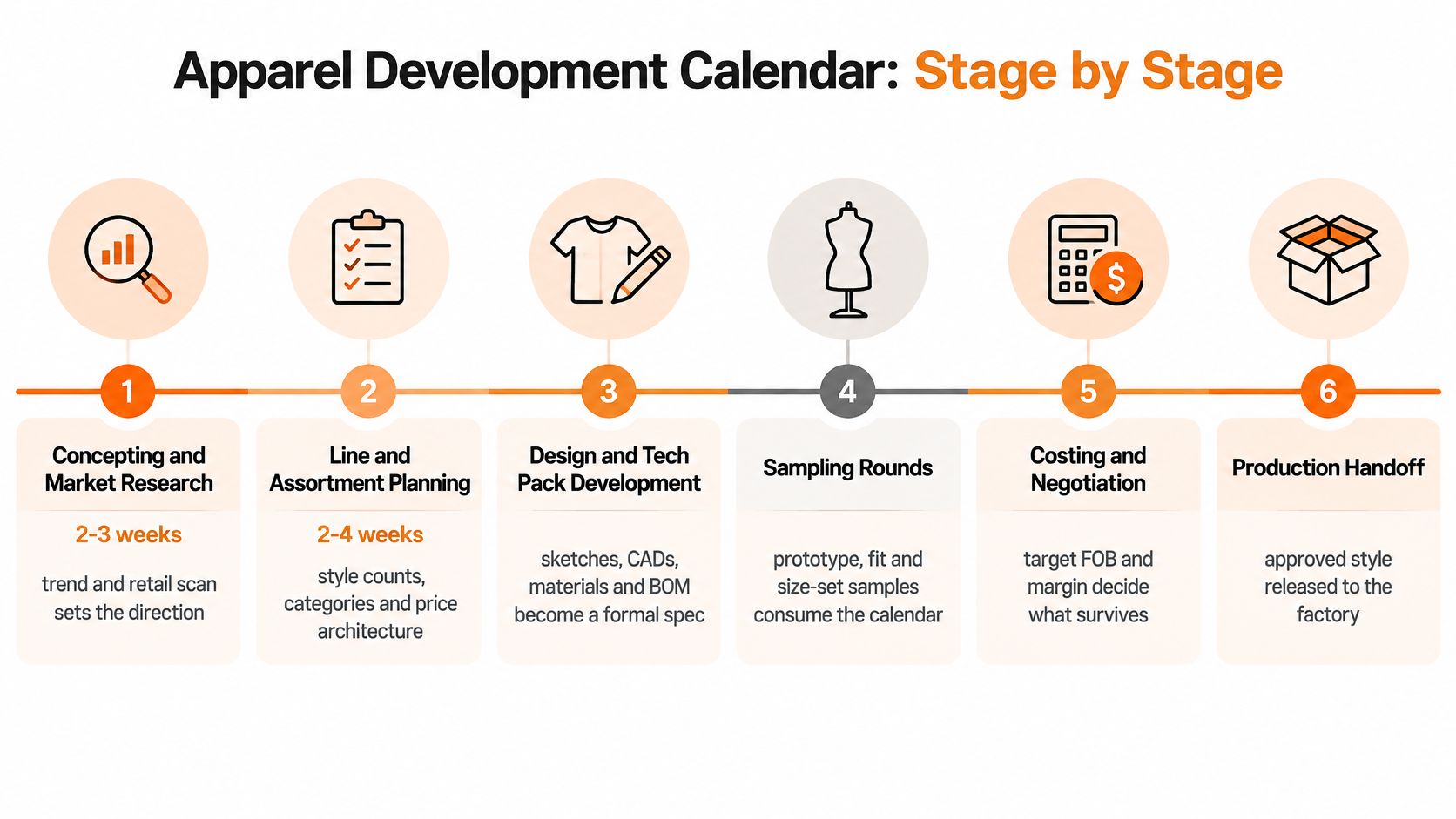
Add those ranges up and you get roughly a season. An industry guide to apparel product development timelines cites an average total lead time of about 167 days, with product development accounting for approximately 104 days, or 62% of the total, and allocates 2 to 3 weeks to concepting, 3 to 4 weeks to tech-pack preparation and the first prototype, 4 to 6 weeks to sampling rounds, and 8 to 12 weeks to production.
What actually sets the calendar
Lead time isn't one number and it isn't set by your template. Origin, category and material set it. Research on ready-made garments reported average lead time in one major South Asian apparel sector exceeded 100 days, while comparable Chinese production ran approximately 30 to 60 days (CORE study of ready-made garment lead times). Category shifts it again: knit-composite production was approximately 70 to 90 days, knit apparel 90 to 110 days, and woven apparel around 120 days. Fabric sourcing was a major contributor, with imported fabric requiring up to 60 days.
That's why a commercially attractive concept can miss its selling window while factory capacity sits open. The constraint was never the sewing line.
Practical rule: confirm fabric availability during concepting, not during sampling. A late fabric confirmation restarts the calendar no matter how good the line plan is.
Two habits protect the schedule. Approve substitute materials and dual-source trims at the concept-to-sample handoff, so a sourcing change becomes a swap rather than a restart. And treat the handoff itself as a milestone with an owner, because it's where merchandising and design most often lose days to unanswered questions.
If you want the front half of that calendar in more detail, this breakdown of the product design process covers how concept work hands off into technical development.
How do sampling rounds work and where does the cost come from?
A style normally passes through four sample types, and each one is a decision gate. The prototype is the first physical expression of the design, and it answers whether the silhouette reads the way the sketch promised. The fit sample corrects construction and fit on a live model. The size-set sample confirms grading across the run, not just the base size. The pre-production sample is the final reference the factory is held to. Miss a gate and the style goes around again.
A 2024 study of apparel new-product development identifies sampling as a major source of cost, delay and inefficiency, because the conventional process runs through multiple physical stages including prototype, fit and size-set samples, so a design may need repeated rounds before approval (study of NPD models in apparel sampling).
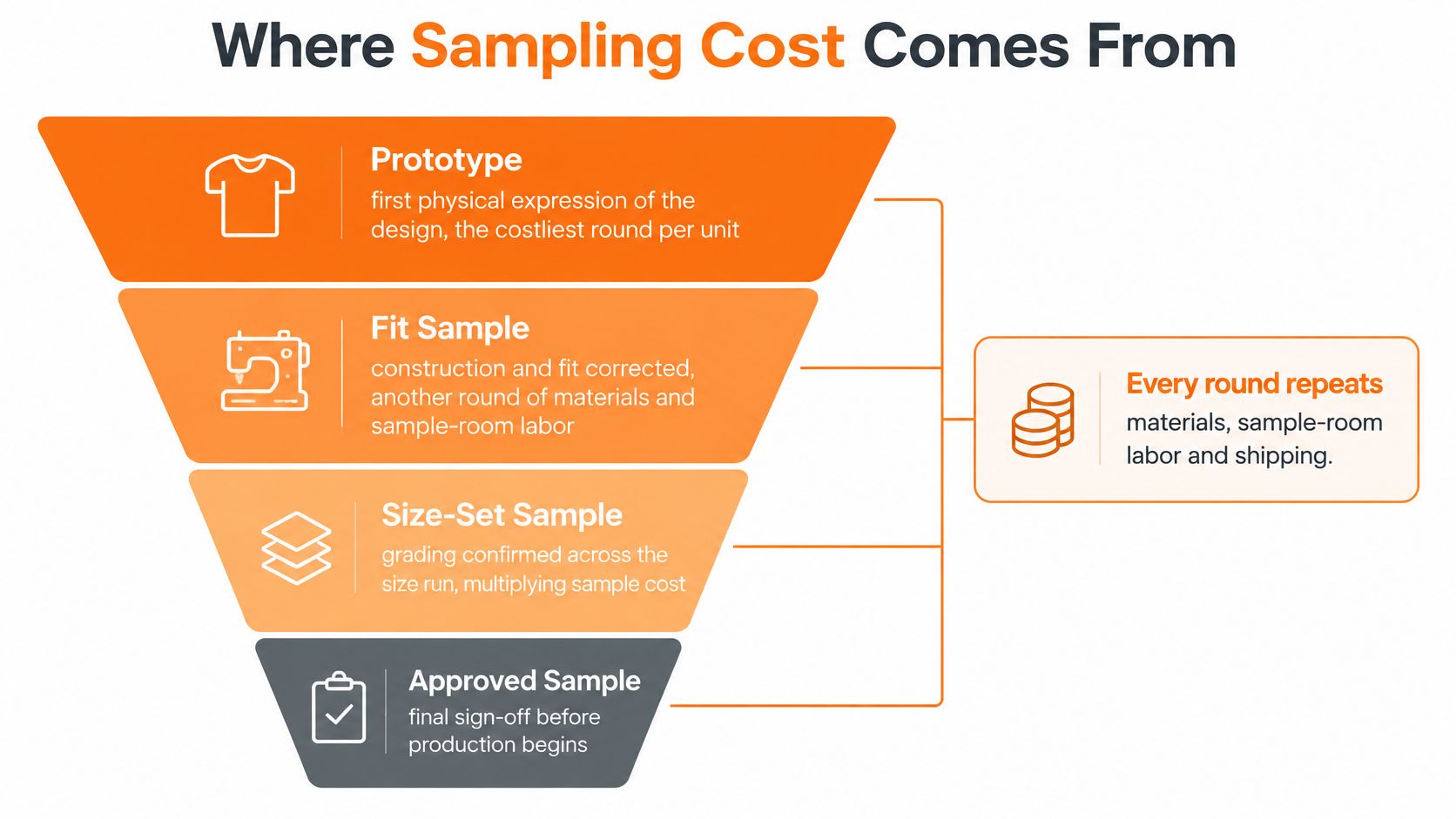
Each round repeats material, sample-room labor and shipping. Across a range of a few hundred styles, the bill tracks how many rounds each style needs, not the price of one prototype.
Three levers cut that loop count without weakening the product. Review silhouettes, materials, references and colorways visually before commissioning every physical sample. Agree fit tolerances and pass/fail rules before the first sample arrives, so a comment is a decision rather than a fresh request. Batch comments per style into one consolidated round instead of sending three separate sets of notes that each trigger a new sample.
A screen review will not show how a seam sits after an hour of wear, so the physical rounds that remain still have to happen. What you avoid is a full round spent on a silhouette, colorway or material direction you could have rejected earlier. Teams that review silhouettes, materials and colorways visually before commissioning physical samples cut sample rounds and prototype-to-market lead time.
Sprello's canvas takes in sketches, CAD files, materials and references and uses them to create and refine product visuals, so teams can explore colorways and material directions with AI before making the next physical sample. Every style then lives in one shared product catalog, with its details and the visuals created for it, which keeps the approved concept reusable downstream instead of trapped in a folder.
Which fit, fabric and construction specifications must be set before sampling?
Treat body data as a development input, not a late fit check. The U.S. National Institute of Standards and Technology states that apparel quality depends substantially on satisfactory fit for intended wearers, and it compiles the body dimensions used in apparel manufacturing and fitting.
In practice that means fixing the size architecture before anyone cuts fabric: primary control measurements (bust or chest, waist, hip, shoulder, inseam, rise), the derived measurements that follow from them, grade rules, size intervals and labeling. One base size with proportional grading fails when body-shape distributions differ by region, age group or gender segment. Expert sizing segments users by dimension and shape, then validates patterns through fit trials or 3D body-scan analysis.
Material behavior belongs in the tech pack
A correct pattern can still fail on a fabric that moves. ISO 5077, used with laundering procedures such as ISO 6330, measures dimensional change after washing and reports it as a percentage separately in the warp and weft directions (textile testing standards guide). Direction matters, because uneven shrinkage shifts sleeve length, body length and hem balance differently across panels.
Seam durability gets measured, not inferred from fabric strength. ISO 13935-2 reports seam tensile strength in newtons for woven garments. A fabric that passes appearance review can still fail at the seam if stitch density, seam allowance, thread or seam orientation is mismatched to the load it carries.
The protocol I'd adopt this season: record pre- and post-laundering measurements, calculate change by direction, set approved limits in the tech pack, and carry those limits into pre-production approval. Keep test records by SKU and colorway so unverified variants can't advance.
Fit review is easier when the size run is laid out in full. It pays to compare terry-lined shirt fits across a full run, because you can see how much of the variation comes from grading versus the base pattern. Writing the sample request itself tightly is the other half of the job, and a sharper sample design brief removes most of the ambiguity that causes a second round.
How do you build circularity and compliance into product development?
Most guidance treats sustainability as a material-selection exercise, swap in a recycled fiber and call the style circular. That framing is why progress stalls. The Kearney circular fashion report finds that circularity efforts are still frequently isolated within sustainability departments instead of being embedded in product development, sourcing, supply chain and commercial decisions.
Regulation is closing that gap. The EU's Ecodesign for Sustainable Products Regulation pushes requirements around durability, recycled content, repairability, reuse and product-level information, and Digital Product Passports are expected to require fuller traceability by 2027. A sustainability team that only advises will not satisfy either.
The work is a trade-off problem, and it resolves at SKU level. Four moves make it operational.
- Define attributes in the line plan. Durability, recycled content, reparability and end-of-life route become fields on the style, not notes in a deck, so merchandising sees them next to cost and margin.
- Write the conflict rule in advance. When durability and recyclability pull apart, decide now which one wins for which category, otherwise every style becomes a fresh debate.
- Compare totals, not materials. A lower-impact fiber paired with heavy trims, a finish, extra packaging and air freight can lose to a conventional fiber moved by sea.
- Attach evidence to the product record. Supplier certificates and test reports live with the style, so a claim survives buyer review and an audit without a scramble.
Those choices then flow into line architecture, colorway counts, size runs, costing, supplier selection and regional compliance. Guidance like 2ndShotMVP's eco-friendly polo advice is useful at the material end, but the decisions that decide whether a range is circular happen in the line plan and the approval gates.
Where do PLM, planning and visual tools fit together?
Apparel product development is served by four tool categories, and no single one covers the process. Merchandising teams get into trouble when they buy for the whole workflow instead of for the gap they have.
| Category | Core job | Does not do | Representative option |
|---|---|---|---|
| PLM suite | Formal specs, bills of materials, tech packs, production records | Product visuals or buyer assortments | Enterprise PLM suites |
| Planning and assortment system | Line plans, buy plans, open-to-buy, financial targets | Tech packs, patterns, product visuals | Merchandise planning suites |
| AI visualization and content tools | Photoreal visuals, colorways and campaign assets | Tech packs, bills of materials, demand forecasting | General-purpose image tools |
| Catalog and line-sheet tools | Shared product record, wholesale line sheets, buyer assortments | Pattern making, demand forecasting | Dedicated catalog tools or spreadsheet templates |
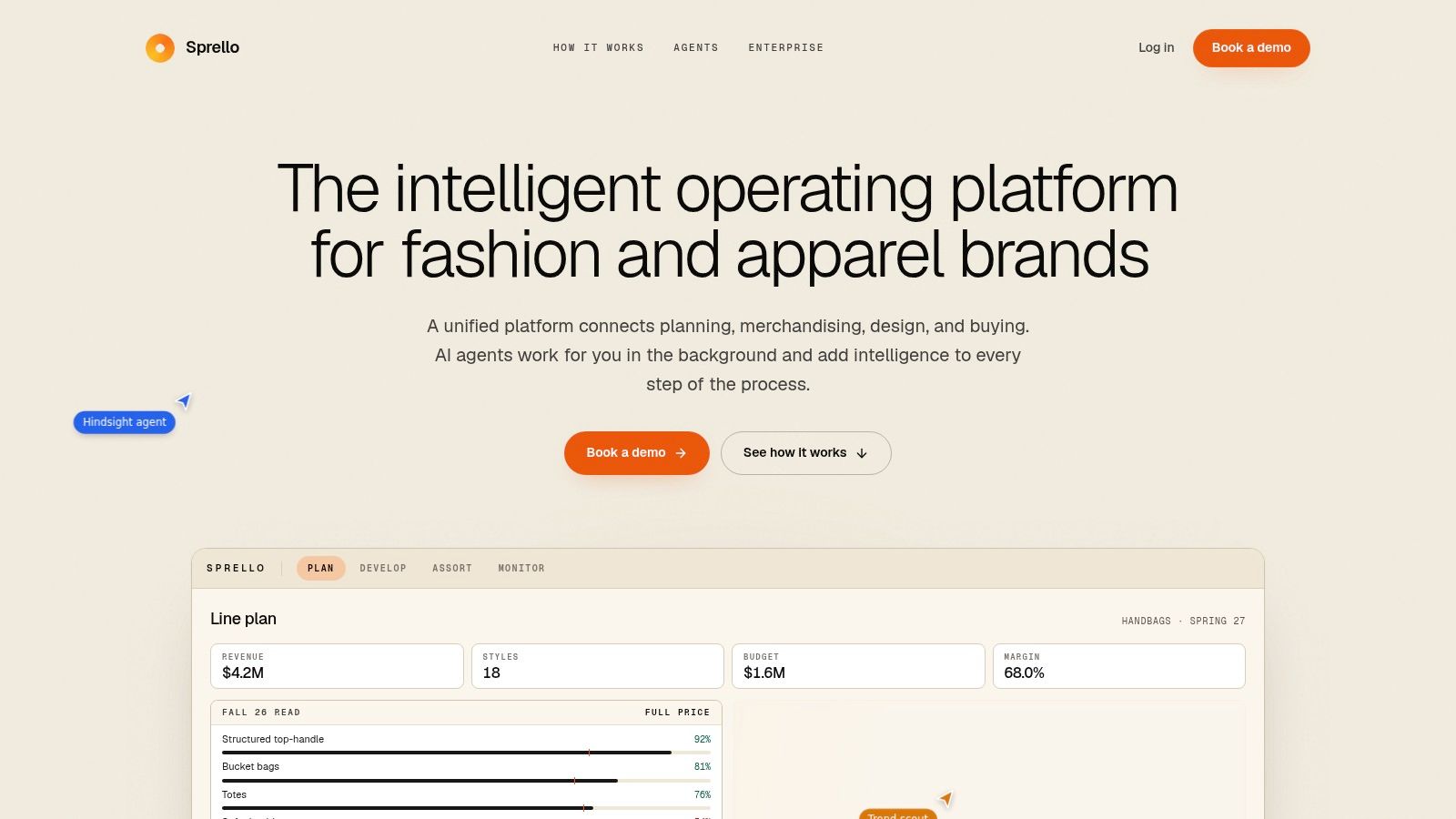
| Sprello (our product) | AI product visuals from sketches, CADs and references, one shared catalog, line review, wholesale line sheets, separate buyer assortments per account or channel | Tech packs, bills of materials, pattern making, demand forecasting, open-to-buy | AI for product development and merchandising; complements PLM and planning suites |
Sprello is our product, so read that row with the disclosure in mind. We're sold through a demo, and we don't claim to replace the systems above. PLM and planning suites are peers in this stack, not substitutes.
The handoffs that cause the friction
Approved visuals usually live in one system while the product record lives in another, so a merchandiser rebuilds the same style twice. Line sheets get recreated per account because the catalog can't hold buyer-specific views. Buyer assortments get edited by hand, which means the mix is never reviewed as a whole.
The fix is structural, not cosmetic. Selected visuals and product details should flow from the catalog into line sheets and buyer assortments, and each buyer's assortment should start from the same product information so the mix can be reviewed in one place. Sprello is SOC 2 compliant and built for exactly that layer.
When you're choosing between categories or vendors, ask three questions. Does it replace a system you already run, or feed it? Does it write to the same product record your PLM holds? Can a team audit what the AI produced, from input to output? For the PLM side of that decision, this overview of PLM software for the fashion industry is a reasonable starting point.
Which bottleneck should you fix first?
Measure before you buy. If the calendar slips, log where each style spends its days against the stage table, because teams routinely blame sampling for time lost in concepting and costing. If sampling rounds are the cost, fix review discipline and add visual review before physical samples, rather than negotiating harder with the sample room. If line sheets and buyer assortments are rebuilt by hand every season, consolidate the product record first, since that's a data problem wearing a formatting costume.
A 30-day starting plan that costs nothing but attention:
- Map current stage durations for your last two seasons against the timeline table and mark the two longest gaps.
- Count sample rounds per style for one season. The average, and the worst five styles, tell you where the loop problem lives.
- List the documents rebuilt per account, including line sheets, assortment books and buyer decks.
- Only then choose a tool category, matched to the bottleneck you just measured rather than the one a vendor pitched.
Sprello sits in the visualization and catalog layer, connecting AI product visuals to one shared product catalog, line review, wholesale line sheets and separate buyer assortments per account or channel. It complements PLM and planning suites rather than replacing them.
What do merchandisers and product leads ask before adding AI visualization?
Does AI visualization replace physical samples?
No. Visuals help a team decide which silhouettes, materials and colorways deserve a physical sample, which is where the savings come from. Fit, construction and performance still need physical review on a model and in the wash lab. The right mental model is that visualization moves cheap decisions earlier so expensive samples carry only the questions a screen cannot answer.
Does Sprello replace PLM or a planning suite?
No. It complements both and doesn't produce tech packs, bills of materials, pattern making, demand forecasting or open-to-buy. Those records still live in the systems you already run. If a vendor tells you one tool covers all of that, ask to see the production record it writes.
What security questions should a team ask?
Ask whether the vendor trains on your designs and sketches, where data sits, and how workspaces are isolated. Sprello is SOC 2 compliant, encrypts designs, sketches and brand IP at rest and in transit, and never uses customer uploads to train its models or anyone else's. Confirm the specifics during a demo rather than in a sales deck.
How many sample rounds should a style need?
There is no universal number, and any vendor quoting one is guessing. Count rounds per style for one season, split by category and complexity, and use that as your baseline. Improvement means a smaller number next season, not hitting a benchmark someone else published.
Sprello is AI for product development and merchandising, from product concept to buyer-ready collection: Canvas turns sketches, CADs, materials and references into photoreal visuals and colorways, and approved concepts flow into one shared product catalog, line review, wholesale line sheets and separate buyer assortments per account or channel, with SOC 2 compliance and no training on your data. It sits alongside your PLM and planning suites rather than replacing them. Book a demo at Sprello and we'll walk the catalog, Canvas, line sheets and assortments on one of your own product categories.
Related
More to explore
Fresh reads
Virtual Showroom Software: What It Does and How to Pick One
Virtual showroom software presents products to buyers and teams in visual form. Compare core features, categories and fit for your workflow.

3D Product Photography: A Guide for Large Catalogs
3D product photography explained for fashion, beauty and home brands: workflow, capture settings, tool options and catalog scaling.
Sketch to Render AI: Create Polished Concepts Fast
Turn hand-drawn ideas into polished visuals with sketch to render AI. Explore styles, refine details, and bring your design concepts to life.