
At its core, a social media content calendar is your roadmap. It’s a schedule that lays out what you're going to post, where you're going to post it, and when. Think of it as the single source of truth for your entire team, the tool that takes your social media from a reactive, chaotic scramble to a proactive, organized machine.
Why a Content Calendar Is Your Best Strategic Tool
Let's be real—we've all been there. It's 4 PM, and you realize you haven't posted anything today. That last-minute scramble is not only stressful, but the content that comes out of it rarely hits the mark. This is where a content calendar completely changes the game. It provides the structure and purpose your social media needs.
The benefits run much deeper than just saving you a headache. It's about building a consistent presence your audience can rely on. When followers know they can expect great stuff from you on a regular basis, you start building real trust and loyalty.
From Chaos to Clarity The Impact of a Content Calendar
A quick look at how a calendar transforms your social media workflow and business outcomes.
| Benefit | How It Changes Your Workflow | The Business Result |
|---|---|---|
| Strategic Alignment | Every post is tied to a specific marketing goal (e.g., Q3 sales, brand awareness). | Higher ROI on social media efforts and measurable progress toward goals. |
| Consistent Presence | Your feed is always active with planned, high-quality content. No more random gaps. | Increased audience trust, loyalty, and brand recall. |
| Team Collaboration | Everyone (writers, designers, managers) knows their role and deadlines. | Smoother operations, fewer bottlenecks, and a more cohesive brand voice. |
| Time Savings | You can batch-create content, saving hours of daily decision-making. | More time for high-value tasks like community engagement and performance analysis. |
Ultimately, a calendar isn’t just an organizational tool; it’s a strategic asset that brings order and intent to your entire social media operation.
Align Every Post with Business Goals
Posting without a plan is like shouting into the void and hoping for the best. A calendar forces you to step back and think strategically. The daily question shifts from a frantic, "What can I post right now?" to a purposeful, "What content will help us hit our Q3 lead generation goals?"
This simple shift ensures every single asset you create has a job to do.
- Looking for Brand Awareness? Pencil in posts that share your brand's origin story or spotlight a team member.
- Need to Generate Leads? Schedule content that promotes a gated e-book or an upcoming webinar.
- Want More Community Engagement? Block out time for interactive posts like polls, Q&As, or "ask me anything" sessions.
This kind of intentional planning is the backbone of any strong social media content strategy. If you really want to get this right, there's a fantastic guide on how to create a winning social media content calendar that breaks it all down.
Free Up Space for Genuine Creativity
This might sound backward, but having a rigid structure is one of the best things you can do for your creativity. Once the "what" and "when" are locked in, your team's mental bandwidth is freed up to focus on what really matters: making the content amazing. Suddenly, there's more time for brainstorming that wild campaign idea, writing sharper copy, and actually engaging with your followers in the comments.
A content calendar doesn’t kill creativity; it creates the ideal environment for it to thrive by taking away the daily pressure of the blank page.
Instead of putting out fires, you can look ahead and proactively plan for holidays, industry events, or cultural moments that resonate with your brand. Just imagine having your entire Black Friday campaign mapped out by the first week of October. Your creative team would have weeks, not days, to produce stunning visuals and compelling ad copy. That’s the real power a simple calendar gives you.
First Things First: Figure Out Your Goals and Your Audience

Let's be honest. A content calendar packed with random posts is just a prettier to-do list. It’s organized chaos, not a strategy. To turn it into a powerhouse for your brand, you have to nail down the fundamentals before you even think about what to post next Tuesday.
It all boils down to two simple but critical questions: "Why are we even doing this?" and "Who are we actually talking to?"
Answering the "why" means getting serious about your goals. Forget vanity metrics like likes and follower counts for a minute. We're talking about real business objectives that you can actually measure. A good goal isn't just a vague wish; it’s specific, has a deadline, and gives your content a clear purpose.
From Vague Hopes to Concrete Goals
It's easy to say you want to "grow on Instagram." But what does that really mean? A much stronger, more actionable goal is something like, "increase Instagram Story engagement by 15% in Q2." This tells you exactly what to do: build a more active, responsive community.
Similarly, instead of a fuzzy goal like "get more traffic," you could aim to "drive 500 qualified leads from LinkedIn to our new e-book landing page this month." See the difference?
When you have targets this specific, your content ideas practically write themselves. For that engagement goal, your calendar will suddenly fill up with polls, Q&As, and interactive stickers. For the lead gen goal, you’ll be planning posts that offer a sneak peek of your e-book's best insights, giving people a real reason to click and download.
Setting clear goals ensures every piece of content has a job to do. It transforms your calendar from a simple schedule into a powerful tool for achieving real business outcomes.
Once your goals are locked in, it’s time to get laser-focused on your audience. If you don't know who you're talking to, even the most brilliant content will completely miss the mark.
Creating Actionable Audience Personas
And no, "women, 25-40" is not an audience. That’s a demographic. You need to go deeper and build detailed audience personas—profiles of your ideal customers that feel like real, living people. This is where you dig into their motivations, their headaches, and where they spend their time online.
To build a persona that actually helps you, think about:
- Pain Points: What are their biggest struggles? A B2B software company might realize their audience isn't looking for more features; they're desperate to fix clunky, inefficient workflows.
- Content Habits: Where do they actually hang out? Are they scrolling through quick TikTok videos, reading long-form articles on LinkedIn, or saving ideas on Pinterest?
- Language and Tone: How do they talk? Pay attention to the slang, humor, or professional jargon they use in the online communities they trust.
For instance, a sustainable fashion brand might create a persona named "Eco-Conscious Chloe." She's a 28-year-old graphic designer who cares deeply about ethical production. She follows activists on Instagram, reads curated newsletters, and can spot corporate greenwashing from a mile away.
Armed with this insight, the brand’s calendar is no longer a guessing game. It's built around behind-the-scenes content, educational carousels on sustainable materials, and collabs with eco-influencers Chloe already trusts. Every single post is crafted to connect with her, which is what makes social media truly work. This foundational step is absolutely non-negotiable.
Alright, now that you know why you're posting and who you're talking to, it's time to figure out what you're actually going to say. This is where we build the creative backbone of your social media calendar.
Defining Your Content Pillars and Posting Cadence
First up are your content pillars. Think of these as the 3-5 core topics or themes your brand will own. They’re the main sections of your own little brand magazine, making sure you’re not just shouting "buy my stuff!" into the void.
Content pillars are what keep your strategy from feeling one-note. Instead of a constant stream of product promotions, you're creating a space where people can learn something, be entertained, and feel like part of a community. This is how you build a real audience that sticks around, positioning your brand as a helpful guide, not just a seller.
Finding Your Core Content Themes
So, how do you find these pillars? The magic happens at the intersection of what you're an expert in and what your audience actually cares about.
Let’s say you run an e-commerce brand selling sustainable home goods. Your pillars might look something like this:
- Eco-Friendly Living Tips: Simple, practical advice for cutting down on waste at home.
- Product in Action: Showing your goods in real-life settings, not just sterile product shots.
- Meet the Makers: The stories behind your artisans and the sustainable materials they use.
- Community Spotlights: Sharing photos and stories from your happy customers (user-generated content is gold!).
See how that works? These pillars give your content a clear direction. When it’s time to plan, you’re not staring at a blank calendar. You’re asking, "What's a great 'Eco-Friendly Living Tip' we can share on Tuesday?" This simple framework makes brainstorming a hundred times easier and keeps your content perfectly on-brand.
Nailing Your Posting Rhythm
Once you’ve got your pillars, the next question is how often to post. Your posting cadence is a delicate balance. You want to stay top-of-mind without burning out your team or spamming your followers.
Consistency beats intensity every single time. It's far better to post reliably three times a week than to post ten times one week and then go silent for the next two.
The data backs this up. While posting just 1-2 times a week will give you a little follower growth, kicking it up to 3-5 posts a week can more than double your growth rate and boost your reach per post by about 12%. If you can manage 6-9 posts weekly, you could see 18% more reach. And for the ambitious, 10+ posts a week can unlock nearly 24% more reach per post, almost tripling engagement compared to posting just once a week. If you want to get really nerdy with the numbers, Buffer did a great deep dive on social media frequency.
Your ideal posting frequency is the one you can consistently maintain while still putting out great content. Never, ever sacrifice quality for quantity.
Start with a schedule that feels doable, then scale up from there. A small business might start with three Instagram posts and two LinkedIn updates a week. Once you’ve got a good workflow, maybe you add a few more. We've actually built out a social media posting schedule template that can help you map this out.
Ultimately, the best cadence is the one that keeps your audience coming back for more without driving your team crazy.
Finding the Best Times to Reach Your Audience
You can create the most amazing post in the world, but if you publish it while your audience is asleep, it’s going to get lost in the void. Great content is only half the equation; the other half is timing. Your goal is to get your message in front of people when they’re actually scrolling, ready to engage.
It's easy to fall back on generic advice like "post at noon on weekdays," but that's a shot in the dark. The online habits of a B2B professional scrolling LinkedIn during their coffee break are completely different from a Gen Z student browsing TikTok at night. To really nail your timing, you have to look at your own data.
Start with Industry Benchmarks
Before you get lost in your own analytics, it's smart to look at the bigger picture. Broad industry studies give you a solid baseline—a starting point for your scheduling experiments. They show you the general rhythm of user activity across different platforms.
For instance, a lot of data points to the middle of the week as a sweet spot for engagement. An analysis from Social Champ pointed to Wednesday as a peak day for most networks, with Tuesday and Thursday following close behind for business-focused content. Friday mornings are also typically strong before activity drops off for the weekend. You can see more data-driven posting trends on Jeff Social Marketing.
Think of these benchmarks as an educated guess. They give you a logical place to start scheduling posts in your content calendar while you wait for your own, more specific data to roll in.
Use Your Own Analytics to Find the Gold
The real answers are waiting for you inside your platform analytics. This is where the magic happens. Tools like Meta Business Suite (for Facebook and Instagram), LinkedIn Analytics, and TikTok Analytics are packed with information about when your followers are most active.
Dive into the audience sections and look for the activity charts. They'll usually break down user presence by both the day of the week and the time of day.
- Days of the Week: Find the top two or three days where your audience consistently shows up.
- Hours of the Day: On those key days, what are the peak hours? Is it 8 AM during the morning commute, 1 PM during lunch, or 9 PM when people are unwinding?
Industry benchmarks might tell you to post at 9 AM, but if your own data shows a huge activity spike at 8 PM, that’s your prime time. Your analytics always win.
This is how you move from guessing to knowing. By layering general industry knowledge with your specific audience data, you build a posting schedule that actually works. It ensures all that great content you've planned gets the attention it deserves.
Choosing Your Tools and Building a Smart Workflow
Once you’ve got your strategy sketched out, it’s time to bring it to life. This is where you build the actual system—the living, breathing content calendar that will become your team's command center. The tool you pick is the foundation for everything, so choose wisely based on your team's size, budget, and how complex your needs really are.
You don't need a pricey, all-in-one platform right out of the gate.
Finding the Right Tool for the Job
For solo creators or small teams just getting started, a simple Google Sheet can be a game-changer. It's free, completely flexible, and something everyone already knows how to use. Just set up a few columns for the essentials, and you’re good to go.
But as your team and your ambitions grow, you'll likely feel the limitations of a basic spreadsheet. That’s when dedicated platforms like Trello, Asana, or Notion start to look really appealing. They offer advanced features like assigning tasks to teammates, building approval workflows, and providing visual calendar views that make managing a packed schedule feel so much easier.
What Every Good Calendar Needs
No matter what tool you land on, a few key details are non-negotiable for keeping things organized. Think of these as the essential columns in your spreadsheet or the custom fields in your project management app.
Your calendar should always include:
- Publication Date & Time: The exact moment you plan to hit "publish."
- Platform: Where is this going? Instagram, LinkedIn, TikTok?
- Post Copy: The final, polished text, ready to be copied and pasted.
- Visual Asset: A direct link to the approved image, video, or graphic.
- Status: What stage is this post in? (e.g., Draft, In Review, Scheduled).
- Notes: A catch-all for campaign details, specific hashtags, or other context.
For a deeper dive into your options, our guide on essential social media content creator tools is a great resource. You might also find that comprehensive social media management packages can help streamline the entire process from planning to publishing.
The Secret to Getting Ahead: Content Batching
Now, let's talk about a workflow habit that will completely change your life: content batching. Instead of waking up every morning in a panic thinking, "What am I going to post today?", you set aside a dedicated block of time to create a week's or even a month's worth of content at once.
Content batching is the difference between being a reactive content creator and a proactive content strategist. It frees you from the daily grind and gives you back the mental space needed for high-impact work like audience engagement and analysis.
This process isn't just about creating content in bulk; it’s about strategically scheduling it. You start by looking at industry benchmarks, then dive into your own analytics to see what’s working before you ever schedule a single post.
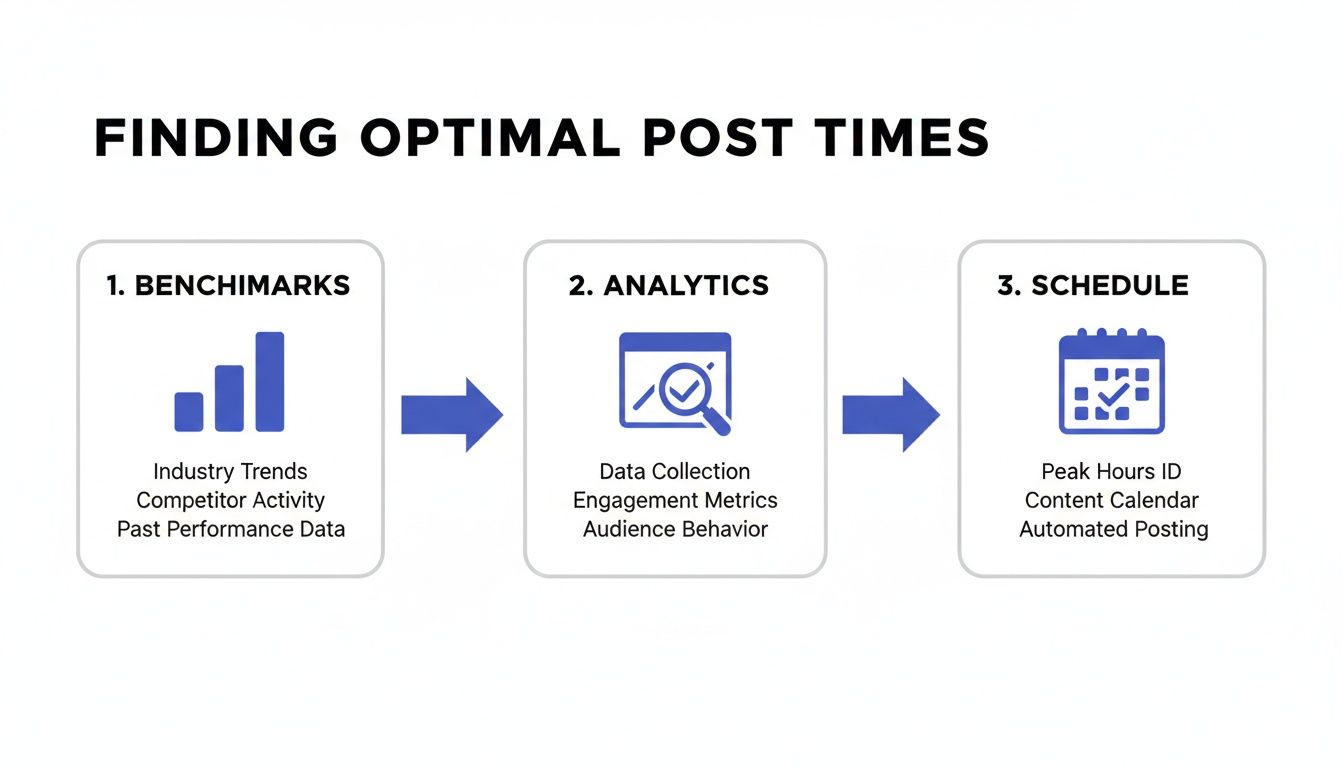
This simple flow reminds us that while best practices are a good starting point, your own data is the ultimate truth-teller. Don't be afraid to experiment. For example, I once worked with a B2B client who found that shifting their LinkedIn posts from a typical mid-week morning slot to a late-week afternoon resulted in 3.2x more engagement and 2.8x more profile clicks. That’s the kind of insight you only get from testing.
It just goes to show how a smart workflow, powered by the right tools and a little bit of testing, can elevate your entire social media strategy from good to great.
Answering Your Top Content Calendar Questions
Okay, you've got the strategy down, but now you're in the trenches, and the real-world questions are starting to pop up. It happens to everyone. Let's tackle some of the most common snags people hit when managing their content calendar so you can keep things moving without a hitch.
How Far Out Should I Actually Plan My Content?
This is a classic "it depends," but I can give you some solid guideposts. Finding the right planning window is a balancing act between being prepared and staying agile.
For most brands, planning one full month in advance is the sweet spot. This gives your team enough time to brainstorm, create thoughtful content, get designs done, and run everything through approvals. It provides structure without boxing you in so tightly that you can't react to anything.
However, if you're in a super fast-moving space where trends pop up and die in a week, you might feel more comfortable with a two-week rolling calendar. On the flip side, for those big-ticket items—think major product launches, seasonal campaigns, or holiday promotions—you’ll want to sketch those out a full quarter ahead. The key is to find a rhythm that lets you be proactive but still leaves room for a little real-time magic.
What Fields Are Non-Negotiable in a Calendar Template?
A calendar with just a date and a caption is a recipe for chaos. To keep your workflow smooth and everyone on the same page, your template needs a few essential columns. Think of these as the bare minimum for sanity.
- Publication Date & Time: When, exactly, is this thing going live?
- Platform: Where is it going? Instagram, LinkedIn, TikTok, etc.
- Content Pillar: Which core theme does this post connect back to?
- Post Copy: The final, approved text. No more "is this the right version?"
- Visual Asset: A link straight to the final image, graphic, or video file.
- Status: What stage is it in? (e.g., Draft, In Review, Scheduled, Published).
I've also seen teams get a lot of value from adding a "Notes" column for campaign details or specific hashtags. Another great addition is a column for the live post URL, which makes it much easier to go back and track performance later.
It's helpful to remember the difference between a calendar and a library. Your content calendar is the schedule—it tells you when and where to post. Your content library is the warehouse—it's where all your approved assets (images, videos, testimonials) live. You pull from the library to fill the calendar.
How Can I Plan Ahead but Still Jump on Trending Topics?
A good content calendar is a guide, not a straitjacket. You absolutely have to leave room for spontaneity, or you’ll miss the moments that make social media feel, well, social.
The secret is to build flexibility right into your plan. Don't book every single slot.
When you're planning your month, map out all your core content—the educational posts, the product features, the campaign promotions. But then, intentionally leave one or two open slots each week. These are your designated spots for jumping on a trending meme, sharing some amazing user-generated content you just found, or reacting to a piece of breaking news in your industry. This hybrid approach gives you the consistency of a plan and the freedom to be relevant.
Ready to stop filming and start creating? With Sprello, you can generate high-converting video ads and social content in minutes using AI. Streamline your entire workflow from script to storyboard to final export, and ship more videos than ever before. Start creating with Sprello today!


