

A solid social media content strategy is your game plan. It’s what transforms random posting into a focused system designed to attract, engage, and ultimately win over your ideal customers. It’s the roadmap that gives every single post a purpose.
Laying the Foundation for Your Social Media Strategy
Before you even think about what to post next Tuesday, you need to lay some serious groundwork. Jumping straight into content creation without a plan is like building a house without a foundation—it’s destined to crumble. A truly effective social media presence connects every single action back to a clear business objective.
This initial planning phase is all about making sure your efforts are targeted and measurable. Forget chasing empty metrics like follower counts. We're going after the KPIs that actually move the needle for your business.
Define Your Goals and Key Performance Indicators
First things first: what are you actually trying to accomplish? Are you looking to drive more traffic to your website? Generate leads for your sales team? Boost product sales? Or maybe build a die-hard community around your brand?
Each of these goals requires a completely different playbook and a different way of measuring success.
For instance, a brand that’s all in on community building will obsess over engagement rates and the quality of comments. On the other hand, an e-commerce store will live and die by its click-through rates and conversion numbers from social ads.
Common goals usually fall into a few key buckets:
- Brand Awareness: Getting your name in front of the right people.
- Lead Generation: Collecting contact info from potential customers.
- Customer Engagement: Sparking conversations and building real relationships.
- Direct Sales: Driving sales right from your social channels.
This process—moving from goals to your audience and then to your competition—is the absolute bedrock of a strategy that works.
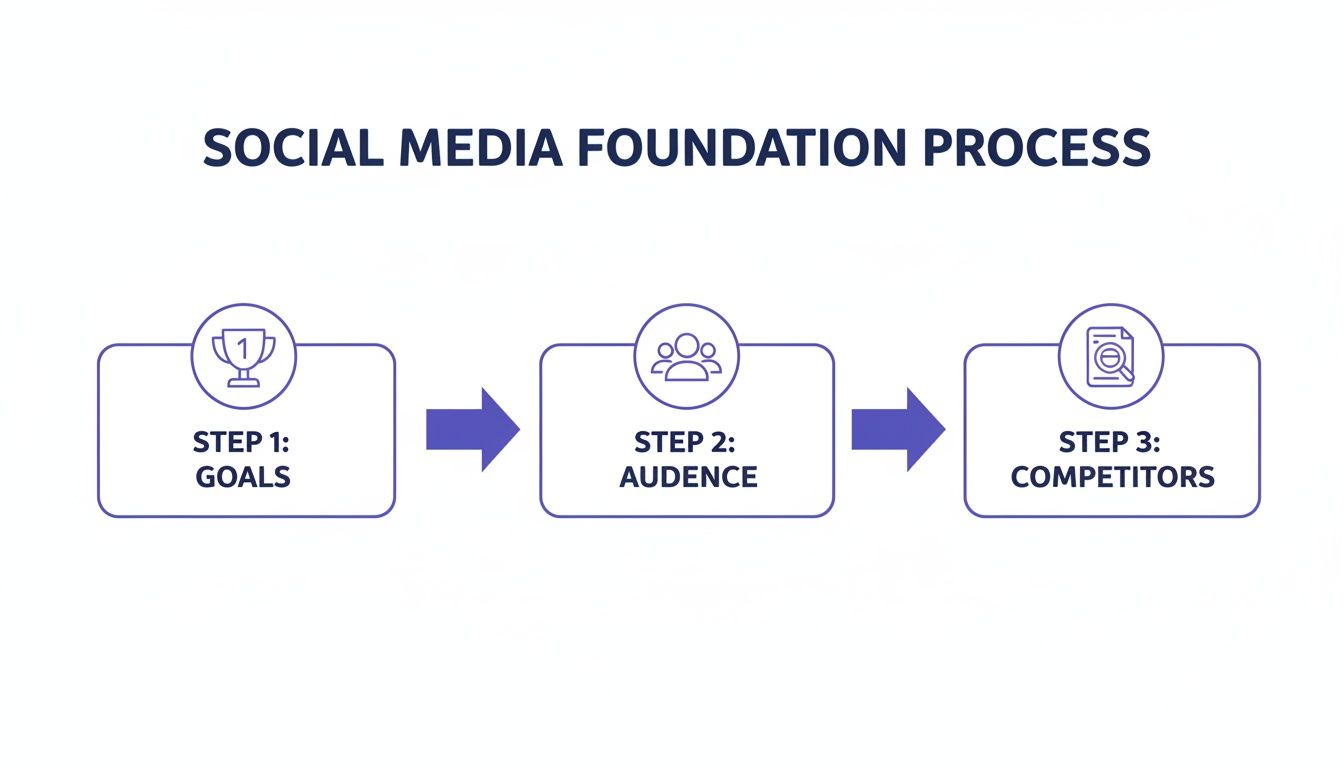
This simple flow is a constant reminder: strategic success starts with crystal-clear objectives, a deep understanding of your audience, and a sharp eye on what everyone else is doing.
Understand Who You're Talking To
With your goals locked in, it’s time to get laser-focused on who you're talking to. Building out detailed buyer personas helps you go beyond basic demographics and get into what really makes your ideal customer tick—their biggest headaches, what motivates them, and where they spend their time online.
Your audience isn't a monolith. They are individuals with distinct needs and preferences. A well-researched persona allows you to create content that speaks directly to them, making them feel seen and understood.
To really bring these personas to life, you need to answer a few key questions:
- What are their biggest pain points and challenges?
- Which social media platforms are they scrolling through every day?
- What type of content makes them stop and engage (videos, articles, memes)?
- What ultimately influences their decision to buy something?
The better you get at answering these, the more your content will resonate. This is exactly how you start to work with the social media algorithms instead of against them. For a deeper dive, check out our guide on how the social media algorithm works: https://sprello.ai/blog/social-media-algorithm-explained
Analyze Your Competitors
Last but not least, it's time to do a little recon. A quick and dirty competitive analysis will show you what others in your space are doing well and, more importantly, where they’re dropping the ball.
This isn’t about copying what your competitors do. It’s about spotting opportunities. Look for content gaps you can fill or a unique angle you can own to make your brand stand out. Getting this groundwork right is crucial if you want to build a winning social media content strategy. This homework sets the stage for everything that comes next.
Developing Your Core Content Pillars
Okay, you've figured out your goals and who you're talking to. Now for the fun part: deciding what you’re actually going to say. This is where we stop strategizing and start creating, and it all begins with your core content pillars.
Think of these as the 3-5 big themes your brand will own. They're the topics you'll return to again and again, establishing your expertise and giving your social media a clear focus. Without them, you’re just scrambling for random post ideas every day. With them, you have a repeatable system.

Defining your pillars gives every piece of content a purpose. It’s how you become the go-to resource people think of for a specific topic.
How to Find Your Pillars
The magic happens at the intersection of what you know and what your audience needs. Your best pillars live right in that sweet spot.
A simple exercise I use with clients is to grab a whiteboard (or a notebook) and draw two columns:
- Our Expertise: What are the 5-10 things our company knows inside and out? This could be technical skills, industry secrets, or unique perspectives. Don't be shy here.
- Audience Problems: What are the 5-10 biggest challenges or burning questions our ideal customer has? Go back to your audience research for this.
Now, look for the overlap. The themes that pop up on both lists are your strongest candidates for content pillars.
For instance, a company selling project management software isn't just selling software; they're selling efficiency and calm. Their pillars might be "Team Productivity Hacks," "Remote Work Leadership," and "Project Planning Essentials." Each one is broad enough for endless ideas but specific enough to be genuinely helpful. This kind of focus is a game-changer when you're building out a small business content marketing plan.
Don't Be a One-Trick Pony: Create a Balanced Content Mix
Once you have your pillars, it’s tempting to just start teaching all day, every day. Big mistake. No one wants to sit through a lecture, and they definitely don't want a constant sales pitch. A healthy social media feed feels more like a good conversation, with a natural give and take.
To keep people engaged, you need a balanced mix of content types that serve different needs.
- Educate: This is your bread and butter. Share your knowledge through how-to guides, quick tips, and industry analysis. This is how you build trust and prove you know your stuff.
- Entertain: Show some personality! Behind-the-scenes content, team member spotlights, or even a well-placed meme can make your brand feel human and relatable. It’s about connection, not just conversion.
- Engage the Community: Turn the spotlight on your audience. Share user-generated content (UGC), run polls, ask questions, and feature customer stories. This makes your followers feel like part of something bigger.
- Promote: Yes, you still need to sell. But do it strategically. We're talking case studies, testimonials, product demos, and special offers. These land much better when they're sprinkled in, not shoved down people's throats.
A great rule to live by is the 80/20 rule: 80% of your content should provide value (educating, entertaining, or building community), while just 20% directly promotes your business. It's about earning the right to sell.
Let's be real: modern social media runs on video and striking visuals. The data is overwhelming. Branded video is so powerful that 74% of people report sharing it, and visual content, in general, is a staggering 40x more likely to be shared.
This means every post is a potential engine for growth. As you brainstorm ideas for your pillars, think visually first. Your strategy should revolve around creating shareable, testable video content that's built to be discovered.
Building a Practical Content Calendar and Cadence
So, you've got your core content pillars sorted. Fantastic. But ideas without a schedule are just wishes. Now it's time to turn those big concepts into a real, manageable plan. This is where your social media content calendar comes in—it's the tool that transforms your strategy from a document into a daily workflow.

Think of it as your single source of truth for what gets posted, where it goes, and when it goes live. A good calendar completely eliminates that last-minute panic of, "Oh no, what are we posting today?" and ensures you maintain a consistent, thoughtful presence across your channels.
Choosing Your Planning Horizon
One of the first questions I always get is, "How far out should we plan?" There’s no magic number here. The right answer really depends on your team's size and how quickly your industry moves. The goal is to find a rhythm that lets you plan ahead but still leaves room to be spontaneous.
- Weekly Sprints: This is perfect for small, nimble teams or in industries where trends pop up and die in a day. You plan the upcoming week in detail but can easily pivot to jump on a timely conversation.
- Monthly Cycles: This is the sweet spot for most businesses. It gives you enough runway to map out major themes for the month ahead while still planning the specific, day-to-day posts on a weekly basis.
- Quarterly Roadmaps: If you're part of a larger organization with fixed campaigns and big product launches, this is for you. You'll plot out the major milestones for the quarter and then fill in the finer details month by month.
No matter which timeline you choose, your calendar needs a healthy mix of content types to keep things interesting. For those bigger pushes, using a dedicated marketing campaign planning template can be a lifesaver to structure everything within your broader calendar.
The Anatomy of a Great Content Calendar
A truly functional calendar is more than just a list of dates. It’s a strategic command center that holds all the essential details your team needs to get the job done right.
Whether you're using a simple spreadsheet or a fancy tool, you absolutely need to track these key elements:
| Calendar Field | Purpose | Example |
|---|---|---|
| Date & Time | The exact moment the post is scheduled to go live. | Oct 26, 9:00 AM EST |
| Platform | Which social network the content is for. | |
| Content Pillar | Which of your core themes this post supports. | Team Productivity Hacks |
| Format | The type of content (e.g., Reel, Carousel, Story). | Carousel (5 slides) |
| Copy | The final text for the caption, including hashtags. | "5 ways to reclaim your focus..." #productivity |
| Visuals | A link to the final image, video, or graphic. | Link to Canva/Drive |
| Status | The current stage of the post in your workflow. | In Review |
This level of detail keeps everyone on the same page and prevents silly mistakes. It’s what turns your social media strategy into a process you can actually repeat and scale.
Finding Your Optimal Posting Cadence
"How often should I post?" This is the question, isn't it? Generic advice like "post three times a week" is pretty useless because the only real answer is: it depends.
The ideal posting frequency is the maximum number of times you can post high-quality content consistently without seeing a decline in engagement per post. Consistency trumps frequency every single time.
Start with some baseline numbers, but be ready to listen to what your own data is telling you.
- Instagram: A good starting point is 3-5 feed posts per week.
- TikTok: The algorithm here loves volume, so 1-3 times per day is common.
- LinkedIn: This is a quality-over-quantity game. Aim for 3-5 strong posts per week.
- Facebook: Start with 3-5 posts a week and see how your audience responds.
Run with this for a month, then get into your analytics. Did you increase your posting but see your engagement rate per post tank? You might be annoying your audience. If your reach and engagement are holding strong or growing, you might have room to post even more. Let your audience's behavior be your guide, not some generic rulebook.
How to Scale Content Production with AI
Let’s be honest: churning out enough high-quality content to feed all your social media channels is a beast. The pressure for fresh videos, graphics, and posts is relentless, and it's a fast track to burnout. This is the point where you stop working harder and start working smarter. It's time to bring in AI to scale your output without killing your quality.

Tools like Sprello are built to solve this exact problem. Instead of staring at a blinking cursor, you can generate dozens of audience-specific scripts, video hooks, and fresh concepts in minutes. This completely slashes your ideation time, freeing you up to focus your creative energy on refining the absolute best ideas.
Accelerate Your Video Workflow
Video production has always been the big time and money sink. But AI is completely changing that game. Modern tools let you create polished, professional-looking videos without ever picking up a camera or hiring an actor.
You can streamline the entire process from start to finish:
- Script Generation: Got a topic or a blog post? Pop it in and generate multiple script variations tailored for TikTok, YouTube Shorts, or any other platform.
- AI Voices and Avatars: Skip the expensive voiceovers and on-screen talent. You can choose from a library of surprisingly realistic AI voices and avatars to bring your scripts to life.
- Automated Editing: Forget spending hours in an editor. Features like one-click background removal and auto-generated captions with dynamic highlighting give your videos a pro finish in a tiny fraction of the time.
This approach lets you test more creative angles and messages than was ever possible before. If a video doesn't perform well, who cares? You only spent a few minutes on it, not a few days. You can pivot and try something new almost instantly. This isn’t just a trend; it's a fundamental shift in how marketing teams get things done.
AI has become the ultimate creative partner. It handles the repetitive, time-consuming tasks, freeing up marketers to focus on the high-level strategy and creative direction that truly make a brand stand out.
The numbers back this up. Nearly 60% of marketers now use AI every week, and 70% say it makes their jobs easier. It’s why a staggering 97% of marketing leaders now consider AI literacy a non-negotiable skill. To get a better sense of how deep this goes, check out these insights on AI-powered advertising strategies.
Multiply Your Content with Smart Repurposing
The most efficient social media strategies aren't about constantly creating new things from scratch. The real secret is repurposing a few high-value assets into tons of smaller, platform-specific pieces. A single piece of long-form content can easily fuel your social calendar for weeks.
Think about a one-hour webinar you just hosted. That's not one piece of content; it's a goldmine.
With AI tools, you can instantly turn that one webinar into:
- Short-Form Video Clips: Automatically pull the most interesting 30-60 second segments and turn them into Reels, TikToks, and Shorts. Add captions and a headline, and you’ve got a dozen videos ready to schedule.
- Quote Graphics: Extract the most powerful quotes and transform them into slick, shareable graphics for Instagram and LinkedIn.
- Carousel Posts: Summarize the webinar's key takeaways into a multi-slide carousel that breaks down complex ideas into bite-sized, digestible steps.
- Audio Snippets: Rip the audio from key moments to create audiograms for people who prefer to listen on the go.
This "create once, distribute forever" mindset is how you maintain a high-volume, high-quality presence without a massive team or budget. It makes sure your core message hits your audience in whatever format they prefer, squeezing every last drop of ROI from the content you work so hard to create.
Measuring What Matters and Optimizing for Growth
So, you’ve created some killer content. That’s a huge win, but it's really only half the battle. A social media strategy without a solid plan for measuring what works is just throwing spaghetti at the wall and hoping something sticks.
To really understand the impact you’re having, you need to look past the vanity metrics. Sure, a high follower count looks nice, but the numbers that truly matter are the ones that connect directly to your business goals.
This is how you prove your worth. By tracking the right Key Performance Indicators (KPIs), you can draw a straight line from your social media efforts to tangible results—whether that’s more brand awareness, a flood of new leads, or a direct boost in sales. It’s all about turning data into decisions.
Build Your Essential KPI Dashboard
First things first, let's get organized. It’s easy to get lost in a sea of metrics. Instead, create a simple, focused dashboard that aligns with what you’re actually trying to achieve. This gives you a clear snapshot of your performance without getting bogged down by numbers that don't mean much.
Think of your dashboard as a living document, a health report for your entire strategy.
Don't just track everything; track what tells a story. Your KPI dashboard should answer one simple question: "Is our social media strategy working?" If a metric doesn't help answer that, it probably doesn't belong on your main dashboard.
Here’s a look at how you can build a dashboard that ties your metrics back to your strategic goals. This approach turns random data points into a clear story about your performance.
Your Essential Social Media KPI Dashboard
This simple framework helps you measure the true impact of your social media content by connecting every number to a strategic purpose.
| Goal | Primary KPI | Secondary Metrics | Why It Matters |
|---|---|---|---|
| Brand Awareness | Reach & Impressions | Follower Growth Rate, Shares | This tells you how many unique people are seeing your content and how far your message is spreading. It's your visibility score. |
| Engagement | Engagement Rate | Comments, Likes, Saves | This shows how well your content is actually connecting with your audience and starting conversations. It's the pulse of your community. |
| Website Traffic | Click-Through Rate (CTR) | Clicks, Website Sessions from Social | This directly tracks how effective you are at getting people to take action and leave the social platform for your website. |
| Conversions | Conversion Rate | Leads Generated, Sales from Social | The bottom-line metric. This ties your social media work directly to revenue or lead generation, proving its business value. |
With a dashboard like this, you have the foundation for making smart, informed decisions and continuously fine-tuning your approach.
Use A/B Testing to Find What Works
Once you’re tracking your core metrics, you can start actively improving your content. The best way to do this is with good old-fashioned A/B testing. The idea is simple: create two versions of a post where you change just one single thing, then see which one performs better.
This data-driven approach removes the guesswork and emotion from content creation. You let your audience’s behavior tell you what they want to see.
You can A/B test almost anything. Some of the most valuable elements to experiment with include:
- The Hook: Try different opening lines in your caption or the first three seconds of your video. Does a question work better than a bold statement?
- The Visuals: Pit a static image against a short video or a carousel. Does showing a person's face get more clicks than a clean product shot?
- The Call-to-Action (CTA): Test different CTAs to see what drives action. Does "Learn More" get more clicks than "Shop Now"? Does asking a direct question get more comments?
Imagine an e-commerce brand running two identical ads. Ad A uses a lifestyle photo of someone using the product, while Ad B shows the product on a clean, white background. By comparing the click-through and conversion rates, they’ll know exactly which visual style drives more sales for future campaigns.
Establish a Regular Review Cadence
Your social media strategy is not a "set it and forget it" document. The social world moves at lightning speed, so your plan needs to be flexible enough to keep up. Setting up a regular review cycle is absolutely essential for long-term growth.
This is how you make sure you’re always learning from your data and making smart adjustments.
A simple and effective rhythm is to break reviews down into weekly, monthly, and quarterly check-ins.
- Weekly Check-In: This is your quick pulse check. Just take 30 minutes to review your best and worst-performing posts from the week. Look for any immediate patterns or surprises you can act on right away.
- Monthly Review: Time for a deeper dive. Pull up your KPI dashboard and see how you’re tracking against your monthly goals. Analyze the trends in your engagement, reach, and traffic to make tactical tweaks for the month ahead.
- Quarterly Strategy Session: Now, zoom out and look at the big picture. Are your content pillars still resonating? Are your main goals still the right ones? Use the data from the entire quarter to make bigger, more strategic decisions for the next three months.
This structured review process turns measurement into a powerful feedback loop, ensuring your social media strategy is always an engine for real business growth.
Answering the Tough Social Media Strategy Questions
Let's be real—building a social media strategy from scratch can feel like you're wrestling with a handful of the same tricky questions over and over. Even with a great plan, the day-to-day of social media is a constantly moving target.
Getting straight, practical answers to these common hurdles is what separates a strategy that looks good on paper from one that actually drives growth. So, let's cut through the noise and tackle the big ones.
How Often Should I Really Be Posting?
This is the question I get asked most often, and my answer is always the same: consistency beats frequency, every single time. There's no magic number that works for everyone. The right posting cadence comes down to a mix of the platform, your audience, and what your team can realistically produce without burning out.
Think of it this way: for fast-moving feeds on platforms like Instagram and TikTok, you need a steady drumbeat to stay relevant. But that doesn't mean you need to post constantly.
Here's a good place to start:
- Instagram & Facebook: Aim for 3-5 quality posts a week. This is enough to stay on your audience's radar without sacrificing quality.
- TikTok & YouTube Shorts: These platforms are hungrier. If you can keep the quality up, 1-3 posts a day is a solid goal.
- LinkedIn: This is a "less is more" network. Focus on 3-5 thoughtful, value-packed posts a week.
The secret sauce? Test, and then listen to your data. If you start posting more but your engagement rate per post tanks, you've found your limit. Let your analytics tell you what your audience actually wants.
How Long Until I See Real Results?
Patience is probably the most underrated skill in organic social media. You'll likely see some encouraging little wins—a jump in engagement, a few more followers—within the first 1-3 months. That's great! It means you're on the right track.
But for the big stuff, like a real impact on leads or sales, you need to play the long game. It typically takes about 6-12 months of consistent, high-quality work to see a major return from your organic social efforts. (Of course, paid ads can speed this up dramatically by buying you reach).
The key is to track your leading indicators. Is your click-through rate improving? Are people leaving more thoughtful comments? These are the signs that prove your strategy is working, long before the revenue starts to show up in a big way.
Where Do I Find New Content Ideas When I'm Stuck?
Staring at a blank content calendar is a uniquely painful experience. But you don't need to reinvent the wheel every single week. A good system for generating ideas is your best friend.
Your content pillars are your North Star, but you can always pull from these reliable wells for inspiration:
- Listen to Your Audience: The best ideas are usually hiding in plain sight. What questions are people asking in your DMs and comments? What are their biggest frustrations? That's your content, right there.
- Scope Out the Competition: See what's working for others in your space. I'm not saying you should copy them, but you can absolutely find content gaps to fill or popular formats you can put your own unique spin on.
- Use AI to Brainstorm: Modern tools are a massive shortcut here. You can feed an AI tool a single topic and get back dozens of interesting hooks, video scripts, and fresh angles to explore.
What Are the Biggest Mistakes to Avoid?
I've seen a few common missteps completely derail an otherwise great social strategy. Knowing what they are is half the battle.
The absolute biggest mistake is not having clear, measurable goals. If you don't know what you're trying to achieve, how can you possibly know if you're succeeding? Close behind is treating every platform like it's the same—you have to tailor your content for each network's vibe and audience.
Finally, so many brands are still way too promotional. Your feed can't be all "buy my stuff." You have to earn that right by educating, entertaining, and actually building a community. And the final nail in the coffin? Ignoring your data. Your analytics are your roadmap—use them.
Ready to stop scrambling and start scaling your video content? Sprello helps you produce high-converting social videos and ads in minutes, not days. Generate scripts, use realistic AI voices, and create polished content without ever touching a camera. Start creating faster with Sprello.


