October 15, 2026
Product Concept Design That Actually Ships
A practical guide to product concept design for fashion and lifestyle brands. Master ideation, moodboards, and production-ready briefs that scale.
At 2 a.m., a merchandising director is staring at forty product concept sketches spread across a screen. Every image looks promising. None carries a target cost, material path, size range, regional role, or channel plan. The team has plenty of creative energy, but no reliable way to decide what deserves sampling.
That scene repeats across fashion, beauty, lifestyle, and home goods businesses. The problem usually isn't a shortage of ideas. It's the absence of a system that connects creative direction, customer demand, merchandising logic, sourcing constraints, and production evidence. Product concept design earns its value before a product reaches the sample room, because that's where teams can still change direction without dragging an entire season behind them.
A well-built concept should help a buyer understand the commercial role, a designer refine the visual language, a sourcing manager assess feasibility, and a content team anticipate the assets required later. Even early advertising references, such as collections of sources for Facebook video ad inspiration, can reveal how a visual idea might translate beyond a product board into a channel-ready story.
Why Most Product Concepts Never Reach Production
A forty-sketch review can look productive while concealing a decision problem. The team evaluates images as separate expressions of taste, then tries to resolve commercial and technical questions after different stakeholders have committed to different options.
One person backs the sculptural silhouette because it feels new. Another supports the simpler version because a factory can repeat it reliably. Merchandising needs a clear price ladder, while regional teams may require different proportions or colorways. Marketing may prefer the concept with the strongest editorial presence. Shared criteria are absent, so the most forceful opinion often wins and objections surface during costing, sampling, or line review.
Channel references can sharpen that conversation early. Collections of sources for Facebook video ad inspiration show how a visual direction might become a campaign story, helping the team test whether the concept can carry content beyond a product board.
The risk grows for brands managing many SKUs across markets and channels. A concept that succeeds as a hero image may fail across multiple sizes, materials, colorways, packaging formats, or regional assortments. Creative teams redraw, sourcing teams re-cost, and merchandisers rebuild the range under seasonal pressure. A production-ready concept gives each function a decision it can act on.
Product concept design has always connected vision and making
The discipline developed through the relationship between appearance and production. The term “industrial design” was first recorded in 1839, in connection with preparing patterns for silk manufacture. The generally attributed use of “industrial designer” dates to 1919, when Joseph Claude Sinel used the title. Carnegie Institute of Technology opened a design program in 1934, helping establish design as an academic and occupational field rather than only a manufacturing support activity. These milestones are documented in this history of product design.
The historical lesson remains practical. A distinctive appearance is only one part of a viable concept. The proposal also needs a plausible material, repeatable construction, usable proportions, a commercial role, and a route to production. Product concept design gained its value by connecting creative exploration with industrial reality.
Practical rule: If a concept cannot explain who it serves, how it will be made, and where it belongs in the assortment, it is not ready for selection.
The beautiful bottleneck
A moodboard can start a conversation, while a line review needs decisions. A sketch can express a point of view, but sourcing also needs to know whether the trim is available and whether the silhouette can be graded across the required size range.
Exploration still has a place. It works best inside a decision structure that records assumptions, constraints, and evidence before sampling begins. Design capability also has measurable strategic importance. UK Design Council analysis found that design-engaged firms were 8.1% more likely to be product or service innovators, while UK businesses invested £14.7 billion in design in 2015. The UK design economy generated £85.2 billion in gross value added in 2016, equal to 7% of national GVA, as reported in UK Parliament's written evidence on design.
Those figures do not guarantee sales for an attractive concept. They show why design belongs inside commercial decision-making rather than at its edge. The working question becomes which concept has enough evidence, production logic, and assortment value to justify the next investment.
The Five Gates of a Production-Ready Concept Workflow
A production-ready workflow uses five controlled gates. Each gate creates an artifact that makes the next decision easier and prevents the team from advancing a visually exciting but commercially weak idea.
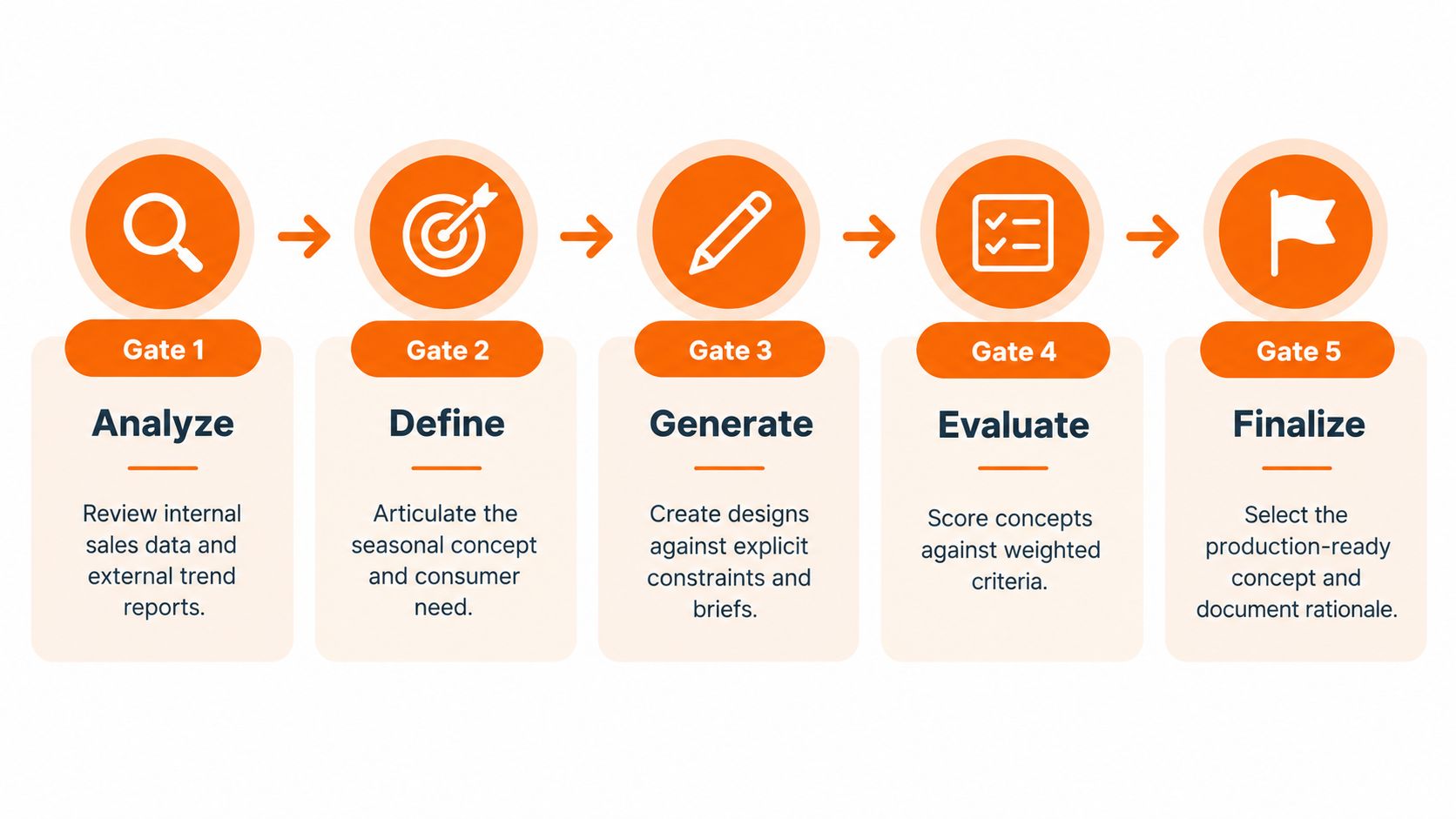
Gate 1, analyze the evidence
Start with internal evidence, not a blank page. Review sales patterns, assortment gaps, returns, regional performance, prior material choices, channel needs, and brand codes. Add external trend signals, competitor observations, cultural references, and relevant customer feedback.
The output is an evidence map, not a moodboard. It should identify the opportunity, the constraints, and the assumptions that still need testing.
Gate 2, define the concept
Turn the opportunity into a concise seasonal or product concept. State the customer, need, use occasion, emotional territory, commercial role, and boundaries. A useful concept gives designers room to interpret while removing ambiguity about what the product must accomplish.
For example, “quiet utility for urban commuters” is more useful than “modern minimalism” because it implies use, attitude, and functional expectations.
Gate 3, generate against constraints
Designers should explore widely inside a defined brief. Generate silhouettes, materials, details, packaging forms, or colorways that answer the concept and carry structured metadata from the beginning.
Every candidate should include:
- Target customer: The specific audience and need being addressed.
- Use occasion: Where and how the product enters the customer's life.
- Material direction: Proposed base, trim, finish, or substrate.
- Silhouette or form: The proportions and construction logic.
- Colorway: Core, seasonal, or market-specific use.
- Price position: The intended place in the assortment.
- Channel: E-commerce, wholesale, retail, editorial, or another route.
- SKU role: Hero, volume driver, entry point, seasonal statement, or complement.
Gate 4, modify and evaluate
Don't select the first attractive output. Remove details that create sourcing risk, adjust proportions that distort the line, and compare candidates against agreed criteria. This shared record keeps designers, merchandisers, sourcing specialists, and regional stakeholders aligned throughout the process.
A documented evaluation method can assess novelty, innovation potential, feasibility, and business-success factors. Tools such as Pugh matrices, Quality Function Deployment, Analytic Hierarchy Process, and Pahl–Beitz evaluation are established approaches to concept assessment, as described in the Design Society's method for selecting innovative product concepts.
Gate 5, finalize the production specification
The final gate converts the selected direction into a production brief. Attach approved visuals, dimensions, material requirements, color references, construction notes, target cost, size range, regional variations, and ownership for approval.
One AI-fashion pilot reported an inception score of 7.40, an image-reality score of 3.76, a response time of 1.02 seconds per request, and throughput of 58.4 requests per minute. Those figures are system benchmarks, not evidence of market demand or production readiness, as the underlying AI fashion design study makes clear. Speed helps only when human review, technical checks, material availability, fit, and assortment coherence remain in the workflow.
Moodboards That Mean Something vs Canvases That Decide
A concept review can stall over a rounded shoulder bag that looks compelling in isolation but has no clear route through sourcing, merchandising, or regional approval. Moodboards help teams agree on light, texture, proportion, attitude, and cultural reference before details harden. Their limit appears when several concepts must be compared across SKUs, markets, and seasons.
Take the bag beside references of curved architecture, brushed metal, pale stone, and restrained travel photography. The board communicates tactility and restraint. It leaves practical decisions open: whether the bag is an entry product or a premium statement, whether the handle works for weekday use, and whether the proposed leather can be sourced consistently across regions.
A structured concept canvas preserves the visual language while recording the decisions required for review.
| Dimension | Moodboard | Concept Canvas |
|---|---|---|
| Purpose | Establishes atmosphere and creative direction | Defines a product decision and its commercial role |
| Customer | Implied through references | Named by target need, audience, and use occasion |
| Product form | Suggested through images | Described through silhouette, proportion, dimensions, and details |
| Materials | Shown as texture or reference | Connected to availability, finish, compliance, and cost implications |
| Color | Expressed as an emotional palette | Assigned to core, seasonal, regional, or channel use |
| Assortment role | Usually absent | Identifies hero, volume, entry, seasonal, or complement role |
| Review outcome | “This feels right” | Advance, revise, test, or reject with a documented reason |
The canvas earns its place in an enterprise workflow
Small teams can carry missing information in conversation. Larger organizations cannot. As a concept passes through design, merchandising, sourcing, regional review, content production, and approval, undocumented assumptions turn into rework and inconsistent SKU decisions.
Keep the canvas concise enough for a quick review, with enough specificity to answer operational questions. For the bag, record the target customer, weekday-to-weekend use, rounded shoulder silhouette, coated textile with recycled metal hardware, accessible premium position, e-commerce and wholesale channels, hero SKU role, two core colorways, and allowance for regional adaptation.
That information gives creativity a destination instead of boxing it in. It also makes the concept legible to reviewers who missed the original ideation session and gives sourcing teams a clear basis for challenge.
A visual workflow such as Sprello's Product Concepting can support the transition by helping teams explore materials, silhouettes, and palettes while connecting creative direction with structured product information. The software matters less than the decision record that remains after the moodboard meeting and can be checked across regions, seasons, and assortment reviews.
Exploring Silhouettes, Materials, and Colorways With Intention
Early exploration works best as a constrained combinatorial exercise. Open-ended generation produces visual volume, but volume alone overwhelms review teams and hides the strongest directions inside a pile of near-duplicates.
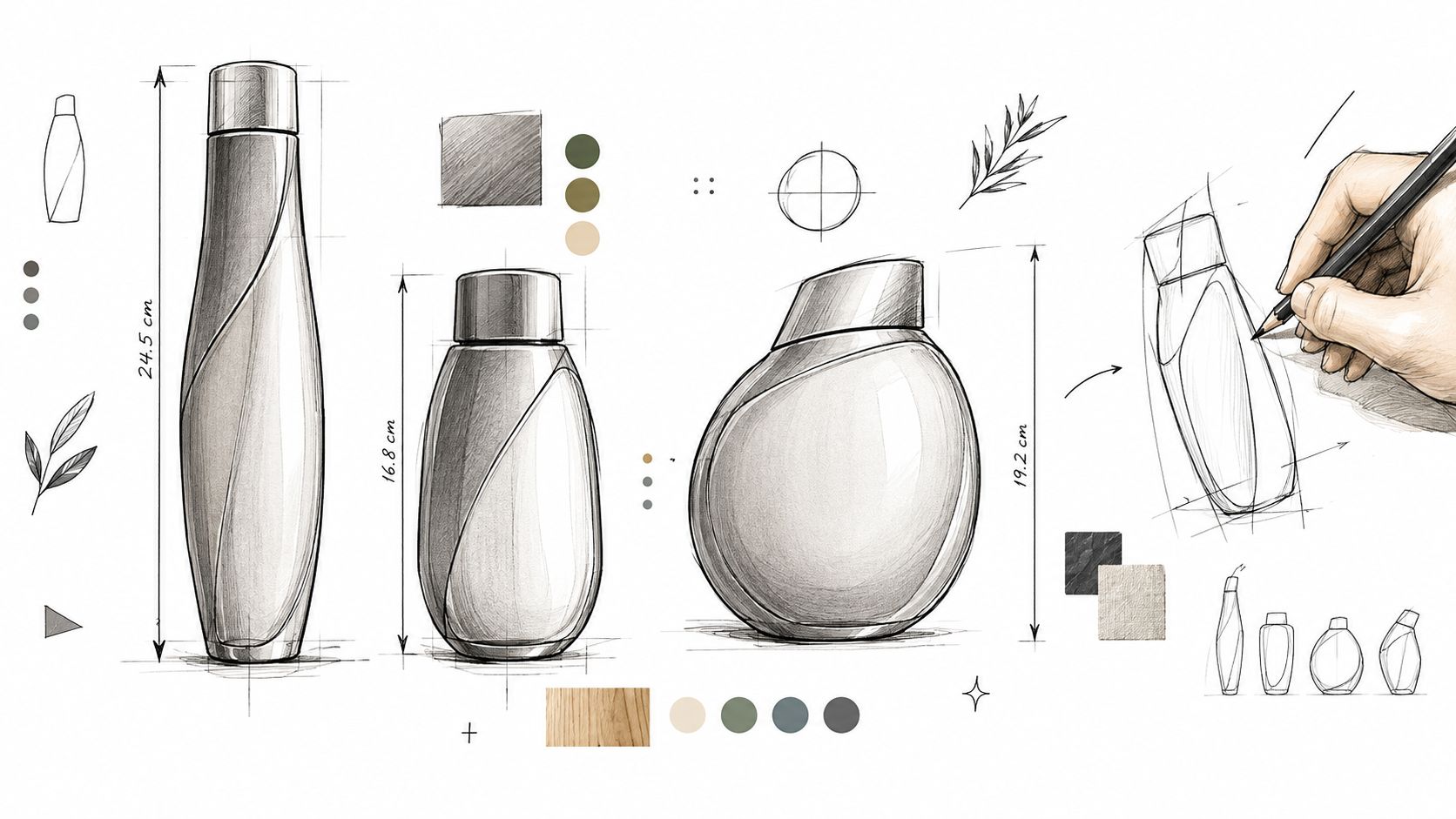
Start with the form. Vary proportion, volume, length, closure, hardware, or surface treatment, but keep the concept recognizable. For a beauty package, that might mean comparing a low cylindrical bottle with a tall rectangular bottle, then testing how the shoulder, cap, and label area affect handling and shelf presence. For apparel, it could mean two clear silhouette directions, one closer to the body and one more relaxed, rather than a dozen minor proportion changes.
Material decisions are commercial decisions
Material selection changes more than appearance. It affects sourcing, durability, compliance, manufacturing technique, perceived value, margin, and the content story. A beautiful finish that requires a fragile process or uncertain supply path may be useful as a directional reference, but it shouldn't advance as though it were production-ready.
I use a simple review discipline: choose two silhouette directions, two material directions, and three colorways before asking the committee to review the set. That creates meaningful contrast without turning the meeting into a permutation exercise.
Colorways also need roles. A core color supports continuity and replenishment. A seasonal color creates freshness. A regional color can reflect local preferences or climate without fracturing the global identity. Naming those roles early helps merchandising understand why a color exists, rather than treating every swatch as an equal candidate.
AI can widen the search, not make the judgment
AI assistance is useful when the team knows what it wants to compare. It can translate a brief into visual directions, apply a silhouette to several material treatments, or show how a palette behaves across a line. It becomes less useful when the prompt is vague and the output is judged by novelty alone.
For a practical example of how a concept can be developed visually before detailed production work, see this product concept example. The review still belongs to people who understand the brand, the customer, the factory, and the assortment.
Use the visual outputs to ask sharper questions:
- Does the silhouette create a meaningful distinction within the existing line?
- Can the material direction survive sourcing and compliance review?
- Does the color system support the intended channel and region?
- Can the same concept generate coherent content without misleading customers?
- Which details are essential to the idea, and which are expensive decoration?
A strong concept review ends with fewer, clearer directions. If the team leaves with more permutations than it started with, the exploration stage has probably avoided its real job.
Scoring Concepts With a Decision Matrix That Survives Skeptics
Teams often say they want an objective review, then score concepts after seeing them. That order invites confirmation bias. The designer who loves the sculptural option unconsciously raises its innovation score, while the buyer who fears the cost lowers its feasibility score.
Agree on criteria and weights before reviewing the candidates. A practical matrix can score each concept from 1 to 5 against customer relevance, brand fit, margin potential, manufacturability, sustainability constraints, regional adaptability, and content scalability. The score isn't a prediction of sales. It's a shared way to expose trade-offs.
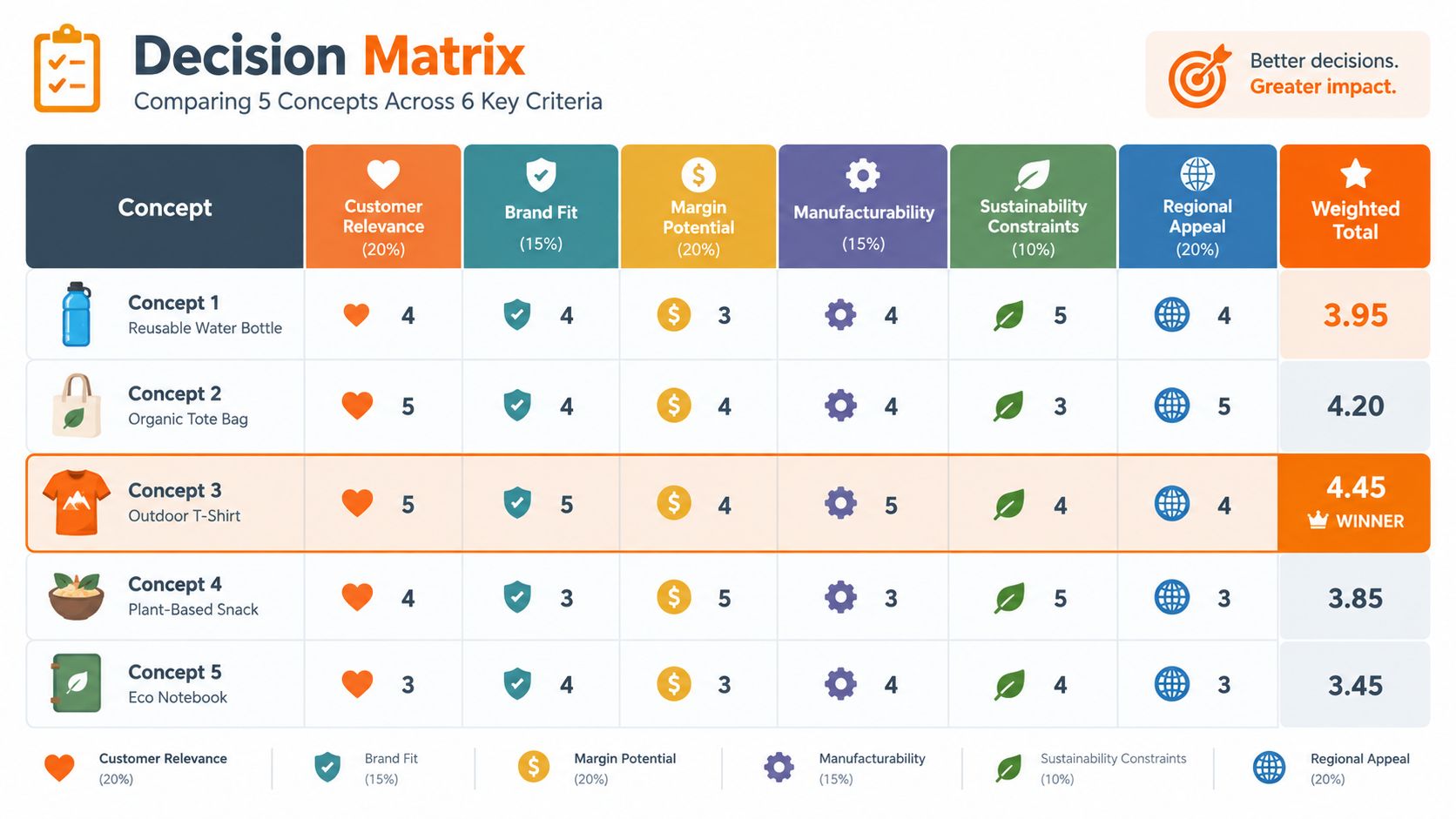
Make the weighting visible
Suppose two concepts are under review for a travel accessory line:
| Criterion | Weight | Concept A | Concept B |
|---|---|---|---|
| Customer relevance | 25% | 5 | 4 |
| Brand fit | 15% | 4 | 5 |
| Margin potential | 15% | 3 | 4 |
| Manufacturability | 20% | 2 | 5 |
| Sustainability constraints | 10% | 3 | 4 |
| Regional adaptability | 10% | 4 | 3 |
| Content scalability | 5% | 5 | 3 |
Concept A has stronger editorial energy and customer appeal, but Concept B is easier to manufacture and more commercially balanced. The matrix doesn't eliminate judgment. It shows where judgment is being applied, which makes disagreement useful rather than personal.
Constraints override preference
The weighted total is only the second gate. First, test requirements. A concept that fails the target cost, material compliance, required size range, or a mandatory regional requirement should be rejected or sent back for modification, even if its visual score is high.
This prevents a familiar failure pattern: a concept wins the room, then loses three weeks later when sourcing reveals that the core material isn't approved or the construction can't meet the required specification.
The matrix doesn't replace creative leadership. It protects creative leadership from late-stage surprises.
Document the rationale beside the score. Record why a concept advanced, what risk remains, who owns the next validation, and what would cause the team to stop. That record helps the next review begin with evidence instead of memory.
AI as a Concept Partner, Not a Concept Replacement
AI can produce directions quickly. It can't decide whether a concept deserves a place in the line.
The more important question is provenance. Who supplied the reference? Which parts came from a designer? What did the system transform? Who approved the result? Does the market require disclosure? If those answers live outside the concept record, trust breaks when the work reaches buyers, regional teams, customers, or legal reviewers.
A 2025 experiment with 194 Korean online shoppers found that greater transparency about AI involvement improved perceived creativity and authenticity, with full transparency producing more favorable evaluations than partial or no disclosure. The study also found that purchase-intention effects differed by age group, as reported in this research on AI transparency and consumer evaluation. That doesn't mean every image needs a prominent label in every context. It means teams should decide disclosure rules deliberately rather than hiding AI involvement by default.
Build provenance into the canvas
A credible AI-assisted concept record should include:
- Source references: Sketches, CAD files, swatches, photographs, prompts, and licensed references.
- Human decisions: What the designer changed, rejected, or combined.
- Model transformations: The visual operations used to create variations.
- Approval ownership: The person accountable for design, sourcing, merchandising, and market release.
- Market rules: Regional disclosure, brand, cultural, or regulatory requirements.
- Validation status: What has been reviewed and what remains hypothetical.
Research involving 607 design professionals in China and the United Kingdom examines shared and country-specific drivers of AI adoption, reinforcing that acceptance depends on context rather than tool capability alone. The practical conclusion is straightforward: a global brand needs a governance model that can accommodate regional expectations.
AI can also support downstream content exploration. Teams producing short-form campaign material may use a guide to AI video clipping to adapt approved visual narratives, but repurposing should begin only after the product concept and brand permissions are clear.
For a deeper look at AI's role in fashion design workflows, see AI for fashion design. The same discipline applies across tools: use AI to expand options and reduce repetitive work, then rely on human review for taste, feasibility, provenance, and accountability.
Turning the Chosen Concept Into a Production Brief
Selection is only useful when the next team can act on it. The production brief should give merchandising, sourcing, design, marketing, and regional operators the same version of the product.
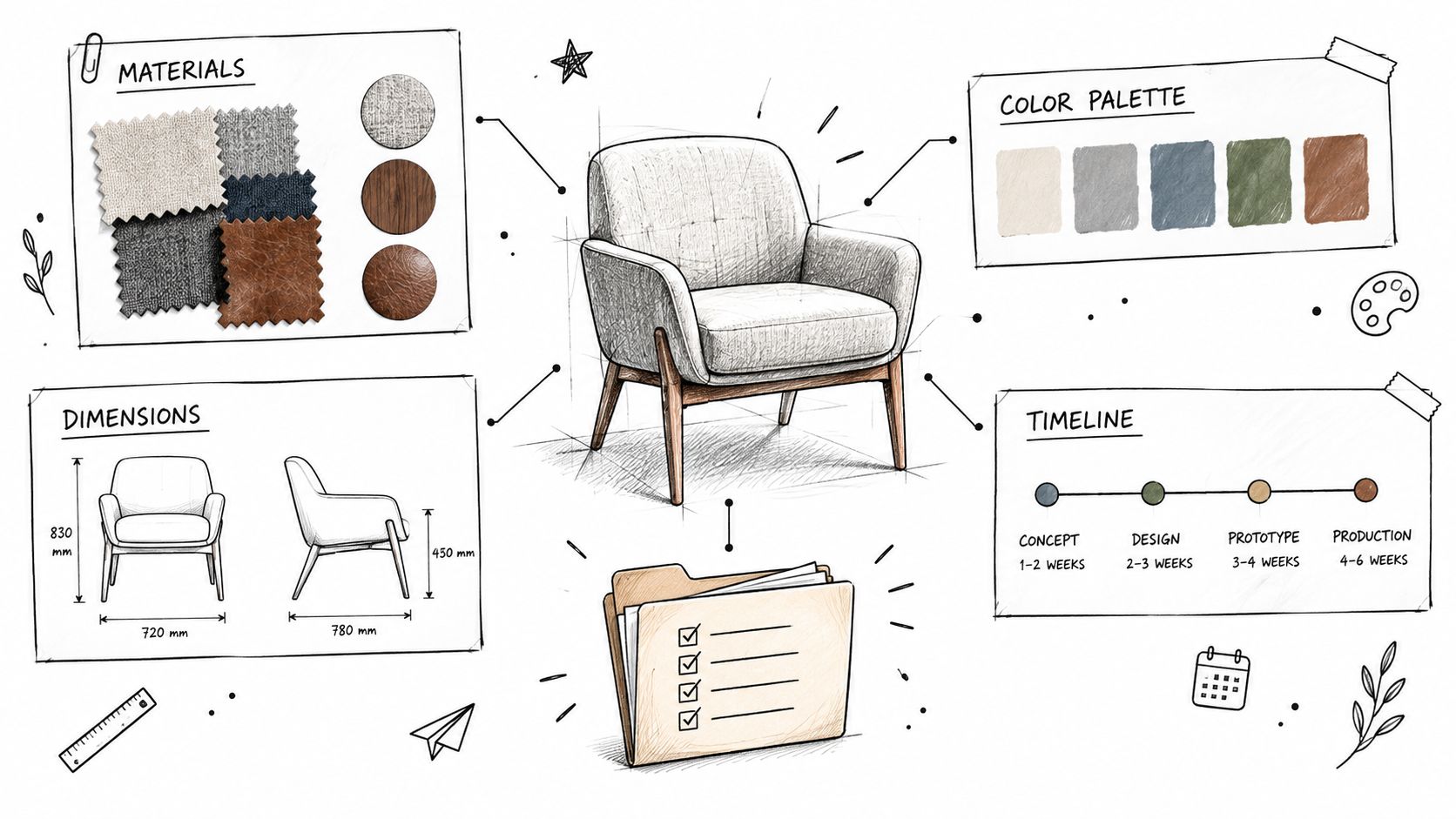
Include the approved visual direction, technical specification requirements, material and colorway callouts, size run, target cost, regional variants, channel role, approval owner, and required content assets. A useful brief also states what is intentionally out of scope, such as an experimental finish reserved for editorial imagery rather than the commercial SKU.
The handoff should support downstream assortment visualization, editorial campaign planning, and seasonal production dossiers. It should also preserve the rationale behind the decision, so a regional team can adapt the product without changing its role.
For teams refining the transition between design and development, guidance on how to avoid handoff friction in 2026 offers a useful reminder: ambiguity at the handoff becomes rework downstream. A practical sample design brief can help turn the selected concept into a repeatable document.
Before the next review, check:
- Customer: Is the target customer and use occasion explicit?
- Commercial role: Does everyone know whether this is a hero, volume, entry, or seasonal product?
- Feasibility: Have material, construction, size, cost, and compliance risks been recorded?
- Assortment: Does the concept strengthen the line rather than duplicate it?
- Content: Can the approved direction support the required channels and regions?
- Ownership: Is one person accountable for each unresolved decision?
Sprello brings product concepting, assortment visualization, editorial campaign workflows, and seasonal production dossiers into an AI workflow canvas for fashion, beauty, and lifestyle teams. Use it to connect concept exploration with the SKU, channel, regional, and seasonal decisions that determine whether an idea ships, then visit Sprello to see how the workflow can fit your next product review.
Related
More to explore
Fresh reads
7 Lookbook Examples for Fashion Brands in 2026
Explore 7 lookbook examples from Vogue, Behance, Canva and more, with layout tactics, merchandising notes and implementation tips for creative teams.

Turquoise Complementary Color: A Practical Guide
Discover the turquoise complementary color, explore hex codes, color theory, and styling tips for fashion, beauty, and brand merchandising palettes.
Salmon Pink and Apple Green: A Practical Color Pairing Guide
A practical guide to the salmon pink and apple green color pairing, with tonal matches, merchandising combos, and seasonal styling tips.