

If your customer acquisition cost (CAC) is spiraling out of control, you’re in good company. But let’s be clear: getting CAC down isn't about gutting your ad budget. It's about getting smarter with every dollar you spend. This means shifting away from "spray and pray" campaigns and adopting a laser-focused, data-backed system to improve your targeting, creative, and conversion funnel.
Why Your Customer Acquisition Cost Keeps Climbing

It’s a feeling every founder and marketer knows well. You keep pumping money into ads, but the returns just aren't scaling with your spend. This isn't just a feeling; it's a market-wide trend. Across many industries, customer acquisition costs have shot up by nearly 60% in the last few years, a direct result of more competition and crowded ad platforms.
Often, the problem isn’t your product or even the size of your budget. The real issue is a fundamental disconnect between your marketing message and what your ideal customers actually want. Throwing money at campaigns without a deep understanding of what’s driving performance is like driving blind. Sure, you’re moving, but you're probably headed straight for a wall.
Uncovering the Hidden Cost Drivers
A high CAC is never just one thing. It's almost always a combination of small, interconnected leaks that, together, create a massive drain on your budget. Finding these weak points is the absolute first step toward building an acquisition machine that actually works.
I’ve seen this time and again. The costs tend to get out of hand in a few key areas:
- Vague or Misaligned Targeting: When you try to talk to everyone, you end up talking to no one. Casting a wide net means you’re paying to show ads to people who have zero interest in buying. You get impressions, but they don't connect with a real-world problem your audience is trying to solve.
- A High-Friction Funnel: Every bit of friction costs you money. A clunky landing page, a website that loads at a snail's pace, or a checkout process with too many steps will send potential customers running for the hills. You paid to get them there, only to lose them at the last second.
- Creative That Blends In: If your ads are boring, generic, or fail to communicate value in the first three seconds, they’re invisible. This leads directly to low click-through rates (CTR), which signals to ad platforms that your content isn’t relevant, and they charge you more for it.
The secret to lowering CAC isn't about spending less; it's about precision. It’s about auditing every dollar, obsessing over the 'why' behind your data, and systematically testing your way to profitability.
This guide isn’t going to give you fluffy advice. We're going to walk through a practical framework for auditing what you’re doing now, pinpointing exactly where your money is going to waste, and implementing strategies that deliver real, measurable improvements. By making small, data-driven changes, you can start acquiring customers more profitably and build a growth engine that lasts.
Building Your Foundation: Measuring and Auditing CAC
Before you can start slashing your customer acquisition cost, you have to know exactly what it is. And I mean exactly. Flying blind is a recipe for wasted ad spend.
The classic formula—total marketing spend divided by new customers—is a starting point, but it's dangerously incomplete. It’s like trying to bake a cake with only half the ingredients. To get the full picture, you need to calculate your fully-loaded CAC.
This means accounting for every single dollar that goes into acquiring a customer, not just the obvious ad spend.
What Goes Into a Fully-Loaded CAC?
Your ad campaigns don't just appear out of thin air. There's a whole ecosystem of people, tools, and creative work supporting them. A proper audit ropes in all these often-forgotten costs to give you an honest number to work with.
Here’s what you absolutely must include:
- Salaries: The portion of your marketing and sales team salaries dedicated to acquisition.
- Software and Tools: All those monthly subscriptions for your CRM, analytics platforms, design software—anything that touches the acquisition process.
- Creative Production: The real cost of making your ads, whether it's paying an agency, hiring a freelancer, or accounting for your in-house team's time.
- Ad Spend: The direct cost paid to platforms like Google, Meta, or TikTok.
Once you’ve tallied up this total cost, divide it by the number of new customers from that same period. Now you have your true, fully-loaded CAC. This is your north star.
Your goal isn't just to get a single CAC number, but to understand its components. Breaking down costs reveals exactly where your budget is going, which is the first step to finding optimization opportunities.
Segment Your CAC to Find Actionable Insights
A single, blended CAC is a good health check, but the real power comes from segmentation. Not all customers cost the same to acquire, and lumping them all together hides your biggest wins and most expensive mistakes.
Breaking down your CAC is how you go from a vague feeling of "our CAC is too high" to a specific, solvable problem like, "Our CAC on Facebook ads for the Q2 campaign is 35% higher than on Google Search." Now that's something you can act on.
Get started by segmenting your CAC across these key dimensions:
- By Channel: Compare the cost to land a customer from Google Ads versus organic search or email.
- By Campaign: Drill down to see which specific ad campaigns are giving you the most bang for your buck.
- By Customer Cohort: Analyze the CAC for different customer types, like enterprise vs. SMB clients.
This granular view is what allows for smart, data-driven decisions. You’ll know exactly where to double down and what needs fixing—or cutting. Tracking crucial marketing performance metrics, including CAC is fundamental to this entire process.
To get a complete view during your audit, you’ll want to look beyond just the top-line CAC number. The metrics below work together to tell the full story of your acquisition performance.
Essential Metrics for Your CAC Audit
| Metric | What It Measures | Why It Matters for CAC |
|---|---|---|
| Cost Per Click (CPC) | The average cost you pay for a single click on your ad. | High CPCs are often the first sign of weak ad creative, poor targeting, or high competition. They directly inflate your CAC. |
| Click-Through Rate (CTR) | The percentage of people who see your ad and actually click on it. | A low CTR signals a disconnect between your ad and your audience. Improving it means more efficient ad spend and a lower CAC. |
| Conversion Rate (CVR) | The percentage of visitors who complete a desired action (e.g., sign up, purchase). | If your CVR is low, you're paying to bring people to your site who aren't converting, which drives your CAC through the roof. |
| Customer Lifetime Value (LTV) | The total revenue you can expect from a single customer over their lifetime. | The LTV-to-CAC ratio is the ultimate health metric. It tells you if you're acquiring profitable customers in the long run. |
By monitoring these interconnected KPIs, you can move from just knowing your CAC to understanding the levers you can pull to actively reduce it.
Diagnosing Performance Gaps
With your segmented data in hand, you can start playing detective. A high CAC on a particular channel is a symptom, not the root cause. Your job is to find what’s really going on in the funnel.
For example, a sky-high CPC could point to uninspired ad creative or an audience that’s just too broad. On the other hand, a dismal landing page conversion rate might mean your ad promises one thing and your page delivers another.
Fixing these disconnects is a huge part of the optimization puzzle. For a deeper dive, our guide on conversion rate optimization has actionable strategies you can use. A systematic audit connects the dots, turning high-level costs into a clear, prioritized list of what to fix first.
Zeroing In on Creative, Targeting, and Your Funnel
Once you’ve audited your performance, you have a clear map of where your money is going. Now it’s time to get your hands dirty. Lowering your customer acquisition cost really boils down to systematically improving three core areas: your ad creative, your audience targeting, and your conversion funnel.
Think of these as the three main levers you can pull. A small improvement in one can create a ripple effect, but when you start optimizing all three at once, you build a powerful, cost-reducing engine.
Let's break down how to tackle each one.
Reinvent Your Ad Creative for Maximum Impact
Your ad creative is your first handshake with a potential customer. If it's generic, boring, or fails to get to the point in the first three seconds, you've already lost. In today's crowded ad feeds, "good enough" creative is a direct path to a high CAC.
Ad platforms are built to reward relevance. Ads with higher click-through rates (CTR) and engagement get tagged as more relevant, which almost always leads to a lower cost-per-click (CPC). Your entire job here is to stop the scroll and earn that click as efficiently as possible.
This means you have to ditch the "one-size-fits-all" mindset and build a system for rapid creative iteration. Instead of spending weeks on a single, perfectly polished video, you should be testing multiple concepts, hooks, and calls-to-action every single week.
- Test Different Hooks: The first 1-3 seconds are everything. Try problem-focused hooks ("Tired of X?"), solution-focused hooks ("Imagine achieving Y..."), and maybe even a shocking statistic ("Did you know 80% of businesses struggle with...?").
- Vary Your Visuals: Don't get stuck in a rut. Pit user-generated content (UGC) against polished studio shots. Test animated text overlays versus simple talking-head videos.
- Refine Your Call-to-Action (CTA): Small tweaks here can make a surprising difference. Test "Learn More" vs. "Get Started" vs. "Shop Now" to see what actually connects with your audience's mindset at that moment.
The most expensive ad is the one that doesn't get noticed. Your primary creative goal is to make something that is impossible for your specific target audience to ignore.
This is where AI-powered video tools like Sprello completely change the game. Instead of dealing with the high costs and slow turnarounds of traditional video production, you can spin up dozens of ad variations in minutes. This speed lets you test more ideas, find what works faster, and slash your creative production costs—a key part of your fully-loaded CAC.
To build a real system around this, you need a structured approach. You can explore a detailed creative testing framework to see how to organize your experiments for clear, actionable results.
Sharpen Your Audience Targeting
Even the best creative will fall flat if it's shown to the wrong people. The next lever to pull is refining who sees your ads. The key to lowering CAC here is moving from broad demographic targeting to highly specific, intent-driven audiences. You simply stop wasting money on clicks from people who were never going to buy.
The goal is to find those small, valuable pockets of high-intent users who are actively looking for a solution just like yours.
Move Beyond Basic Demographics
Start by layering on interests and behaviors. Instead of just targeting "males aged 25-40," get more specific: "males aged 25-40 who have shown interest in project management software and follow popular tech entrepreneurs." This one simple step filters out a massive amount of irrelevant impressions.
Next, you need to tap into your most valuable asset: your own first-party data.
- Create Lookalike Audiences: Upload a list of your best customers (those with the highest LTV) to platforms like Meta or Google. Their algorithms are incredibly good at finding new people who share similar traits. A 1% lookalike audience is usually the most potent place to start, as it's the most similar to your source list.
- Build Smart Retargeting Segments: Not all website visitors are created equal. You need to create distinct retargeting audiences based on their actions. Someone who abandoned a cart is far more valuable than someone who just glanced at your homepage. Tailor your ads accordingly—show the cart abandoner a small discount, while the homepage visitor might see a brand-building video.
This level of precision ensures your ad budget is focused only on the users most likely to convert, which has a direct and immediate impact on your CAC.
Optimize Your Conversion Funnel for a Seamless Journey
Okay, you've nailed your creative and your targeting. You're driving high-quality, relevant traffic to your landing page. The final piece of the puzzle is making sure the path from that first click to a conversion is as smooth and frictionless as possible.
Every hurdle, every moment of confusion, and every unnecessary form field is another reason for a potential customer to leave. You paid for that click; don't lose the conversion because of a clunky user experience.
Start with your landing page. The message has to match the ad. If your ad promised a "50% off discount," that offer better be the first thing a visitor sees on the page. Any disconnect creates distrust and sends your bounce rate soaring.
From there, streamline the path to purchase or sign-up.
- Simplify Your Forms: Only ask for the information you absolutely need right now. For a lead magnet, an email is probably enough. For a checkout, consider offering a guest option to remove the friction of creating a whole new account.
- Improve Page Load Speed: This is a silent killer of conversions. A one-second delay in page load time can reduce conversions by 7%. Use free tools like Google PageSpeed Insights to diagnose and fix whatever is slowing your site down.
- Add Social Proof: This isn't optional anymore. Include customer testimonials, reviews, and trust badges right where people can see them. This builds credibility and reassures hesitant buyers that they're making the right choice.
One of the most effective ways to slash CAC is by using advanced personalization. Research shows that companies deploying these strategies can cut their acquisition costs by up to 50% while boosting revenue by 5-15%. Personalization works because it makes the customer journey feel more relevant, which naturally leads to higher conversion rates and less wasted ad spend. By pulling these three levers—creative, targeting, and funnel—you create a repeatable system for driving down acquisition costs and building a much more profitable growth engine.
A Systematic Framework for Testing and Scaling Your Ads
To consistently bring your customer acquisition costs down, you have to stop looking for one-off fixes and start building a system for continuous improvement. The real goal is to create a predictable, repeatable process for testing ideas, figuring out what actually resonates with customers, and then scaling your wins.
This is what turns marketing from a guessing game into a reliable growth engine.
It all boils down to a simple but powerful feedback loop: run a test, dig into the data, learn why it worked (or didn't), and then apply that knowledge to your next campaign. This methodical approach is what truly separates the top-performing marketing teams from everyone else.
Building Your Testing Plan
A solid testing plan doesn't need to be overly complicated. Its main purpose is to keep your tests clean, your data reliable, and your takeaways actionable. Without a plan, you end up with messy tests where you have no idea what actually caused the change in performance.
Start by creating a simple testing calendar or backlog. I've found a simple spreadsheet works just fine. At a minimum, it should track:
- Hypothesis: A clear statement of what you believe will happen. (e.g., "We think a user-generated style video ad will get a higher CTR than our polished animated ad.")
- Variable: The one thing you’re changing. (e.g., The ad creative itself.)
- Success Metric: How you’ll measure the winner. (e.g., Click-through rate or, even better, cost per conversion.)
- Timeline: How long the test needs to run to be statistically confident in the results.
This basic structure keeps your team on the same page and ensures every test teaches you something valuable—which is the whole point.
This workflow shows how the different pieces of your acquisition system fit together, from the initial creative spark to the final conversion.
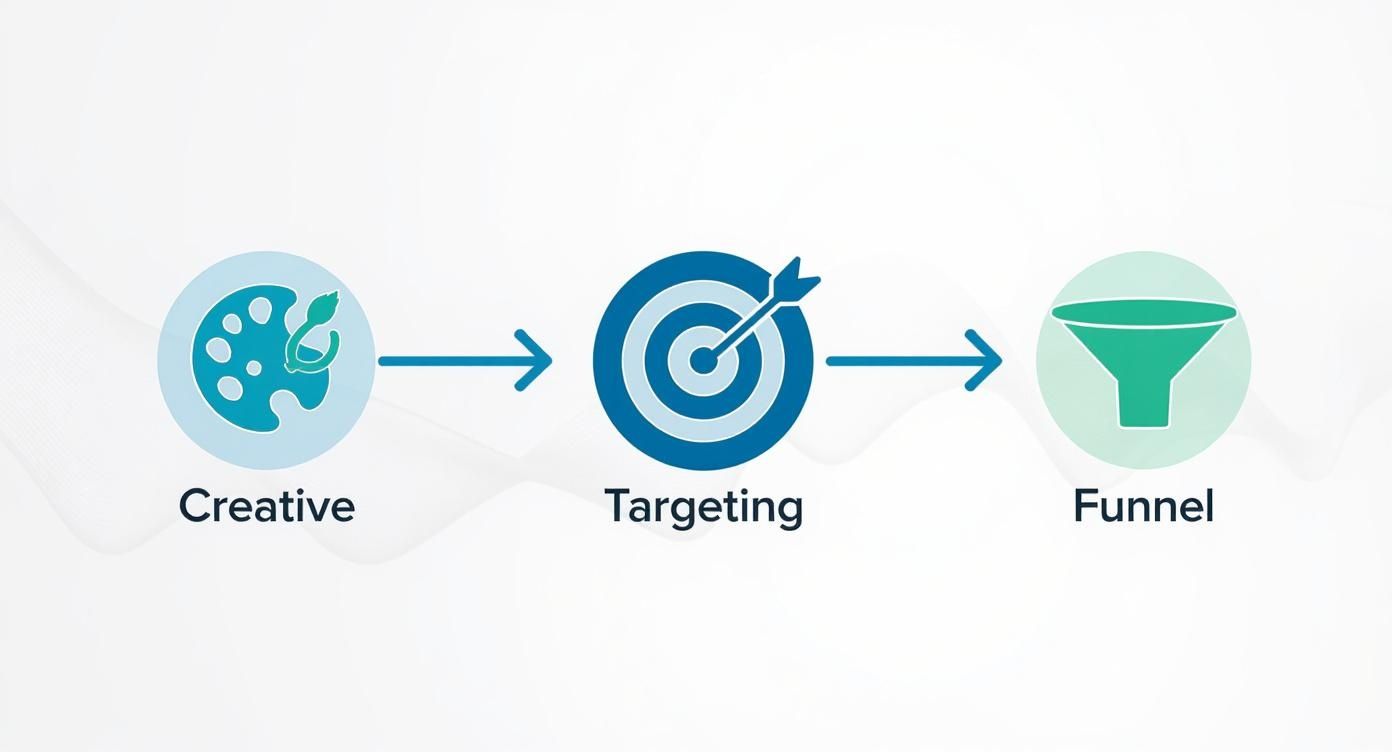
You can see how each stage builds on the last, turning raw ideas into targeted campaigns that actually drive results.
Executing Clean A/B and Multivariate Tests
Once your plan is ready, it’s time to run the tests. The two workhorses here are A/B testing and multivariate testing. They sound similar, but they're used for different things.
A/B testing, or split testing, is your go-to for big, decisive changes. You're pitting two fundamentally different versions of something against each other—like two completely different landing pages—to see which one comes out on top. The key is to keep it clean by only changing one major element. If you change the headline, the main image, and the CTA button all at once, you’ll never know which change really made the difference.
Multivariate testing, on the other hand, is perfect for fine-tuning your ad creative. Instead of testing two totally different ads, you test multiple combinations of individual elements at the same time. For instance, you could test:
- 3 different hooks (the first 1-3 seconds of your video)
- 2 different visual styles (like authentic UGC vs. a polished studio look)
- 2 different calls-to-action (maybe "Shop Now" vs. "Learn More")
The ad platform’s algorithm then mixes and matches these components to find the single best-performing combination. This is powerful because it helps you understand not just which ad works, but which specific creative ingredients are driving that performance.
The real magic of testing isn't just finding a winner. It's about understanding why it won. Every test result, good or bad, is a piece of intel that sharpens your understanding of your customer.
From Winning Test to Scaled Campaign
Finding a winning ad or landing page isn't the finish line; it's the starting gun. The final, crucial step is to scale that success. When one variation is clearly outperforming the others, it's time to double down.
This means you start shifting more budget to the winning asset while turning off the underperformers. Keep a close eye on performance as you scale up. Sometimes an ad that’s a rockstar with a small budget doesn't perform as well at 10x the spend, so you have to watch your numbers.
Most importantly, dig into the "why" behind the win. If a specific user-generated video style completely blew your other ads out of the water, that's your new creative blueprint. Use that insight as the foundation for your next round of ads. This creates a powerful cycle: you test, you learn, you scale, and you iterate.
This is the system. This is how you methodically chip away at your customer acquisition cost and build a truly profitable marketing machine.
Diversifying Your Channels for Sustainable Growth
Relying on a single acquisition channel is a gamble. I've seen too many businesses, especially those hooked on paid ads, get burned by a sudden algorithm change or skyrocketing ad costs. When all your eggs are in one basket, a single bad month can throw your entire growth plan off the rails.
A much safer and more profitable strategy is to build a diverse marketing mix. Think of it as creating multiple pathways for customers to find you. This approach not only spreads your risk but also builds a more resilient business that isn't at the mercy of one platform. The real magic happens when you get these channels to work together, amplifying each other's efforts.
Creating an Integrated Channel Strategy
Stop thinking about your marketing in silos. Instead, view it as an ecosystem where every channel has a specific job but also supports the others.
A classic, powerful combination is pairing high-intent paid channels for quick wins with long-term organic assets that drive down your costs over time. It's a one-two punch that delivers both immediate results and lasting value.
Here’s how this plays out in the real world:
- Content Marketing to Fuel SEO: When you publish genuinely helpful blog posts (like this one!), you're not just attracting readers. You're building topical authority that helps you rank for valuable keywords in Google, which brings in consistent, "free" traffic.
- SEO to Build Your Email List: That high-ranking content becomes a lead-generation machine when you add a simple newsletter signup form. You're effectively moving traffic from a channel you rent (Google) to one you own (your email list).
- Email to Convert at a Low Cost: Once someone is on your list, you can nurture that relationship and guide them toward a purchase for a tiny fraction of what a paid ad would cost.
This creates a powerful growth loop. Content fuels SEO, SEO builds your list, and your list converts customers at an incredibly low CAC. Our guide to small business lead generation dives deeper into building this kind of sustainable engine.
Relying on a single channel is like trying to build a house on one pillar. A diversified marketing mix provides a stable foundation that can withstand market shifts and rising costs.
Comparing Channel Cost-Effectiveness
Expanding your marketing shouldn't be a mad dash. It needs to be a thoughtful, data-driven process. Before jumping into a new channel, take a hard look at its potential cost-effectiveness. While paid ads give you speed, organic channels almost always deliver a better long-term return.
The numbers back this up. Businesses that successfully blend organic and paid strategies have seen their CAC drop by up to 40% compared to those stuck on paid ads alone. And within that mix, email marketing remains a powerhouse, consistently generating an average ROI of $42 for every dollar spent. It's one of the most reliable tools for keeping acquisition costs low. You can discover more insights about these industry trends and see just how well this approach works.
Methodically building out your marketing mix is one of the surest ways to lower your customer acquisition cost for good. It frees you from platform dependency and builds a far more profitable and sustainable business.
Boosting Profitability by Improving Retention and LTV

Up to this point, we’ve been zeroed in on the top of the funnel—fine-tuning ads, nailing down targeting, and getting that first conversion. But one of the most powerful ways to make your ad spend more sustainable is to look at what happens after the first purchase.
Think about it this way: the more revenue you generate from each customer over their lifetime, the more you can justify spending to get them in the door.
This simple shift in perspective moves the conversation from just cutting costs to actually building a more profitable, resilient business. When your Customer Lifetime Value (LTV) increases, you suddenly have more breathing room. You can afford to bid more aggressively for ad placements and still come out ahead.
Improving LTV all comes down to customer retention. Get that right, and you’ll see a massive impact on your bottom line. It makes every dollar you’ve already spent on acquisition work that much harder for you.
Turning One-Time Buyers into Lifelong Fans
The customer journey doesn’t end at the checkout. Honestly, that’s where the real relationship begins. A fantastic post-purchase experience is what turns a one-off buyer into a loyal advocate for your brand.
It all starts with onboarding. If you're a SaaS company, this means getting users to their "aha!" moment as quickly as possible with helpful walkthroughs and tutorials. If you sell physical products, a well-crafted welcome email series showing them how to get the most out of their purchase can work wonders.
This isn’t just about being helpful; it’s about proving the value of their purchase right away and setting the tone for a long-term relationship.
"The most sustainable way to reduce customer acquisition cost is to stop treating acquisition as the finish line. The real goal is to acquire customers you can keep, turning your marketing spend into an appreciating asset."
Of course, retention is impossible without stellar customer support. When something goes wrong—and it will—your ability to provide a fast, friendly, and genuinely helpful solution is critical. It’s these moments that build trust and make customers feel like you’ve got their back.
Building a Customer-Powered Growth Engine
Your happiest customers are sitting on the sidelines, waiting to be your best marketers. All you have to do is give them a reason. Well-designed loyalty and referral programs are a ridiculously cost-effective way to bring in new business.
Here are two proven ways to do it:
- Loyalty Programs: Give customers a reason to come back. Whether it’s points, exclusive discounts, or early access to new products, you’re incentivizing them to stick with you instead of trying a competitor. This directly pumps up their LTV.
- Referral Programs: Make it easy and rewarding for existing customers to spread the word. A simple "give $10, get $10" offer can create a powerful word-of-mouth engine that brings in new, high-intent customers for a tiny fraction of what you’d pay for ads.
The data doesn’t lie. It can cost five times more to attract a new customer than to keep an existing one. That’s why retention is the foundation of any smart growth strategy. According to customer acquisition cost findings from DevRev, companies that really lean into customer loyalty have slashed their overall CAC by as much as 25%.
Common Questions We Hear About Reducing CAC
As you dig into optimization, a few questions always pop up. The big one is, "What's a 'good' CAC, anyway?"
Honestly, there’s no magic number. It all comes down to its relationship with your Customer Lifetime Value (LTV). A solid benchmark most businesses aim for is a 3:1 ratio—meaning for every dollar you spend to get a customer, they bring in at least three dollars in revenue over their lifetime.
Another common puzzle is budget. We often hear, "My Google Ads CPC is through the roof, should I just kill the channel?" Not so fast. Before you pull the plug, you need to look at the whole picture. That expensive channel might be bringing in your most valuable, highest-LTV customers, making the upfront cost a worthwhile investment. It's not just about the cost; it's about the profitability.
Troubleshooting Your Strategy
"Help! My CAC just shot up overnight. What happened?" It's a classic scenario, and it’s tempting to panic. But usually, a sudden spike points to a specific problem.
Here are the first places I'd look:
- Audience Saturation: Are you hitting the same small group of people with the same ads over and over? They've probably started tuning you out.
- Creative Fatigue: That video ad that was crushing it last month? It might have run its course. Even the best creative gets stale.
- Platform Shifts: Did a social media algorithm change? Did a big competitor just ramp up their ad spend? Sometimes the reason is completely outside your control.
A sudden change in CAC is rarely a fluke. It's a signal that something fundamental has shifted—your creative, your audience, or the competitive environment. It’s your cue to adapt.
Getting a handle on these issues starts with the basics. If you're still getting your bearings, this guide on What Is Cost Per Acquisition (CPA) is a great resource for understanding how it all ties back to your marketing ROI.
Ready to slash your creative production costs and test more ideas, faster? Sprello helps you produce high-converting video ads in minutes, not weeks. Get started with Sprello today.


