

At its core, measuring your marketing ROI is pretty straightforward. You take the revenue your marketing efforts generated, subtract what you spent on those efforts, and then divide that number by the total cost. The result gives you a clear percentage, showing you exactly what you got back for every dollar you put in.
But knowing the formula is just the beginning.
Why Measuring Marketing ROI Is a Game Changer

In a world of tight budgets and high expectations, every marketing dollar is under a microscope. Being able to accurately measure your marketing return on investment (ROI) isn't just about filling out a report anymore. It’s the one practice that can shift the perception of marketing from a "cost center" to a proven revenue engine.
When you have solid ROI data in your back pocket, you can make smarter decisions, and you can make them faster. It's the difference between guessing where to put your money and knowing you should shift budget from a channel that's sputtering to one that's actually delivering results. It’s also the hard proof you need to show leadership that your creative campaigns are directly boosting the bottom line.
Justify Your Budget and Prove Your Value
The days of getting by on vanity metrics like clicks and impressions are long gone. Leadership wants to see the financial impact, plain and simple.
The pressure is on. In fact, 83% of leaders now say marketing ROI is their top priority, a huge jump from just 68% five years ago. This isn't just talk, either—it’s changing how businesses operate. About 64% of companies now tie their future marketing budgets directly to past ROI performance. You can dig into more of this data on how companies are tackling ROI over at firework.com.
When you can confidently walk into a meeting and report that a specific video campaign generated a 400% ROI, you’re not just sharing numbers. You’re building trust and making a rock-solid case for future investment.
Make Data-Driven Strategic Decisions
Getting a handle on your ROI gives you a clear roadmap for what to do next. Once you know which activities are actually generating the highest returns, you can start making real strategic moves.
- Allocate Resources Wisely: It becomes obvious where to double down. You can confidently shift spending toward the channels and tactics that are proven winners.
- Refine Your Creative Strategy: You can finally connect creative to conversions. You’ll know which ad creatives—like the videos you produce with Sprello—are resonating with your audience and which ones are just noise.
- Optimize Your Funnel: ROI data helps you find the leaks. You can pinpoint exactly where in the customer journey you’re losing potential revenue and take action to fix it.
This isn’t just about justifying your existence; it’s about solidifying your team’s value. It’s about moving past gut feelings and into a world where every marketing move is measurable and accountable. This guide will give you the full playbook—not just a single formula—to master modern ROI measurement and prove your marketing’s true impact.
Building Your Measurement Foundation
Before you can even think about calculating your return on investment, you have to define what "return" actually means for your business. It's a surprisingly common mistake. Marketers jump straight to formulas and spreadsheets, but without a clear destination, they're just measuring movement, not progress.
So, where do you start? The first and most critical step is to tie your marketing objectives directly to the company's bigger goals. What is the business really trying to accomplish this quarter? Are we aiming to steal market share? Boost customer loyalty? Or maybe crack a whole new demographic? Your marketing goals have to be a direct reflection of these ambitions.
For instance, if the company's C-suite wants to grow market share by 10% this year, a good marketing objective would be to generate 25% more marketing-qualified leads (MQLs) than last quarter. This way, your work isn't happening in a vacuum; it’s directly fueling the company's engine.
Selecting Your Key Performance Indicators
Once you know what you’re trying to achieve, you need to pick the right Key Performance Indicators (KPIs) to track your progress. KPIs are just the specific, numbers-driven metrics that tell you if you're on the right path. Think of them as the vital signs for your marketing campaigns.
It's easy to get overwhelmed by all the data available, but a few core metrics will always give you the clearest view of your financial impact.
- Return on Marketing Investment (ROMI): This is the classic. It’s a straight comparison of the revenue you generated from a campaign versus what you spent on it. Pure and simple profitability.
- Customer Acquisition Cost (CAC): This tells you exactly what it costs, on average, to bring a new paying customer through the door. It's absolutely essential for figuring out if your marketing and sales funnel is efficient or just burning cash.
- Customer Lifetime Value (LTV): This metric looks to the future, predicting the total revenue you can expect from a single customer over their entire relationship with your brand. It's how you prove the long-term value of what you're doing.
The trick is knowing which metric to use for which situation. A B2B software company trying to generate leads will live and die by its CAC. They have to know if their paid campaigns are sustainable—is the cost to get a user lower than the value they'll bring in over time?
On the other hand, an e-commerce brand will probably focus more on LTV, especially for their email and retention marketing. Their whole game is about getting that second, third, and fourth purchase, so the long-term value of a loyal customer is way more important than what it cost to get their first sale.
Pro Tip: A healthy LTV should be at least 3x your CAC. This 3:1 ratio is a widely accepted benchmark for a sustainable business model. If you're seeing a 1:1 or 2:1 ratio, it might be a red flag that you're paying too much to acquire customers who don't stick around.
Connecting Objectives to the Right Metrics
Let's make this real. Say you're the marketing manager for an online store, and the big company goal is to boost profitability. You translate that into a marketing objective: "Increase customer retention by 15% in the next six months."
So, how do you measure that? LTV becomes your north-star KPI. To get a fuller picture, you'd also keep a close eye on supporting metrics like repeat purchase rate and customer churn. Now, every marketing activity you run—from a win-back email series to a new loyalty program—is judged by how much it moves those specific numbers. To really nail this down, you can use our guide on building a marketing campaign planning template to structure this entire process.
Finally, to get a true read on your marketing ROI, you need context. Setting performance expectations without knowing what’s "good" is just guessing. This is where benchmarking in marketing comes in. It helps you set realistic targets and understand what success actually looks like in your industry. Without that context, your data is just numbers on a screen.
Choosing the Right Attribution Model
Attribution can feel like marketing's biggest puzzle. You know a customer probably saw a few of your ads, read a blog post, and got an email before they finally bought something. So, which one gets the credit? Was it the first ad that caught their eye, or the final email that sealed the deal?
Nailing this down is absolutely critical for figuring out what's actually working.
Think of it like a soccer team scoring a goal. Does all the credit go to the striker who kicked the ball into the net? What about the midfielder who made the brilliant pass, or the defender who started the whole play? Giving 100% of the credit to the last player just doesn't tell the whole story.
That's where attribution models come in. They're just different rulebooks for assigning value to each marketing touchpoint along a customer's path to purchase. There’s no single "best" model—the right one for you depends on your business, how long it takes for a customer to decide to buy, and what you’re trying to learn.
Single-Touch Models: The Simplest View
The most basic approaches are the single-touch models. They're easy to set up and understand, which is why a lot of people start with them. The catch? They give you a very narrow view of reality.
First-Touch Attribution: This model gives all the credit to the very first interaction. It’s like giving the MVP award to the defender who won the ball way back in your own half. This is super useful for figuring out which channels are bringing brand new people into your world. If top-of-funnel growth is your main goal, this model can offer some great clues.
Last-Touch Attribution: This is the polar opposite. It gives 100% of the credit to the final touchpoint right before the sale. It’s the most common model out there because it’s the default setting in many analytics tools. It’s great for seeing what closes deals, but it completely ignores everything that warmed the lead up in the first place.
Leaning too heavily on these can be risky. You might end up cutting the budget for an amazing blog that introduces hundreds of future customers, all because it never gets that "last click."
Multi-Touch Models: A More Complete Picture
To get a more honest look at your marketing ROI, you need to see the entire customer journey. Multi-touch attribution models spread the credit across multiple interactions, giving you a much more balanced perspective.
The global market for measuring ad effectiveness is blowing up, driven by AI and better analytics. For brands using a tool like Sprello to create high-converting AI videos, this means tying those efforts to real results. In fact, attribution modeling is on track to be the top measurement method by 2025, which makes sense when you need to track a journey from a video script all the way to a sale. You can read more about this trend over at usdanalytics.com.
Here are a few popular multi-touch models to get you started:
Linear: This one is simple and fair. It divides credit equally among every single touchpoint. If someone saw a social ad, opened an email, and attended a webinar, each gets 33.3% of the credit. It’s a democratic approach that says every interaction played a part.
Time-Decay: This model gives more credit to the touchpoints that happened closer to the sale. The ad they clicked yesterday gets more weight than the blog post they read three weeks ago. This is a great fit for businesses with shorter sales cycles where recent touchpoints are more persuasive.
U-Shaped (Position-Based): This model highlights the beginning and the end of the journey. It gives most of the credit to the first and last touches (usually 40% each), then sprinkles the remaining 20% across all the interactions in the middle. It values what got them in the door and what pushed them over the finish line.
Choosing the right model is a strategic decision. A B2B company with a six-month sales cycle will get far more value from a Linear or Time-Decay model than a simple Last-Touch view. They need to understand the long, complex journey their buyers take.
Ultimately, your goal is to find a model that actually reflects how your customers behave. For a deeper dive into how these work and to figure out which one might be right for you, check out our guide on what is attribution modeling. Choosing a more sophisticated model will help you measure your marketing ROI with far greater accuracy and make smarter bets with your budget.
Getting Your Tracking and Analytics Dialed In
You can't measure what you don't track. It’s that simple. Before you can even dream of calculating marketing ROI with any real confidence, you need to get the technical plumbing right. This is the bedrock of your entire measurement strategy—it’s what turns vague customer journeys into hard, analyzable data.
Without this groundwork, you’re just guessing. Sure, you might see sales coming in, but you’ll have no clue which campaigns, channels, or specific ads are actually doing the heavy lifting. Let's get this foundation built properly.
Make Google Analytics 4 Work for You
For most of us, Google Analytics 4 (GA4) is the command center for understanding user behavior. But a fresh, out-of-the-box installation isn't going to cut it. You have to tell it what actions actually matter to your business.
This means going beyond tracking simple pageviews and setting up conversion events. These are the specific, valuable actions a user takes that signal they're moving closer to becoming a customer.
- Running an e-commerce store? Your big one is
purchase, obviously. But you should also be tracking the smaller steps along the way, likeadd_to_cartandbegin_checkout. - A B2B SaaS company? Your key events are probably things like
demo_request,contact_form_submission, or a high-valueebook_download.
Once you have these events configured, GA4 can start connecting the dots between your marketing spend and actual business results. It’s the critical first step.
Get Serious About Your UTM Strategy
UTM parameters are those little tags you add to the end of your URLs, and frankly, they're one of the most powerful and criminally underused tools in a marketer's kit. They tell your analytics exactly where your traffic is coming from, down to the specific ad or link.
A consistent UTM strategy isn't just a nice-to-have; it's non-negotiable. It’s how you tell the difference between traffic from your email newsletter, a specific Facebook ad campaign, or a link you gave an influencer.
Most UTMs have five parts you'll want to use:
- utm_source: Where is the user coming from?
google,facebook,newsletter. - utm_medium: How did they get here?
cpc,social,email. - utm_campaign: What initiative is this part of?
summer_sale_2024. - utm_term: What keyword did they search for? (Mainly for paid search).
- utm_content: Which ad or link did they click? This is your secret weapon for A/B testing.
Here’s how it works in the real world: Let's say you're running a video ad campaign using two different creatives you whipped up in a tool like Sprello. By tagging each ad's destination URL with a unique
utm_content(likeutm_content=video_aandutm_content=video_b), you can pop into GA4 and see precisely which video is driving more sign-ups. Suddenly, every creative choice becomes directly measurable.
Use Pixels Wisely and Look to the Future with Server-Side Tracking
While GA4 is great for what happens on your site, you still need tracking pixels from ad platforms like Meta, TikTok, and LinkedIn. A pixel is just a tiny bit of code that pings the ad platform when someone who clicked your ad takes an action on your website.
This connection is crucial. It lets the platforms:
- Attribute sales and leads back to the right ads.
- Optimize who sees your ads, showing them to people more likely to convert.
- Build powerful retargeting audiences from your website visitors.
But let’s be honest—browser-based pixels are getting less reliable thanks to privacy updates and ad blockers. That’s why you need to have server-side tracking on your radar. Instead of data being sent from a user's browser (where it can be blocked), it’s sent from your web server directly to the ad platform’s server. It’s far more accurate and secure. Getting a server-side container set up through Google Tag Manager is a smart move to future-proof your ROI measurement.
Crunching the Numbers and Proving Real Impact
Alright, with your tracking in place, it's time for the fun part: turning all that raw data into a clear picture of what's actually working. This is where we stop guessing and start proving. We're going to connect your marketing spend directly to revenue and show that your campaigns aren't just running alongside sales—they're actively driving them.
The bedrock of this whole process is Return on Marketing Investment (ROMI). It’s the classic, no-nonsense formula that tells you how profitable your campaigns are.
ROMI (%) = [(Revenue from Marketing - Marketing Investment) / Marketing Investment] x 100
So, let's say you spent $10,000 on a campaign that brought in $45,000 in sales. Your ROMI would be a very healthy 350%. This single number is your secret weapon. It translates your hard work into the language of business impact—something every C-suite executive and stakeholder understands.
Plug in Your Numbers and See for Yourself
I find it helps to just lay it out simply. Use this little table to plug in your own numbers and get a quick ROMI calculation.
| Metric | Your Numbers | Example |
|---|---|---|
| Revenue from Marketing | $_________ | $45,000 |
| Marketing Investment | $_________ | $10,000 |
| Your ROMI (%) | _________% | 350% |
Now, while ROMI is a fantastic starting point, it doesn’t tell the whole story. A high ROMI is great, but how do you know for sure that those customers wouldn't have bought from you anyway? That's the million-dollar question. To answer it, we have to go a layer deeper.
If you want to explore the technical side of this, here's a great resource on how to measure marketing ROI in your tech stack.
Going Beyond Basic Math with Incrementality
This is where we talk about incrementality. It's a bit of a buzzword, but the concept is simple and incredibly powerful. It helps you answer the question: "What happened because of my marketing that wouldn't have happened otherwise?" It’s about isolating the true, undeniable lift your campaigns provide.
The gold standard for measuring this is running controlled experiments, like A/B tests. You show your marketing to one group (the test group) and withhold it from a similar group (the control group). The difference in their behavior is the incremental impact of your campaign. Simple as that.
To do this right, you need a solid foundation.
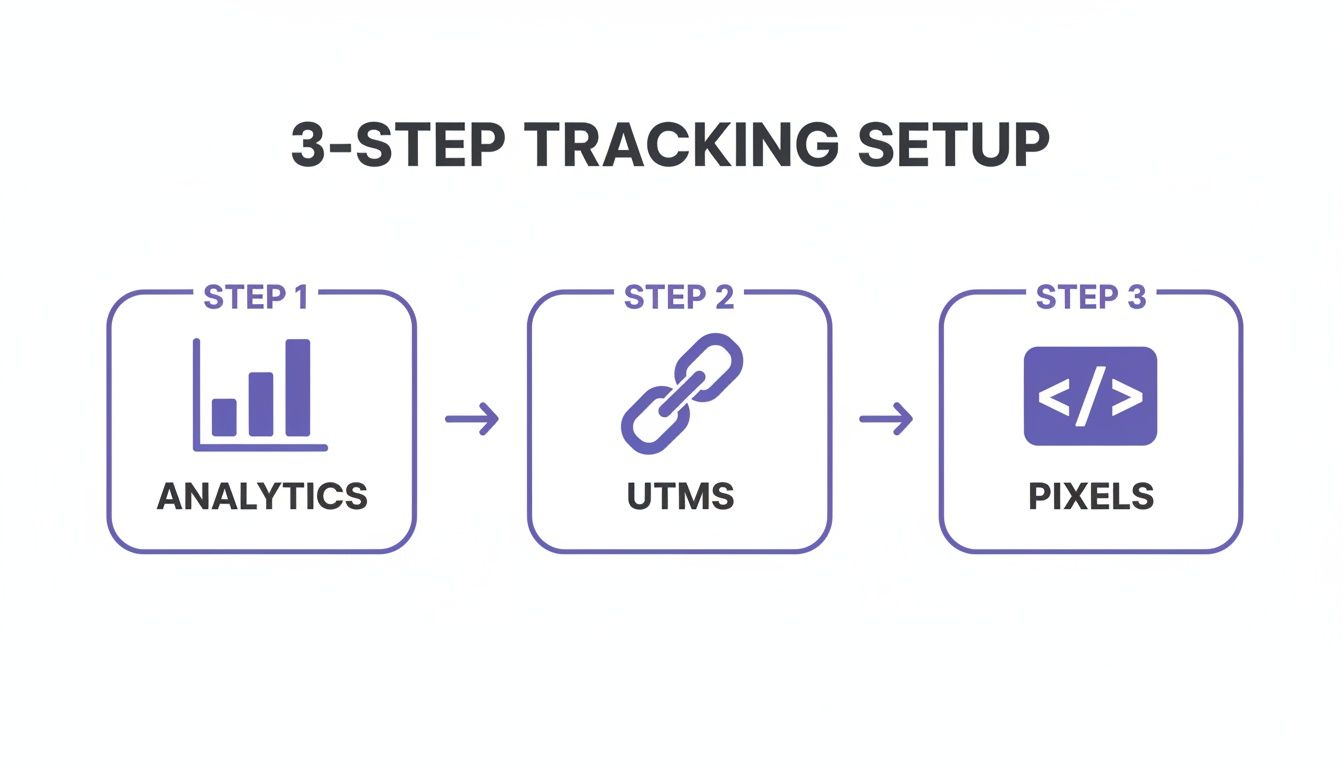
This setup—solid analytics, consistent UTMs, and reliable pixels—is what gives you the clean data you need to trust the results of your tests.
Let’s Run a Test to Find the Winner
Let's make this real. Picture an e-commerce brand wanting to see which of two video ads, maybe made with a tool like Sprello, actually drives more sales for less money.
- Set up the Test: They create two different ads. Ad A is a straightforward product demo. Ad B features a handful of authentic customer testimonials.
- Define the Goal: The main KPI is Cost Per Acquisition (CPA). They want the ad that brings in new customers for the lowest cost. (If you need a refresher, we've got a whole guide on what is Cost Per Acquisition.)
- Launch and Track: They put $1,000 behind each ad, targeting similar audiences. Because their tracking is dialed in with pixels and UTMs, they can easily see which conversions came from which ad.
After a week, the results are in:
- Ad A (Demo): Brought in 50 sales. That’s a CPA of $20 ($1,000 / 50).
- Ad B (Testimonials): Drove 65 sales. The CPA here is just $15.38 ($1,000 / 65).
The data tells a clear story. The testimonial ad is the winner, acquiring customers for almost 25% less. The brand now has hard evidence to scale up the winning creative, cut the loser, and immediately improve their overall marketing ROI.
This is especially true for video. Studies have shown that video content on social media delivers returns 49% faster than static ads, which really underscores the value of being able to produce and test different video concepts quickly.
Presenting Your ROI Story with Dashboards

All that meticulous data tracking doesn't mean a thing if you can't communicate what it says. Let's be honest, raw numbers in a spreadsheet make people’s eyes glaze over. They rarely make an impact.
The final piece of the puzzle is turning that data into a compelling story that actually drives action. This is where a well-designed dashboard becomes your best friend.
A good dashboard translates complex metrics into a visual narrative that anyone, from your CEO to your junior creative, can grasp in seconds. Tools like Google Looker Studio are great for pulling everything into one place. The goal isn’t to cram every metric you track onto a single screen, but to spotlight the KPIs that really connect marketing spend to business results.
Tailoring Your Reports for Your Audience
One of the biggest mistakes I see is a one-size-fits-all report. The insights your creative team needs to see are worlds apart from what your CEO cares about. To make your data hit home, you have to tailor the dashboard to the audience.
- For the C-Suite: They want the 30,000-foot view. Stick to the big stuff: overall Marketing ROI, Customer Acquisition Cost (CAC), and LTV. Show them the trends over time and how your efforts are directly impacting revenue.
- For the Marketing Team: Here, you can get into the weeds. This is where you break down performance by channel, campaign, and even individual ad creative. This dashboard should answer, “What's working, what isn't, and what do we do next?”
- For the Sales Team: The key here is lead quality. Show them conversion rates from marketing-generated leads and highlight which campaigns are sending the most sales-ready opportunities their way. This is crucial for building that marketing-sales alignment we all strive for.
Setting a Reporting Rhythm
Data builds trust, but only with consistency. Don’t just fire off a report when you have a big win to share. You need to establish a predictable rhythm. A regular cadence means everyone knows what to expect and when, making data a core part of your team's culture.
For fast-moving paid ad campaigns, a quick weekly check-in is probably right. For longer-term plays like content marketing or SEO, a monthly or quarterly review makes more sense to assess true impact.
The purpose of a dashboard isn't just to report on the past—it's to inform the future. Each chart and metric should lead to a clear question or a potential next step, turning insights into intelligent business decisions.
When you present your ROI story this way, you finally close the loop on measurement. You stop just reporting on numbers and start using data as a strategic asset that proves marketing's value and guides the entire company toward smarter growth.
Common Questions About Marketing ROI
We've walked through the whole process of measuring marketing ROI, from setting KPIs to building dashboards. But let's be honest, a few tricky questions always pop up. Here are some straight-to-the-point answers to the ones I hear most often.
What’s a Good Marketing ROI, Really?
There’s no magic number here. While a 5:1 ratio ($5 in revenue for every $1 spent) is often thrown around as a great benchmark, it’s not a universal rule.
For some businesses, a 3:1 return is perfectly healthy and profitable. For others with high-margin products, the goal might be closer to a 10:1 return. The best thing you can do is figure out what your break-even point is and then set your own internal benchmarks. The real win is seeing that number climb steadily over time.
How Often Should I Be Checking My ROI?
This completely depends on the speed of your business.
For fast-paced channels like paid social or e-commerce campaigns, you'll want to check in weekly, or maybe even daily. This lets you react quickly and make adjustments before you burn through your budget.
For long-game strategies like SEO or content marketing, looking at the numbers every day is just going to drive you crazy. A monthly or quarterly review gives you a much clearer picture of what's actually working.
The goal isn't to stare at a dashboard 24/7. It's about finding a consistent rhythm that lets you spot meaningful trends without overreacting to tiny, everyday fluctuations.
Ready to prove the value of your video content? Sprello helps you create high-converting ads and social videos in minutes, making it easier than ever to connect creative performance to your bottom line. Test more ideas, ship more content, and see what truly drives returns. Start creating for free at sprello.ai.


