
If you want to improve your click-through rate, you really only need to focus on two things: making your content more relevant and boosting its visibility. It’s all about writing magnetic headlines that perfectly match what someone is searching for and using structured data to make your results pop on the page.
Why Click-Through Rate Is Your Most Important Metric
Before we jump into the tactics, let's get clear on why CTR is so much more than just another number on your dashboard. Think of it as the handshake between a user seeing your content and actually visiting your site. You could have the top spot on Google, but if nobody clicks, that hard-won visibility means nothing.
A high CTR sends a powerful message to search engines. It tells them your listing is exactly what users want for that specific query. While it’s not the only factor, Google definitely notices user engagement signals. When a result consistently pulls in more clicks than its competitors, it's proving its worth, and that can give its ranking a serious boost over time. To really dig into the fundamentals, this guide explains in detail what click-through rate is and why it matters.
The Direct Impact on Your Bottom Line
In paid advertising, the connection between CTR and your budget is even more direct. Platforms like Google Ads use your expected CTR to calculate your Quality Score. A higher Quality Score signals that your ads are relevant, and Google rewards you with better ad positions and a lower cost-per-click (CPC). Simply put, a strong CTR saves you money and gets you more qualified traffic.
Let’s break down the impact:
- SEO Performance: A better CTR tells Google your content hits the mark for user intent, which can help you climb and hold onto top search rankings.
- Paid Campaign Efficiency: In Google Ads, a higher CTR lifts your Quality Score, which directly lowers your ad spend and increases your ad's visibility.
- Traffic Volume: Even a small bump in CTR can lead to huge gains. Imagine a page gets 100,000 monthly impressions. At a 2% CTR, that's 2,000 visitors. Increase that to just 3%, and you’ve just brought in another 1,000 potential customers that month.
The real power of CTR is its ripple effect. A higher click rate leads to more traffic, which creates more opportunities for engagement and sales. It's the first step in a successful user journey.
From Clicks to Conversions
Ultimately, getting the click is only half the battle. Once you've earned that visit, the next challenge is turning that person into a customer. This is where your CTR efforts connect with your broader marketing strategy.
For a deep dive on mastering that next step, our guide on conversion rate optimization offers practical advice to make sure your hard-earned traffic turns into real business results. When you stop seeing CTR as just a metric and start treating it as the engine for your entire marketing funnel, you're setting yourself up for long-term growth.
Finding Your Hidden CTR Opportunities

Before you can boost your click-through rates, you need to know where your biggest wins are hiding. Relying on your website's average CTR is like trying to navigate with a blurry map—it gives you a general idea, but you'll miss all the important turns. The real, game-changing insights are found by digging deeper into your performance data.
This isn't just about crunching numbers; it's about turning that data into a clear, actionable roadmap. Instead of randomly guessing which headlines to tweak, you’ll know exactly which pages and keywords are begging for your attention. This is how you work smarter, not just harder.
Go Beyond Surface-Level Averages
Your first stop is almost always Google Search Console (GSC). It's an absolute goldmine of information that shows you precisely how people find and interact with your site in organic search. But don't just glance at the overview dashboard. The real magic is in the "Performance" report.
This is where you can start filtering your data to isolate specific opportunities. I always start by looking for pages that have a high number of impressions but a frustratingly low CTR. This combination is the classic sign of a hidden gem. It tells you your page is visible and relevant, but the title or description just isn't compelling enough to earn the click.
A common mistake I see is people chasing only high-impression keywords. An impression without a click is just a missed opportunity. Your time is better spent on queries that are already getting seen but are failing to attract visitors.
Getting this right is more important than ever. Improving click-through rates on Google has become more challenging as certain industries see performance dip. For example, recent data showed that in the 'Society' category, the top three search results on desktop saw their CTR drop by a staggering 7.97 percentage points. That drop was coupled with a 16.60% fall in search demand for the category, which just goes to show how external factors can make strategic optimization essential for survival. You can read the full research about these CTR trends to see how your own industry might be affected.
Segment Your Data for Clearer Insights
To really understand what's going on, you have to slice and dice your data. This is how you move from broad observations like "our blog CTR is low" to a specific diagnosis like "this one article is tanking our mobile CTR for our most important keyword."
Here are a few ways I always segment the analysis in GSC:
- By Query: Filter your report to see which search terms drive the most impressions. Are there keywords with thousands of impressions but a CTR below 1%? These are your immediate targets for a title and meta description rewrite.
- By Page: Look at performance on a page-by-page basis. A single blog post might have a fantastic CTR for its main keyword but a terrible one for related long-tail queries. This could be a sign that you need to better align your content with those secondary search intents.
- By Device: Always compare your desktop and mobile CTRs. If you notice your mobile CTR is significantly lower, it might mean your titles are getting cut off on smaller screens, or that the user's intent is fundamentally different when they're searching on their phone.
Diagnose the "Why" Behind a Low CTR
Once you've flagged a page with a low CTR, the next step is to play detective and figure out why it's underperforming. The best way to do this is to open an incognito browser window and search for the target keyword yourself.
Look at the search engine results page (SERP) with fresh eyes, as if you were a potential customer.
- How does your headline stack up against the competition? Is it boring?
- Are other results using eye-catching rich snippets like FAQs or reviews?
- Does your meta description clearly explain the value of clicking and include a call to action?
This simple competitive analysis almost always reveals the exact reason you're losing clicks. Maybe your title is generic while competitors use numbers, questions, or emotional triggers. Or perhaps your description is just a random chunk of text Google pulled from the page instead of a carefully crafted summary. By pinpointing these weaknesses, you can build a targeted plan for improvement that actually works.
Writing Headlines That Demand a Click
Your headline is your first impression. It's the handshake, the opening line, and the gatekeeper all rolled into one. Get it wrong, and even the most brilliant content will gather dust. Get it right, and you open the floodgates to qualified traffic.
Think about it like this: a search results page is a crowded digital bookshelf. Dozens of titles are screaming for attention, but people only spend a few seconds scanning. What makes them pull your "book" off the shelf? Your headline.
The Psychology Behind a Great Headline
Crafting a headline that actually works isn't about cheap tricks or clickbait. It’s about tapping into basic human psychology. The best headlines trigger curiosity, create a sense of urgency, or promise a clear benefit. They make a deal with the reader: "Click here, and I'll solve your problem or answer your question."
A truly effective headline goes beyond just describing your content. It has to connect with why the person is searching in the first place. Are they in a hurry and need a quick fix? Are they researching and want an in-depth guide? Your title is the signal that tells them they've found the right place.
From Bland to Unmissable: A Real-World Example
Let's see how a few tweaks can transform a forgettable headline into a click-magnet.
- Before: "Tips for Social Media Marketing"
- After: "11 Social Media Tips for 2024 That Actually Work"
The "Before" version is lazy. It’s vague and blends into the background. But the "After" headline is packed with power. The number “11” signals a scannable list. The year “2024” promises up-to-date information. And the phrase “That Actually Work” hits on a major pain point—the fear of wasting time on outdated tactics. It's a simple change, but the impact is huge.
A great headline isn’t just a label; it’s an advertisement for the content itself. It should be benefit-driven, specific, and intriguing enough to make a user stop scrolling and choose your result over all others.
Proven Formulas That Boost CTR
You don't need to reinvent the wheel every time. Over the years, certain headline formulas have proven to work again and again because they appeal directly to how our brains process information.
Here's a quick look at some of the most effective formulas I've used to boost CTR.
| Headline Formulas for Higher CTR |
| :--- | :--- | :--- |
| Formula Type | Example | Psychological Trigger |
| The Numbered List | 7 Ways to Declutter Your Inbox | Certainty & Specificity: Promises a structured, easy-to-read format. Odd numbers often feel more authentic. |
| The "How-To" Guide | How to Fix a Leaky Faucet in Under 10 Minutes | Problem/Solution & Urgency: Directly offers a solution to a specific problem with a time-based benefit. |
| The Question | Are You Making These Common SEO Mistakes? | Curiosity & Self-Interest: Triggers the reader to reflect on their own actions and click to find the answer. |
| The Benefit-Driven Title | The Simple Trick to Doubling Your Website Traffic | Desire & Gain: Focuses entirely on the positive outcome the reader wants, making a bold, hard-to-ignore promise. |
These formulas provide a solid framework. By understanding the psychology behind them, you can adapt them to fit any topic and immediately make your headlines more compelling.
A critical part of any great headline is the hook—that little something that grabs attention. This is especially true for visual media. If you're working with video, our guide on how to create attention-grabbing hooks with AI video tools offers some great techniques that you can easily apply to your written headlines, too.
Don't Forget the Technical Details
Creativity is key, but you also have to follow the rules set by search engines. Getting the technical specs right ensures your masterpiece doesn't get awkwardly cut off in the search results.
- Title Tag Length: Keep your titles between 50-60 characters. This is the sweet spot to prevent them from being truncated, especially on mobile.
- Meta Description Length: You have a bit more room here, so aim for under 160 characters. Use this space to elaborate on the headline's promise and add a clear call to action.
- Keyword Placement: Try to place your main keyword near the beginning of the title. This helps both users and search engines instantly confirm that your page is relevant to their query.
Even small word choices in your calls to action can make a difference, as shown in the data below.
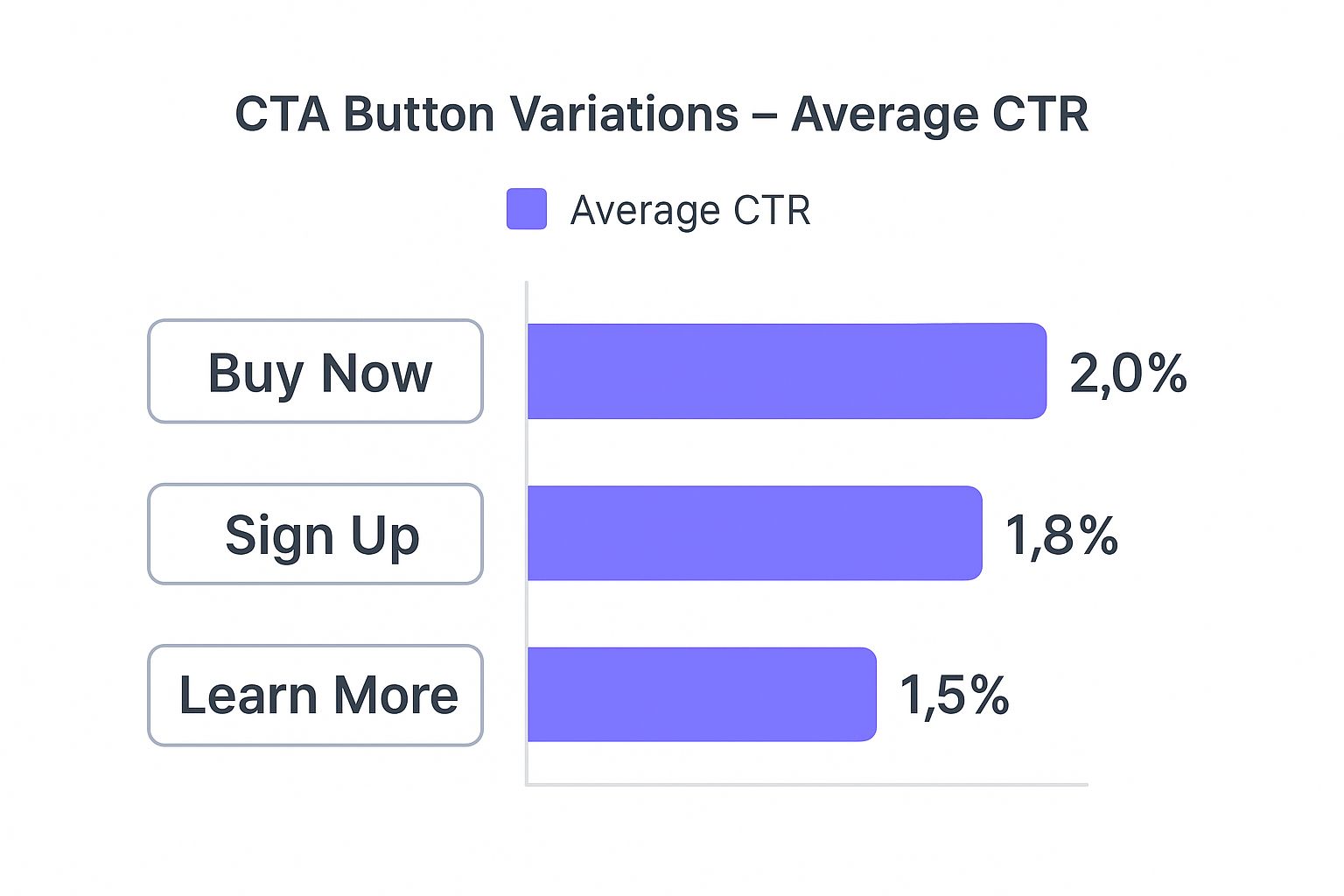
The takeaway is clear: direct, action-oriented language like "Buy Now" tends to outperform more passive phrases like "Learn More."
Mastering headlines is more important than ever. Organic search still drives about 53% of all website traffic, and with the SEO industry valued at nearly $90 billion in 2024, the competition is fierce. In fact, 61% of marketers say generating traffic and leads is their biggest challenge—a problem that a higher CTR directly solves.
Start by auditing your most important pages. Find the ones with high impressions but a low CTR, and test some of these headline formulas. Even a small bump in your click-through rate can lead to a serious increase in traffic over time.
Using Rich Snippets to Dominate the SERPs
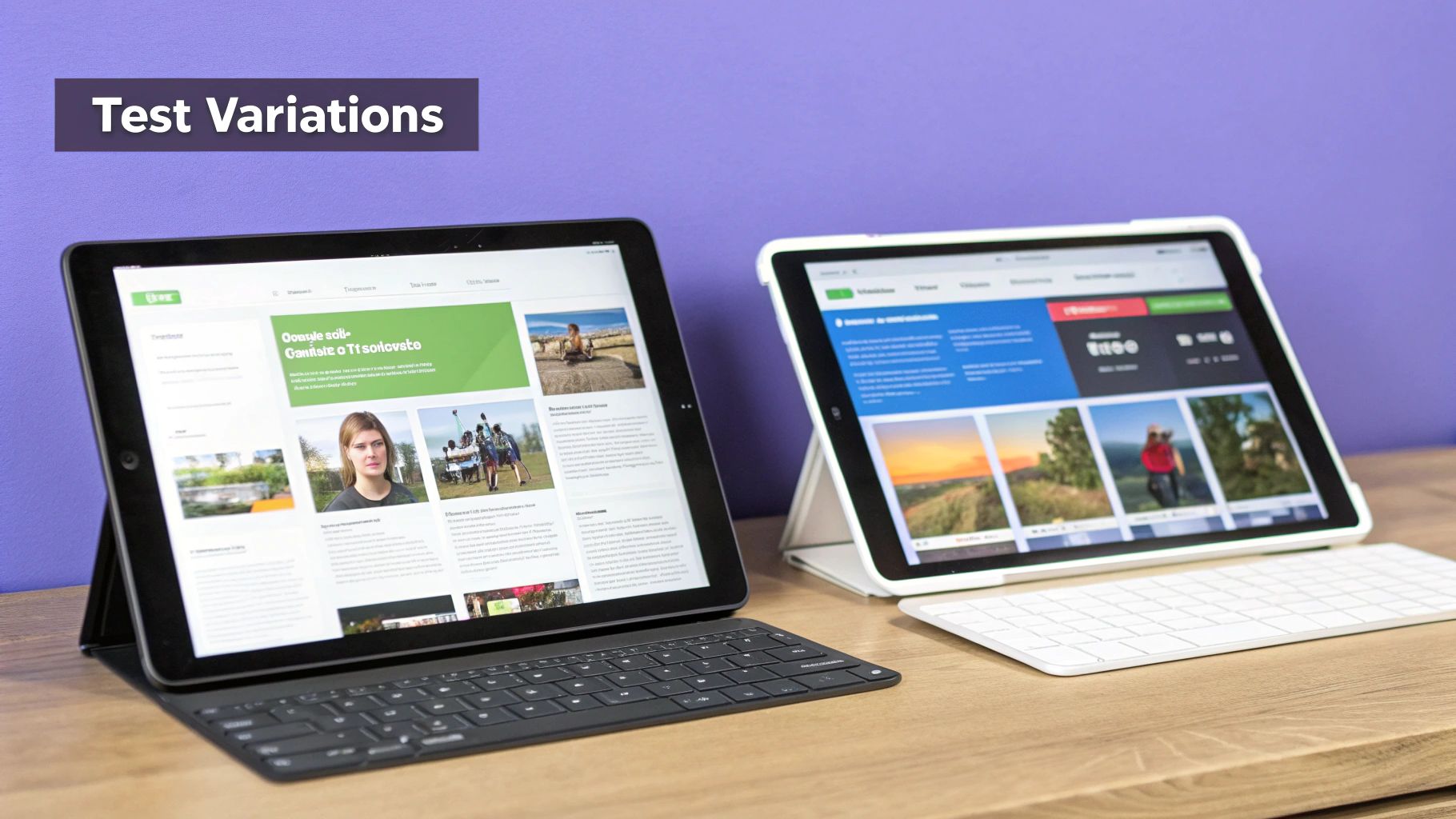
Think of your headline as the hook. If that’s the case, then rich snippets are the big, flashing neon sign pointing right at it. On a search results page full of standard blue links, these enhanced listings are impossible to ignore. They make your result bigger, more informative, and a whole lot more appealing than the competition.
Rich snippets work by pulling extra details directly into your search listing—things like star ratings, product prices, or event dates. This magic happens because of something called Schema markup.
It's a special type of code you add to your website that translates your content into a language search engines like Google can understand instantly. It doesn't change what visitors see on your page, but behind the scenes, it's spoon-feeding Google exactly what your content is about. This clarity is what helps Google display those eye-catching details that can make a huge difference in your click-through rates.
The Most Valuable Schema Types to Implement
There are literally hundreds of schema types out there, but you don't need to worry about most of them. Just focusing on a few high-impact ones can give you a massive boost. The key is to pick the ones that best fit your content and offer real value to someone scanning the search results.
I've found these three consistently deliver the best results:
- Review Schema: This is what adds those gold stars and a rating count to your listing. It’s an absolute game-changer for products, local services, and even recipes because it provides immediate social proof. Seeing a 4.8-star rating next to your link instantly builds trust.
- FAQ Schema: This markup creates a dropdown list of common questions and answers right under your main result. It’s a fantastic way to take up more real estate on the SERP, pushing competitors further down while positioning you as the go-to expert.
- How-To Schema: If you create instructional content, this is a must. It can outline the steps of your guide directly in the search results, showing users that you have a clear, actionable solution before they even click.
How to Add Schema to Your Site Without Touching Code
The thought of adding code to your site probably sounds a bit daunting, but it’s much easier than you think. You can implement schema without writing a single line of HTML yourself.
One of the simplest ways is to use Google's own Structured Data Markup Helper. It's a free, point-and-click tool. You just paste in your page's URL, and then you can highlight different elements on the page—like an author's name, a product price, or a recipe's cook time—and tell Google what each element represents.
Schema is all about removing the guesswork for search engines. The more context you provide, the better Google can represent your page in search results. This ultimately leads to more qualified clicks from users who know exactly what they're getting.
After you're done tagging the content, the tool spits out the necessary code for you. You can then copy and paste this snippet into your page's HTML.
Better yet, if you're on WordPress, plugins like Rank Math or Yoast SEO have this functionality built right in. They make adding different schema types as easy as filling out a few fields in a form.
By taking the time to implement structured data, you’re not just chasing a higher CTR today; you're setting your content up for long-term success. As search engines get smarter, they'll rely more and more on this kind of structured information. Getting on board now gives you a serious competitive edge.
Boosting CTR in Your Paid and Social Campaigns
While organic search is a long game, your paid and social campaigns are where click-through rates make an immediate dent in your budget. In this world, every single click has a price tag. That makes a high CTR more than just a vanity metric—it's a critical lever for maximizing your return on ad spend (ROAS).
When your ad's promise perfectly aligns with what a user finds on the other side of the click, platforms like Google Ads actually reward you. This is called message match, and it's the foundation of any successful paid campaign. It’s all about making sure the promise you make in your ad is instantly kept on your landing page, creating a smooth, trust-building experience.
Mastering Message Match in Google Ads
The connection between your ad copy and your landing page isn't just a "nice-to-have." It’s a huge part of your Quality Score.
A high Quality Score signals to Google that your ads are relevant and genuinely helpful, which earns you better ad positions and a lower cost-per-click (CPC). Think of it as Google’s way of rewarding you for not duping its users.
If your ad shouts "50% Off Running Shoes" but the landing page just dumps them on your generic homepage, you've broken that promise. People will hit the back button, your Quality Score will tank, and you'll end up paying more for fewer conversions.
A strong message match comes down to three things:
- Consistent Headlines: Your landing page headline should feel like a direct continuation of your ad.
- Mirrored Keywords: The same keywords that triggered the ad should pop up right away on the landing page.
- Cohesive Design: The look and feel—the branding, colors, and style—should be consistent from ad to page to build trust.
The goal is to make the jump from ad to page feel completely natural. A user should never have to second-guess if they clicked the right link. Getting this right is one of the single most effective ways to boost your campaign's profitability.
Stop the Scroll on Social Media
On social media, you’re not just up against other ads. You're fighting for attention against puppy videos, your cousin's vacation photos, and breaking news. Your ad creative has to be a genuine thumb-stopper.
A pretty picture is a decent start, but a truly great CTR comes from a powerful mix of eye-catching visuals, sharp copy, and an unmissable call to action (CTA).
For example, instead of a static photo of your product, why not test a quick video of it in action? And rather than a tired "Learn More" CTA, try something with more urgency and specificity, like "Get Your Free Quote Now" or "Shop the Limited Edition."
The trick is to create an ad that feels less like an interruption and more like a welcome discovery. This means you have to understand the native vibe of each platform. An ad that crushes it on LinkedIn's professional feed is going to fall completely flat on TikTok's fast-paced, trend-heavy environment.
The Power of Systematic A/B Testing
Never, ever assume you know what will work best. A/B testing (or split testing) is how you remove the guesswork by systematically comparing different versions of your ads to see what people actually respond to.
A solid testing plan involves changing just one thing at a time. It could be the headline, the main image, or even the color of your CTA button. By isolating that single variable, you can say with confidence what caused the change in performance. To get started, check out our guide on building a complete creative testing framework.
This methodical approach is more critical than ever. In 2024, global ad spending is projected to hit nearly US$1.1 trillion, a 7.3% jump from last year. Digital channels claim a massive 72.7% of that, totaling over US$790 billion. And the investment is paying off: average CTRs are on track to climb from 1.6% to 1.86% by early 2025, proving that smart, data-driven campaigns are genuinely boosting engagement.
The principles for optimizing CTR are universal, but each platform has its own quirks. For a great deep-dive into a specific e-commerce environment, check out these strategies to improve click-through rates on Amazon. By combining a tight message match, scroll-stopping creative, and a relentless testing mindset, you can turn your paid campaigns into powerful growth engines.
Common Questions About Click-Through Rate
Even when you start seeing progress, questions inevitably pop up. Improving your click-through rate isn't a one-and-done task; it's a constant process of tweaking and testing. It’s totally normal to hit a roadblock or just wonder if you’re heading in the right direction.
Let's dig into some of the questions I hear most often from other marketers. My goal here is to cut through the confusion and give you the confidence to keep pushing forward.
What Is a Good Click-Through Rate?
This is the big one, but the honest answer is always: it depends. There’s no universal number for a "good" CTR that fits every situation. Your results will swing wildly depending on your industry, the channel you're on, and even the keywords you’re targeting.
Still, it helps to have a few benchmarks to get your bearings:
- Google Ads: Across all industries, the average search network CTR hovers around 3.17%.
- Organic Search: The top result on Google can pull in a CTR of 30% or more. If you're lingering at the bottom of page one, you might see less than 3%.
- Email Marketing: A typical email campaign often sees a CTR somewhere between 2-3%.
Forget about chasing some mythical magic number. Your real mission is to consistently beat your own baseline. A "good" CTR is one that's better than last month's and holds its own against the competition for your specific keywords.
How Long Does It Take to See CTR Improvements?
Patience is a virtue here, but you won't be waiting forever. How quickly you see results really comes down to what you changed and where you changed it.
If you’re working on organic search, simple tweaks to your title tags and meta descriptions can move the needle pretty fast. You might notice a difference in just a few days or a couple of weeks, depending on how often Google swings by to re-crawl your site.
Bigger technical lifts, like adding Schema markup to get those fancy rich snippets, can take a bit longer for search engines to pick up. On the other hand, with paid ads, the feedback is almost instant. You’ll know how a new headline is performing within hours of launching a test.
Can a High CTR Ever Be a Bad Thing?
Almost always, a high CTR is a great sign. It means your ad copy or headline is doing its job and grabbing attention. But there's one critical exception you need to watch out for, and it’s something we call "pogo-sticking."
This is what happens when someone clicks your link, takes one look at your page, realizes it’s not what they were looking for, and immediately hits the back button.
This behavior gives you a high CTR, but it's paired with a sky-high bounce rate and a dismal time on page. To Google, this sends a huge red flag. It says your snippet made a promise that your content couldn't keep, and that can tank your rankings over time. Always make sure your compelling headline is an honest preview of the value on the page.
Ready to create stunning video ads that grab attention and drive clicks? Sprello gives you an all-in-one AI suite to produce high-converting social content in minutes. Test more ideas, ship more videos, and discover what truly boosts your CTR. Start creating at https://sprello.ai.


