October 4, 2026
Ecommerce Content Production: The Enterprise Playbook
Master ecommerce content production for fashion and beauty brands. Learn enterprise workflows, AI acceleration, and scaling strategies for catalog growth.
Ecommerce content production is becoming a major growth category, with the broader digital content creation market valued at USD 67.40 billion in 2024 and projected to reach USD 258.37 billion by 2034. The practical answer is to build a governed production system rather than just generate more assets.
A merchandising team is preparing a seasonal launch across multiple regions and channels. Product photography is still being retouched, local teams are requesting different descriptions, campaign designers are adapting layouts, and marketplace managers are asking for formats that weren't included in the original brief. Everyone is busy, but nobody has a complete view of what is approved, what is missing, and which version belongs to which market.
That is the operating problem behind modern ecommerce content production. It isn't just writing product descriptions or commissioning campaign images. It is the coordinated system that moves product information, creative concepts, visual assets, localized variations, approvals, and final deliverables from concept to channel-ready publication at scale.
The Reality of Modern Ecommerce Content Production
A seasonal collection rarely moves in a straight line. Merchandising defines the assortment, design develops the visual direction, photographers or image specialists create the core assets, copywriters prepare product stories, regional teams adapt the content, and channel owners format everything for web, marketplaces, email, and social media. One late product change can ripple through every stage.

The work becomes harder when the catalog includes colorways, size runs, bundles, accessories, and region-specific assortments. A product page may need a clean catalog image, a lifestyle composition, a short-form video, structured attributes, benefit-led copy, and versions adapted for different channels. Each asset carries dependencies, and those dependencies need owners.
Production is a system, not a pile of files
The most useful definition is operational: ecommerce content production is the repeatable process for turning product and brand inputs into approved commercial content. That process should answer five questions for every deliverable:
- What is the source: Which product record, image, material swatch, or approved claim supplies the input?
- What transformation is required: Does the asset need retouching, localization, resizing, rewriting, or a new composition?
- Who approves it: Which person owns product accuracy, brand quality, legal review, or regional suitability?
- Where will it appear: Is the output intended for a product detail page, marketplace listing, campaign, email, or social feed?
- What happens after publication: How will the team update the asset when the product, price, packaging, or campaign changes?
The scale of this shift is visible in market data. The digital content creation market is projected to grow from USD 77.95 billion in 2025 to USD 258.37 billion by 2034, at a projected 14.38% CAGR from 2025 to 2034, according to Market Research Future's digital content creation market estimate. The same source identifies retail and ecommerce as the segment with the highest revenue share in 2024.
That growth doesn't mean teams should chase maximum output. It means brands need infrastructure that keeps output useful, accurate, and traceable as the catalog expands.
Why Commerce Content Became a Formal Operating Model
Commerce content used to sit between editorial publishing and campaign marketing. A small group might write buying guides, insert product links, and assemble promotional pages when time allowed. That model breaks when content has to support a substantial catalog, multiple markets, recurring launches, and direct revenue accountability.
A 2021 survey of 200 digital media executives and professionals found that 87% already had a dedicated commerce content team of at least one person. The same survey reported that 57% expected commerce content revenue to grow by at least 25% annually over the following two years, while 32% expected growth above 50% per year. These figures come from the commerce content survey by Impact.com and Pressboard.
Those numbers matter because they describe an organizational change, not merely a publishing trend. When commerce content has dedicated staff and growth targets, it needs planning rituals, approval rules, production capacity, performance feedback, and a clear relationship with merchandising and product data.
The economics of a dedicated function
A formal operating model changes the question from “Who can make this asset?” to “What process can produce this class of asset repeatedly?” That distinction determines whether a team responds to demand by improving the system or by adding more manual labor.
An enterprise team typically needs a shared production calendar, defined briefs, reusable templates, structured product inputs, and a handoff model that doesn't depend on inbox searches. It also needs to separate creative decisions from mechanical adaptations. A designer should decide the campaign concept. They shouldn't spend the afternoon recreating the same approved composition for every channel.
This is especially important for fashion and beauty brands. A seasonal collection has visual nuance, but its production still contains repeatable elements. Background treatments, naming conventions, product claims, image crops, shade labels, and marketplace fields can be governed without flattening the creative work.
Practical rule: Standardize the repeatable parts so the team has more time for the decisions that actually differentiate the brand.
The formal model also creates a useful boundary for automation. AI can help transform an approved input into multiple formats, suggest variations, and accelerate first drafts. It shouldn't decide whether a shade description is accurate, whether a garment detail has changed, or whether a regional claim is commercially acceptable without review.
That is why hiring more people isn't always the answer. If briefs are incomplete, files are scattered, and approvals happen in private conversations, additional staff can increase activity without improving throughput. Infrastructure must come first.
Traditional Workflows Versus AI-Driven Production Canvases
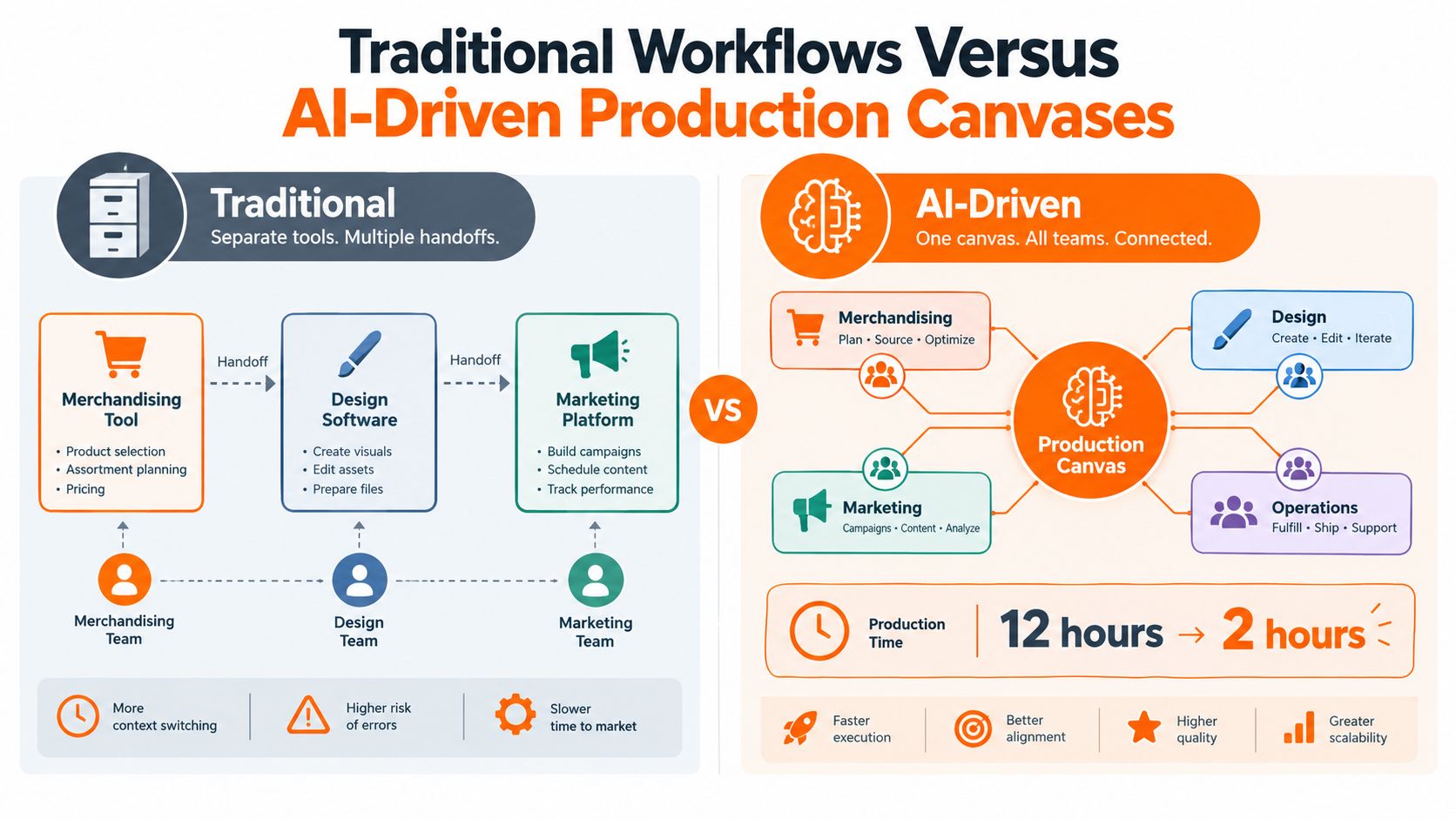
In a fragmented workflow, merchandising works in an assortment tool, design works in creative software, marketing manages campaign requests in spreadsheets, and ecommerce teams publish through a separate platform. The handoffs are usually connected by email, chat messages, file names, and memory.
An AI-driven production canvas changes the center of gravity. Instead of treating each asset as an isolated request, the team maps the workflow from input to output. Product data, references, instructions, brand rules, review stages, and channel variants remain connected to the work.
Where the traditional model loses time
The manual model can work for a small launch with few dependencies. It becomes fragile when several teams modify the same asset class.
- Brief handoffs: Product information arrives separately from the creative request, so the creator has to reconcile conflicting details.
- Version control: Teams approve one image while another team publishes an earlier export.
- Regional adaptation: Local teams duplicate files rather than adapting a controlled source.
- Revision tracking: Feedback arrives through different channels, making it difficult to distinguish a requested change from an approved decision.
- Output formatting: People repeat the same resizing, naming, and export tasks for every destination.
The issue isn't that spreadsheets or email are bad. The issue is that they don't provide a reliable production record when the work contains many dependencies.
What a canvas adds
A production canvas gives each workflow a visible structure. The team can define the source asset, apply a transformation, route the result through a review checkpoint, and generate channel-specific outputs from the approved version. AI becomes a controlled layer inside that process.
For example, an approved product photograph might feed a catalog background treatment, a lifestyle composition, and a vertical social crop. The canvas should preserve the original, record the instructions used for each variation, and make the review status visible. It should also prevent a regional adaptation from being mistaken for the global master.
Use the same test when diagnosing a slow process. If you need more detail on identifying and fix your content workflow bottlenecks, focus on where information waits, not only where people work.
A unified canvas won't solve weak inputs or unclear ownership. It does make those problems visible. Teams can then decide which steps should remain human-led, which transformations can be automated, and where a quality gate belongs. For a broader view of how teams structure an AI content workflow, compare the desired process with the actual path an asset takes through your organization.
The video below illustrates the broader shift from disconnected production tasks toward coordinated creative operations.
The useful measure isn't how many assets the system can generate. It is how many approved assets reach the right channel without avoidable rework.
Essential Workflow Types for Fashion and Beauty Brands
Fashion and beauty teams shouldn't begin with an AI tool. They should begin by identifying the workflow that is failing. A collection-planning problem needs a different system from a catalog-photography problem, even if both eventually use image generation.

Assortment visualization
Start with the line architecture. Bring together silhouettes, colorways, materials, size runs, and complementary accessories in a shared view before the team commissions every downstream asset. Merchandising can identify gaps, duplication, or missing coordination while changes are still inexpensive.
The workflow should preserve the relationship between the core product and its variants. A colorway isn't just another image. It may require a different name, swatch, styling story, regional description, and channel treatment.
Editorial campaign production
A campaign workflow begins with a creative brief, not a folder of unstructured references. Define the campaign idea, hero products, required formats, approved visual language, copy direction, and channel destinations. Then create a master composition that can be adapted without losing the original concept.
Designers should approve the visual system early. Once the system is approved, production specialists can create the necessary crops, layouts, motion treatments, and supporting assets without reopening the entire creative debate for every output.
Product concepting
AI is useful before the product exists as a finished asset. Teams can explore materials, silhouettes, color palettes, and styling directions using sketches, swatches, and references. That makes concepting faster to review, but exploratory visuals must remain clearly separated from production-ready representations.
A useful approval label is simple: concept, direction approved, sample reference, or production master. Without that distinction, an inspirational image can accidentally become the visual source for a product listing.
Catalog-scale product photography
Catalog production benefits most from templates and strict inputs. Define the camera logic, background treatment, shadow behavior, crop rules, product positioning, and prohibited alterations. Feed the system approved product references, then route outputs through product and brand review.
For teams assessing faster campaign rollout with AI, the important question is not whether the tool can create an attractive image. It is whether the output remains usable across a defined product set and channel specification.
A production canvas can connect these workflows into a seasonal dossier. That dossier should hold the brief, product list, references, approved templates, regional requirements, review owners, and final exports. Teams building a creative production workflow should also document what changes between workflow types, rather than forcing every project into one generic template.
The result is a more deliberate operating model. Concepting stays exploratory, assortment planning stays structured, and catalog production stays controlled.
The Product Fidelity Problem Most Brands Overlook
AI-generated ecommerce imagery can look polished while still being commercially wrong. A zipper may shift, a logo may distort, a stitch pattern may disappear, or a beauty product may change its shade. Those errors are easy to miss when a reviewer evaluates the composition as a whole instead of checking the product against the source.
A vendor-run product-fidelity benchmark, cited in an independent review, found that across four 2K image-editing models, critical details such as buttons, zippers, logos, stitches, and color were preserved only 28% of the time. The findings are discussed in Lamina's product image editing benchmark.
That result changes the production question. Raw generation volume is a weak measure if the team still has to reject most outputs. The useful metric is approved-output rate, supported by clear reasons for rejection.
Build a fidelity gate
Use a fixed test set of 20 to 50 real product images, as the same benchmark review recommends, and include difficult examples. Test reflective packaging, small logos, fine stitching, patterned materials, transparent containers, color-sensitive cosmetics, and products with distinctive hardware.
Review each output against a checklist:
- Identity: Does the item remain the same product?
- Construction: Are seams, closures, proportions, and components intact?
- Color: Does the result match the approved reference and shade information?
- Brand marks: Are logos, labels, and packaging text preserved?
- Context: Does the environment support the product without implying an inaccurate use or claim?
Human review belongs at the point where an output could create customer confusion. It doesn't need to slow every exploratory iteration, but it should be mandatory before publication.
Separate visual polish from truth
A beautiful image can still create a misleading shopping experience. In beauty, a changed shade or texture can undermine purchase confidence. In fashion, an altered fit or missing detail can misrepresent the garment. In lifestyle categories, the generated scene can imply features the product doesn't have.
Teams exploring creating product visualizations should treat visualization as a controlled production stage, not as permission to improvise product facts. Lock the source reference, define acceptable transformations, and record the reviewer who approved the final image.
Quality control starts with the product reference, not the final render.
AI works well as a first-pass production layer when the workflow tells it what it may change and what it must preserve. It doesn't replace product expertise, merchandising judgment, or final brand approval.
Scaling Localization Without Multiplying Rework
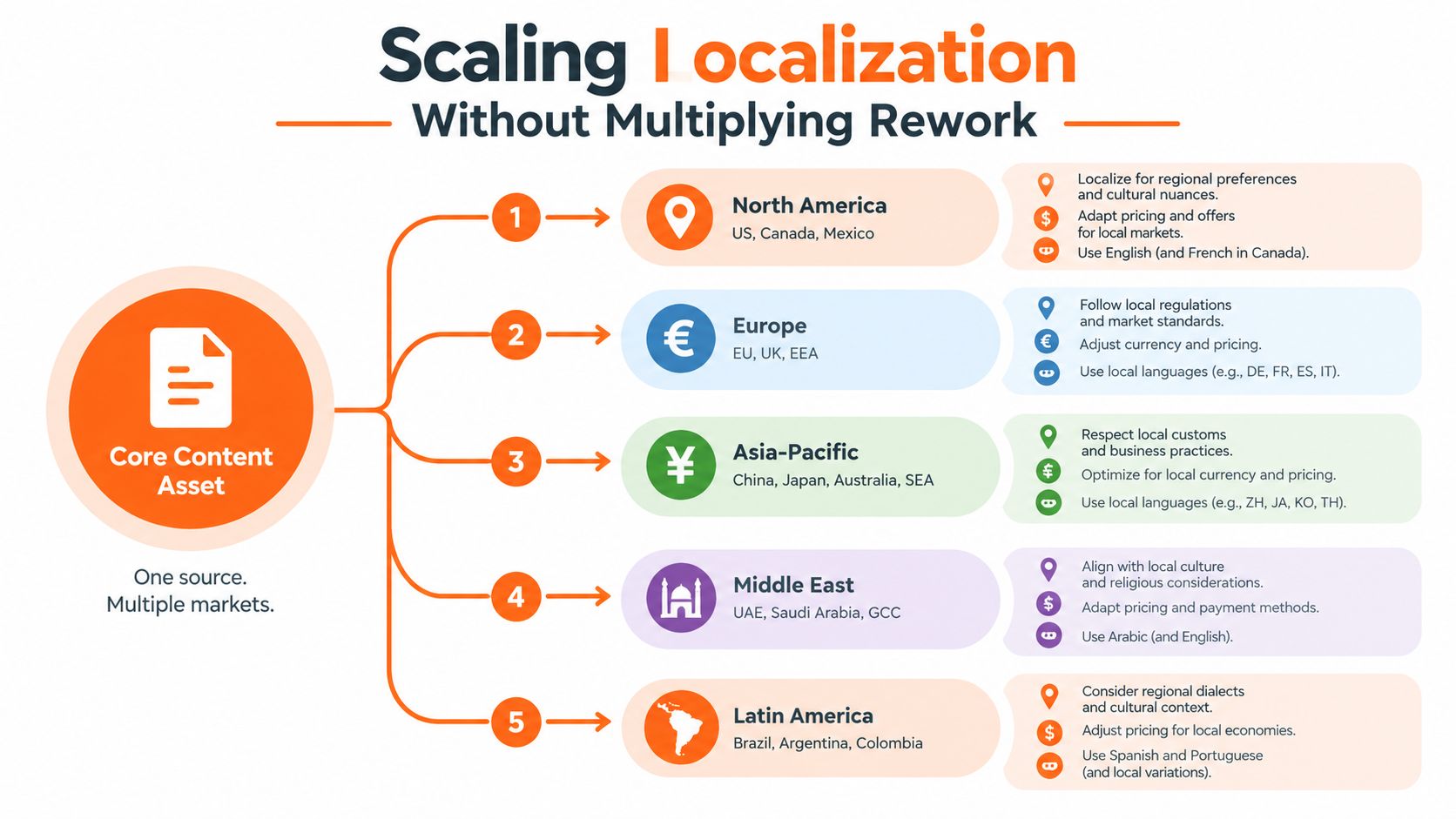
Localization fails when teams treat it as a translation queue. A global product asset often needs changes to language, currency, units of measure, imagery, merchandising context, interface elements, payments, shipping information, and the customer journey. The source asset may be visually correct but operationally unusable in a particular market.
The ecommerce localization guidance from Phrase makes this broader point clearly. Localization extends beyond translated words, and the same principle applies to production infrastructure. Regional variation needs to be designed into the asset system from the start.
Use a controlled source with local variables
The global team should own the core product truth and brand system. Regional teams should control market-specific adaptations within defined boundaries. That division prevents two common failures: central teams approving content that doesn't fit local conditions, and local teams creating disconnected versions that drift from the brand.
Structure each asset with fields rather than flattened copy. A product description might separate the product name, material, care information, benefit language, legal qualifiers, unit display, and local merchandising message. A campaign image might separate the core composition from the model styling, text overlay, cultural reference, and channel crop.
A practical localization flow looks like this:
- Create the core asset: Establish the approved product truth and visual direction.
- Define market variables: Document language, currency, units, imagery, claims, and channel rules.
- Generate regional versions: Adapt only the fields and elements approved for variation.
- Route local review: Give regional owners a meaningful approval stage, not a final proofreading task.
- Publish with traceability: Store the market version alongside the source and its approval history.
This approach reduces duplicated work because teams don't rebuild the entire asset to change one market variable. It also makes updates safer. When a product attribute changes, the system can identify which regional versions depend on it.
The catalog is the operational foundation. Teams managing large assortments can review product catalog management software as part of the broader effort to connect product data, creative production, and market delivery.
Localization also needs a stop rule. If a market requires a new claim, a different product interpretation, or a substantially different visual story, it should become a new creative brief rather than an invisible modification to the master asset.
Building Your Enterprise Content Production Strategy
Start by auditing the path of one real launch, not by buying another tool. Follow a product from assortment approval to final publication and record every handoff, duplicate file, clarification, review, and rejected output. The bottleneck usually appears where ownership or source information becomes ambiguous.
Choose the right workflow boundary
Create a shared production template for repeatable work. It should include the brief, source assets, product identifiers, brand rules, required outputs, market variables, reviewers, status, and publication destination. Templates reduce the need to reconstruct context every time a new season or channel begins.
Then separate three layers:
- Creative direction: The concept, story, styling, and visual choices that need expert judgment.
- Production transformation: Cropping, resizing, formatting, controlled variations, and structured first drafts.
- Quality governance: Product fidelity, claims, regional suitability, brand standards, and final approval.
This structure keeps AI in the right place. It can accelerate transformations and help teams explore options, but people remain accountable for the decisions that affect trust.
Measure what can ship
Don't celebrate asset counts by themselves. Track how many outputs pass review, how often teams revise the same asset, where approvals wait, and how frequently local teams rebuild central work. Those measures tell you whether the workflow is becoming more reliable.
For fashion, beauty, and lifestyle teams, Sprello provides a visual workflow canvas for designing and auditing production workflows across SKUs, channels, regions, and seasons. Its use is most relevant when teams need shared templates, seasonal production dossiers, brand guardrails, and catalog-scale creative operations in one visible process.
The enterprise canvas is not a replacement for creative leadership. It is the operating layer that lets creative leadership remain focused on direction while the organization manages complexity with less confusion. Build the system around approved inputs, explicit ownership, controlled variation, and a review standard that protects the product.
If your team is losing time to scattered briefs, repeated adaptations, and unclear approvals, Sprello gives fashion, beauty, and lifestyle brands a visual canvas for building production workflows across SKUs, channels, regions, and seasons. Visit Sprello to organize your next ecommerce content production workflow around shared templates, brand guardrails, and production-ready outputs.
Related
More to explore
Fresh reads
Enterprise Content Production Platform: Strategy and Guide
Explore the enterprise content production platform for fashion and beauty brands. Learn core capabilities, vendor selection, and ROI implementation strategies.

Product Photography Automation for Fashion Brands at Scale
Learn how product photography automation helps fashion, beauty, and lifestyle brands scale catalogs, cut costs, and keep visuals consistent across every

Generative AI Ecommerce Playbook for Brand Teams
Generative AI ecommerce guide for fashion and lifestyle brands. Explore use cases, brand controls, implementation steps, and ROI metrics that actually move