October 3, 2026
Enterprise Content Production Platform: Strategy and Guide
Explore the enterprise content production platform for fashion and beauty brands. Learn core capabilities, vendor selection, and ROI implementation strategies.
A content production platform is a governed, visual workflow system, not just an AI generator, and the market is projected to grow from USD 31.81 billion in 2025 to USD 36.66 billion in 2026. Its purpose is to standardize brand-consistent asset production across SKUs, channels, regions, and seasons.
A seasonal launch can expose the weakness of a brand's content operation within hours. The collection is approved, the merchandising story is clear, and the campaign concept is strong. Yet product images sit in one folder, retouched files sit in another, regional requests arrive through email, and e-commerce teams are still asking which version has final approval.
That environment makes every new colorway, accessory, language, and channel feel like a fresh production project. A modern platform changes the unit of work. Instead of treating each image or video as an isolated file, it treats the brief, product data, creative rules, transformations, approvals, and final outputs as one governed pipeline.
Why Fashion Brands Need a New Content Operating System
Three days before a major seasonal launch, the merchandising team discovers that several product images were created against an outdated color reference. Design has the approved version, e-commerce has a compressed export, and the regional marketing team has already adapted the wrong file for paid social. Nobody has made a serious creative mistake. The process gave too many teams too many places to work.

Traditional creative tools are useful inside individual tasks. Photoshop can support detailed retouching, Figma can help teams review layouts, and a DAM can store approved files. None of those tools, by themselves, defines what should happen between a product brief and the final regional deliverables. Teams still coordinate dependencies manually, copy files between systems, and rely on personal knowledge to keep production moving.
The result is usually familiar:
- Long lead times: A small change to a product detail can trigger a chain of manual exports and reviews.
- High production costs: Senior creatives spend time on resizing, versioning, file preparation, and repetitive corrections.
- Fragmented collaboration: Merchandising, design, marketing, and e-commerce work from different views of the same assortment.
- Brand inconsistency: Regional adaptations drift when guardrails live in documents rather than inside the production path.
A content production platform acts more like an operating system for this work. It connects the brief to reusable workflows, applies rules to each output, records who approved what, and gives teams a shared view of progress. Adobe describes this model through custom reusable workflows and a visual canvas for automating high-volume production while preserving brand governance and quality in its scaled content production guidance.
The change from files to flows
The practical shift is simple but consequential. A file-based process asks, “Where is the latest image?” A workflow-based process asks, “What stage is this product in, which transformations are complete, and which approval is blocking publication?”
That distinction matters when a fashion team needs a studio image, a marketplace crop, a campaign video, and region-specific adaptations from the same product source. Teams can also use specialist services for isolated needs, such as studio-quality video in minutes, but the output still needs a governed place in the broader content pipeline.
The platform doesn't replace every specialist application. It gives those applications and teams a common operating context. A useful reference for mapping the handoffs is this creative production workflow guide, especially when the problem isn't image creation but coordination between people, systems, and approval stages.
Core Capabilities of an Enterprise Content Production Platform
An enterprise platform earns its place by controlling the path from product idea to publishable asset. In fashion and beauty, that path must accommodate assortment planning, product references, campaign concepts, regional variations, channel specifications, and approval policies without forcing teams to rebuild the process for every launch.
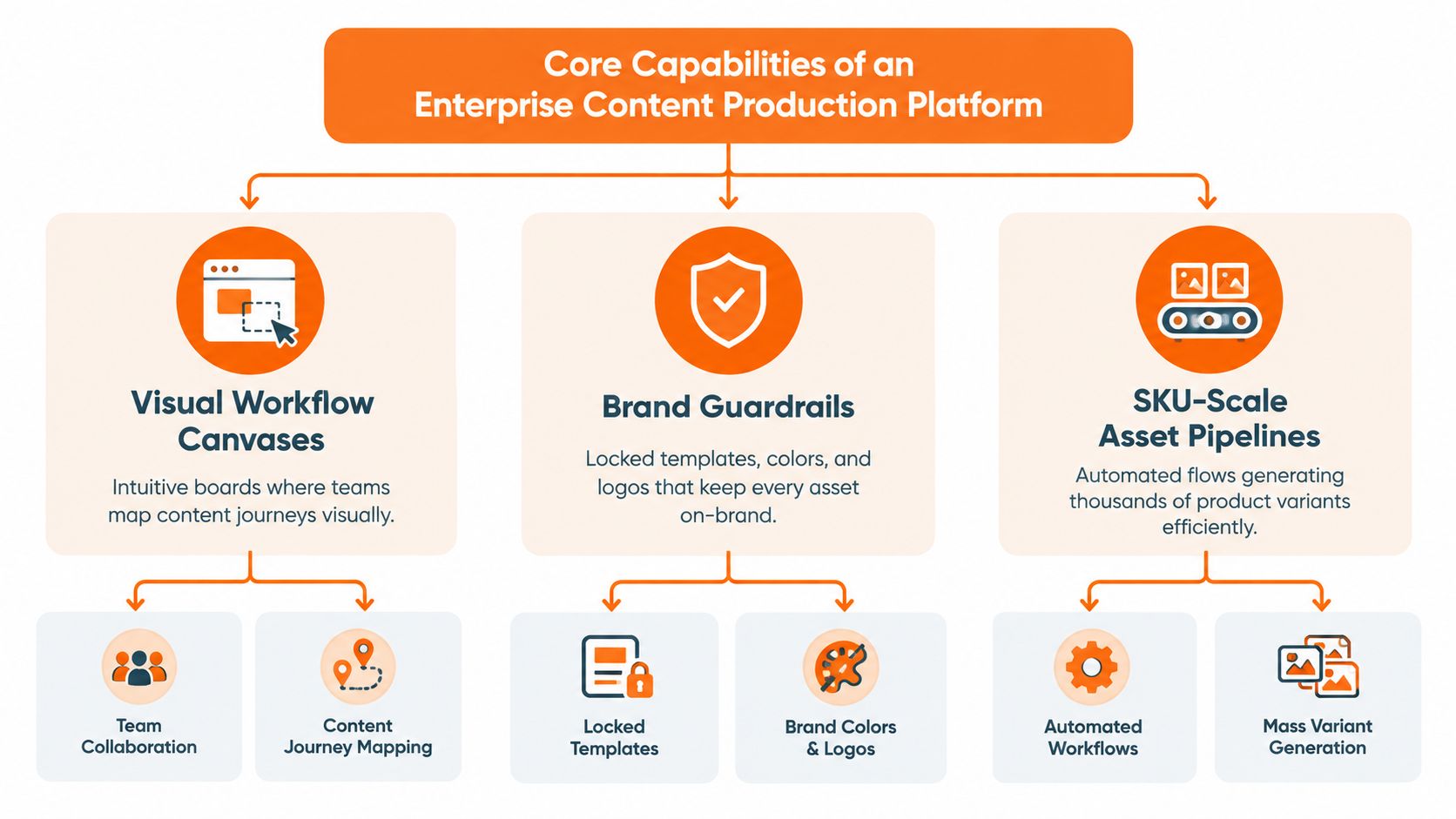
Visual workflow canvases
A visual canvas makes production logic visible. Instead of burying instructions in a project brief, the team can map the sequence from assortment input to concept development, image generation, retouching, localization, review, and delivery. Each stage can expose its inputs, owner, output, and approval condition.
That visibility helps creative operations identify bottlenecks before launch pressure builds. It also makes a workflow teachable. A new producer can understand how a seasonal campaign moves through the organization without relying on a private spreadsheet or a verbal handoff.
Brand guardrails
Brand consistency requires more than a shared logo folder. A platform should preserve approved templates, color references, typography rules, naming conventions, composition guidance, and product-specific constraints inside the workflow. The system must allow variation where the market needs it while protecting the elements that define the brand.
For a beauty launch, that might mean keeping pack proportions, shade naming, claims language, and visual hierarchy consistent while adapting copy or imagery for a regional channel. For a fashion collection, it might mean maintaining silhouette accuracy and styling rules across different editorial scenes.
SKU-scale asset pipelines
The final capability is throughput with control. A pipeline should separate invariant elements, such as the product identity and core brand treatment, from variable fields, such as background, crop, language, placement, or campaign context. That structure allows one approved source to feed multiple outputs without restarting production for each variation.
Automation is most useful when it handles predictable work, including resizing, templating, localizable module swaps, and format conversion. A practical overview of AI-powered content automation is useful for understanding the distinction between generating an asset and automating the surrounding production tasks.
A serious evaluation should also test integrations, permissions, review history, and exception handling. A creative automation platform framework can help teams separate attractive generation features from the workflow controls required for enterprise production.
Strategic Benefits for Fashion, Beauty, and Lifestyle Brands
The strategic value of a content production platform lies not just in enabling a team to produce more assets. The value comes from making the right assets more predictably, with fewer preventable decisions repeated across every product and market.
Fashion teams should start with speed to market. Seasonal lineups often move through concepting, buying, production, and channel preparation under intense time pressure. A reusable workflow lets teams visualize a collection early, identify missing product inputs, and prepare channel adaptations before the final campaign rush. The advantage is not speed for its own sake. It gives merchandising and marketing more time to make informed choices.
Beauty teams should prioritize controlled variation. A shade family may need multiple product views, educational scenes, retail formats, and local market adaptations. If each variation is built independently, inconsistency becomes difficult to detect. Guardrails make the approved product representation the starting point for every derivative asset.
Lifestyle and home brands often need both editorial storytelling and catalog precision. A platform should support the difference between a room scene designed to communicate aspiration and a product image designed to answer a shopper's practical question. Treating both as identical outputs produces weak work. Treating them as separate systems creates unnecessary fragmentation.
Vendor criteria that shouldn't be negotiable
Use the following questions during evaluation:
- Workflow depth: Can the platform represent briefs, dependencies, approvals, exceptions, and final delivery, or does it stop at generation?
- Category fit: Does it understand assortment structure, product variants, seasonal planning, accessories, and channel-specific creative?
- Governance: Can teams lock templates, define naming conventions, preserve source references, and review changes?
- Integration readiness: Can it connect with the systems that hold product information, approved assets, campaign data, and publishing requirements?
- Cloud collaboration: Can distributed teams work from a shared browser-based environment rather than passing exports between desktops?
The market context supports this shift toward collaborative infrastructure. One estimate places the digital content creation market at USD 31.81 billion in 2025, with a projection of USD 66.05 billion by 2030, implying a 15.2% CAGR from 2026 to 2030 in its market forecast. The same source assigns cloud deployment a 70.15% share in 2025, which reinforces the operational case for shared, browser-based production rather than isolated tooling.
Implementation Considerations and Governance at Scale
Implementation fails when a brand treats the platform as a new application instead of a new production model. Before configuration begins, leaders need to define which decisions belong to merchandising, design, marketing, legal, regional teams, and e-commerce. They also need to decide which outputs can move automatically and which require human approval.
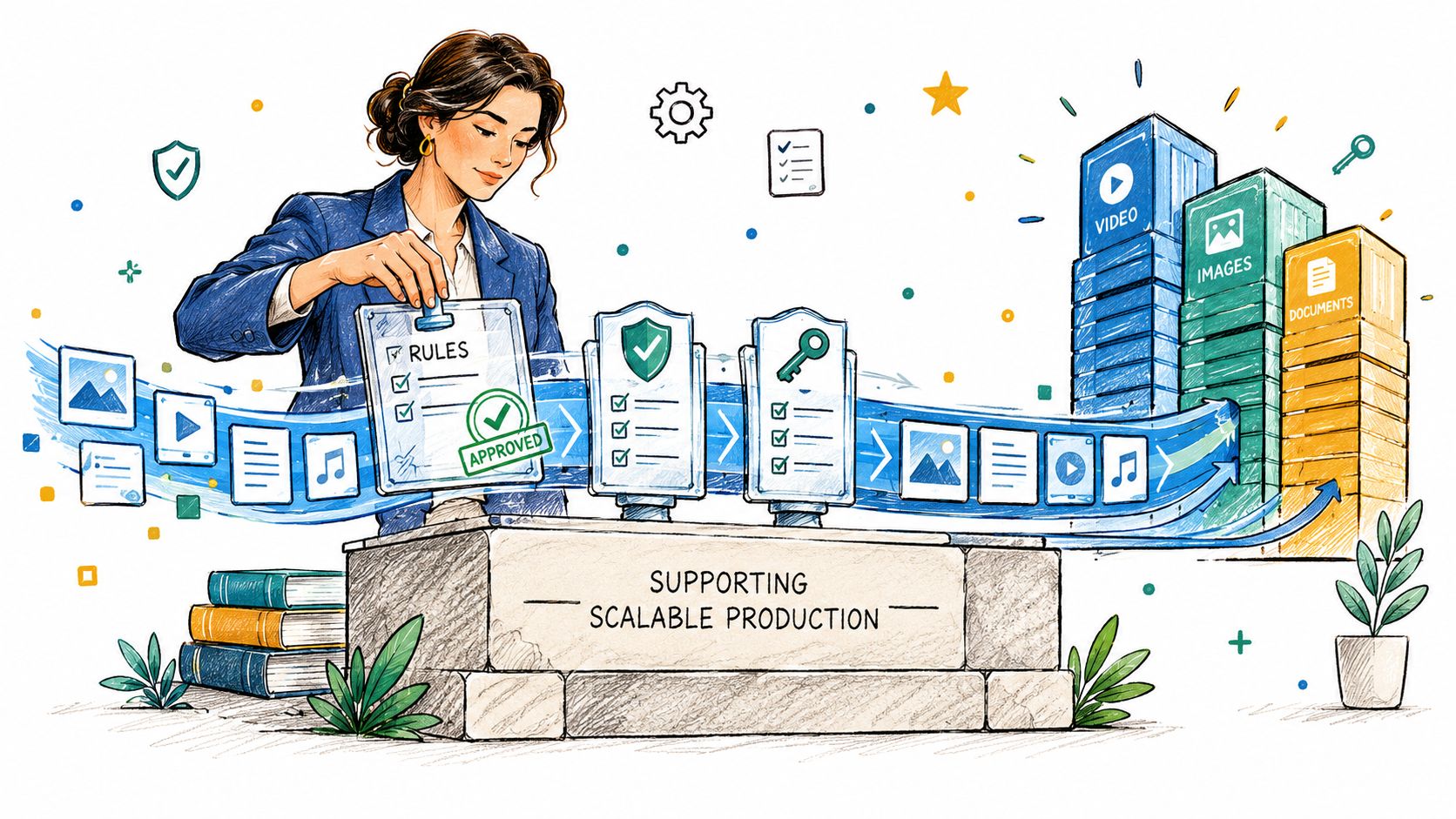
A sound governance model starts with the source of truth. Product attributes should come from the appropriate product information system, approved media should remain connected to the digital asset environment, and workflow status should remain visible to the teams responsible for delivery. If the platform creates another disconnected repository, it may accelerate creation while making the overall content supply chain harder to audit.
Design the approval logic before the templates
Templates are only as reliable as the rules around them. Define which product fields are locked, which creative elements can vary, who can approve a regional adaptation, and what happens when an output fails validation. Include an exception path for unusual products, late assortment changes, and creative work that cannot fit a repeatable pattern.
Research on content teams indicates that research, editing and approvals, and promotion or performance tracking remain significant bottlenecks after AI adoption, with governance needed to prevent quality drift and preserve brand consistency across regions as described in the State of Content Teams report. That finding has a direct operational implication. Automation should move routine work forward, but it shouldn't remove the checkpoints that protect product accuracy and brand intent.
Team roles also change. Producers spend less time chasing files and more time maintaining workflow health. Creative directors define reusable standards. Merchandising teams contribute structured product context earlier. Regional marketers review the exceptions that require local judgment instead of rebuilding every asset from scratch.
A platform becomes viable when these responsibilities are visible in the system. Teams need an audit trail showing inputs, transformations, reviewers, and final outputs. They also need dashboards that reveal where work pauses, which templates create rework, and which markets regularly require exceptions.
The technical and organizational pieces reinforce each other. Without integration, governance becomes manual administration. Without governance, integration only moves inconsistent content faster.
Teams assessing their current structure can use a digital asset workflow model to map ownership, approvals, storage, and delivery before selecting configuration settings. The exercise often reveals that the largest improvement doesn't come from adding another generation feature. It comes from removing unclear handoffs.
How to Evaluate Vendors and Select the Right Platform
A vendor demonstration can make almost any content platform look capable. The presenter starts with a polished reference image, generates several variations, and shows an attractive gallery. That demonstration answers whether the system can create something. It doesn't answer whether your organization can trust the result across a seasonal launch, a complex assortment, or a regional approval chain.
Ask vendors to work with your operating reality. Provide a representative product set, a real campaign brief, existing naming conventions, and the channel outputs your teams already produce. Ask them to show the complete path from input to approved delivery, including a deliberate error or late change.
Test the workflow, not the showcase
A useful evaluation should include these exercises:
- Assortment test: Start with products that differ in color, material, size, or packaging. Check whether the platform preserves product distinctions through every transformation.
- Regional test: Request a market variation that changes the required content while retaining the approved brand treatment. Review how permissions and approvals work.
- Exception test: Introduce a missing reference, an outdated product detail, or a nonstandard item. See whether the platform flags the issue or quietly produces an unusable output.
- Handoff test: Follow the file into the systems used by e-commerce, DAM, PIM, campaign management, or retail publishing teams.
Pay close attention to what the vendor cannot demonstrate. A polished generation interface doesn't compensate for weak version control, poor metadata, limited permissions, or an unclear integration roadmap. Support matters too. Enterprise teams need implementation guidance, workflow design help, issue resolution, and a realistic process for requesting changes.
Practical rule: Don't approve a platform because it creates the most impressive first image. Approve it because your team can govern the hundredth variation.
The strongest business case connects production performance to launch outcomes. Track how long a brief takes to become an approved asset, how much rework occurs after review, and whether teams can deliver channel and regional requirements without compromising the product representation. Those measures expose value more clearly than a feature checklist.
A platform should also fit the organization's maturity. A small creative operations team may need a focused workflow canvas and dependable templates. A global enterprise may require role-based access, auditability, structured integrations, and a partner able to support multiple business units. The right choice is the one that matches the complexity you must govern now while leaving room for the processes you expect to build.
Real-World Applications and Success Scenarios
A fragmented workflow and an integrated platform can produce similar-looking files, but they produce very different working conditions. The difference becomes clearest in the handoffs.

Consider catalog photography. In a traditional process, a product moves from sample coordination to a shoot, retouching, cropping, regional review, and channel delivery through a series of folders and messages. A change in product information may require the team to locate every affected export. In an integrated process, the product reference remains connected to the workflow, and the platform generates defined variants from governed inputs.
The same contrast applies to editorial campaigns. A disconnected team may create a compelling hero image, only to discover later that the crop, product angle, or accessory treatment doesn't work for e-commerce. A coordinated team can define the editorial intent alongside the required commerce outputs, then route each version through the appropriate review.
Where AI helps and where it doesn't
AI-generated fashion photography is moving into mainstream production. The market is projected to grow from USD 2.01 billion in 2025 to USD 6.11 billion by 2029, according to fashion industry coverage on AI-generated photography. The most useful applications currently include packshot-to-model conversion, background generation, scene creation, retouching, and high-volume catalog imagery.
Those applications solve a meaningful production problem, but they don't constitute the whole workflow. AI can create a scene while merchandising still needs to confirm assortment logic. It can generate a model image while design still needs to check silhouette fidelity. It can produce a regional variation while marketing still needs to approve the message and channel fit.
The platform creates value by placing AI inside those decisions. It lets teams compare exploratory concepts with production-ready outputs, retain product context, and route assets to the people who own quality. Generation is the acceleration layer. Governance is what makes the result usable.
Measuring ROI and Optimizing Your Content Strategy
A content production platform should be measured as an operating system, not as a collection of creative features. The first question is whether the organization can move an approved product or campaign from brief to market with less friction. The second is whether that speed remains compatible with brand, product, and regional standards.
Start with a baseline for the current process. Document where teams wait, where files are recreated, which approvals cause rework, and which outputs require manual preparation. Then connect those observations to practical measures:
- Time to approved asset: Measure the elapsed time from a complete brief to a channel-ready output.
- Cost per asset: Include production labor, review effort, rework, and localization activity rather than counting generation alone.
- First-pass approval: Track how often an asset clears review without avoidable corrections.
- Workflow exceptions: Record the reasons a product or campaign leaves the standard path.
- Reuse rate: Identify which templates, transformations, and production dossiers support repeated work.
- Brand consistency: Review whether product representation, naming, visual treatment, and regional adaptations follow the approved rules.
These measures should be reviewed by workflow, not only by department. A campaign may appear efficient for creative while creating delays for e-commerce. A regional process may deliver quickly while generating excessive review work for brand management. Shared reporting makes those trade-offs visible.
Optimization should follow the evidence. If teams repeatedly correct the same crop, improve the template. If regional reviewers reject the same type of adaptation, clarify the guardrail. If a workflow generates too many exceptions, redesign the standard rather than asking people to work around it.
The long-term advantage comes from turning production knowledge into reusable structure. Each successful launch should leave behind better templates, clearer approval rules, stronger integrations, and a more accurate understanding of where human judgment adds value. That is how a content production platform supports immediate launch needs while becoming a durable content operating system.
Sprello gives fashion, beauty, and lifestyle teams a visual canvas for production-ready creative workflows across products, campaigns, channels, regions, and seasons. Visit Sprello to see how your team can replace fragmented asset handoffs with governed, scalable content production.
Related
More to explore
Fresh reads

Product Photography Automation for Fashion Brands at Scale
Learn how product photography automation helps fashion, beauty, and lifestyle brands scale catalogs, cut costs, and keep visuals consistent across every
Generative AI Ecommerce Playbook for Brand Teams
Generative AI ecommerce guide for fashion and lifestyle brands. Explore use cases, brand controls, implementation steps, and ROI metrics that actually move
Marketing Workflow Software Guide for Enterprise Brands
Explore marketing workflow software built for enterprise fashion and beauty teams. Compare features, integration benefits, and evaluation criteria.