

A great ad campaign starts with a great script. While eye-catching visuals and a compelling offer are crucial, the words you choose form the backbone of your message, guiding your audience from initial curiosity to final action. A poorly written script can sink even the most brilliant creative concept, while a strong one can turn a simple idea into a high-performing asset. This is where having a proven ad script example to follow can make all the difference, providing a clear roadmap to structure your message effectively.
This article moves beyond theory to provide practical, detailed examples you can adapt and use today. We will break down six powerful ad script frameworks, including classics like AIDA and Problem-Agitate-Solution, showing you exactly how they work in real-world scenarios. For each framework, you’ll get a complete script, a strategic analysis of why it’s effective, and actionable takeaways to apply to your own campaigns. Understanding how to write an effective video script is the crucial first step, providing the blueprint for engaging your audience and achieving your campaign goals. Let's dive into the examples that will help you craft ads that convert.
1. Problem-Agitate-Solution (PAS) Ad Script
The Problem-Agitate-Solution (PAS) framework is a classic, high-impact copywriting formula that drives conversions by tapping directly into the customer's emotions. It’s a powerful ad script example because it follows a simple, psychologically persuasive three-step sequence. First, you identify a specific pain point your target audience experiences.
Next, you agitate that problem by exploring its negative consequences and frustrations, making the pain feel more immediate. Finally, you introduce your product or service as the perfect, targeted solution that resolves their struggle. This structure creates a sense of urgency and positions your offer as a necessary relief, not just a nice-to-have.
How the PAS Framework Works
The PAS model is effective because it mirrors a natural problem-solving process. It validates the customer's feelings by first acknowledging their struggle, which builds trust. By agitating the problem, you prevent them from dismissing it as minor, increasing their motivation to find a solution.
- Problem: Clearly state a pain point. For a B2B software, this could be: "Tired of juggling projects across messy spreadsheets?"
- Agitate: Dive deeper into the frustration. "You're wasting hours on manual updates, deadlines are slipping, and communication is breaking down."
- Solution: Present your product as the clear answer. "Our platform centralizes everything, automating tasks and giving you a clear view of every project."
This approach works exceptionally well in video ads, social media posts, and landing pages where you need to capture attention and drive action quickly.
The following infographic illustrates the simple yet powerful flow of the PAS framework.
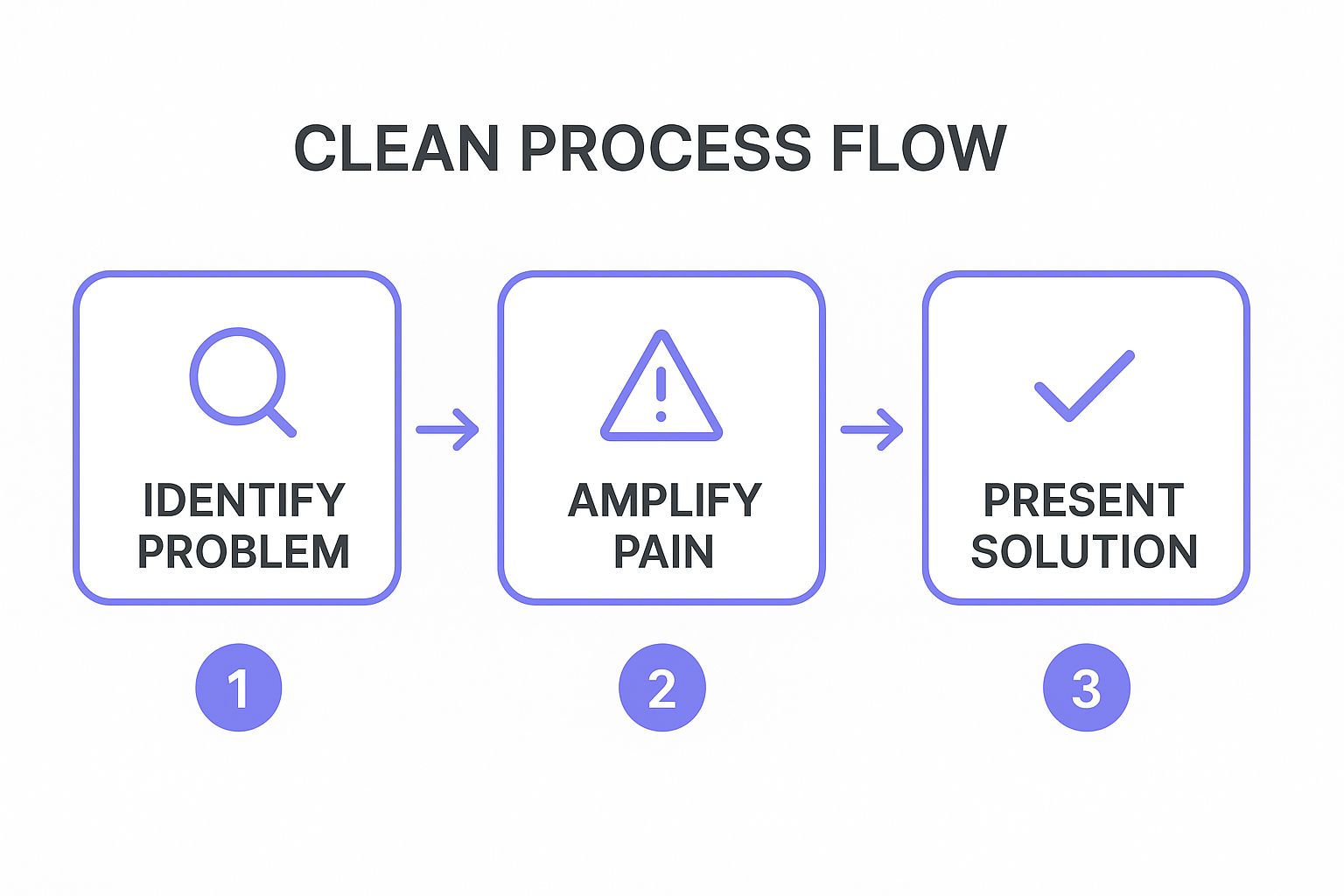
This visual shows how the sequential flow from problem to solution creates a compelling narrative that guides the potential customer toward a decision.
Actionable Takeaways for Your Ad Script
To create a successful PAS ad script example, focus on authenticity and precision.
- Deep Audience Research: Don't guess their problems. Use surveys, reviews, and customer interviews to find the exact language they use to describe their pain points.
- Balance Agitation: Agitate the problem enough to create urgency, but not so much that you sound fear-mongering or out of touch. The goal is empathy, not anxiety.
- Provide a Credible Solution: Your solution must directly address the agitated problem. Support your claims with data, testimonials, or a clear demonstration to build credibility.
2. AIDA (Attention-Interest-Desire-Action) Ad Script
The AIDA model is a time-tested advertising framework that maps the consumer's journey from initial awareness to final purchase. This classic ad script example guides potential customers through four distinct psychological stages: grabbing their Attention, building their Interest, creating a strong Desire for the product, and prompting a specific Action.
Developed by E. St. Elmo Lewis in 1898, its longevity is a testament to its effectiveness. AIDA works because it aligns perfectly with the natural cognitive process people follow when making decisions, making it a foundational tool for marketers across every industry.

This visual highlights how each stage builds upon the last, systematically moving the audience closer to conversion by addressing their awareness, consideration, and decision-making needs in a logical sequence.
How the AIDA Framework Works
The AIDA model is powerful because it provides a clear, step-by-step roadmap for structuring persuasive communication. Each stage serves a specific purpose, ensuring you don’t ask for a sale before you’ve earned the customer's trust and interest. This methodical approach is ideal for everything from social media ads to video scripts and email campaigns.
- Attention: Hook the viewer immediately. For an e-commerce brand, this could be a bold "FLASH SALE!" banner or a striking visual.
- Interest: Hold their attention with relevant information. Showcase your best-selling sneakers and explain what makes them unique.
- Desire: Transform interest into want. Focus on the benefits: "Experience the cloud-like comfort you've been dreaming about."
- Action: Tell them exactly what to do next. "Shop now before they're gone!" or "Start your free trial today."
This structured flow ensures your message resonates at each point in the customer journey. You can explore a variety of commercial script examples to see how AIDA is applied in different contexts.
Actionable Takeaways for Your Ad Script
To craft a compelling AIDA ad script, you must master each of the four stages.
- Craft a Powerful Hook: The "Attention" phase is the most critical. Use a surprising statistic, a bold question, or captivating visuals to stop the scroll and earn the next few seconds of their time.
- Build Interest with Storytelling: Don't just list features. Weave a narrative or present a relatable scenario to keep the audience engaged and help them connect emotionally with your brand.
- Create Desire with Benefits: Shift from what your product is to what it does for the customer. Show them the transformation or positive outcome they will experience.
- Make the Action Clear and Simple: Your call to action (CTA) must be direct, easy to follow, and low-friction. Vague instructions like "learn more" are less effective than specific commands like "Get 50% Off Now."
3. Before-After-Bridge (BAB) Ad Script
The Before-After-Bridge (BAB) formula is a powerful storytelling framework that connects with audiences by showing them a clear path to a better future. This ad script example works by first describing a familiar, frustrating reality (Before). It then paints a vivid picture of an ideal, transformed state (After).
Finally, it introduces your product or service as the essential link, or "Bridge," that makes this transformation possible. This approach is highly effective because it helps potential customers visualize their own success and emotionally invest in the outcome your offering provides, making it a compelling narrative tool.
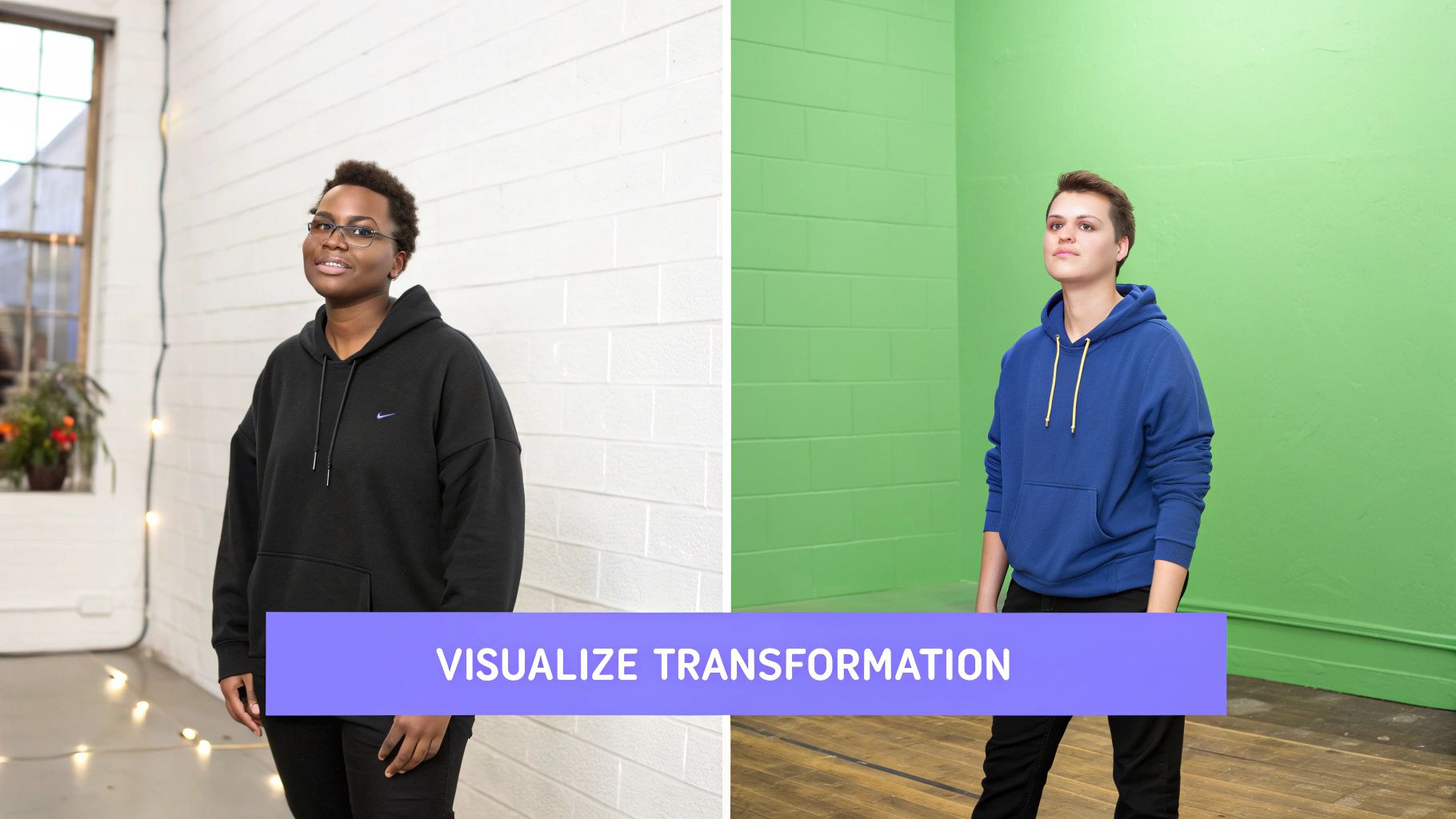
This visual represents how the BAB model guides the audience from their current struggles to a desired resolution, with your brand as the hero of their journey.
How the BAB Framework Works
The BAB model is persuasive because it leverages the human desire for progress and improvement. By starting with a relatable "Before" state, you establish an immediate connection and show you understand your customer's challenges. The "After" state creates aspiration and desire, while the "Bridge" provides a clear, logical next step.
- Before: Describe the customer's current world. For a home organization service, this could be: "Overwhelmed by clutter and can't find anything in your own home?"
- After: Illustrate their dream scenario. "Imagine a perfectly organized, stress-free space where everything has its place and you feel calm and in control."
- Bridge: Position your offering as the clear pathway. "Our professional organizers create custom systems that transform your chaotic spaces into havens of tranquility in just one weekend."
This structure is ideal for visual platforms like Instagram, Facebook, and YouTube, where you can literally show the "Before" and "After" states for maximum impact.
Actionable Takeaways for Your Ad Script
To craft an effective BAB ad script example, your focus should be on creating a compelling and believable transformation story.
- Get Specific with the 'Before': Use sensory details and emotional language to make the "Before" state highly relatable. The more your audience sees themselves in this picture, the more they will desire the "After."
- Make the 'After' Tangible: Don't just promise a vague improvement. Describe the specific, tangible benefits of the transformation. How will their life look, feel, and function differently?
- Strengthen Your Bridge: Your bridge needs to be credible. Use testimonials, case studies, statistics, or a clear demonstration of your product to prove that you can deliver the promised "After" state.
4. The 4 Ps (Picture-Promise-Prove-Push) Ad Script
The 4 Ps framework is a comprehensive copywriting formula that guides a prospect through a complete decision-making journey. This ad script example is designed to build both emotional desire and logical trust. It starts by painting a vivid Picture of a desired future, makes a specific Promise of how to get there, Proves the claim with credible evidence, and finally Pushes the viewer to take action.
This structure moves beyond a simple pain point and focuses on aspiration, making it ideal for high-ticket items, complex B2B services, or educational products. It combines the art of storytelling with the science of conversion by appealing to both the heart and the mind, which is essential for audiences who require validation before committing.
How the 4 Ps Framework Works
The 4 Ps model is effective because it creates a compelling vision and then backs it up with undeniable proof, methodically dismantling skepticism. By starting with a "Picture," you immediately capture attention with an aspirational goal, creating an emotional connection.
- Picture: Create a vivid mental image of success or relief. For an online course, this could be: "Picture yourself confidently closing high-ticket clients and earning a consistent six-figure income."
- Promise: State a clear, tangible benefit your product delivers. "Our masterclass gives you the exact blueprint to land your first five premium clients in 90 days."
- Prove: Back up your promise with social proof and data. "We have over 5,000 successful students, with testimonials showing a 300% average increase in their monthly revenue."
- Push: Give a clear, urgent call to action. "Enroll now to get our limited-time bonus module on client retention, valued at $497."
This framework is particularly powerful for video ads, webinars, and long-form sales pages where you have more time to build a case and earn the prospect's trust.
Actionable Takeaways for Your Ad Script
To build a high-converting 4 Ps ad script example, each stage must be crafted with precision and authenticity.
- Paint with Sensory Details: When creating the "Picture," use descriptive language that engages the senses. Talk about what success looks, sounds, and feels like to make the vision more tangible and desirable.
- Make Your Promise Specific: Vague promises like "improve your life" are weak. A strong promise is measurable, like "double your sales pipeline in six months." This makes your "Prove" section more believable.
- Stack Your Proof: Don't rely on just one type of proof. Combine testimonials, case studies, statistics, expert endorsements, and awards. The more layers of proof you provide, the lower the purchase risk becomes for the customer.
- Create a Compelling Push: Your "Push" should feel like the logical next step. Use urgency (limited-time offer), scarcity (limited spots available), or a value-added bonus to encourage immediate action.
5. The Star-Story-Solution Ad Script
The Star-Story-Solution framework is a powerful narrative formula that builds an immediate emotional connection with your audience. This ad script example leverages the classic storytelling arc by introducing a relatable protagonist (the Star), detailing their authentic struggle (the Story), and finally presenting your product as the key to their successful transformation (the Solution). It's a testimonial-driven approach that turns a sales pitch into an inspiring journey.
This framework is highly effective because it uses social proof and empathy to build trust. When viewers see someone just like them overcome a familiar challenge, they don't just see a product; they see a clear path to their own success. The narrative makes the solution feel achievable and desirable, rather than just another item to buy.
How the Star-Story-Solution Framework Works
This model taps into our innate love for stories by creating a compelling narrative with a clear hero. It’s a perfect structure for case studies, user-generated content, and video ads where building a personal connection is key to conversion.
- Star: Introduce a relatable character who embodies your ideal customer. For a fitness app, this is "Sarah, a busy mom of three."
- Story: Describe their specific problem and the emotional journey it created. "She struggled to find time for the gym and felt her energy levels plummeting, affecting her family life."
- Solution: Show how your product empowered them to overcome their obstacle. "Using our 15-minute home workouts, Sarah regained her energy, lost 20 pounds, and now has more vitality than ever."
This method is particularly powerful in video, as it allows you to visually showcase the "before" and "after" of the transformation, making the story even more impactful.
Here’s a great example from Dove’s "Real Beauty" campaign, which features real women as the "stars" to tell compelling stories.
The video’s success comes from its authenticity, positioning the brand as a champion for the customer’s journey rather than just a seller of products. To master this technique, you can learn more about how to create commercials that resonate on a deeper level.
Actionable Takeaways for Your Ad Script
To build a compelling Star-Story-Solution ad script example, authenticity is your most important tool.
- Find the Right Star: Your protagonist must be a genuine reflection of your target audience. Use customer interviews and feedback to find real people with compelling stories.
- Show, Don't Just Tell: Instead of just listing benefits, show the transformation. Use visuals, specific numbers ("lost 20 pounds"), and emotional language to make the story feel real.
- Highlight the Struggle: Don't shy away from the "Story" part. Showcasing vulnerability and real challenges makes the final "Solution" and transformation far more credible and impactful.
- Keep it Authentic: Avoid over-scripting the story. Let the star use their own words to describe their experience. Genuine emotion will always outperform a polished but robotic script.
6. The Hook-Story-Offer (HSO) Ad Script
The Hook-Story-Offer (HSO) framework is a modern, high-energy formula built for the fast-paced world of social media. This ad script example is designed to stop the scroll, build a rapid connection, and drive immediate action. It starts with an attention-grabbing hook, transitions into a concise and relatable story, and concludes with a clear, compelling offer.
This structure is highly effective because it directly addresses the short attention spans of users on platforms like Instagram, TikTok, and Facebook. Where other formulas might take time to build a case, HSO gets straight to the point, prioritizing initial engagement above all else. By leading with value or curiosity, it earns the user's attention before telling a story that makes the offer more meaningful.

How the HSO Framework Works
The HSO model works by aligning with the typical user journey on a social feed. It recognizes that you have less than three seconds to make an impression. The hook serves as the pattern interrupt, the story creates an emotional or logical bridge, and the offer provides the clear next step.
- Hook: Grab attention immediately. This could be a bold claim, a controversial question, or a surprising visual. Example: "This is the one mistake that keeps 99% of new e-commerce stores from making a profit."
- Story: Quickly build context and connection. The story should be short and relevant, leading logically to the solution. Example: "I spent years testing everything, losing money on ads until I discovered one simple pricing strategy that changed everything."
- Offer: Present a clear, low-friction call-to-action. Example: "I put this exact strategy into a free 5-minute guide. Click the link to download it now."
This ad script example excels in video ads where the first few frames are critical. It is also a staple for influencers and personal brands who rely on storytelling to build authority and trust with their audience.
Actionable Takeaways for Your Ad Script
To master the HSO ad script, focus on speed, clarity, and relevance. Your primary goal is to make an instant impact.
- Prioritize Your Hook: The hook is the most crucial element. Test multiple variations with different angles, visuals, and opening lines. For more guidance, you can explore how to create attention-grabbing hooks with AI video tools.
- Keep the Story Brief: The story is not a detailed narrative; it's a bridge. It should be just long enough to connect the hook to the offer. Focus on a single, powerful point or a relatable "aha" moment.
- Make an Irresistible Offer: The offer should feel like a natural and valuable conclusion. Whether it's a free download, a limited-time discount, or a webinar sign-up, ensure the value is clear and the next step is simple.
6 Ad Script Frameworks Comparison
| Ad Script | Implementation Complexity | Resource Requirements | Expected Outcomes | Ideal Use Cases | Key Advantages |
|---|---|---|---|---|---|
| Problem-Agitate-Solution (PAS) | Simple, three-step process | Requires deep customer pain insight | Emotional engagement, urgency, conversions | Clear urgent problems, health, B2B, financial | Strong emotional connection, easy to apply |
| AIDA (Attention-Interest-Desire-Action) | Moderate, four sequential stages | Moderate skill for smooth transitions | Structured engagement from attention to action | Product launches, e-commerce, email, landing pages | Time-tested, versatile, clear structure |
| Before-After-Bridge (BAB) | Moderate, storytelling based | Needs strong visuals and credible proof | Aspirational transformation visualization | Fitness, education, career, home improvement | Strong emotional impact, easy visualization |
| The 4 Ps (Picture-Promise-Prove-Push) | Higher, comprehensive structure | Substantial proof and data required | Builds trust, reduces objections, inspires action | High-ticket products, B2B, coaching, complex offers | Balances emotion and logic, trust-building |
| The Star-Story-Solution | Moderate to high, narrative focus | Access to genuine customer stories | Emotional connection, memorable storytelling | Testimonials, video ads, social media, case studies | Deep engagement, authentic social proof |
| The Hook-Story-Offer (HSO) | Moderate, fast and concise | Creative hooks, tight storytelling | Quick attention capture, high engagement | Social media ads, short videos, direct-to-consumer | Optimized for short attention spans, flexible |
From Framework to Finished Ad: Your Next Steps
We’ve explored a powerful arsenal of ad script frameworks, from the classic AIDA and PAS models to the narrative-driven Star-Story-Solution and Hook-Story-Offer approaches. Each ad script example dissected in this guide serves as more than just a template; it's a strategic blueprint for connecting with an audience on a deeper, more persuasive level. The core lesson is clear: a successful ad isn't just about what you say, but how you structure your message to guide a potential customer from curiosity to conversion.
The true strength of these frameworks lies in their adaptability. Whether you're crafting a 15-second TikTok video or a 2-minute YouTube pre-roll ad, the underlying principles of grabbing attention, building desire, and proving value remain constant. Your next great ad campaign begins not with a blank page, but with a strategic choice: which framework best aligns with your product, your audience, and your primary objective?
Key Takeaways and Actionable Next Steps
To translate these concepts into tangible results, focus on these critical actions. Think of this as your post-article checklist for creating high-impact advertising.
- Audit Your Current Ads: Review your existing ad creative. Can you identify the framework used, if any? If not, try retrofitting one of the models we've discussed, like the Before-After-Bridge, to see how it could sharpen your message and improve clarity.
- Match the Framework to the Platform: A fast-paced, hook-centric model like HSO is perfect for scroll-heavy platforms like Instagram Reels or TikTok. A more detailed, proof-oriented framework like the 4 Ps might be better suited for a landing page video or a longer Facebook ad.
- A/B Test Your Structures: Don't just test headlines or visuals. Test the entire narrative structure. Pit a PAS script against an AIDA script for the same product and see which one resonates more with your target demographic. This data is invaluable for understanding what truly motivates your audience.
Turning Theory into High-Performing Creative
The journey from a conceptual framework to a polished, ready-to-launch ad involves several creative and logistical steps. As you move from outlining your chosen ad script example to writing the final copy, efficiency and creativity become paramount. This is where modern tools can provide a significant advantage, helping you generate multiple variations and refine your messaging with speed.
For teams looking to streamline this process, leveraging specialized platforms can be a game-changer. For instance, tools designed to assist with creative writing, like an Ad Copy AI, can help you rapidly brainstorm hooks, flesh out story points, and craft compelling calls to action based on these proven frameworks. This allows you to focus less on the manual labor of writing and more on the high-level strategy that drives results.
Ultimately, mastering these scriptwriting formulas is about building a repeatable system for success. It’s about removing the guesswork and replacing it with a strategic, intentional approach to communication. By internalizing these structures, you empower yourself to create ads that not only capture attention but also build trust, articulate value, and consistently drive action.
Ready to move beyond scripts and manage the entire ad creative process in one place? Sprello helps you organize assets, collaborate with your team, and get stakeholder feedback faster than ever. Streamline your workflow from script to final ad with Sprello.


