
Picture this: a professional actor, ready to deliver your message perfectly, any time of day, without ever stepping into a studio or in front of a camera. That’s the magic behind real life avatars. These are not your average digital characters; they are incredibly realistic digital humans created by AI to look, sound, and act just like real people. They’re making professional-quality video something anyone can create.
What Are Real Life Avatars Exactly
When we talk about real life avatars, we're not talking about the cartoony characters you see in video games or on social media. The avatars making waves in business are sophisticated digital people built for a single, powerful purpose: communication. They are your tireless, on-demand presenters, ready to deliver any message, in any language, at a moment's notice.
Let's use an analogy. Traditional video production is like commissioning a one-of-a-kind painting. It's a beautiful result, but it's also expensive, takes a ton of time, and involves coordinating with a whole team of specialists. An AI avatar, however, is more like having an advanced 3D printer for video—you just upload your design (the script), and it produces a flawless result in minutes.
The Tech Behind the Persona
So, how does it all work? At the core, these digital humans are brought to life by generative AI. The technology studies massive amounts of footage of real actors, learning every nuance of human expression—from subtle smiles and vocal inflections to natural hand gestures.
When you feed it a script, the AI does more than just generate a voice. It animates the avatar to deliver the lines with convincing mannerisms and perfectly synchronized lip movements. You can learn more about how these incredibly lifelike digital creations are made by exploring images of fake people and the technology behind them.
This completely sidesteps the usual headaches of video creation. Suddenly, you don't have to worry about:
- Scheduling nightmares with actors, camera crews, and studios.
- Sky-high costs for equipment rentals, location fees, and talent.
- Endless editing cycles to correct small mistakes or update a line of text.
The real power of real life avatars is that they open up high-quality video production to everyone. They tear down the old walls of cost, time, and technical skill, giving everyone from a solo entrepreneur to a global corporation the tools to create amazing video content.
Why This Matters for Your Business
At the end of the day, these AI presenters solve a huge problem for businesses today: the constant need for more and more high-quality video. We all know video is king for marketing, training, and sales, but making it has always been a slow, expensive grind. Real life avatars flip that entire equation.
They make personalization possible on a scale we could only dream of before. Think about an online store creating a unique demo video for every single product they sell. Or a company translating its entire employee onboarding program into ten different languages in an afternoon. That's the kind of speed and flexibility AI avatars deliver.
To put this into perspective, let's compare the old way with the new way.
Traditional Video Production vs AI Real Life Avatars
| Factor | Traditional Video Production | AI Real Life Avatars |
|---|---|---|
| Time to Production | Weeks or months | Minutes or hours |
| Cost | High (thousands per video) | Low (subscription or per-minute) |
| Scalability | Difficult; each video is a new project | Easy; create hundreds of videos at once |
| Updating Content | Requires reshoots and re-edits | Simple text edit; regenerate in seconds |
| Localization | Very expensive and time-consuming | Instant translation and dubbing |
| Consistency | Varies with actors and crew | Perfectly consistent every time |
This side-by-side comparison makes it clear: AI avatars aren't just an alternative; they represent a fundamental shift in how we approach content creation, prioritizing agility and cost-effectiveness without sacrificing quality. They are a game-changing tool for any modern content strategy.
The AI Technology Powering Digital Humans
Ever wonder how a machine can conjure up a digital person that looks and sounds completely real? It’s not magic, but it is a fascinating process. Think of it less as a single invention and more like a sophisticated assembly line where several powerful AI technologies work together seamlessly.
The journey starts with data—a whole lot of it. To create a real life avatar, AI models are first fed hours of video footage of a real actor. The AI doesn't just glance at the footage; it meticulously analyzes thousands of frames to learn every little thing about that person's facial expressions, movements, and quirks.
Teaching the AI to Be Human
This initial training stage is often driven by a clever type of AI called a Generative Adversarial Network (GAN). The easiest way to picture a GAN is as a pair of dueling AIs: one is the "Artist," and the other is the "Critic."
- The Artist (Generator): This AI tries to create brand-new images of the person's face, doing its best to make them look completely real.
- The Critic (Discriminator): This AI’s job is to inspect the Artist’s work and call it out as either real or fake.
The Artist keeps trying to fool the Critic, getting better and better with every round. After millions of these back-and-forths, the Artist gets so good that it can generate a perfectly photorealistic, animatable digital face from any angle. This is a key piece of what we call synthetic media, a field all about creating realistic AI-generated content. If you want to dive deeper, you can check out our post explaining what synthetic media is and how it’s shaking up content creation.
From a Silent Face to a Lifelike Speaker
A realistic face is great, but our avatar needs a voice. That's where advanced text-to-speech (TTS) technology steps in. AI voice generation has come a long, long way from the robotic monotones of the past. Today’s systems can clone a person's voice or create entirely new ones that are full of natural-sounding pitch, tone, and inflection.
When you hand the AI a script, it doesn't just read the words back. It actually analyzes the text to figure out the right emotional delivery, adding subtle pauses and emphasis just like a human would.
The real magic happens when the audio and visuals are synced. AI algorithms carefully map the sounds from the generated audio—known as phonemes—to the exact mouth movements on the avatar. This is what makes the lip-sync perfect, and it’s absolutely critical for a believable performance.
This process is incredibly precise, syncing every single syllable to a specific facial animation. It’s this attention to detail that helps the final video feel authentic and professional, sidestepping that creepy "uncanny valley" effect where something looks almost real, but just feels... off.
Making a Complex Process Feel Simple
While all the tech humming away in the background is incredibly complex, tools like Sprello are built to make the whole thing feel easy. You don’t need a Ph.D. in AI to direct your own digital actor.
This flowchart breaks down the simple, three-step workflow that takes your script and turns it into a polished video.
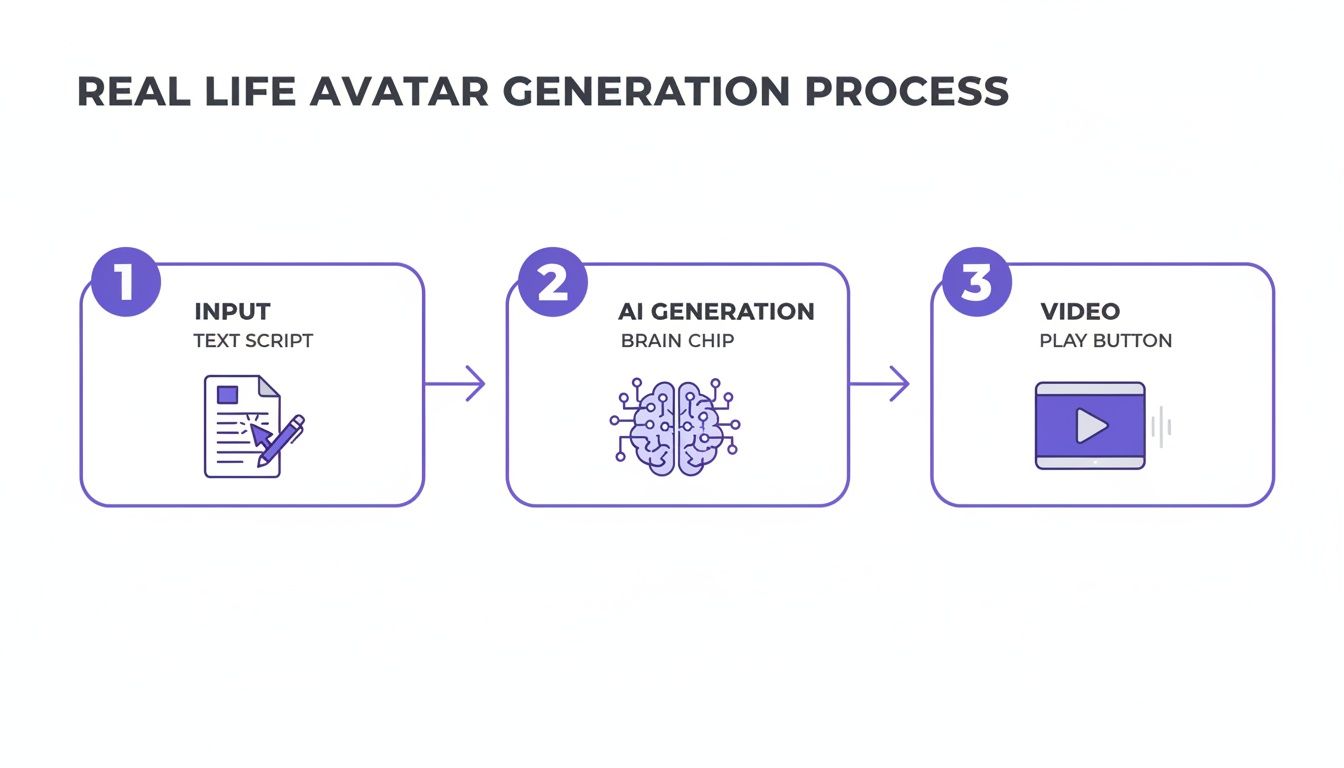
As you can see, the heavy lifting is handled behind the scenes. All you need to do is focus on your message, not the mechanics.
The entire AI pipeline—from generating the visuals and synthesizing the voice to the final animation—is bundled into a straightforward interface. You just type your script, pick your avatar, and the system does the rest. It's this accessibility that turns real life avatars from a futuristic idea into a practical tool you can use for business communications, today.
Why Businesses Are Investing In AI Avatars
The technology behind **real life avatars** is fascinating, no doubt. But the real story isn't just about the tech—it's about why businesses are jumping on board so quickly. The answer is simple and powerful: a clear, measurable return on investment. This isn't some futuristic gimmick; it's a smart business move driven by huge financial and operational wins.For years, professional video production was a slow, expensive grind. You had to hire actors, book locations, coordinate film crews, and then wait through a long post-production process. Every step added more time and more cost, making it impossible for most companies to create video content at the scale they needed. AI avatars are here to completely upend that old model.
Slashing Production Costs Dramatically
The most immediate and obvious win is how much money you save. By getting rid of physical shoots, businesses can wipe out a massive chunk of their content budget. Just think about all the typical expenses that just… disappear:
- Talent Fees: No more hiring actors or presenters for every single video.
- Crew and Equipment: Forget paying for camera operators, sound engineers, and renting expensive gear.
- Location Scouting and Rentals: You don't need to book studios or find the perfect backdrop.
- Travel and Logistics: All the costs of moving people and equipment from one place to another are gone.
We're not talking about trimming a few dollars here and there. For many companies, this means cutting video production costs by up to 90%. That’s a game-changer. Suddenly, that marketing budget can be used for other things that grow the business, like running more ads or funding new projects.
This kind of economic impact is fueling some serious market growth. The global AI avatar market is expected to skyrocket from USD 7.41 billion in 2024 to a massive USD 118.55 billion by 2034. That's a compound annual growth rate of 31.95%. This tells you that businesses see AI-powered people as a core part of their future, not just a passing trend. You can read the full market analysis from Precedence Research to see just how big this shift is.
Achieving Unprecedented Speed and Agility
Beyond the savings, the sheer speed is what really changes the game. In the time it used to take just to plan a video shoot, a team using real life avatars can create, test, and launch dozens of different videos.
Let’s say you want to A/B test a new ad campaign. With an AI avatar, you can spin up five different versions with slightly different scripts or calls to action in a matter of minutes. This kind of agility means you can iterate fast and make decisions based on real data—something that was once a logistical nightmare.
A marketing team can go from a fresh idea to a finished video in under an hour. This allows businesses to react instantly to market trends, launch timely promotions, and keep their social media feeds filled with fresh, relevant content.
This new speed isn't just about being efficient; it gives you a serious competitive edge. When you can produce more content faster, you have more chances to engage your audience, capture leads, and ultimately drive more sales.
Unlocking Personalization at Scale
Maybe the most powerful advantage of all is the ability to deeply personalize your video communications. In the past, creating custom videos for different audience segments was way too expensive to even consider. Now, it's not only possible—it’s easy.
Here’s where this really shines in the real world:
- E-commerce Product Demos: An online store with 1,000 products could create a unique, professional demo video for every single item on their site, without ever stepping in front of a camera.
- Multilingual Corporate Training: A global company can build out all of its HR and compliance training modules and then instantly translate them into ten languages, complete with a native-sounding presenter for each region.
- Tailored Sales Outreach: Your sales team can create personalized video messages for key prospects, calling them by name and speaking directly to their specific needs—all generated from a simple script.
This kind of one-to-one customization builds a much stronger connection with your audience. Your communications feel more relevant and hit a lot harder. It turns video from a one-to-many broadcast into a personal conversation, which is exactly what drives higher engagement and better conversion rates.
Putting Real Life Avatars to Work
We've talked about the impressive savings and strategic wins that come with using real life avatars, but what does that actually look like day-to-day? Let's move past the theory and see how these digital presenters are becoming a serious tool for marketers, creators, and corporate teams trying to get their message out there without the usual headaches.
The best way to think about an AI avatar isn't as a one-trick pony, but as a flexible production engine. It can adapt to almost any kind of content you need—from a high-energy social media ad to a formal company-wide announcement—all while skipping the logistical nightmare of a traditional video shoot.
Supercharge Your E-commerce and Marketing
For anyone in e-commerce, the fight for eyeballs is constant. Real life avatars give you a way to create sharp, compelling video content that actually stops the scroll and gets people to click. Because you can produce video so quickly, brands can finally break free from generic ads and start making highly specific content that truly connects.
Think about an online store using an AI avatar to whip up new promotional videos every single week. One version could be all about a product’s technical specs for the hardcore enthusiasts, while another focuses on the lifestyle benefits for a more casual audience. Same script, minor tweaks, completely different videos.
Here’s how marketing teams are already using them:
- Product Demos at Scale: Imagine creating a unique, professional video for every single product in your catalog. You get perfect consistency while explaining all the features and benefits.
- Social Media Ad Variations: Need to test what works on TikTok or Instagram? You can generate dozens of ad variations in minutes to A/B test different hooks, calls to action, and messages.
- Targeted Landing Page Videos: Greet visitors with a personalized video that speaks directly to the ad or link they just clicked. It’s a simple way to make your page more relevant and keep people engaged.
This kind of speed completely changes the game for marketing. A campaign that used to take weeks of planning and filming can now be dreamt up, produced, and launched in a single afternoon. That’s a massive advantage.
Streamline Agency and Creator Content Production
Agencies and solo creators are under constant pressure to pump out fresh content. Real life avatars act like a force multiplier, letting them produce huge volumes of branded material for clients or their own channels without hitting a wall.
A social media agency, for example, could manage multiple client accounts way more efficiently. They could knock out a full week's worth of TikToks or Instagram Reels for five different clients in the time it would’ve taken to film for just one. That’s a direct boost to both profitability and client happiness.
The trick is to treat the avatar as your reliable, on-call digital presenter. This frees you up to focus on the fun stuff—strategy and storytelling—instead of getting bogged down in the mechanics of filming.
Revolutionize Corporate Communications and Training
Marketing is just the start. Real life avatars are also making a huge dent in internal communications. Big, global companies are using them to create multilingual training videos, HR updates, and messages from leadership, making sure every single employee gets the same clear, professional message.
A perfect example is a company that needs to localize its HR onboarding program. With an AI avatar, they can translate the material and generate videos in ten different languages almost instantly, with a presenter who speaks each one fluently. Trying to do that the old-fashioned way would be incredibly expensive and take months.
The most advanced use cases involve interactive AI avatars, which are quickly becoming the new standard. These are dynamic digital people powered by natural language processing and generative AI, allowing them to act as virtual assistants or immersive training guides. Businesses are already using them as virtual customer support agents, and the results are pretty stunning: response times have been slashed by 70% and satisfaction scores have jumped by 25%. The education sector is also getting on board, using avatars for more engaging training simulations. You can dig into more data on this trend in the latest AI avatar market report from MarketsandMarkets.
From sales training to compliance updates, avatars offer a scalable and affordable way to communicate with a workforce spread across the globe. This flexibility is exactly why they’ve moved from a niche tech toy to a core part of a modern content strategy.
How to Create Your First AI Avatar Video
Alright, enough with the theory—let's get to the fun part. The best thing about creating videos with real life avatars is just how straightforward it’s become. You honestly don't need a film degree or any AI expertise to make something that looks professional. The entire process is designed to be intuitive, taking you from a rough idea to a finished video in a matter of minutes.
This ease of use is a huge reason why the technology is taking off. Just look at the numbers. In 2024, North America alone accounts for over 39.2% of the global AI avatar market share, pulling in an estimated USD 0.9 billion in revenue. That kind of growth happens when powerful tools become accessible to everyone. If you're curious, you can discover the full AI avatar market report to see the trend for yourself.
Let's walk through just how simple it is. I've broken the whole thing down into five basic steps.
Step 1: Craft Your Message
Every great video starts with a script. This is the bedrock of your message, and you've got a couple of solid options. You can, of course, write it yourself to make sure every word is perfect and on-brand.
Or, if you're short on time, most platforms now have an AI scriptwriter built right in. Just give it a simple prompt, like "write a 30-second ad for our new running shoe," and it will generate a script for you—often complete with a catchy hook and a clear call to action.
Step 2: Select Your Digital Presenter
With your script locked in, it's time to cast your on-screen talent. This is where you pick the real life avatar who will be the face of your message, someone who vibes with your brand and will connect with your audience. You'll find that modern platforms offer a huge library of avatars covering different ages, ethnicities, and professional styles.
Next, you need to give them a voice. You can browse through dozens of surprisingly natural-sounding AI voices. The best part is being able to preview them with your actual script to hear exactly how your message will land. For a deeper dive, check out our guide on how to create an AI avatar that’s a perfect match for your brand.
Step 3: Design Your Scenes
Now that you have your presenter and your script, it's time to build out the visuals. A video is more than just a talking head; it needs some visual spice to keep people watching. You can easily add elements like:
- Backgrounds: Go with a simple color, a stock office setting, or upload your own branded image.
- B-roll Footage: Drop in short video clips that show what your avatar is talking about.
- Images and Text Overlays: Use these to pop key points on screen, display your logo, or show off product shots.
Think of this stage like building a PowerPoint deck. Each scene is like a slide, and you can give each one a different layout and different visuals, all timed perfectly to your avatar's narration.
Step 4: Polish Your Video
This is where you add those little professional touches that make a video feel complete. It's the small details that take your content from "good" to "great," and most platforms make it incredibly easy.
For example, you can add auto-generated captions with a single click—an absolute must for social media where so many people watch with the sound off. You can also drop in your logo as a watermark to keep everything consistently branded. If you’re ready to get your hands dirty, this guide on how to generate videos with AI like a pro is a great resource.
Step 5: Finalize and Export
You're at the finish line. Once you’re happy with how everything looks and sounds, all that's left is to hit the export button. The AI engine takes over from here, stitching together the avatar animation, voiceover, visuals, and captions into a single, clean video file.
In just a few minutes, your video will be rendered and ready to download. From there, you can share it everywhere—your website, social channels, or email campaigns. It’s that simple.
Using AI Avatars Authentically and Ethically
Jumping into the world of real life avatars brings a ton of creative power to your content, but it's not a free-for-all. With that power comes a real responsibility to be upfront and ethical with your audience. Trust is everything, and how you handle this tech will make or break it. Remember, the point isn't to fool people; it's to find a better, smarter way to communicate.
The number one rule? Just be transparent.
AI avatars are getting ridiculously realistic, but that's all the more reason to be clear about what your audience is seeing. A simple note in the video description or a small graphic on-screen is all it takes to let people know the presenter is AI-generated. This honesty builds a much stronger connection than trying to hide it ever could.
When you're open about it, you let your audience focus on what really matters: your message. They stop wondering if the person is real and start listening to the valuable information you're sharing. True authenticity comes from the value you provide, not who (or what) is delivering it.
Navigating Ethical Considerations
Beyond just being transparent, using real life avatars the right way means ticking a few ethical boxes. These aren't just suggestions; they’re guardrails that protect your brand, respect the people whose likenesses are being used, and keep you in line with platform rules.
First things first, you have to respect the person who was filmed to create the avatar. These aren't just digital puppets; they're based on real people. It’s absolutely critical to use their likeness in a way that’s positive and professional, sticking to the terms you agreed to when you started using the service. That means no misleading, harmful, or flat-out deceptive content.
To keep your brand on solid ground, stick to these core ideas:
- No Deceptive Tactics: Don't even think about using an avatar for fake testimonials, phony endorsements, or to spread bad information. Your content has to reflect your brand's true integrity.
- Follow Platform Rules: Big players like YouTube and TikTok have specific policies about AI-generated content. You need to know them and stay up-to-date.
- Keep it Positive: Use avatars to create content that helps, informs, and adds real value. Don't use the tech just for cheap shock value.
A brand's reputation is built on trust. Using real life avatars ethically means treating your audience with respect, being transparent about the technology, and committing to providing genuinely useful content.
Getting this right isn't just about avoiding a slap on the wrist; it's about building a brand that lasts. As AI becomes a normal part of our lives, audiences will gravitate toward brands that use it responsibly. For a deeper dive into the specific regulations, our guide on compliant synthetic influencer advertising is a must-read.
By taking an ethical approach from the start, you can tap into the full potential of real life avatars and build an even stronger, more honest relationship with your community.
Got Questions About Real Life Avatars? We've Got Answers.
Jumping into any new tech can feel a bit daunting, and it's smart to have questions. Let's tackle some of the most common ones about using real life avatars so you can feel confident about getting started.
Can People Tell the Avatar Isn't a Real Person?
Sometimes, yes. The tech is getting freakishly good, but a sharp eye might still spot that the presenter is AI-generated. But here’s the thing: the goal isn’t to fool anyone. It's about getting your message across clearly and professionally.
What your audience really cares about is the value you’re delivering. For marketing videos, tutorials, or internal training, the clean look and consistent delivery of an avatar usually matter more than anything else. A good rule of thumb is to be upfront about it; transparency builds trust, and you still get all the incredible time and money-saving benefits.
The point isn't to trick your audience. It's to share a high-quality, consistent message without the headaches and costs of a full-blown video shoot. Your authenticity shines through in the quality of your content, not in who (or what) is presenting it.
Can I Make an Avatar That Looks Exactly Like Me?
Making a custom "digital twin" of yourself is definitely on the horizon and is already a premium option on some platforms. For most people, though, there’s an easier way.
Today’s top AI video tools come with huge libraries of pre-built real life avatars. You can find presenters of different ages, ethnicities, and professional styles, making it easy to find one that aligns perfectly with your brand and connects with your audience. For 99% of business use cases, you’ll find a great fit right out of the box.
Is This Tech Too Expensive for a Small Business?
Not at all. In fact, it’s one of the biggest advantages for smaller teams. Think about what a traditional video shoot costs—you're talking thousands of dollars for actors, a film crew, location rentals, and post-production. It adds up fast.
AI video platforms completely change the economics. Most work on a simple subscription basis, giving you a flat monthly fee to create as much video content as you need. This makes it one of the most budget-friendly ways for a small business to produce professional-grade videos that can actually compete with the big guys.
Ready to create stunning, professional videos in minutes without ever touching a camera? With Sprello, you can turn simple text into high-converting video content using our realistic AI avatars. Start creating today and see the difference for yourself at sprello.ai.


