
Video isn't just a part of the marketing landscape anymore; it's the entire terrain. From TikTok to LinkedIn, video content dominates user attention, drives engagement, and converts customers more effectively than any other medium. But what worked last year is already becoming obsolete. The pace of change, driven by AI innovation and shifting platform algorithms, demands a new, more strategic approach.
Simply creating a video is no longer enough to guarantee success. You need a framework built on proven principles that capture attention instantly and hold it. This guide cuts through the noise to deliver 10 essential video marketing best practices that will define high-performing content in 2026. Forget generic advice; we're diving deep into actionable tactics that deliver measurable results.
Whether you're a small business owner, an agency marketer, or an independent creator, mastering these strategies is non-negotiable. Inside, you'll find a clear roadmap for:
- Crafting irresistible hooks that stop the scroll in under three seconds.
- Leveraging AI for data-driven scriptwriting and scalable production.
- Optimizing every detail, from auto-synced captions to platform-specific formats.
- Implementing rapid testing to continuously improve your video performance.
This isn't a theoretical overview. It's a practical playbook designed to help you produce high-impact videos that don't just get views, but build audiences and drive revenue. Let's get started.
1. Hook Viewers in the First 3 Seconds
In the fast-paced world of digital content, you have a razor-thin window to capture a viewer's attention before they scroll away. Studies show that a significant percentage of viewers decide whether to keep watching within the first three seconds. This makes your video’s opening the most valuable real estate you have. A strong hook is not just a best practice; it is a fundamental requirement for modern video marketing success.
The goal is to immediately disrupt the viewer's scrolling pattern with something that sparks curiosity, presents a surprising visual, or states a bold claim. This initial moment must quickly answer the viewer’s unspoken question: “What’s in it for me?” By delivering immediate value or intrigue, you earn their attention for the next few seconds, and hopefully, the rest of your video.
Why It Works & How to Implement It
A powerful hook works by creating a "pattern interrupt," a psychological concept where an unexpected event breaks a routine behavior, like mindlessly scrolling. This forces the brain to pay attention and process the new information.
For example, Dollar Shave Club’s viral launch video opened with the founder bluntly stating, "Our blades are f***ing great," immediately grabbing attention with unexpected humor and directness. Similarly, Blendtec’s "Will It Blend?" series hooks viewers by posing a simple, visually compelling question right away: can this powerful blender destroy an iPhone?
To implement this, focus on creating an opening that is impossible to ignore.
- Ask a provocative question: "Are you still making this marketing mistake?"
- State a shocking statistic: "90% of startups fail for this one reason."
- Use bold text overlays: Flash keywords like "STOP" or "WAIT" on the screen.
- Start with dynamic action: Show the most exciting visual clip from your video first.
Key Insight: Don’t save your most compelling point for the middle of the video. Lead with your strongest statement, most surprising visual, or most intriguing question to stop the scroll and earn the viewer's attention.
By mastering this element of your video marketing strategy, you drastically increase watch time and message retention. To explore this topic further and see how AI can help generate dozens of hook ideas, you can learn more about creating attention-grabbing hooks with AI video tools.
2. Optimize for Mobile-First Vertical Video Formats
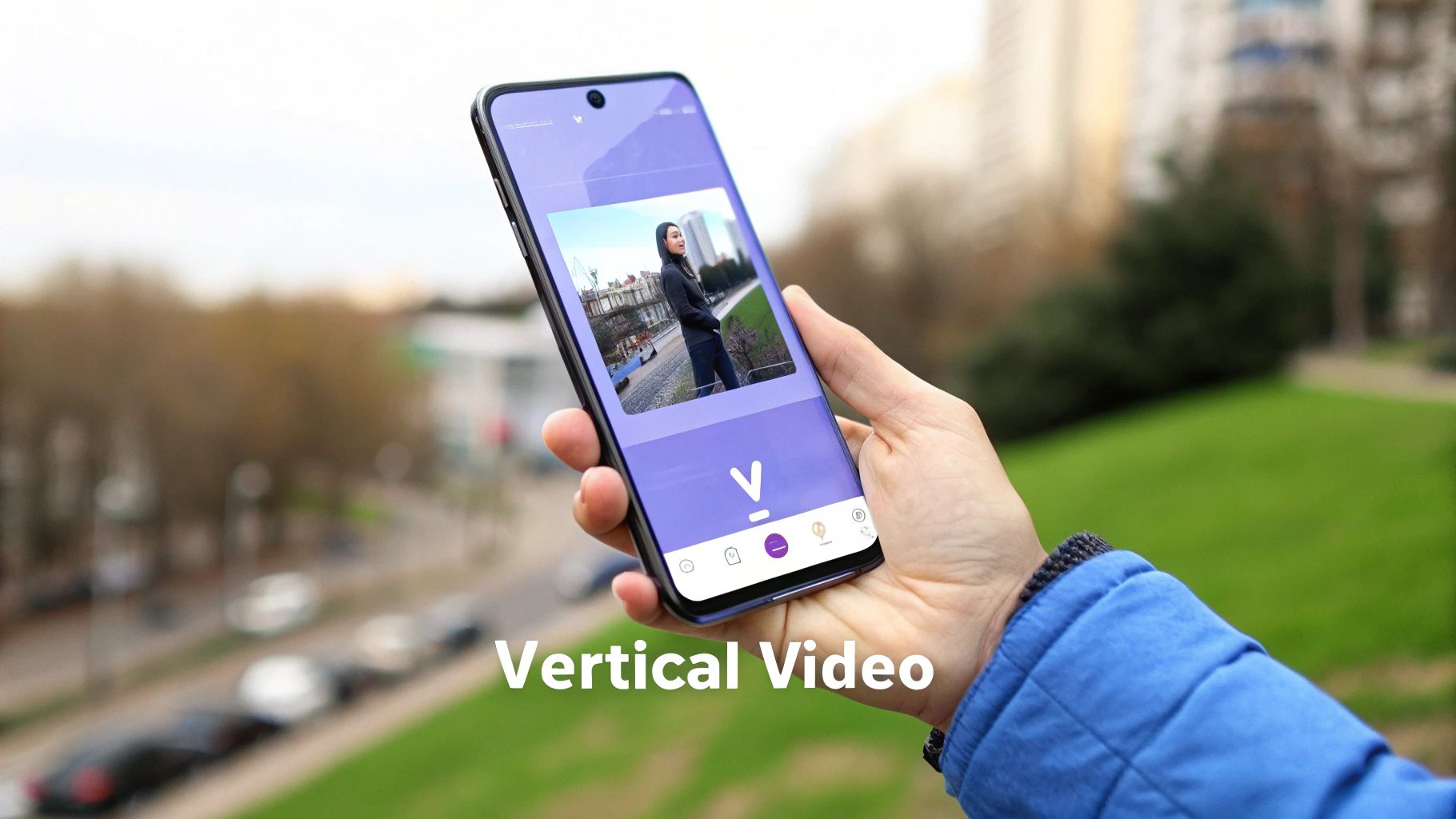
With the vast majority of video consumption now happening on mobile devices, vertical video (9:16 aspect ratio) has transitioned from a trend to a standard. Optimizing for mobile-first means creating content specifically for vertical screens, not just cropping a horizontal video. This approach maximizes screen real estate, creating a more immersive experience that aligns with how users naturally hold their phones. A mobile-first mindset is a critical video marketing best practice for engaging today's audience.
The goal is to design your entire video within a vertical frame from the beginning. This ensures that every visual element, text overlay, and key action is perfectly placed for vertical viewing on platforms like TikTok, Instagram Reels, and YouTube Shorts. Failing to do so results in awkward black bars or crucial information being cut off by platform interfaces, immediately signaling to the viewer that the content wasn't made for them.
Why It Works & How to Implement It
Vertical video works because it is native to the mobile experience, reducing friction and increasing viewer comfort. Platforms like TikTok and Instagram have conditioned users to expect full-screen, immersive content. When your video fills the screen, it commands more attention and feels more professional and engaging. This format has proven to outperform horizontal or square video on mobile-centric platforms, leading to higher watch times and better engagement rates.
E-commerce brands like Shein master this by using vertical Reels to showcase outfits in a full-body view that feels natural and direct. Similarly, creators on YouTube Shorts have seen massive channel growth by embracing the 9:16 format, which the platform's algorithm heavily favors for its mobile audience. The success is built on respecting the user's context.
To implement this, plan your content with a vertical-first approach.
- Shoot and edit in 9:16: Start with the correct aspect ratio from the very beginning.
- Keep action centered: Position the main subject and important actions in the center of the frame, which is the "safe zone" on all platforms.
- Use large, readable text: Ensure text overlays are bold and have high contrast to be easily readable on small screens.
- Mind the interface: Place text and key visuals away from the top and bottom of the screen where platform logos, captions, and buttons appear.
Key Insight: Don’t adapt your horizontal video for mobile; create it for mobile from the start. A vertical-native approach shows your audience you understand the platform and respect their viewing experience, leading to significantly better performance.
Adopting a mobile-first strategy is fundamental to any modern video marketing effort. To streamline this process, you can explore tools designed for vertical content, such as Sprello's AI-powered video creator, which helps automate formatting and captioning for mobile-optimized videos.
3. Use Data-Driven Script Writing with AI Hooks
Guesswork has no place in a high-performing video strategy. Instead of relying solely on intuition, the best video marketing practices now involve leveraging audience data and AI to craft scripts that are scientifically engineered to convert. This data-driven approach moves beyond creative brainstorming to generate multiple script variations based on what analytics show will actually resonate with your target viewers.
The goal is to combine human creativity with machine precision. By feeding AI tools like Sprello information about your target audience's pain points and demographics, you can generate scripts optimized for engagement and action. This allows you to test different angles, hooks, and calls to action systematically, ensuring your final video is built on a foundation of data, not just assumptions.
Why It Works & How to Implement It
This method works because it taps directly into audience psychology and platform algorithms. AI can analyze vast amounts of data on what types of language, emotional triggers, and structures perform best for specific demographics, then generate scripts that incorporate those winning elements. This is especially powerful for performance marketing, where every word can impact ROAS.
For example, an e-commerce brand could use AI to generate 10 different scripts for a single product ad, each highlighting a unique benefit or addressing a different customer pain point. A SaaS company can test variations focusing on features versus outcomes. This high-volume testing, once impossibly time-consuming, is now accessible to teams of any size.
To implement this, integrate AI into your pre-production workflow.
- Define your audience: Start with clear data on your target customer’s demographics, needs, and pain points.
- Generate variations: Use an AI tool to create 5-10 script hooks and body variations. Test different emotional angles like urgency, curiosity, or humor.
- A/B test systematically: Run small campaigns to test your script variations against each other, focusing on metrics like watch time and click-through rate.
- Analyze and iterate: Use the performance data to identify the winning elements and refine your scripts for larger campaigns.
Key Insight: Treat scriptwriting as a scientific process. Use AI to create multiple hypotheses (script variations), test them with real-world data, and use the results to build a repeatable formula for what resonates with your specific audience.
4. Implement Auto-Synced Captions and Dynamic Highlighting
In a mobile-first world where most videos are watched without sound, captions have evolved from an accessibility feature into a core engagement tool. A staggering percentage of viewers on platforms like Instagram and Facebook watch videos on mute, meaning your message is lost without on-screen text. This makes auto-synced captions and dynamic highlighting an essential component of modern video marketing best practices.
Auto-synced captions align text with spoken words automatically, while dynamic highlighting animates those words as they are spoken, drawing the viewer's eye and improving comprehension. This dual approach not only makes your content accessible but also boosts watch time, engagement, and information retention by making the video visually compelling even in silence.

Why It Works & How to Implement It
This technique works by catering directly to modern viewing habits. Dynamic, highlighted text creates visual motion that captures attention and guides the viewer through the narrative, much like a karaoke track. This visual reinforcement significantly boosts message recall and keeps viewers engaged, often leading them to turn the sound on.
We see this everywhere, from viral TikTok videos using bold, animated captions to match trending audio, to educational creators on YouTube using colored highlighting to emphasize key concepts. Even major streaming platforms like Netflix use stylized captions to enhance the viewing experience. These brands understand that well-executed captions are a powerful driver of performance.
To implement this, focus on making your captions both functional and visually appealing.
- Review for accuracy: Always double-check AI-generated captions for errors before publishing.
- Use brand colors: Match caption styles to your brand guidelines for a cohesive look.
- Ensure readability: Keep text size large enough to be easily read on small mobile screens.
- Position strategically: Place captions where they won’t cover important visual elements of your video.
Key Insight: Treat your captions as a primary creative element, not an afterthought. Dynamic, well-designed captions can dramatically increase watch time and message retention, especially for the large audience that consumes content with the sound off.
By integrating auto-synced and dynamically highlighted captions, you make your videos more accessible, engaging, and effective. Tools like Sprello can automate this process, allowing you to add stylish, auto-synced captions to your videos in minutes.
5. Leverage AI Avatars and Realistic Voiceovers for Scalable Production
The need for a human presenter has historically been a major bottleneck in video production, requiring significant time, budget, and logistical coordination. Today, AI-powered avatars and realistic text-to-speech technology have emerged as a powerful solution, allowing brands to create professional-quality videos at a fraction of the cost and effort. This approach removes the dependency on on-camera talent, enabling unprecedented scalability and consistency in video marketing.
By using a digital presenter, you can generate endless video variations for different products, services, or audiences without ever needing to schedule a film shoot. This is a game-changer for businesses that need to produce content in high volumes, such as e-commerce stores creating product demos, SaaS companies developing tutorial libraries, or agencies managing ad campaigns for numerous clients.
Why It Works & How to Implement It
This practice works by separating the message from the messenger, making the content creation process more agile and efficient. Instead of relying on a human actor's availability and performance, you can generate, edit, and update videos with a few clicks. This is one of the most transformative video marketing best practices for teams looking to maximize output without sacrificing quality.
For example, a Shopify store can use AI avatars to create unique showcase videos for hundreds of products, each with a consistent brand feel. Similarly, corporate training departments can use the same AI avatar across all learning modules to create a familiar and uniform educational experience for new employees. The technology empowers rapid, large-scale production that was previously unattainable.
To implement this strategy, focus on aligning the AI persona with your brand identity.
- Match avatars to your audience: Choose an avatar that reflects the demographics and style of your target customer.
- Align voice tone with brand personality: Select a voice that is energetic for a youthful brand or calm and authoritative for a professional service.
- Customize avatar appearance: Use tools like Sprello to adjust outfit colors and backgrounds to match your brand guidelines.
- Test and iterate: Produce multiple video versions with different avatars and scripts to A/B test which one resonates most with your audience.
Key Insight: Use AI avatars for high-volume content needs like product explainers, tutorials, and social media ads to achieve scale and speed. This frees up your human talent and budget for high-impact, brand-building "hero" content where a personal touch is essential.
This scalable approach ensures your video strategy can keep pace with your marketing demands. To see how you can apply this to your workflow, you can explore the top tools and techniques for creating compelling videos with AI avatars.
6. Apply the Story Arc for Emotional Connection and Retention
Facts and figures can inform, but stories are what truly resonate and stick with an audience. The classic story arc, featuring a setup, conflict, and resolution, is a powerful tool for creating emotional engagement. This narrative structure keeps viewers invested, making your message far more memorable and impactful than a straightforward product pitch or feature list.
By structuring your video around a narrative journey, you tap into fundamental psychological patterns that humans are hardwired to respond to. A good story makes your brand relatable, builds trust, and transforms a passive viewer into an engaged participant. This approach is one of the most effective video marketing best practices for forging a lasting connection with your audience.
Why It Works & How to Implement It
Storytelling works because it triggers an emotional response, releasing chemicals like oxytocin in the brain that are associated with empathy and trust. When a viewer connects with a character's struggle and subsequent triumph, they also build a positive association with the brand that facilitated that resolution. This is why campaigns like TOMS Shoes' "One for One" story created such a powerful, committed community.
Apple’s iconic 'Think Different' campaign didn't list computer specs; it told the stories of innovators and rebels, aligning the brand with their spirit. Similarly, Charity:water uses powerful personal stories of transformation to drive donations, showing the direct impact of a contribution.
To implement this, build your video around a clear narrative flow.
- Start with a relatable character: Introduce a person or situation your target audience immediately identifies with.
- Identify the conflict: Frame a specific problem or challenge that resonates emotionally with your viewer.
- Show the transformation: Clearly demonstrate how the character overcomes the conflict, ideally with the help of your product or service.
- Connect the resolution: The climax of your story should naturally and authentically lead to your product as the solution.
Key Insight: People forget statistics, but they remember stories. Frame your value proposition within a simple narrative of problem and resolution to make your message emotionally compelling and unforgettable.
By leveraging the timeless power of storytelling, you can elevate your video content from a simple advertisement to a memorable experience that builds brand loyalty and drives action.
7. Use Picture-in-Picture and Visual Layering for Engagement
Static, single-shot videos can quickly bore a modern audience accustomed to dynamic content. Picture-in-picture (PiP) and visual layering are powerful techniques to combat this by combining multiple visual elements like video clips, graphics, and text overlays into a single, cohesive frame. This creates a more immersive and visually stimulating experience that holds viewer attention for longer.
This practice is essential for communicating complex information efficiently. By showing multiple perspectives at once, such as a product demo alongside a user’s reaction, or a tutorial presenter next to their screen recording, you provide richer context. This is a core component of effective video marketing best practices because it enhances comprehension and keeps the visual presentation from becoming stale.
Why It Works & How to Implement It
PiP and layering work by providing constant visual variation, which prevents viewer fatigue and encourages them to stay engaged. The technique is incredibly versatile, popularized by gaming streamers, online educators, and reaction channels who need to present multiple information streams simultaneously. For example, a podcaster can layer their video feed over relevant b-roll, or a product marketer can show a close-up of a feature while the main product remains in view.
Modern editing tools have simplified this process, with some offering one-click PiP features that make this advanced technique accessible to everyone. This allows creators to focus on the story rather than complex editing tasks.
To implement this effectively, follow these guidelines:
- Establish a clear hierarchy: The most important visual element should be the largest and most prominent.
- Limit your layers: Stick to two or three layers at most to avoid a cluttered and confusing screen.
- Use borders or shadows: Add subtle visual separators to make each layer distinct and easy to follow.
- Check mobile compatibility: Preview your video on a small screen to ensure all layered elements are legible and well-spaced.
Key Insight: Treat your video frame like a dynamic canvas, not a static window. Use picture-in-picture and layering to present complementary information simultaneously, creating a richer, more engaging viewing experience that boosts watch time and message clarity.
8. Optimize for Platform-Specific Algorithms Through Format and Timing
Posting the same video across all social media platforms is a common mistake that ignores a fundamental truth: each platform is a unique ecosystem. TikTok, Instagram, YouTube, and LinkedIn have different algorithms, audience expectations, and content formats that they favor. True video marketing best practices involve tailoring your content to each platform’s specific rules and user behaviors.
This approach means moving away from a one-size-fits-all distribution strategy and instead creating content natively for its intended channel. A 10-minute deep-dive video that performs well on YouTube will almost certainly fail as an Instagram Reel, just as a video using trending TikTok audio would feel out of place on LinkedIn. Success requires a deliberate, platform-specific optimization strategy.
Why It Works & How to Implement It
Platform algorithms are designed to keep users engaged by showing them content they are most likely to enjoy. By creating videos that align with a platform's preferred format, length, and style, you signal to the algorithm that your content is a good fit for its audience, increasing its visibility and reach. This is how platform-native creators master algorithm mechanics and achieve viral growth.
For example, a SaaS company might create a detailed, 8-minute case study for YouTube to attract qualified leads, while posting a 30-second video on LinkedIn highlighting a single customer win. An e-commerce brand could use trending sounds on TikTok for broad awareness but focus on polished, aesthetically pleasing Reels on Instagram to drive sales. Each video is optimized for the platform’s unique audience and purpose.
To implement this, you must treat each platform as a separate campaign.
- Analyze platform analytics: Identify when your specific audience is most active on each channel and schedule posts accordingly.
- Adapt content formats: A single core idea can be repurposed. Turn a long-form YouTube video into a series of short Instagram Reels, a text-based LinkedIn video, and a quick TikTok tip.
- Use native features: Incorporate platform-specific tools like Instagram Reels stickers, TikTok sounds, or YouTube end screens and cards to boost engagement.
- Optimize technical specs: Export each video in the recommended resolution, aspect ratio (e.g., 9:16 for mobile), and file format for that platform.
Key Insight: Don’t just distribute your content; adapt it. The goal is to make your video feel like it was created specifically for the platform it’s on, which will significantly improve its performance with both the algorithm and the audience.
By customizing your video marketing strategy for each platform, you maximize your content’s potential, build a more engaged community, and achieve better results. For those looking to streamline this process, tools can help generate platform-specific script variations from a single idea, like those found at Sprello.ai.
9. Implement Rapid Testing and Iteration Based on Analytics
In today's fast-moving digital landscape, the "set it and forget it" approach to video marketing is obsolete. The most successful brands have shifted from trying to create one perfect video to a model of rapid production, constant testing, and data-driven iteration. This agile approach treats video content not as a final product but as a series of experiments to find what truly resonates with an audience.
This methodology replaces intuition-based creative decisions with hard data. Instead of guessing which hook, visual, or call to action will perform best, you test multiple variations simultaneously. By analyzing performance analytics, you can systematically identify winning elements and scale them, turning marketing from an art into a science and significantly improving ROI.
Why It Works & How to Implement It
This practice works because audience preferences are often unpredictable and can change quickly. A rapid testing framework allows you to adapt in real-time, letting performance data guide your creative strategy. It minimizes waste on underperforming campaigns and maximizes investment in proven winners, a core principle of modern video marketing best practices.
For example, a direct-to-consumer brand can test ten different opening hooks for the same ad. Analytics might reveal that a hook focused on a product benefit drives 3x more clicks than one focused on a lifestyle visual. The brand can then double down on the winning formula, leading to dramatic improvements in return on ad spend (ROAS).
To implement this, build a system for continuous experimentation.
- Isolate variables: Start by testing one small change at a time, like the first three seconds of the video or the headline text, to understand its direct impact.
- Allocate a test budget: Use a 70/20/10 split: 70% of your budget on proven winners, 20% on promising variations, and 10% on completely new, experimental ideas.
- Define success metrics: Determine what a "winner" looks like before you start. Is it click-through rate, conversion rate, or watch time? Ensure you have enough data (e.g., 100-500 conversions) for statistical significance.
- Document everything: Maintain a shared database of all tests, results, and key learnings to build a library of what works for your specific audience.
Key Insight: Don't aim for a single perfect video. Aim for a perfect testing system. The goal is to build a machine that consistently learns from your audience and improves video performance over time.
By adopting this data-first mindset, you transform your video strategy from a gamble into a predictable growth engine. To build a robust system for this, you can learn more about establishing a creative testing framework for your marketing team.
10. Create Audience-Specific Variations and Segment Testing
A one-size-fits-all video rarely delivers maximum impact. Different audience segments have unique pain points, motivations, and language. Creating tailored video variations for specific groups, such as by industry, age, or stage in the buyer's journey, transforms a generic message into a highly relevant conversation. This approach dramatically increases relevance, engagement, and conversion rates because viewers feel the content was made specifically for them.
This practice moves beyond creating a single "perfect" video and focuses on creating multiple effective versions. For instance, a SaaS company might create one video for small business owners highlighting affordability and ease of use, and another for enterprise clients emphasizing security and scalability. This segmentation ensures that your video marketing best practices resonate deeply with each target group, rather than shallowly with everyone.
Why It Works & How to Implement It
Audience segmentation works because personalization drives connection. When a video addresses a viewer's specific challenges using their industry's language, it builds instant rapport and credibility. This targeted approach leverages the sophisticated audience-targeting capabilities of platforms like LinkedIn and Facebook, ensuring your ad spend is more efficient and effective.
HubSpot, for example, excels at this by creating distinct content for small business owners versus enterprise marketers. Their messaging, examples, and featured use cases are all carefully tailored. Similarly, Shopify produces specific video content for aspiring entrepreneurs just starting out, while creating different material for established merchants looking to scale.
To implement this, start small and build from there.
- Identify 2-3 key segments: Don't try to target everyone at once. Focus on your most valuable customer groups first.
- Tailor the hook and message: Create entirely different hooks and scripts that address the unique pain points of each segment. A hook for an engineer will differ greatly from one for a sales manager.
- Use segment-specific visuals: If targeting different industries, show visuals, case studies, or even animated avatars that reflect that specific environment.
- Test and track performance: Run A/B tests with your video variations and monitor metrics for each segment. This will reveal which messages resonate and which audiences are most profitable.
Key Insight: The goal isn't just to tweak a few words; it's to reframe your value proposition through the specific lens of each audience segment. A small adjustment in messaging to match a segment’s needs can lead to a massive improvement in results.
10-Point Video Marketing Best Practices Comparison
| Technique | Implementation complexity | Resource requirements | Expected outcomes | Ideal use cases | Key advantages |
|---|---|---|---|---|---|
| Hook Viewers in the First 3 Seconds | Medium — creative experimentation and rapid iterations | Creative assets, short-form edits, A/B testing | Higher initial retention and improved platform performance | Short-form ads, TikTok/Reels/Shorts, acquisition ads | Immediate attention; improves watch-through and conversion potential |
| Optimize for Mobile-First Vertical Video Formats | Low–Medium — reframing and composition changes | Vertical filming/exports, mobile testing, caption adjustments | Increased mobile engagement and better algorithm reach | TikTok, Reels, Shorts, mobile-first campaigns | Full-screen immersion; better readability and platform fit |
| Use Data-Driven Script Writing with AI Hooks | Low — tool-assisted but requires human review | Audience data, AI script tool, editor for voice tuning | Faster ideation, scalable variations, higher conversion likelihood | Performance ads, product demos, high-volume content | Scales scripting; produces data-backed messaging quickly |
| Implement Auto-Synced Captions and Dynamic Highlighting | Low–Medium — setup and accuracy checks | Transcription tools, editor, localization support | Longer watch time, improved accessibility and SEO | Sound-off environments, educational content, social feeds | Accessibility, retention, and visual emphasis for message clarity |
| Leverage AI Avatars and Realistic Voiceovers for Scalable Production | Low — tool-driven but needs creative direction | Avatar licenses, TTS voices, customization and QA time | Faster production, lower talent costs, consistent output | Tutorials, explainer videos, high-volume campaigns | Scalable production; consistent branding without on-camera talent |
| Apply the Story Arc for Emotional Connection and Retention | High — requires storytelling skill and planning | Scriptwriting, longer shoots, higher production effort | Stronger emotional engagement, memorability, shares | Brand campaigns, long-form ads, fundraising spots | Deep emotional resonance; higher retention and shareability |
| Use Picture-in-Picture and Visual Layering for Engagement | Medium–High — design and hierarchy management | Multiple source assets, editing software, rendering power | Higher attention, clearer comparisons, polished presentation | Tutorials, product demos, explainers, reaction videos | Conveys complex info efficiently; dynamic, professional visuals |
| Optimize for Platform-Specific Algorithms Through Format and Timing | Medium–High — ongoing adaptation and monitoring | Analytics, platform research, multiple exports | Improved organic reach and platform-specific engagement | Multi-platform distribution, growth strategies | Maximizes reach and ROI by aligning with each platform's mechanics |
| Implement Rapid Testing and Iteration Based on Analytics | High — process-driven with statistical rigor | Testing budget, analytics stack, AI generation tools | Faster discovery of winning creative and improved ROAS | Paid social, growth experiments, performance marketing | Data-driven optimization; compounds gains through continuous testing |
| Create Audience-Specific Variations and Segment Testing | High — strategic segmentation and production complexity | Audience research, multiple creatives, targeting infrastructure | Higher relevance, better conversion rates, lower CAC | Personalized campaigns, cross-segment launches | Increases conversion via tailored messaging; reveals high-value segments |
From Best Practices to Best Performance
We've explored a comprehensive roadmap for transforming your video content from a creative exercise into a predictable, high-performance growth engine. The journey through these video marketing best practices reveals a powerful, unifying theme: success is no longer just about intuition and production value. It's about building an agile, data-informed, and audience-centric system.
From grabbing attention in the first three seconds with an AI-generated hook to leveraging mobile-first vertical formats, the modern video landscape demands precision and speed. The days of producing one blockbuster video and hoping it resonates are over. Today’s winners are those who can rapidly test, iterate, and deploy multiple variations tailored to specific audience segments and platforms. This is where the real competitive advantage lies.
The New Framework for Video Success
The most crucial takeaway is that these tactics are not isolated tricks; they are interconnected components of a holistic strategy.
- Storytelling Meets Data: The emotional power of a classic story arc is magnified when its script is informed by data-driven insights and its performance is meticulously tracked. Your analytics don't just measure past success; they provide the creative brief for your next video.
- Scalability Through AI: The ability to produce content at scale is no longer a barrier. With AI avatars, realistic voiceovers, and auto-synced dynamic captions, even small teams can compete with large enterprises, creating polished, professional content without massive budgets or production timelines.
- Optimization as a Standard: Optimization is not an afterthought. It's built into every step of the process. This includes designing compelling thumbnails, writing engaging CTAs, and using visual layering to maintain viewer engagement from the first frame to the last.
Mastering these video marketing best practices means shifting your mindset from "creating a video" to "building a video marketing machine." It's about embracing a cycle of continuous improvement where every piece of content you release teaches you something new about your audience. This iterative loop, fueled by analytics and rapid testing, is what separates stagnant channels from those that experience exponential growth. For instance, understanding the nuances of platform-specific algorithms allows you to adapt your content's format and timing, ensuring it gets the visibility it deserves. To comprehensively refine your approach, delve deeper into these 10 essential best practices for video marketing that can further boost your engagement and reach.
Your Actionable Path Forward
The path to excellence can feel overwhelming, but it starts with a single step. Don't try to implement everything at once. Instead, choose one or two key areas from this guide to focus on for your next campaign.
- Start with Your Hook: Before you do anything else, commit to scripting and testing three different hooks for your next video. Let the initial engagement data guide your creative direction.
- Embrace Vertical Video: If you haven't already, make your next video a mobile-first, vertical production. Pay close attention to how you frame your shots and use on-screen text for a 9:16 aspect ratio.
- Implement One AI Workflow: Experiment with an AI-generated voiceover for a short social media clip or use an AI tool to generate dynamic captions. See how it impacts your production speed and audience retention.
By methodically integrating these principles, you will build momentum. Each small win provides the data and confidence to tackle the next challenge. The future of video marketing belongs to the adaptable, the data-driven, and the fast-moving. By adopting these strategies, you are not just keeping up with trends; you are positioning your brand, agency, or channel at the forefront of digital communication.
Ready to put these best practices into action with unprecedented speed and intelligence? Sprello is the all-in-one platform designed to streamline your entire video creation workflow, from data-driven scripting and AI-powered production to rapid testing and analytics. Stop juggling multiple tools and start building your video marketing engine by trying Sprello today.


