
For a startup, a social media strategy isn't just about posting cool stuff. It’s a game plan that turns random social updates into a real engine for building a community and, most importantly, growing your business. It all comes down to having clear goals, knowing exactly who you're talking to, and creating content that actually connects with them on the right platforms.
Why Your Social Media Isn't Working (And How to Fix It)

Does it ever feel like you're just shouting into the void? You’re not alone. So many startups get caught in the same cycle: posting whenever they remember, chasing follower counts that don't mean anything, and wondering why none of it leads to actual sales. The problem is rarely the platform—it's the lack of a real plan.
Posting without a strategy is basically gambling. Sure, you might get a lucky hit with a viral post, but you can't build a sustainable brand or a loyal customer base on luck. This approach just leads to burnout, making social media feel like another chore on your never-ending to-do list.
Shifting from Activity to Strategy
A smart startup social media strategy changes the entire conversation. You stop asking, "What should I post today?" and start asking, "How does this post get us closer to our business goals?" That simple shift makes all the difference.
This guide is designed to help you build a social presence that actually helps your bottom line. We're skipping the generic advice and giving you a tactical framework to turn social media into one of your most powerful growth channels.
Here’s what a solid strategy can do for your startup:
- Targeted Reach: You’ll stop trying to appeal to everyone and start connecting with the specific people who are most likely to become your customers.
- Measurable Impact: Forget vanity metrics. You’ll focus on what actually matters, like qualified leads, website traffic, and new sign-ups.
- Efficient Production: You'll figure out how to create great content—even compelling videos with AI tools—without needing a huge team or a massive budget.
- Competitive Edge: You’ll build an authentic community around your brand, creating the kind of loyalty that bigger, slower competitors can only dream of.
The real problem for most startups is the gap between their social media activity and their business goals. A winning strategy closes that gap. It ensures every single post, comment, and campaign serves a clear purpose.
If what you're doing now isn't driving growth, it might be time for a comprehensive social media content strategy overhaul. The first step is admitting that random content isn't a business plan. It's time to get strategic. Let's dive in.
Start with Goals That Actually Move the Needle
Before you even think about what to post, let's get one thing straight: your social media strategy needs a purpose. Too many startups get caught up in the vanity game, chasing likes and follower counts that feel good but do nothing for the business. A big follower count doesn't pay the bills.
The real goal is to pivot from simply "getting more engagement" to driving tangible business results. You need to connect your social media activity directly to your company's growth, turning vague ideas into sharp, measurable objectives.
Turn Vague Hopes into SMART Goals
The best way to give your goals some real teeth is to use the SMART framework. It’s a classic for a reason. This simple checklist ensures every objective you set is Specific, Measurable, Achievable, Relevant, and Time-bound. It’s the difference between hoping for the best and actually engineering a result.
Here's what that looks like in the real world for, say, a B2B SaaS startup:
- The Vague Idea: "We should get more leads from LinkedIn."
- The SMART Goal: "In Q3, we will generate 100 qualified demo sign-ups from our organic LinkedIn content."
See the difference? The second one gives your team a clear target, a deadline, and a platform to own. It's a real destination, not just a direction.
Think of your goals as the compass for your content. If a piece of content doesn't point directly toward a specific, measurable business objective, ask yourself why you’re making it in the first place.
Of course, tracking these goals means you also have to understand their financial impact. For a deeper look at tying your efforts back to the bottom line, our guide on how to calculate marketing return on investment will show you how to prove the value of your work.
You Can't Hit a Target You Can't See: Know Your Audience
Once your goals are locked in, you need to know exactly who you're talking to. You can't get those 100 demo sign-ups if your content is shouting into the void or reaching the wrong crowd. This is where building a detailed Ideal Customer Profile (ICP) becomes non-negotiable.
Generic content is invisible. Content that speaks to a specific person's frustrations, ambitions, and daily grind is what gets noticed. To build out your ICP, you need to answer a few key questions:
- The Basics: What’s their job title? What industry are they in?
- The Pain: What's the one nagging problem they face every day that you can solve?
- The Hangouts: Where do they actually spend their time online? Are they on LinkedIn looking for industry news or scrolling TikTok for quick, smart takes?
- The Format: Do they want to read in-depth articles, watch quick video tutorials, or see data-packed infographics?
How to Get Inside Your Audience's Head
Don't worry, you don’t need a massive research budget for this. You just need to be a little resourceful.
Spy on Your Competitors (Ethically!): Look at who is commenting on and sharing your competitors' posts. What are their job titles? What questions are they asking? Tools like SparkToro can be a goldmine, but honestly, just spending 30 minutes scrolling through LinkedIn comments can give you a ton of insight.
Talk to Your Actual Customers: This is the most valuable and overlooked source of information. If you have even a few customers, get on a call with them. Ask them why they chose you, what made them finally pull the trigger, and what social platforms they really use. Their words are pure strategic gold.
Become a Lurker: Find the digital water coolers where your audience gathers. Dive into relevant subreddits, industry-specific Slack communities, or niche Facebook Groups. Listen to their conversations, learn their jargon, and identify the problems that keep coming up. That's your future content calendar right there.
By tying sharp business goals to a deep, empathetic understanding of your customer, you build an unshakable foundation. From here, every post, video, and comment has a clear job to do and a specific person to reach. This is how you stop posting randomly and start building a real engine for growth.
Choosing Your Battleground Platforms and Content Pillars
Spreading your startup thin across every social media platform is a fast track to burnout and mediocre results. The smartest startup social media strategy isn’t about being everywhere; it’s about winning where it actually matters. You have to focus your limited resources on the 1-3 platforms where your ideal customers are already hanging out.
Trying to master LinkedIn, TikTok, Instagram, and X (formerly Twitter) all at once is a recipe for disaster for a small team. Each platform is its own world with unique algorithms, content formats, and audience expectations. The better move is to choose your battlegrounds carefully, based on real data, not just a hunch.
This decision tree can help you connect your main business goal to the right strategic focus from the very beginning.
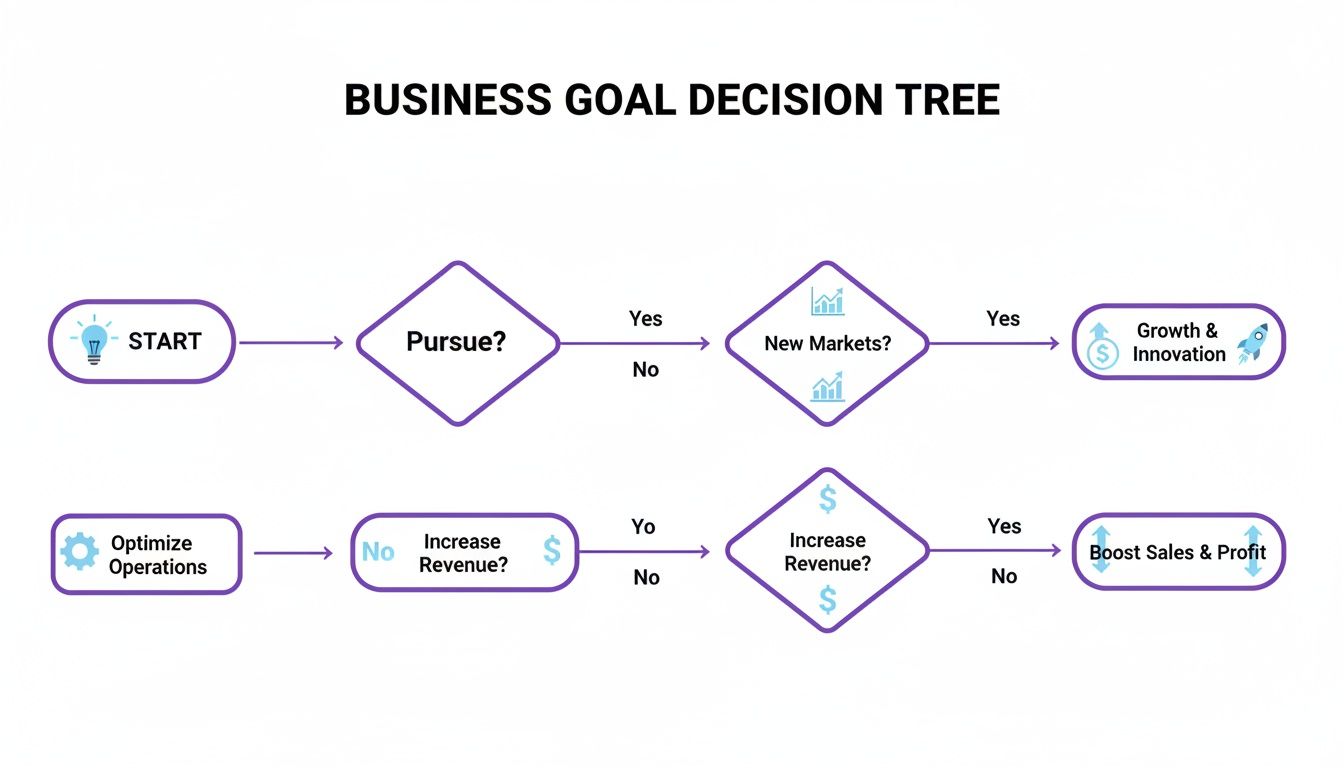
As the flowchart shows, your core objective—whether it's pure growth or driving sales—should be the starting point that guides your entire strategy and the kind of content you create.
Go Where Your Audience Lives
So, how do you pick the right platforms? Go back to your ideal customer profile (ICP). Where do these people really spend their time online? Don't just guess; look for clues.
- For a B2B SaaS Startup: Your audience of VPs and managers is probably scrolling LinkedIn for industry news and career advice. They're looking for case studies, hard data, and expert analysis, not memes.
- For a D2C E-commerce Brand: If you’re selling a cool, visual product, your customers are almost certainly on Instagram and TikTok. They respond to beautiful photos, influencer shout-outs, and fun, short-form videos.
- For a Community-Focused Business: If your goal is to build a tight-knit community, platforms like Reddit, Discord, or private Facebook Groups can be absolute gold. This is where organic conversations and true word-of-mouth happen.
Once you’ve narrowed it down, go and lurk on those platforms. Seriously. Watch what people do. What kind of content gets the most love? How are other brands in your space talking to customers? For a deeper dive, check out this guide on the best platforms for content creators to see where your style fits.
Build Your Content Pillars
Okay, you've picked your platforms. Now what do you talk about? This is where content pillars come in. These are the 3-5 core themes or topics your brand will own. Think of them as the main sections of your own little magazine—they create consistency and make planning a million times easier.
Content pillars mean that every single post has a purpose and reinforces what your brand stands for. Instead of waking up and thinking, "Ugh, what do I post today?" you can just ask, "Which pillar am I talking about today?"
A huge mistake startups make is creating random, one-off content. Content pillars provide a strategic framework, ensuring every post builds on the last and contributes to a cohesive brand story.
For example, a fintech startup’s pillars might be:
- Startup Funding Insights: Actionable advice on raising capital.
- Founder Success Stories: Inspiring interviews and case studies.
- Financial Productivity Hacks: Tips for managing cash flow and burn rate.
- Life at the Startup: Humanizing the brand by showing the team behind the tech.
This focused approach stops your feed from becoming a jumbled mess of product updates, memes, and random news. It positions you as the go-to expert for a very specific set of topics.
Matching Platforms with Pillars
To help you get started, here’s a quick-reference table that shows how different business models can pair platforms with specific content that performs well.
Platform and Content Strategy Match-Up
| Business Model | Primary Goal | Recommended Platform(s) | Winning Content Format |
|---|---|---|---|
| B2B SaaS | Lead Generation | LinkedIn, X (Twitter) | Data-rich carousels, in-depth articles, expert interview clips |
| D2C E-commerce | Brand Awareness | Instagram, TikTok, Pinterest | User-generated content (UGC), Reels, aesthetic photo grids |
| Fintech Startup | Build Authority | X (Twitter), LinkedIn | Short, insightful threads, quick data visualizations |
| Health & Wellness App | User Education | TikTok, Instagram | Quick how-to videos, myth-busting clips, trending audio use |
This kind of intentional pairing makes sure your message is delivered in the right package for the people you want to reach. A detailed report might be an amazing article on LinkedIn, but it needs to be remixed into a snappy carousel or a short video for Instagram.
By being selective with your platforms and strategic with your pillars, you're laying the foundation for a social media presence that drives real business results—not just vanity metrics. You’re not just posting; you're building authority, one focused piece of content at a time.
Build a Content Machine with AI Video Tools

This is what a modern video workflow looks like. Tools like Sprello turn a simple idea into a polished video in minutes, bringing the script, visuals, and audio together in one place. It completely removes the old roadblocks of time and technical skill.
Once you’ve nailed down your goals and content pillars, it's time to actually make the stuff. For any startup today, that means getting serious about video.
With more than 5.2 billion people on social media globally, video is no longer just an option; it's the most effective way to grab someone's attention. Think about it: campaigns with video see 34% higher conversion rates compared to static posts. That's a huge lift when you're fighting to make an impact.
But let's be real. For a lean startup, the idea of consistently churning out high-quality video can feel completely overwhelming. The costs, the time, the technical know-how—it all adds up. This is where AI video tools are changing the entire game, letting you build a real content machine without a Hollywood budget.
The New AI-Powered Video Workflow
Modern AI video suites like Sprello are designed to smash through the old production bottlenecks. What used to be a complicated dance between writers, designers, editors, and voice actors is now handled on a single, clean platform. You don't need to be a video editing pro to create something that looks sharp and gets results.
Let’s walk through a real-world scenario. Imagine you're a B2B SaaS startup and need a short promo video for LinkedIn. Here’s how it works:
- AI Scripting: You kick things off with a simple prompt, something like: "Write a 30-second script about how our project management tool helps remote teams save 10 hours a week." The AI spits back several solid script options, complete with a strong hook and a clear call-to-action.
- Instant Storyboarding: With one click, that script becomes a visual storyboard. The AI pulls in relevant stock footage and images that align with your message, giving you a full visual outline in seconds.
- Realistic Avatars & Voiceovers: Forget about hiring actors or booking a studio. You can pick from a whole library of lifelike AI avatars and pair them with a natural-sounding AI voice to narrate your script.
- Final Touches in a Click: The platform can automatically add captions with dynamic word highlighting—perfect for grabbing attention when the sound is off. The whole process, from a vague idea to a final MP4, can take less than 15 minutes.
The real magic here isn't just the speed. It's the ability to test and learn at a pace that was unthinkable a few years ago. You can whip up three different versions of an ad in under an hour, run them all, and see which one actually connects with your audience. This is how you find out what works, fast.
If you want to dive deeper into the nitty-gritty of production, our guide on https://sprello.ai/blog/how-to-make-videos-with-ai offers more tactical steps.
Batch Your Content for Maximum Efficiency
Creating content one piece at a time is a direct path to burnout. The secret to staying consistent is batching—setting aside a specific block of time to create a week's or even a month's worth of content at once. And with AI tools, this process is ridiculously efficient.
Here's a simple framework for batching:
- Pick a Theme Day: Dedicate one day a month to a single content pillar. Let’s say the first Monday is for "Customer Success Stories."
- Brainstorm with AI: Use your AI tool to generate 5-10 video ideas and scripts centered around that theme.
- Run Your Assembly Line: Spend the next couple of hours actually producing all of those videos. Tweak the scripts, choose your avatars, and generate the final cuts.
- Schedule and Forget: Load all your finished videos into a scheduling tool, and boom—you have a month's worth of content for that pillar ready to roll.
This turns content creation from a nagging daily task into a focused, strategic sprint. To really get the most out of this system, check out this great resource on How to Scale Content Creation Using an AI-Powered System.
Use a Content Calendar to Stay on Track
A content calendar is the brain of your entire startup social media strategy. It's where your pillars, batched content, and posting schedule all live together. This doesn't need to be fancy; a simple spreadsheet or a project in Notion or Asana works perfectly.
At a minimum, your calendar should track:
- Post Date & Time: When it's scheduled to go live.
- Platform: Which network it's for (LinkedIn, Instagram, etc.).
- Content Pillar: The core theme it supports.
- Format: Video, carousel, text-only, etc.
- Status: Draft, Approved, Scheduled, or Posted.
A calendar ensures you're putting out a balanced mix of content and hitting all your strategic pillars. It gives you a bird's-eye view, making it easy to spot gaps or plan around important dates like product launches. When you combine a clear strategy with the power of batching and AI, you create a sustainable system that gets results without the chaos.
Amplify Your Message Through Community and Partnerships
Making great content is a huge win, but it's only half the battle. For a startup, the real trick is getting that content seen by the right people. If you just post and pray, you're essentially whispering your big idea in a packed stadium. It's just not going to cut it.
This is where your strategy needs to evolve beyond simple content creation. You have to actively amplify your message by building genuine relationships—turning followers into a real community and teaming up with creators who already have your audience's ear.
Turn Your Followers into a Thriving Community
Let's be clear: a follower is just a number on a screen, but a community is a powerful asset. The difference? True, two-way engagement. Too many startups use their social media channels like a megaphone, just blasting out company news. The winning approach is to treat it like a conversation.
Engaging with your audience isn't just about good manners; it's a smart growth hack. Algorithms on platforms like Instagram and LinkedIn love to see discussion, so the more you reply to comments and DMs, the more the platform will push your posts out to new people.
Here are a few simple habits to start building that community vibe:
- Reply with Substance: Don't just drop a "thanks!" when someone comments. Ask them a question or add another piece of insight. Keep the ball rolling.
- Engage Proactively: Don't just sit back and wait. Spend 15 minutes a day jumping into conversations on other relevant accounts in your industry.
- Showcase Your Fans: Someone posted about your product? Share it! This is called User-Generated Content (UGC), and it's gold. It gives you fantastic, authentic content and makes that customer feel like a VIP.
The startups that truly win don't just get customers; they build a tribe. They make people feel like they’re part of something bigger. That's where the magic really happens.
Tap into the Power of Creator Partnerships
While you're growing your own audience, you can get a massive boost by tapping into existing ones. Working with creators and influencers is one of the fastest ways for a startup to gain credibility and reach a perfectly matched audience.
Instead of burning cash on ads people have learned to ignore, you can borrow the trust a creator has already painstakingly built with their followers.
This isn't about chasing huge celebrities. For startups, the real sweet spot is with micro-influencers—creators with audiences between 10,000 and 100,000 followers. They often have incredibly engaged, niche communities that perfectly match a specific customer profile. Their followers see them as a trusted friend, not a distant celebrity, so their recommendations carry real weight.
How to Find and Work with the Right Creators
The secret is finding partners whose audience is your audience. If you're a fintech startup, you should be talking to creators who discuss business finance, not the latest fashion trends.
Here’s a simple process to get you started:
- Find Your People: Search relevant hashtags and keywords on platforms like TikTok and Instagram. See who’s making great content in your space and getting real, authentic engagement.
- Do a Vibe Check: Scroll through their feed. Does their style feel authentic? Does it align with your brand? Look at the comments—are people having real conversations?
- Make a Clear Pitch: Don’t send a lazy "let's collab" DM. Personalize your message. Explain why you think they're a great fit and be upfront about what you're offering, whether it's a paid partnership or a product exchange.
The game has completely changed. We're now seeing influencer marketing budgets poised to outspend traditional digital ads for the first time. This marks a huge shift in trust toward authentic voices. Consider this: a staggering 67% of marketers are increasing their spending on creators, and 65% of consumers say that relatable creator content directly impacts their buying decisions.
For startups using new AI tools like Sprello, this opens up fascinating possibilities—from creating custom video content for collaborations to even developing virtual brand ambassadors to manage costs. You can dig deeper into the latest social media statistics to see just how much these trends are reshaping modern marketing.
Measure What Matters and Evolve Your Strategy
You’ve built the engine—now it’s time to check the dashboard. It’s one thing to create great content, but a truly successful startup social media strategy hinges on knowing what’s actually working so you can do more of it. Without data, you’re just guessing, and startups can't afford to waste time or money on guesswork.
The real goal here is to get past the vanity metrics. Sure, likes and follower counts feel good, but they don’t pay the bills. Instead, you need to zero in on the numbers that show your audience is actually taking the next step in their journey with you.
From Vanity Metrics to Action Metrics
It’s a simple but powerful shift in perspective. Don’t just track how many people saw your post; track how many people acted on it. This is how you prove that your social media efforts are more than just noise—they're contributing directly to your business goals.
For a startup, these are the metrics that really matter:
- Click-Through Rate (CTR): This shows the percentage of people who saw your post and were compelled enough to actually click the link. It's a direct signal of how good your copy and call-to-action are.
- Conversion Rate: This is the big one. It tracks how many visitors from social media completed a meaningful action, whether that’s signing up for a demo, downloading an ebook, or buying your product.
- Cost Per Lead (CPL): If you're running any paid campaigns, this is non-negotiable. It tells you exactly how much you're spending to get each new lead, which is critical for understanding the efficiency of your ad spend.
- Engagement Rate: While likes alone are a vanity metric, a high overall engagement rate (comments, shares, saves) tells you that your content is truly resonating. The platform algorithms love this, and it’s a strong indicator of community health.
The best social media strategies are built on a continuous feedback loop: test, learn, and iterate. Data isn't just for a report you file away; it's for making smarter decisions next week.
By focusing on these action-oriented KPIs, you can confidently answer the question, "Is our social media actually working?" The answer will be right there in the data, not in your follower count.
Your Simple Monthly Review Framework
To keep this from becoming a huge time-suck, just block out a couple of hours at the end of each month for a quick strategy review. This isn't about building a massive slide deck; it's about digging up actionable insights that will make next month's content even better.
First, pull the key numbers from your platform analytics (like LinkedIn Analytics or Meta Business Suite) and your website analytics. Then, get your team in a room (or on a call) and ask these four questions:
- Which content pillar drove the most website traffic? This tells you which of your core themes is actually getting people off the social platform and onto your turf.
- What content format (video, carousel, text) got the highest engagement? This reveals how your audience likes to consume information, guiding where you should invest your production efforts.
- Which specific post generated the most qualified leads or sign-ups? Break this post down. What was the hook? The CTA? The visual? This is your template for success.
- What did we try last month that completely flopped? Failure is just data. Knowing what doesn't work is just as valuable as knowing what does. Don't be afraid to kill ideas that aren't landing.
Answering these questions turns raw data into a clear plan. If you discover your short-form videos are driving twice the conversions of your static images, the path forward becomes obvious—make more videos. This simple, data-driven loop ensures your strategy never gets stale and keeps delivering real results, turning your social media from just another task into a powerful growth asset.
Ready to create more of the video content that converts? With Sprello, you can produce high-quality, conversion-focused ads and social content in minutes using AI—no complex editing required. Test more ideas, ship more videos, and learn what works faster. Check out how at https://sprello.ai.


