
Let's get right to it: there’s no magic number for what social media advertising costs. It’s not like buying a product off a shelf with a fixed price tag. But to give you a ballpark, most small businesses find themselves spending between $2,000 and $5,000 per month to get real, noticeable traction.
What you'll actually spend depends on your industry, who you're trying to reach, and which platforms you're using.
What Social Media Advertising Costs in Practice
Think of setting a social media ad budget like planning a vacation. There's no single answer to "How much does a trip cost?" It all depends on where you’re going (your business goal), how you get there—a budget airline or first class (the platform)—and how long you stay (your campaign duration).
At the heart of it all is a massive, real-time auction. You're not just buying ad space; you're bidding against other advertisers for the attention of a specific audience. The more desirable the audience, the more competitive the auction.
Common Pricing Models Explained
To get a grip on your spending, you first need to understand how you're charged. It's like choosing how to pay for gas on a road trip: by the gallon, for a full tank, or maybe only for the miles that get you to a specific landmark.
- Cost Per Click (CPC): This is straightforward. You pay only when someone clicks your ad. It’s perfect when your main goal is to get people to your website, a product page, or a sign-up form.
- Cost Per Mille (CPM): "Mille" is just a fancy word for a thousand. With CPM, you pay a flat rate for every 1,000 times your ad is shown (an "impression"). This model is all about visibility and getting your brand name out there, making it great for awareness campaigns.
- Cost Per Action (CPA): Here, you only pay when someone takes a specific step you care about, like making a purchase, filling out a lead form, or downloading an app. It directly ties your ad spend to tangible business results.
The quality of your ad is a huge lever on your costs. Social media platforms reward ads that people actually like. Better ads get better placements and lower costs because they make the platform a better experience for users.
And remember, the ad creative itself—the video, image, and text—is part of your investment. A killer visual can make or break a campaign, but it doesn't have to cost a fortune. For instance, digging into the cost of AI video ads production can show you how to create high-impact content without a Hollywood budget.
Average Social Media Ad Costs at a Glance
So, what should you expect to pay on different platforms? Below is a quick cheat sheet with some typical cost benchmarks. Treat these as a starting point—your own costs will definitely vary based on all the factors we’ll cover next.
| Platform | Average CPC Range | Average CPM Range | Best For |
|---|---|---|---|
| Meta (Facebook & Instagram) | $0.50 – $3.50 | $7.00 – $15.00 | E-commerce, Local Businesses, B2C Brands |
| TikTok | $0.20 – $1.50 | $4.00 – $10.00 | Brand Awareness, Gen Z Targeting, Viral Content |
| $4.00 – $8.00 | $15.00 – $30.00+ | B2B Lead Generation, Professional Networking | |
| YouTube | $0.15 – $0.50 (CPV) | $5.00 – $12.00 | Video Marketing, Brand Storytelling, Search Intent |
| $0.50 – $2.00 | $3.00 – $8.00 | Visual Discovery, Retail, DIY & Home Decor |
These numbers give you a rough map of the terrain. They help you see where your budget might take you, but to truly navigate effectively, you need to understand the engine running everything behind the scenes: the ad auction.
How Social Media Ad Auctions Actually Work
Ever wonder how your competitor seems to pay less to reach the same people you are? It’s not always about having a bigger budget. The secret lies in the ad auction, which is less like a simple bidding war and more like a talent show. The platform's algorithm acts as the judge, and it cares a lot more about your ad's performance than just the entry fee you're willing to pay.
Every single time a user opens their feed, a lightning-fast auction takes place behind the scenes to decide which ad gets the spot. The platform is trying to do two things at once: make money and keep its users happy. To win, your ad needs a high "total value," which is a mix of your bid, how good your ad is, and how relevant it is to the person seeing it.
Deconstructing Ad Pricing Models
To play the game, you need to know the rules. There are three main ways you can pay for ads, and each one lines up with a different business goal. Picking the right one is like choosing the right tool for a job—you wouldn't use a hammer to turn a screw.
Cost Per Mille (CPM): Paying for Eyeballs Think of this like buying a billboard on a busy highway. You pay for the number of cars that drive by, not for how many people actually look at your sign. CPM is the same idea online: you pay a set price for every 1,000 times your ad is shown (an "impression"). This is your best bet for brand awareness campaigns where the goal is simply to get your name in front of as many people as possible.
Cost Per Click (CPC): Paying for Interest Now, imagine you hire someone to hand out flyers and you only pay them for each person they convince to walk into your store. That’s CPC. You only get charged when someone is interested enough to actually click on your ad and visit your website. It’s the go-to model for driving traffic or getting leads.
Cost Per Action (CPA): Paying for Results This model is the equivalent of hiring a salesperson who works purely on commission. You don’t pay them for making calls (impressions) or setting up meetings (clicks)—you only pay them when they actually make a sale. With CPA, you define a specific action you want, like a purchase or a newsletter sign-up, and you only pay when it happens. This model ties your ad spend directly to tangible results.
Why Your Bid Is Only Part of the Story
The whole auction system is built to find a sweet spot between what advertisers want and what users will tolerate. A boring, irrelevant ad might win a spot once if the bid is high enough, but if everyone ignores it, the platform learns not to show it again.
This is exactly why your competitor might win the same ad placement with a lower bid—their engaging video ad is getting more love from users than your static image.
Key Takeaway: The platforms reward ads that people actually like. A high-quality, relevant ad gets better placement and costs less. When people click on your ad (a high click-through rate) and engage with it, you're signaling to the algorithm that you’re adding value, which gives you a major advantage in the auction.
This dynamic has only gotten more intense over the years. Social media ad spend has exploded from a small experiment for most businesses into a core part of a massive global market. Advertisers worldwide are projected to spend about $1.16 trillion on all advertising in 2025, with social ads alone accounting for an expected $306.4 billion.
All that competition means the auction is more crowded than ever, pushing costs up for everyone. For small businesses, this makes one thing crystal clear: creating ads that genuinely perform well is the single most important way to control costs and get a solid Return on Ad Spend (ROAS). You can dive deeper into these digital ad spending trends from We Are Social.
Comparing Ad Costs Across Social Media Platforms
Figuring out where to put your ad dollars isn't a simple choice. Every social media platform is its own little world, with a unique crowd, different ad styles, and completely different costs. The trick is to match your business goals with the platform where your ideal customers actually hang out.
Think of it like picking a spot for a new shop. You wouldn't open a high-end jewelry store in a discount outlet mall, right? In the same way, running an ad for B2B software on a platform full of teenagers is a recipe for wasted money. Knowing the lay of the land on each platform is the first step to getting a real return on your investment.
Here's a quick look at the major players to help you decide where your budget will work hardest.
Platform Cost and Audience Comparison
This table breaks down the main social platforms, giving you a snapshot of their costs, the kind of people you'll find there, and what they're best used for.
| Platform | Primary Audience | Typical Ad Formats | Strengths for Advertisers |
|---|---|---|---|
| Meta (Facebook & Instagram) | Broad, diverse demographic across all age groups. Instagram skews younger and more visual. | Image Ads, Video Ads, Stories, Reels, Carousels, Lead Forms | Unmatched reach and granular targeting. Great for e-commerce, local businesses, and B2C lead generation. |
| TikTok | Gen Z and Millennials seeking authentic, entertaining video content. | In-Feed Video Ads, TopView, Branded Hashtag Challenges, Spark Ads | High engagement and potential for viral reach. Perfect for brand awareness and visually driven products. |
| Professionals, executives, and B2B decision-makers in a business-focused mindset. | Sponsored Content, Message Ads, Dynamic Ads, Lead Gen Forms | Precise targeting by job title, industry, and company. The go-to for B2B leads and high-value services. | |
| YouTube | Massive global audience actively searching for information, tutorials, and entertainment. | Skippable In-Stream Ads, Non-Skippable Ads, Bumper Ads, Display Ads | Captures user intent based on search and viewing history. Ideal for product demos and brand storytelling. |
Each platform offers a distinct advantage. Meta provides the scale, TikTok delivers the engagement, LinkedIn connects you with professionals, and YouTube captures active interest. Your choice depends entirely on who you're trying to reach and what you want them to do.
Meta: Facebook and Instagram
As the biggest social advertising ecosystem out there, Meta’s reach is enormous, and its targeting options are incredibly detailed. This makes it the default choice for a huge variety of businesses, from the local coffee shop to massive e-commerce brands.
- Audience: You can find just about everyone here, covering nearly every age group and interest imaginable. Instagram, specifically, pulls in a slightly younger, more visual crowd.
- Best For: Driving e-commerce sales, promoting local businesses, generating leads for B2C services, and building a community around your brand. An online clothing store, for instance, can do wonders with Instagram Stories and Reels to show off new collections.
Costs on Meta can be a bit of a rollercoaster. You might see average CPMs (Cost Per 1,000 Impressions) in the $8–$14 range for brand awareness campaigns, but that number can swing wildly depending on your industry and audience. With so many advertisers competing, high-quality ad creative is your best weapon for keeping costs in check.
TikTok: The Engagement Powerhouse
TikTok’s insane growth has made it a must-have for any brand trying to connect with younger audiences. The algorithm is ridiculously good at serving up relevant content, which means ads that feel natural on the platform can get incredible, almost organic, reach.
- Audience: This is prime territory for Gen Z and Millennials. They’re on the app for entertainment, trends, and authentic, unpolished content.
- Best For: Big brand awareness pushes, viral marketing campaigns, and selling products that look great on camera. A snack brand could start a branded hashtag challenge, tapping into TikTok’s user-generated content culture for huge, cheap exposure.
You’ll generally find that TikTok has lower CPMs than Meta, often landing somewhere between $4–$10. The catch? Your ad can't feel like an ad. Authenticity and entertainment win the day here, while slick, corporate-style ads usually fall flat.
This chart helps visualize the core pricing models—CPM, CPC, and CPA—that you'll be working with across these platforms.
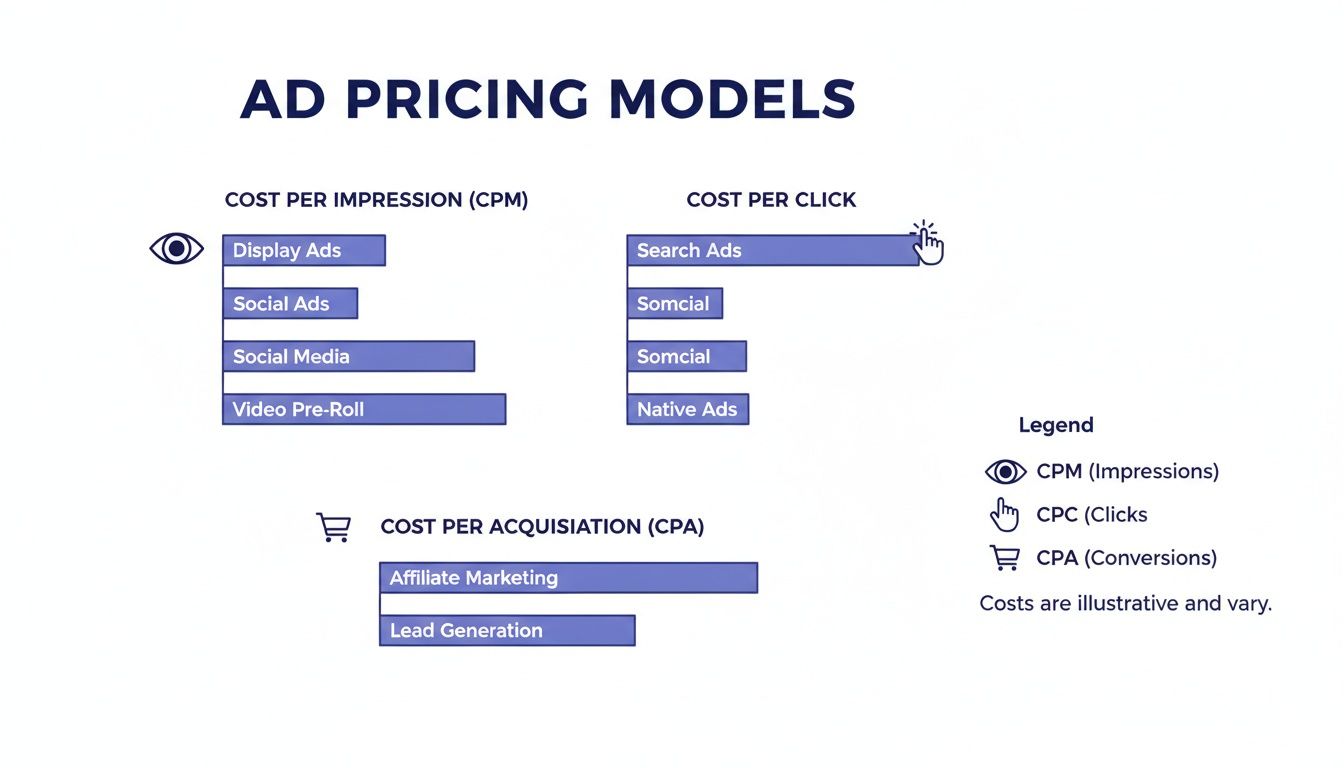
Getting a handle on these models is key to matching your bidding strategy to your campaign goals, whether you’re paying for eyeballs, clicks, or actual sales.
LinkedIn: The B2B Gold Standard
When it comes to B2B advertising, LinkedIn is in a league of its own. Sure, its audience is smaller than Meta’s, but it’s a highly focused group of people who are in a professional headspace. It’s the perfect place to get in front of decision-makers.
LinkedIn is where you go to find customers with company credit cards. The higher costs are a direct reflection of the higher potential value of each lead.
For anyone in B2B marketing, the ability to target users by their job title, industry, or company size is worth its weight in gold.
- Audience: Professionals, executives, and key decision-makers across pretty much every industry you can think of.
- Best For: Generating B2B leads, promoting high-ticket services, running account-based marketing campaigns, and recruiting top talent. A SaaS company selling project management software, for example, can target managers in the tech industry with surgical precision.
This kind of precision doesn’t come cheap. LinkedIn has the highest ad costs of the bunch, with CPCs (Cost Per Click) often between $4–$8 and CPMs that can easily shoot past $25. But the potential return is massive when a single new client can be worth tens of thousands of dollars.
YouTube: The Video Juggernaut
As the second-largest search engine in the world, YouTube gives you a totally different way to advertise. You can target people based on what they’re searching for and watching, catching their attention right when they’re actively looking for answers or entertainment.
When you're in the ad platforms, you’ll see costs broken down by CPM (cost per 1,000 impressions) and CPC (cost per click). Benchmarks show that things like ad quality and competition can make these numbers fluctuate dramatically. Agency data shows that a typical small business needs to invest $2,000–$5,000 per month to see consistent results. Why? Campaigns under $1,000 often don't give the platform's algorithm enough data to learn and optimize effectively. This is exactly why testing multiple ad variations is so important—even a small bump in your click-through rate can seriously lower your overall costs.
You can find more data-driven insights by exploring forecasts on social media ad spending in 2026 on wolfpackadvising.com.
The Key Factors That Influence Your Ad Spend
Ever wonder why social media ad costs feel so unpredictable? It’s a lot like booking a flight. The price for a seat from New York to Los Angeles is never static; it changes based on the time of year, the airline, and whether you’re flying on a holiday weekend. Your ad spend works the exact same way.
A few powerful, interconnected variables are always at play. Once you understand what pushes the price up or down, you can start making smarter decisions, find the best deals, and get way more out of your budget.
Let’s pull back the curtain and look at the five big factors that really determine what you'll pay.
Your Target Audience and Industry
First things first: who are you trying to reach? This is easily the biggest driver of your costs. The more valuable and specific your audience is, the more you're going to pay to get your message in front of them. It's classic supply and demand.
Think about it. If you’re targeting "startup founders in California," you're going after a very specific, high-value group that tons of B2B companies want to reach. The competition is fierce, and that bidding war drives up the price.
On the flip side, an audience like "people interested in technology" is massive and far less competitive. Reaching them will be much, much cheaper.
The same logic holds true for your industry. Crowded spaces like e-commerce, legal services, and finance almost always have higher social media advertising costs. Why? Because more businesses are fighting for the same eyeballs. A local bakery, however, will probably face way less competition and enjoy lower costs as a result.
The Impact of Seasonality and Timing
In advertising, timing can make or break your budget. Costs can skyrocket during certain times of the year. The most obvious example is the holiday rush, from Black Friday right through New Year's. Practically every retailer is throwing money at ads, which floods the auction and drives up prices for everyone.
But it’s not just about the big holidays. Seasonality is often industry-specific.
- Fitness Brands: See costs climb in January when New Year's resolutions are in full swing.
- Tax Services: The ad market heats up in the months before the tax deadline.
- Travel Companies: Summer and spring break are their prime (and most expensive) seasons.
Knowing these cycles is a huge advantage. You can either budget more to compete during the peak seasons or shift your focus to the less expensive "off-season" to make your ad dollars stretch further.
The platform algorithms are built to reward ads that make the user experience better. An ad people actually like or find useful is a win for the platform, and they pass that value back to you with lower costs and better placement.
Your Ad Creative and Quality Score
This is where you have the most control, and honestly, it’s your secret weapon for a better budget. Social media platforms don't just care about who bids the most; they want to show their users ads that are genuinely engaging and relevant.
They measure this with a "quality score" or a similar metric. A high score signals to the platform that your ad is a great match for the audience, and they reward you for it. That reward often comes as a lower cost-per-click (CPC) or cost-per-mille (CPM), meaning you can actually win auctions even if a competitor bids more than you.
A boring, blurry image with confusing copy? That’ll get a terrible quality score, leading to high costs and barely any reach. But a sharp, compelling video ad that racks up clicks, comments, and shares will earn a top score, effectively giving you a discount on your ad spend.
Your Bidding Strategy and Campaign Objective
Finally, how you tell the platform to spend your money has a direct impact on your costs. When you create a campaign, you choose an objective—is your goal brand awareness, website traffic, or sales? That choice tells the algorithm what to optimize for.
Your bidding strategy goes hand-in-hand with that objective.
- Lowest Cost Bidding: This tells the platform, "Get me the most results you can for my budget." It's great for maximizing sheer volume, but you might not get the highest-quality leads.
- Target Cost Bidding: This is where you set a specific cost-per-action (CPA) you're willing to pay. You get more control over your spending, but if your target is too low, you might limit your ad's reach.
Getting this combination right is critical. A campaign aiming for conversions will almost always have a higher CPC than one just trying to get clicks. That's because the platform is doing the heavy lifting to find people who are not just likely to click, but who are also ready to pull out their wallets and buy.
How to Set a Realistic Social Media Ad Budget
Trying to set a social media ad budget can feel like throwing darts in the dark. How much is enough? How much is too much? Instead of just picking a number that feels right, the best way to do it is to work backward from what you’re trying to achieve.
A smart budget isn't just a random figure; it's a calculated investment tied directly to your business goals. The way you calculate it depends entirely on your objective. Are you trying to get direct sales, or are you more focused on getting your brand name in front of as many people as possible? Each goal requires a different kind of math.
Budgeting for Conversions and Sales
If your goal is to generate leads or sell products, your budget should be rooted in your revenue targets. This approach directly connects what you spend to the money it brings in, making it incredibly easy to track your return on ad spend (ROAS).
Think of it this way: if you want to generate $10,000 in new sales from your ads, you need to figure out exactly how much you have to spend to get there.
Here’s a simple, four-step formula to work it out:
- Define Your Revenue Goal: Start with the big number. Let's stick with $10,000.
- Know Your Average Order Value (AOV): If an average customer spends $100, you’ll need 100 sales to hit your goal ($10,000 / $100).
- Find Your Website's Conversion Rate: Let's say 2% of your website visitors end up buying something. To get those 100 sales, you need to drive 5,000 clicks to your site (100 sales / 0.02).
- Estimate Your Cost Per Click (CPC): If your average CPC is around $1.50, your total ad budget needs to be $7,500 (5,000 clicks x $1.50).
Suddenly, a vague goal becomes a concrete number. This calculation shows you exactly what it's going to take to hit your sales target. For a more structured approach, you can use a marketing campaign planning template to map everything out.
Budgeting for Brand Awareness
When your goal is brand awareness, you're not buying clicks—you're buying eyeballs. The entire calculation shifts from conversions to reach and impressions. The key metric here is Cost Per Mille (CPM), which is simply the price you pay for one thousand ad views.
A great starting point for a small business is a daily budget of $10–$20 per platform. This gives the algorithm enough data and breathing room to learn who your ideal audience is, which is absolutely critical for long-term success.
To set a budget for an awareness campaign, just follow these steps:
- Define Your Target Reach: How many people do you want to see your ad? Let's aim to reach 100,000 people.
- Find Your Industry's Average CPM: If the average CPM for your audience is $10, it costs you that much to show your ad 1,000 times.
- Calculate Your Budget: To get your ad in front of people 100,000 times, your budget would need to be $1,000 ((100,000 impressions / 1,000) * $10).
This method helps you put a real dollar amount on the often-fuzzy goal of "getting our name out there."
Sample Monthly Budget Frameworks
To make all of this more tangible, let's look at what this might look like for a few different types of businesses. These are just starting points, of course—you can and should adapt them to your own situation.
| Business Type | Monthly Budget | Focus & Strategy |
|---|---|---|
| Local Service Business | $500 – $1,500 | Hyper-local targeting on Facebook and Instagram. The goal is driving leads through forms or messages and getting more foot traffic. |
| Growing E-commerce Brand | $2,000 – $7,500 | A heavy focus on Instagram and TikTok for product discovery, with a strong retargeting strategy to bring back abandoned carts. The main goal is direct sales. |
| Marketing Agency | $5,000+ per client | A blended, full-funnel strategy across multiple platforms (like LinkedIn for B2B clients), guiding customers from initial awareness all the way to conversion. |
At the end of the day, your budget should be flexible. Start with a solid, calculated estimate, but keep a close eye on your performance. Be ready to move your money to the campaigns and platforms that are actually delivering the best results.
Actionable Strategies to Lower Costs and Maximize ROAS
Knowing what affects your social media advertising costs is one thing, but actually using that knowledge to your advantage is where the real work begins. To make every dollar count, you have to move past a "set it and forget it" approach and get into a rhythm of constant testing, learning, and tweaking.
The aim isn't just to spend less money; it's to get a bigger return for every dollar you do spend. By focusing on a few key areas, you can give your Return on Ad Spend (ROAS) a serious boost, often without touching your overall budget.
Master the Art of A/B Testing
If there's one silver bullet for lowering ad costs, it's relentless testing. Guessing is expensive, but data is cheap. A/B testing (or split testing) is simple: you run two slightly different versions of an ad to see which one your audience responds to more.
You can test just about anything to figure out what clicks with your audience:
- Creative: A video showing your product in action versus a static image with a punchy offer.
- Headlines: "Shop Our New Collection" versus "50% Off Spring Arrivals Today Only."
- Calls-to-Action: "Learn More" versus "Buy Now."
- Audiences: A broad, interest-based group versus a lookalike audience built from your best customers.
By constantly testing and putting more budget behind the winners, you're essentially letting your audience guide your strategy. This process systematically improves ad performance and chips away at your costs. For a deep dive, this guide offers a complete creative testing framework to get you started.
The brands that win in today's ad auctions are the ones that learn the fastest. High-velocity testing lets you discover what works, adapt on the fly, and find pockets of efficiency your competitors are completely missing.
Refine and Segment Your Audience
As your campaigns run, they generate a goldmine of data. Don't let it sit there—use it to sharpen your targeting. Dig into your ad reports and look for the demographic segments (age, gender, location, device) that are bringing in the best results for the lowest cost.
For instance, you might find that your ads convert 30% better among mobile users between 25 and 34. The next logical step is to create a dedicated campaign just for that high-performing group, letting you tailor your creative and bid more effectively.
And don't forget about retargeting. These campaigns show ads to people who have already visited your site, added something to their cart, or liked one of your posts. This "warm" audience already knows who you are, which makes them far cheaper to convert than total strangers.
Increase Your Creative Velocity
Let's be real: rising social media ad costs are the new normal. The global ad market is booming, with forecasts predicting ad spend will cross the $1 trillion mark for the first time in 2026—and digital is getting the biggest piece of that pie. You can read more about these global ad spend forecasts on dentsu.com.
More competition means higher auction prices, making weak creative and sloppy targeting more costly than ever. This is where "creative velocity"—your ability to pump out and test new ad variations quickly—becomes your secret weapon. Finding the best content creation tools for social media is key to producing compelling ads without breaking the bank.
The faster you can test different hooks, visuals, and offers, the faster you'll find a winner you can scale. This doesn't require a Hollywood production budget; it requires a smarter workflow. Modern AI-powered tools can help you spin up dozens of ad variations in minutes, letting you test more, learn faster, and ultimately drive down your cost to acquire a customer.
Common Questions (and Real-World Answers) About Ad Costs
Alright, we've covered the models and the moving parts that determine your ad spend. But I know what you’re thinking—how does this actually play out in the real world? Let's tackle some of the most frequent questions I get from people just trying to get their campaigns off the ground.
How Much Should a Small Business Actually Spend to Start?
Forget trying to find a perfect, one-size-fits-all number. It doesn't exist. Instead, think about giving the platform's algorithm enough fuel to do its job. A solid starting point for most small businesses is $10–$20 per day, per platform.
This translates to a monthly budget of roughly $500 to $1,500. At this level, you’re not just throwing money into the void; you're buying enough data for the system to learn who responds to your ads. Dip too far below that, and the algorithm struggles to find a pattern, which ironically makes your costs go up because it never figures out how to work efficiently for you.
"Help! Why Are My Ad Costs So High?"
If your costs are making your eyes water, it's almost always one of a few usual suspects. Run through this mental checklist before you panic.
- Your Creative is Missing the Mark: Are people scrolling right past your ad? If the visuals or copy don't grab them, low engagement tells the platform your ad isn't relevant, and they'll charge you more to show it.
- You're Fighting Over a Tiny Audience: Targeting a super-specific or popular group means you're in a bidding war with everyone else. More competition always means higher prices.
- Your Audience Has Ad Fatigue: People are sick of seeing the same ad. Once they've seen it a handful of times, performance tanks and costs climb. It's a clear signal to switch things up.
- You Picked the Wrong Goal: Are you running an ad designed for brand awareness but telling the algorithm to optimize for conversions? That's like trying to use a hammer to turn a screw—it’s the wrong tool for the job, and the results will be inefficient and expensive.
The Bottom Line: High ad costs are rarely random. They're a sign that something is out of sync between your ad, your audience, and your goal. Fix the strategy, and you'll almost always fix the cost.
When Will I Actually See Results?
This is where you have to be patient—and I mean it. The first 1-2 weeks are what we call the "learning phase." Performance will be all over the place as the algorithm figures things out. Don't touch anything!
You'll start to see some reliable, predictable trends after about 30 days. But the real magic happens around the 90-day mark. That's enough time to test creatives, tweak your targeting, and truly understand what's delivering a return on your investment.
Ready to slash your production time and test more ad creative than ever before? Sprello helps you create high-converting video ads in minutes with AI, not hours of editing. Start creating for free on sprello.ai.


