
Think of a small business marketing strategy as your game plan for attracting new customers and keeping them coming back. It’s what takes you from posting randomly on social media to running a coordinated system where every dollar and every minute you spend has a clear purpose. This roadmap is what connects your big-picture business goals to your day-to-day marketing tasks.
Why Your Marketing Feels Stuck and How to Fix It

Ever feel like you’re just shouting into the wind? You’re not alone. So many small businesses fall into the trap of "random acts of marketing"—a social media post here, a boosted ad there, with no real thread connecting it all to sales. It's a surefire recipe for burnout and vague results, leaving you wondering if any of it is actually working.
The real problem is usually the lack of a cohesive plan. Without a documented strategy, you end up reacting to things instead of driving the action. You might jump on a new trend or copy what a competitor is doing, but you're skipping the most important part: figuring out if those tactics even make sense for your business and your customers. This is a classic growing pain for businesses on the rise.
The True Cost of a Missing Strategy
Wingin' it isn't just inefficient; it's expensive. When you're operating without a clear plan, you're likely:
- Wasting money: Pouring your budget into ad platforms where your ideal customers simply aren't hanging out.
- Burning out your team: Creating endless content without seeing any real engagement or growth.
- Hitting a growth plateau: Struggling to attract new leads because your message is all over the place.
- Missing out on opportunities: Overlooking profitable channels because you're stuck doing low-impact tasks.
This guide is designed to get you out of that chaos. We're going to show you how a solid small business marketing strategy isn't just a "nice-to-have" for big corporations—it's the essential roadmap you need to grow and thrive.
Here's a little secret: just writing down your strategy makes you 62% more likely to say your marketing is successful. It’s the difference between guessing and building a predictable machine that brings in customers.
A Widespread Challenge with a Clear Solution
If you feel this way, you're in good company. In 2024, the U.S. was home to roughly 33.2 million small businesses, which make up 99.9% of all businesses in the country. Yet, most of them are marketing by the seat of their pants.
One 2024 report found that a staggering 73% of small businesses aren’t sure their marketing is even working, and only a tiny 17% actively use SEO to get found online. You can find more of these eye-opening small business marketing stats online.
The solution is what we're about to walk through: a practical framework for building a marketing engine that actually works, even if you have a small team and a tight budget. We’ll skip the jargon and focus on setting goals that matter, understanding your audience, picking the right places to show up, and knowing what to measure.
First Things First: Build a Marketing Foundation That Actually Works
Before you even think about spending a dollar on ads or a minute crafting a social media post, we need to lay the groundwork. Your entire marketing strategy rests on two simple but crucial pillars: knowing exactly what you want to achieve and deeply understanding who you're trying to reach.
Skipping this part is like trying to build a house on sand. It’s a classic mistake, and it’s why so many marketing efforts feel random and disconnected. When you just throw things at the wall to see what sticks, you get random results. A solid foundation ensures every single thing you do—from the channels you pick to the subject line you write—is intentional and moves the needle.
Set Goals You Can Actually Measure
Let's be honest, vague targets like "get more customers" or "increase sales" aren't real goals. They're wishes. To build a strategy that delivers, you need to set SMART goals—objectives that are Specific, Measurable, Achievable, Relevant, and Time-bound. This simple framework turns fuzzy ideas into a concrete plan.
For example, "sell more online" is a wish. A SMART goal sounds like this: "Increase online sales by 15% in the next quarter by launching a targeted Facebook ad campaign and sending two promotional emails per month." See the difference? It’s specific (15%), you can measure it (sales data), it’s achievable (based on past performance), it’s relevant (drives revenue), and it’s time-bound (next quarter).
A well-defined goal is your North Star. It keeps your team focused and makes it incredibly easy to see if what you're doing is actually working or just keeping you busy. Without it, you’re flying blind.
Here’s how to turn weak goals into strong ones:
Instead of: "Improve brand awareness."
Try: "Grow our Instagram follower count by 500 new, relevant followers in the next 60 days through consistent posting and engagement."
Instead of: "Get more leads."
Try: "Generate 25 qualified leads per month through our website's contact form by optimizing three of our top blog posts for local SEO."
Get to Know Your Ideal Customer (For Real)
Once you know where you're going (your goals), you need to figure out who you’re talking to. You absolutely cannot market to "everyone." When you try to appeal to the masses, your message becomes so generic and watered-down that it resonates with no one. This is where creating a buyer persona is a game-changer.
A buyer persona is essentially a character sketch of your perfect customer, pieced together from market research and real data about the people who already buy from you. It’s way more than just demographics like age and location.
To build a persona that’s actually useful, you need to dig into:
- Their Pain Points: What problems keep them up at night? What frustrates them about the current solutions available?
- Their Motivations: What are they really trying to accomplish? What does a "win" look like for them, and how can you help them get there?
- Their Watering Holes: Where do they hang out online? Are they scrolling Instagram, reading niche blogs, listening to specific podcasts, or active in certain Facebook groups?
Think about a local coffee shop. Their persona isn't just "people who like coffee." A better one might be "Freelance Francis," a 32-year-old remote worker who needs a quiet spot with solid Wi-Fi. His pain point is a chaotic home office. He’s motivated by productivity and a great cup of coffee. He finds new places on Instagram and by searching Google Maps.
Knowing this, the coffee shop can market directly to Francis. They could run Instagram ads targeting users with "freelancer" in their bio, create content showing off their quiet corners and fast Wi-Fi, and make sure their Google Business Profile is flawless.
This foundational work is non-negotiable. To really nail it, you have to understand how all these pieces fit into a powerful ecommerce digital marketing strategy. And if you want to keep everything organized from the start, a complete marketing campaign planning template will help you turn these core ideas into a plan you can actually execute.
Choose Where to Play and What You Already Have
Now that you have your goals locked in and a clear picture of your ideal customer, it’s time to decide where you’re going to show up. This is where so many small businesses get tripped up. They try to be active on every single platform, stretch themselves too thin, and burn out before they see any real results.
The secret isn’t to be everywhere; it’s to be where it counts.
Your small business marketing strategy becomes a real powerhouse when you focus your energy. Instead of posting randomly across five different social media channels, you’ll get far better results by mastering one or two where your audience actually hangs out. It’s all about making smart choices based on the homework you’ve already done.
Pinpoint Your High-Impact Channels
Let's go back to "Freelance Francis" from our coffee shop example. Where does he actually spend his time online? If your research shows he finds new local spots on Instagram and through Google searches, then pouring your time and money into LinkedIn or X (formerly Twitter) is just a waste. Your buyer persona is the key that unlocks this whole puzzle.
Think of it like fishing. You wouldn’t just cast a line into a random pond and hope a trophy fish jumps on the hook. You’d go to the specific lake where you know that type of fish is swimming. Marketing channels are exactly the same.
Choosing your channels isn't about what's popular; it's about what's profitable. Your customer's attention is the most valuable currency you have—spend your marketing efforts where they are already paying attention.
This decision tree helps visualize how to connect your goals and audience directly to the right marketing channels and tactics.
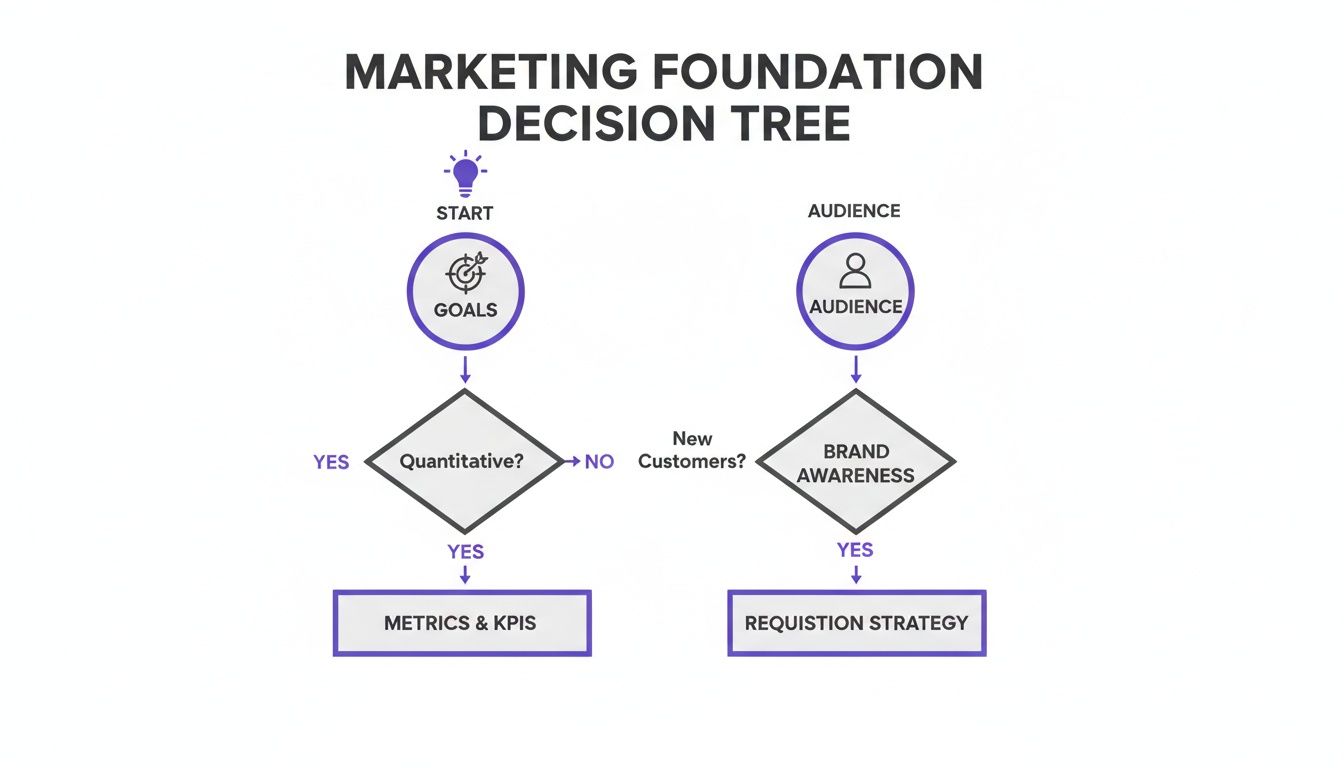
As you can see, every choice should trace back to either your core business goals or your specific audience profile. This keeps you from just throwing spaghetti at the wall to see what sticks.
A Look at Top Channels for Small Businesses
Most business owners today are mixing and matching different tactics to reach customers. In fact, a recent analysis found that 76% of small business owners use at least two marketing channels, and a whopping 78% tried new tactics in 2023.
The most popular channels? Social media ads (60%), websites (60%), SEO (50%), and email marketing (46%). You can dig into more of these small business marketing statistics to see what’s working for others.
To help you get started, here's a quick look at some of the most effective channels.
High-Impact Marketing Channels for Small Businesses
| Channel | Best For | Example Audience | Key Metric to Track |
|---|---|---|---|
| Social Media | Building community, visual storytelling, and running targeted ads. | B2C brands, local services, and businesses with a strong visual element. | Engagement Rate, Follower Growth |
| Email Marketing | Nurturing leads, driving repeat purchases, and sharing updates. | Any business with a customer list. E-commerce and service providers excel here. | Open Rate, Click-Through Rate |
| SEO & Content | Answering customer questions, building authority, and driving organic traffic. | Businesses in research-heavy fields, professional services, and niche experts. | Organic Traffic, Keyword Rankings |
| Paid Ads | Generating immediate traffic, targeting specific demographics, and promoting offers. | E-commerce, lead generation, and businesses needing quick results. | Conversion Rate, Cost Per Acquisition |
Remember, the goal isn't to pick one and stick to it forever. It's about finding the right starting combination for your unique business and customer.
Conduct a Quick Asset Audit
Before you rush off to build anything new, stop and take stock of what you already have. Your existing marketing assets—your website, your email list, your social profiles—are often an untapped goldmine. A quick audit can show you what’s working, what’s broken, and where you can get some easy wins.
This doesn't need to be a week-long project. Seriously, just set aside an hour and run through these simple questions.
Your Website
- Is my contact info dead simple to find?
- Does the site load quickly on a phone?
- Is it painfully obvious what I want visitors to do (e.g., "Buy Now," "Book a Call")?
Your Social Media Profiles
- Are my profiles complete with a clear bio, link, and a decent profile picture?
- Which of my old posts got the most likes and comments? Is there a pattern?
- Am I ignoring DMs or comments from potential customers?
Your Email List
- How many people are actually on my list?
- When was the last time I actually sent them an email?
- Do I have a simple sign-up form on my website for new people?
This quick check-up gives you a baseline. You might find your website’s contact form is broken or that a certain type of social media post always gets a great reaction. Fixing these foundational issues and leaning into what’s already working is one of the fastest, cheapest ways to make your marketing instantly more effective.
Create High-Impact Content Without Breaking the Bank
If you're running a small business, the very idea of a "content machine" probably sounds exhausting. The constant pressure to pump out blog posts, social media updates, and videos can feel like a full-time job you just don't have time for.
It’s a common myth that you need a big team and a bottomless budget to create content that actually gets results. Thankfully, that's just not true anymore.
The playing field has been completely leveled by modern tools, especially those using AI. They give small businesses the power to produce polished, professional content at a tiny fraction of the old-school cost and time. This isn't about replacing your great ideas; it's about amplifying them by automating the tedious, time-sucking parts of the process.
The New Rules of Content Creation
Forget the old, slow way of doing things: brainstorm, write, shoot, edit, publish. That assembly-line process was expensive and took forever. The modern approach is all about speed, agility, and learning as you go.
It starts with a simple idea and explodes into dozens of creative possibilities. Instead of spending a week to produce one "perfect" video, you can now generate five different versions in a single afternoon, each with a unique hook or visual flair. This is an absolute game-changer for any small business marketing strategy.
Today, the goal isn't to create one flawless masterpiece. It’s to rapidly produce multiple good pieces, see what your audience actually responds to, and then double down on the winners.
Let's see what this looks like in the real world. Imagine a local bakery trying to get the word out about its new line of gluten-free pastries on TikTok and Instagram Reels.
A Real-World Example: The Local Bakery
The bakery's goal is simple: drive more foot traffic by making their new gluten-free goodies look irresistible to health-conscious locals. Their target audience is busy professionals and parents who want quality treats but are always short on time.
Here's how they could create a month's worth of video content in just one afternoon using an AI video tool like Sprello.
First, They'll Generate the Core Ideas
The bakery owner starts with a simple prompt: "Create a short, exciting video script about our new delicious gluten-free pastries. Target busy people who want a healthy treat."
The tool instantly spits back several different angles to test.
- Problem-Focused Hook: "Tired of gluten-free treats that taste like cardboard? We get it."
- Benefit-Focused Hook: "Your delicious, guilt-free afternoon snack is waiting for you."
- Curiosity-Focused Hook: "We cracked the code on gluten-free baking. Here’s our secret..."
Next, They'll Build the Visuals
Now for the fun part. The owner can upload a few photos of their actual pastries and let the AI build out the rest of the video with high-quality stock footage—think happy customers, beautiful ingredients, and cozy shots of their café. No filming required.
Then, They'll Add a Voice and Face
This is where the magic happens. Instead of hiring a voice actor or awkwardly filming themselves, they can select a friendly, natural-sounding AI voice to read the script. For a more polished look, they could even use a realistic AI avatar as the bakery's spokesperson. All without a camera crew.
Finally, They'll Export and Test
With a few clicks, they add background music and auto-synced captions—essential for people scrolling with the sound off. The platform then renders multiple video versions, all perfectly formatted for TikTok and Instagram Reels.
In less than an hour, the bakery went from a single idea to a full slate of video ads ready to go. They can run small campaigns for each version, see which hook gets the most clicks, and put their real ad spend behind the winner.
This cycle of creating, testing, and learning is the core of an effective modern content strategy. To dig deeper, check out these additional tips on small business content marketing. It saves a ton of time and money, but more importantly, it replaces guesswork with real data.
8. Measure What Matters and Optimize Your Spend
Alright, this is where your strategy stops being a document and starts becoming a living, breathing system that actually gets smarter over time. The goal isn't just to spend money on marketing; it's to invest it where you'll get the best possible return.
This means getting comfortable with data. But don't worry, you don’t need a degree in analytics to get this right.
It all comes down to a simple loop: test, measure, and refine. You'll make small bets, see what hits, and then double down on the winners while cutting the losers. This is the secret to stopping the cash drain from campaigns that go nowhere and starting to see real, predictable growth.
Build a Simple Marketing Budget
Before you can optimize your spend, you need to know what you’re spending. A marketing budget doesn’t have to be some monstrous, 50-tab spreadsheet. For most of us, simple is always better.
A great starting point is the percentage of revenue model. Many small businesses set aside between 5% and 15% of their total revenue for marketing. If you’re pushing for serious growth or operate in a crowded market, you’ll probably lean toward the higher end of that range.
Let's imagine your business brings in $20,000 a month. A 10% allocation gives you a $2,000 marketing budget to play with. Now, how do you slice up that pie?
- Paid Ads (Google/Social): $800
- Content & SEO Tools: $300
- Email Marketing Platform: $100
- Testing & Experiments: $800
See how half the budget is dedicated to testing? That's your "learning" money. It gives you the freedom to try new things without betting the entire farm on an unproven idea.
Identify Your Key Performance Indicators
Every marketing channel offers a million different metrics you could track. This is exactly where most people get overwhelmed and just give up. The key is to ignore the "vanity metrics" (like impressions or page views) and focus on the handful of Key Performance Indicators (KPIs) that actually signal your business is succeeding.
A KPI is simply a number that shows how well you're hitting your main business objectives. To truly measure what matters and optimize your spend, adopting effective data-driven marketing strategies is the only way to make consistently smart decisions.
Your KPIs should tie directly back to the SMART goals you set earlier. If your goal is to generate leads, then Cost Per Lead is a critical KPI. If it's to drive sales, then Conversion Rate is what you need to live and die by.
Here are the essential KPIs you should be watching for the most common small business channels:
| Channel | Primary KPI | Why It Matters |
|---|---|---|
| Paid Ads | Cost Per Acquisition (CPA) | This tells you exactly how much you're spending to get one paying customer. It's the ultimate bottom line. |
| SEO & Content | Organic Traffic & Conversions | This shows if you're attracting the right visitors and, more importantly, if they're taking the action you want. |
| Email Marketing | Click-Through Rate (CTR) | This measures how many people found your email compelling enough to actually do something about it. |
| Social Media | Engagement Rate | This shows how much your audience is connecting with your content—a crucial early sign of future action. |
Establish a Simple Review Cadence
Data is totally useless if you never look at it. You need to build a simple, repeatable habit of reviewing your performance and making adjustments.
A monthly check-in is the perfect rhythm for most small businesses. It’s frequent enough to catch problems before they spiral but not so often that it feels like a chore.
Block out one hour at the end of each month to do these four things:
- Pull Your Numbers: Open a simple spreadsheet and log the key KPIs for each channel you’re using.
- Ask What Worked: Identify the top-performing ad, email, or blog post from the last 30 days. What was the topic? What was the hook that grabbed people?
- Ask What Didn’t: Find the campaign or piece of content that was a total dud. Where did it go wrong? Was the audience off? The message?
- Decide What to Change: Based on your answers, form a hypothesis for next month. For example: "The video ad with the customer testimonial had the lowest CPA, so next month we'll test two more testimonial-style ads."
This simple loop is the engine that drives optimization. For anyone running paid ads, having a solid creative testing framework is non-negotiable for systematically finding the winning combinations of images, copy, and offers. By consistently measuring what matters, you turn your marketing from a frustrating expense into a strategic investment that actually fuels your growth.
Common Marketing Questions (and Straight-Up Answers)
Even the best marketing plan hits a few bumps. Once you start executing, real-world questions are bound to surface. This is where we tackle those common head-scratchers that can stall your progress.
Let's cut through the noise. Here are some direct answers to the questions I hear most often from small business owners.
So, How Much Should I Actually Spend on Marketing?
This is the million-dollar question, isn't it? While there’s no universal magic number, a solid benchmark for most small businesses is to earmark 5% to 15% of your total revenue for marketing.
If you're brand new and need to make a splash, or if you're fighting for attention in a crowded market, you’ll want to aim for the higher end of that range. For a business bringing in $10,000 a month, that translates to a marketing budget of $500 to $1,500. The key is to see this as a growth investment, not just another line item on your expense sheet.
Pro Tip: Don't just set a budget; make it a smart one. I always recommend the 80/20 rule: put 80% of your cash into channels you know work and deliver results. Use the remaining 20% to experiment with new platforms or creative ideas. This keeps the engine running while you explore new paths without betting the farm.
How Long Until I See Results from All This?
Ah, the "is it working yet?" question. In marketing, patience isn't just a virtue; it's a necessity. How quickly you see results really depends on where you're putting your time and money.
- Paid Ads (Google, Social Media): These are your sprinters. You can see traffic and leads roll in almost immediately—sometimes within hours of a campaign going live. But turning that initial activity into profitable, optimized ads often takes a few weeks of tweaking.
- Content Marketing & SEO: This is a marathon, not a sprint. You're building an asset for the long haul. It generally takes a good 3 to 6 months of consistent, quality work before you start seeing significant organic traffic. The payoff? That traffic is sustainable and compounds over time.
- Email Marketing: If you have an existing list, this is as close to instant gratification as you can get. A great promotional email can spark sales within minutes of you hitting "send."
What's the Single Best Marketing Channel?
Trick question. There isn't one. The "best" channel is simply wherever your ideal customers are already spending their time.
Spreading yourself thin across every platform is a surefire way to get burned out and achieve mediocre results everywhere. Instead, get really good at one or two channels first. If you run a local plumbing business, mastering your Google Business Profile and local search is probably your golden ticket. If you sell beautiful handmade jewelry, Instagram and TikTok are your natural habitats.
Go back to your customer profiles. Where do they hang out online? Where do they look for solutions? Go there.
Do I Really Need a Website in 2024?
Yes. A thousand times, yes. Your website is your digital home base—the only piece of the internet you truly own and control. Social media algorithms can change overnight, and platforms can fade away, but your website is yours.
It’s the central hub where you:
- Build Credibility: A professional website shows you’re a serious, legitimate business.
- Capture Leads: It’s where people can join your email list, fill out a contact form, or book a call.
- Drive Sales: For any e-commerce brand, it’s your primary digital storefront.
Even a simple, clean one-page site is infinitely better than nothing. It gives potential customers a permanent place to find you and reinforces every other marketing effort you make. Your small business marketing strategy will always be stronger with a solid website at its core.
Ready to create high-impact video content for your marketing channels without the high cost or complexity? Sprello helps you produce high-converting ads and social content in minutes. Learn more about Sprello.


