
Forget luck. Making a video go viral is a science, and it all boils down to understanding people and the platforms they use. It’s not about winning the lottery; it’s about having a repeatable process built on a strong emotional hook, a relatable idea, and a reason for people to smash that share button.
What "Viral" Actually Means Today
Before you even think about your camera, let's get one thing straight about what "going viral" means now. It's not necessarily about getting a billion views on one video anymore. In a world this crowded with content, it’s about reaching a tipping point of engagement within a specific community that then spills over and spreads like wildfire.
This spread is driven entirely by the psychology of sharing. People don't share content; they share emotions. The videos that truly take off are the ones that tap into a universal human feeling.
- Awe and Wonder: Think of those breathtaking nature shots or someone pulling off an impossible skill. Content that makes you say "wow" is content you want to show someone else.
- Humor: Laughter is contagious. A perfectly timed joke, a relatable fail, or a clever skit is probably the quickest path to a share.
- Relatability: This is the "OMG, that's so me!" factor. When you nail a shared frustration or an inside joke, you create an instant bond that makes people feel seen.
- Inspiration: We all love a good underdog story. Videos about overcoming the odds or achieving something incredible give people a positive feeling they want to pass on.
The Make-or-Break First Hour
Pay attention here, because this is critical. The first hour your video is live is everything. Platforms like TikTok and Instagram are watching your video's early performance like a hawk. If it doesn't get enough likes, comments, and shares right out of the gate, the algorithm will likely bury it.
This is your "virality window," and knowing a bit about how social media algorithms work (you can get a deep dive here: https://sprello.ai/blog/social-media-algorithm-explained) gives you a massive edge.
This whole process really boils down to three steps: connecting with a core emotion, grabbing attention immediately, and making the share irresistible.
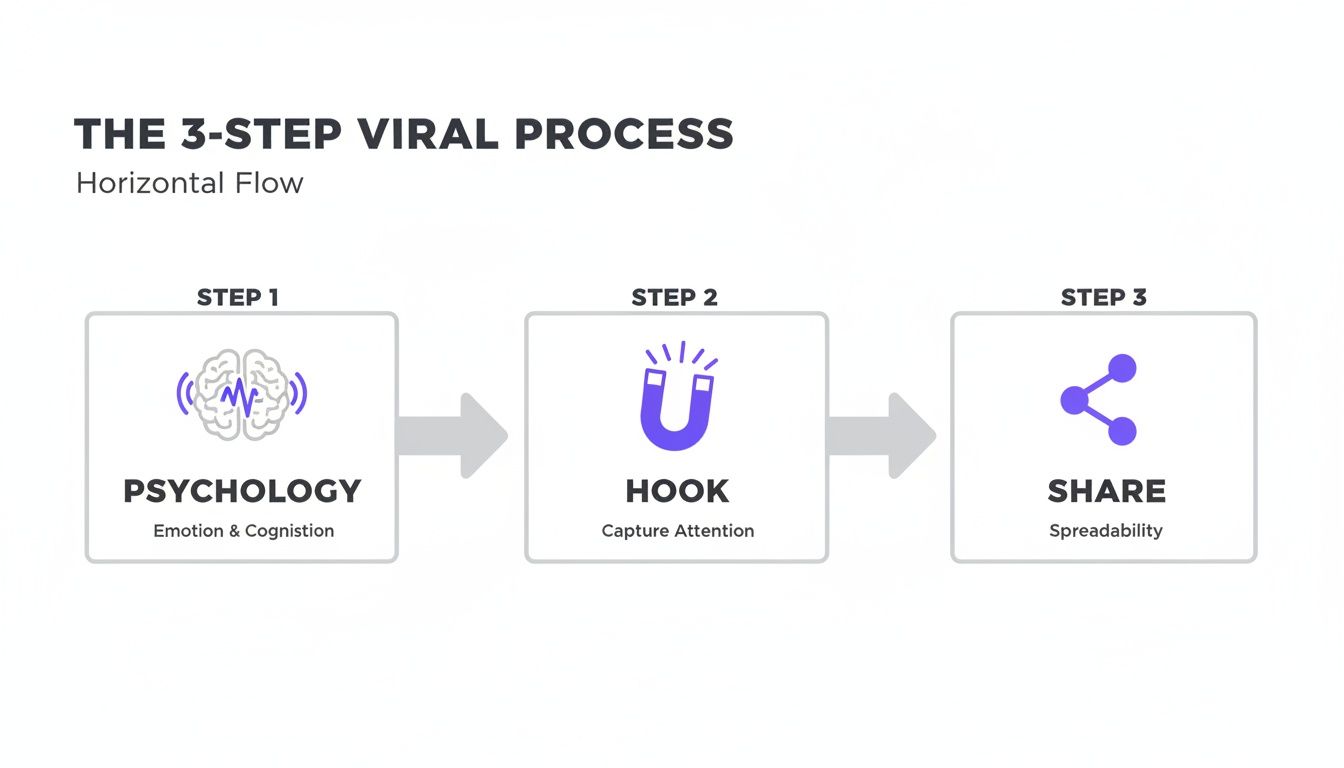
As you can see, it all starts with that psychological trigger. Without it, the best hook in the world won't be enough to make someone share.
The Numbers Don't Lie
The amount of content being uploaded is almost hard to comprehend. Projections for 2025 show the short-form video market hitting nearly 3.7 billion videos that pull in a mind-boggling 172.6 trillion views. With TikTok now boasting over 1.7 billion monthly active users, it’s the main arena for creators fighting for attention.
Mastering this landscape means learning the strategies to increase social media engagement that work today.
Your goal isn't just views. It's to make something so compelling that sharing it becomes an act of self-expression for your viewers. Real virality happens when your audience becomes your promotion team.
Developing Ideas and Hooks That Stop the Scroll
Let’s be honest: viral videos aren’t a happy accident. They’re engineered. Before you even touch a camera or open an editing app, the real work starts with a killer idea and a hook that makes someone physically stop their thumb from swiping.
The secret isn't about what you find interesting. It’s about getting inside your audience's head.
What are their biggest frustrations? What’s the inside joke they’d all get? What do they secretly wish they could do or be? The answers are your roadmap to content that feels like it was made just for them. This isn’t guesswork; it's research. Go lurk in the Reddit threads, read the Amazon reviews, and listen to the exact words your people use in comment sections.
Mastering the First Three Seconds
You’ve got three seconds. That’s it. If your opening is weak, you’ve already lost. Your hook is everything—it’s the first visual, the first line they hear, and any text you slap on the screen.
Great hooks don't just introduce a topic; they spark an immediate emotional reaction. They make you curious, highlight a problem you didn't know you had, or make a bold claim that makes you think, "No way, I have to see this."
Think of your hook as a promise. You're promising a laugh, a solution, a mind-blowing fact, or a story with a satisfying ending. The rest of your video just has to deliver on that promise.
This means your opening needs to be sharp and visually arresting. A quick cut, a weird sound, or a direct question can be the difference between a scroll and a share. Don't be afraid to test a few different openings to see what sticks.
Proven Hook Frameworks to Steal
You don’t have to reinvent the wheel every single time. The best creators lean on proven psychological triggers to grab attention. Here are a few frameworks you can swipe and adapt right now.
Problem-Agitate-Solve (PAS):
- Problem: Hit them with a pain point they know all too well. "Tired of your houseplants always dying?"
- Agitate: Pour a little salt in the wound. "You've tried everything, and now you're just a serial plant killer with a sad-looking apartment."
- Solve: Ride in on your white horse with the solution. "Here’s the one watering trick that brought my fiddle-leaf fig back from the dead."
The Curiosity Gap:
This is all about creating an open loop in someone’s brain. Tease a piece of information without giving it all away, and they’ll feel an almost physical need to stick around for the answer.
- "90% of people make this one mistake when brewing coffee."
- "This is the social media secret nobody is talking about."
- "I stopped doing this one thing, and my productivity completely changed."
Visual Intrigue:
Sometimes, the hook isn't a line of text—it's the visual itself. Starting your video mid-action or showing something incredibly satisfying works wonders. Think of those oddly satisfying videos of things fitting perfectly, a cake being iced flawlessly, or a science experiment that just looks cool. The visual itself asks the question: "What is going on here?"
Using AI as Your Creative Partner
Let's be real, brainstorming dozens of hooks is a grind. This is where AI tools can actually be a massive help, acting as a creative sparring partner. Instead of staring at a blank screen, you can generate a ton of ideas to kickstart your own creativity.
For instance, a platform like Sprello lets you drop in a core idea and get back a bunch of different script angles and hook variations. It helps you get out of your own head and see your topic from new perspectives. To see how this works in practice, you can learn more about how to create attention-grabbing hooks with AI video tools and integrate them into your process.
When you combine deep audience knowledge with these proven frameworks and a little help from modern tools, you stop hoping for a viral hit and start building one on purpose.
Using AI to Build Your Story and Visuals
You’ve nailed the hook and grabbed their attention. Great. Now, the real work begins: keeping them watching. This means telling a story—one with a clear beginning, middle, and a payoff that makes the viewer feel like their time was well spent. The goal is to write scripts that sound like a real person talking, not some stuffy corporate memo.
Not too long ago, this was the most expensive and difficult part. You needed writers, artists, and a whole production crew. Thankfully, technology has completely leveled the playing field, and AI is at the forefront, helping creators streamline everything from the script to the final shot.

From Blank Page to Polished Script
First things first, you need to turn that hook into an actual story. Think about the key moments: the setup, the problem or conflict, the big reveal, and the resolution. Even if your video is only 30 seconds long, treat it like a mini-movie where every scene moves the narrative forward.
This is often where writer's block kicks in, but AI can be a huge help here. For instance, a tool like Sprello doesn't just spit out generic text; it can help generate scripts that are actually aware of your audience. By understanding who you're talking to, the AI can suggest the right pacing, tone, and language that will actually connect with them, saving you hours of second-guessing.
Let's say you're making a cleaning video. Instead of a generic prompt, you could input your audience ("busy millennial homeowners") and your hook ("the one spot you always forget to clean"). The AI might outline a script starting with a relatable messy kitchen, building suspense as it reveals a grimy, overlooked spot, and ending with a super-satisfying cleaning shot. It can even suggest a helpful, non-salesy call-to-action.
Visualizing Your Story Before You Film
A script is just words until you can see it. That's what a storyboard is for. It’s basically a comic-book version of your video, showing each shot in sequence. This helps you map out the visual flow and catch any awkward moments before you’ve spent a dime on production.
Traditionally, you’d need to be a decent artist (or hire one) to do this. Not anymore. Now, you can feed your script into an AI platform that generates visuals for each scene. This lets you:
- Perfect Your Pacing: Instantly see if the story flows smoothly or if some parts drag.
- Plan Your Shots: Figure out the best camera angles and compositions for maximum impact.
- Ensure Visual Consistency: Keep a cohesive look and feel from start to finish.
This AI-powered pre-visualization is a massive time-saver. It turns an abstract idea into a concrete plan, making sure your final video looks sharp and intentional. To dive deeper into this, check out our guide on https://sprello.ai/blog/how-to-make-ai-videos.
A great storyboard is your blueprint for success. It ensures that every single second of your video serves a purpose, pushing the story forward and keeping your audience locked in until the very end.
Generating Custom Visuals Instantly
One of the biggest headaches in video creation has always been B-roll—that extra footage you use to add visual spice and break up the main shots. Hunting for the perfect stock clip can take forever and get expensive fast. AI image and video generators completely change this.
Need a shot of a bustling city at sunset? A close-up of a specific gadget in action? Instead of endlessly scrolling through stock libraries, you can now generate custom, high-quality images and B-roll that perfectly match your script's needs. This saves an unbelievable amount of time and gives your videos a unique visual fingerprint that generic stock footage just can't offer. If you want to really stand out and produce great visuals efficiently, you should explore the best AI tools for content creators.
The difference an AI-assisted workflow can make is huge. Let’s break it down.
Traditional vs AI-Assisted Video Production Workflow
| Production Stage | Traditional Workflow | AI-Assisted Workflow (with Sprello) |
|---|---|---|
| Scripting | Manual writing, multiple drafts, potential writer's block. (4-8 hours) | AI-generated, audience-aware drafts in minutes. (15-30 minutes) |
| Storyboarding | Manual drawing or hiring an artist. (3-6 hours) | AI generates visual storyboard from script instantly. (5-10 minutes) |
| B-Roll Sourcing | Searching stock libraries, licensing fees, potential mismatches. (2-5 hours) | AI generates custom, perfectly-matched visuals on-demand. (30-60 minutes) |
| Editing | Manual assembly of all clips, audio, and graphics. (5-10 hours) | AI assists with clip selection, transitions, and initial cuts. (1-3 hours) |
| Total Time | 14-29 hours | ~2-5 hours |
As you can see, what used to take days of coordinated effort can now be accomplished in a single afternoon. This efficiency is why 91% of businesses are now using video for marketing, and a whopping 75% of video marketers are already using AI. It’s clear that AI makes it possible for anyone to produce professional-grade content much more quickly.
By weaving AI into your scripting, storyboarding, and visual creation, you’re not just saving time and money. You’re giving yourself the ability to test more ideas, create more content, and dramatically increase your odds of going viral.
Don’t Just Cross-Post—Customize for Each Platform
A killer video idea can completely fizzle out if you just dump it on every platform without any thought. I see it all the time. People spend hours on a video, then just hit "share to all" and wonder why it only took off on one, if at all.
Think of TikTok, Instagram Reels, and YouTube Shorts as different social scenes. You wouldn't wear the same outfit or talk the same way at a rave, a coffee shop, and a networking event, right? The same goes for your content. To give your video a real shot at going viral, you need to adapt it to the specific "language" and culture of each platform.
Reading the Room: Platform-Specific Nuances
Before you even think about editing, you have to understand who you're talking to and what they expect. While there’s some audience overlap, the vibe on each app is totally different.
- TikTok: This is the kingdom of trends, raw authenticity, and blink-and-you'll-miss-it entertainment. People are here to see you jump on a challenge, use a trending sound, and keep it real. Speed is everything; the algorithm wants to see instant engagement.
- Instagram Reels: While trends are big here too, Reels often feel a bit more polished and aesthetic. It's a visual-first platform where beautiful shots and a good story can really pay off. Since Reels are tied to the rest of Instagram, they’re perfect for connecting with the community you've already built.
- YouTube Shorts: This is where entertainment meets search. Viewers often land on Shorts looking for quick answers or educational content from creators they already know. If your video can teach something or solve a problem fast, it has a great chance of succeeding here.
How to Adapt Your Content for a Perfect Fit
Okay, so you get the different vibes. Now what? The good news is you don't need to film three separate videos. You just need to create three slightly different versions of your one great idea.
Video Length and Pacing
- TikTok: Keep it snappy. The sweet spot is 15-30 seconds. The editing should be fast-paced with quick cuts to hold that short attention span.
- Instagram Reels: You can breathe a little more here, with up to 90 seconds. This is great for slightly deeper storytelling, but you still need a killer hook right at the start.
- YouTube Shorts: The limit is 60 seconds. Like TikTok, the pacing needs to be quick, but the emphasis should be on delivering clear value.
Audio and On-Screen Text
What people hear (or don't hear) is just as important as what they see. A trending sound can be the single reason a video blows up on TikTok, but it's less of a big deal on YouTube.
- On TikTok, using trending audio is practically a requirement for discovery.
- For Instagram Reels, design for "sound off" viewing. Use text overlays to tell the story, because many users are scrolling silently.
- On YouTube Shorts, focus on a clear, keyword-rich title and description. This helps your video show up in search for months to come.
Your goal isn't just to upload a video. It's to join a conversation that's already happening on each platform. Using the right sound, format, and hashtags is how you show the algorithm—and the audience—that you belong there.
What Does "Viral" Even Mean on Each Platform?
Let's be real: a million views on TikTok isn't the same as a million views on YouTube Shorts. The numbers and what they signify are different everywhere. If you don't know the benchmarks, you can't measure your success accurately.
For instance, a TikTok video is generally considered viral when it hits 1 million views within 72 hours. Over on Instagram, a Reel might be called viral with 500,000 views as long as it’s also getting over 50,000 shares. And get this—a mind-blowing 80% of a video's viral potential is often decided in the very first hour. The window to make an impact is incredibly small. You can dig deeper into these viral benchmarks and what they mean for creators.
Knowing this changes your whole strategy. For TikTok, you'll want to push hard for engagement in that first critical hour. For a YouTube Short, you’ll spend more time crafting the perfect title to win the long game of search. This is the difference between just posting content and truly learning how to make viral videos again and again.
Figuring Out What Worked (So You Can Do It Again)
Scoring a viral video is an incredible feeling. But the real win isn't just that one-time hit; it's figuring out how to do it again and again. The magic isn't in celebrating the view count—it's in digging into the why behind the numbers. This is where you stop guessing and start building a real, data-backed strategy.
Think of your analytics dashboard as your personal playbook. It's telling you exactly what made people stop scrolling and what made them tune out. Learning to read it is like developing a superpower, creating a feedback loop where every video you make informs the next one, making it even better.
Look Past the Views
First things first: stop obsessing over the view count. I know it's tempting, but it's a vanity metric. A video with a million views that everyone clicked away from after two seconds is practically worthless compared to one with 100,000 views that people watched all the way through and sent to their friends.
To get the real story, you have to focus on the metrics that show you how people actually behaved. These are the numbers that matter.
- Average Watch Time: This is a big one. It tells you exactly how long you held someone's attention. A high watch time is a massive signal to the algorithm that your content is genuinely engaging, which means it will get pushed out to more people.
- Audience Retention: This is my favorite tool. It’s a graph that shows, second by second, where you lost people. Find those big drop-offs, because they’re your biggest weaknesses. And just as important, find the spots where the line stays flat or even ticks up—that’s pure gold.
- Share Rate: A share is the ultimate compliment. When someone shares your video, they’re vouching for it with their own reputation. A high number of shares per view is one of the strongest signs of viral potential.
Your goal isn't just to get eyes on your content. It's to make people care enough to finish it and then hit that share button. That's the real engine for growth.
Become an Expert at Reading Retention Charts
Alright, let's get practical. Go pull up the analytics for your best video and find the audience retention graph. This chart doesn't lie.
Did a massive chunk of your audience vanish in the first three seconds? Your hook missed the mark. The idea might have been solid, but the opening just didn’t grab them.
See a steep dip halfway through? Pinpoint that exact moment in the video. Did you launch into a long, rambling explanation? Was there a jarring cut or a boring visual? That’s a clear sign you lost them. The key to replicating success is finding these dead spots and ruthlessly cutting them out of your future videos.
Now, look for the opposite. If you see a spot where the graph holds steady or even bumps up a little, you've found your secret sauce. That was the joke that landed perfectly, the "aha!" moment, or the satisfying payoff your audience was waiting for. Your job is to dissect that moment and figure out how to bottle that feeling for your next video.
A Simple Framework for Testing and Improving
Once you have a good idea of what’s working, it's time to start experimenting with purpose. This isn't about throwing spaghetti at the wall to see what sticks; it's about methodically testing one variable at a time to perfect your formula.
Here’s a simple way to approach it:
- Start with a Hypothesis: Look at your data and make an educated guess. For instance, "My retention dropped when I used a static B-roll shot. I bet a faster-paced, more dynamic clip would keep people hooked."
- Create Two Versions (A/B Test): For your next video, create two slightly different versions of the same element—like the hook. Version A could be your usual style, while Version B tests a new, punchier opening line. Keep the rest of the video identical.
- Test and Measure: Post the two versions. You can try different platforms or just different times of day to minimize audience overlap. Let them run for a day or two to gather enough data.
- Analyze the Results: Dive back into the numbers. Compare the key metrics, especially retention in the first five seconds and average watch time. Did Version B's new hook give you a 10% bump in retention? Boom. You've just discovered a new best practice for your channel.
This constant cycle of analyzing, guessing, and testing is what turns creators into strategists. It takes the guesswork out of going viral and builds a solid, data-driven foundation for your next big hit.
Common Questions About Making Viral Videos

Even with a great playbook, you're bound to have questions as you start creating. Going viral is part science, part art, and a whole lot of trial and error. Let's tackle some of the most common hurdles creators face.
How Long Should My Video Be?
This is the golden question, isn't it? The best answer I can give you is this: as long as it needs to be, but not one second longer. Virality hinges on watch time and completion rate, not just an arbitrary number on a clock.
For short-form platforms like TikTok and YouTube Shorts, keeping things tight is usually the way to go. A video in the 15 to 30-second range has a much higher chance of being watched all the way through, which is a massive signal to the algorithm that your content is valuable.
But don't butcher a great story just to fit a mold. A killer 60-second narrative that keeps people hooked is always better than a confusing 15-second clip that falls flat.
The perfect video length is the one that tells a complete, satisfying story without wasting your audience's time. Your analytics are your best friend here—check your retention graphs to see exactly where people are dropping off. That’s your true ideal length.
Can I Still Go Viral Without Showing My Face?
Of course. It’s a common misconception that you need to be a personality to build a following. Plenty of massive accounts have gone viral without ever showing the creator’s face. The trick is to let the content itself be the star.
A few faceless formats that consistently crush it include:
- "Satisfying" Content: Think ASMR, super-efficient cleaning videos, or those mesmerizing product demos.
- DIY & How-To Guides: A clear voiceover guiding the viewer through well-shot steps is a classic for a reason.
- Storytelling with B-Roll: You can tell incredibly powerful stories just by using stock footage, AI-generated clips, and well-timed text on screen.
- Screen Recordings: These are gold for tech tutorials, software demos, and any kind of educational content.
When you're not on camera, your visuals and audio have to work that much harder to grab and hold attention.
Do I Need Expensive Equipment to Go Viral?
Absolutely not. This is probably the biggest myth out there. Your idea, your script, and your hook are 1,000 times more important than the camera you’re using. Some of the most viral videos in history were shot on a phone in a poorly lit room.
Modern smartphones are incredible; they shoot in 4K and can produce amazing results. Instead of dropping cash on a fancy camera, focus your budget on two things that actually move the needle:
- Good Audio: People will forgive grainy video, but they will click away instantly for bad audio. A simple lavalier microphone is a cheap investment that pays for itself immediately.
- Good Lighting: Natural light is free and almost always looks best. If you have to film at night, a basic ring light will make sure everything looks clean and professional.
At the end of the day, a viral video connects with people on an emotional level. The story is what matters, not the price tag on your gear.
Ready to stop filming and start creating? Sprello is the all-in-one AI video suite that helps you produce high-converting social content in minutes. Generate audience-aware scripts, visualize scenes, and create custom B-roll without any complex editing. Learn more at sprello.ai.


