

Trying to make content go viral can feel like a guessing game. But what if I told you it’s less about luck and more about a repeatable system? I've found that truly shareable content isn't an accident; it's engineered.
The whole process boils down to three key things: sparking a real emotional response, making it insanely relevant to a specific group of people, and having a smart plan to get it in front of them. When you nail these three pillars, you stop just making content and start engineering it to be shared.
So, What Really Makes Content Go Viral?
We've all seen it happen—a video or post seemingly comes out of nowhere and is suddenly everywhere. It feels like lightning in a bottle, but there's a predictable science behind the magic.
Virality isn't about chasing the latest TikTok trend. It’s about tapping into basic human psychology. Content goes viral when it connects with someone on such a deep level that they feel an almost primal urge to pass it on. That compulsion to hit "share" is the engine that drives exponential reach.
To get there, you have to stop thinking like a typical content creator and start thinking like a content engineer. The goal isn't just to make something that looks good; it's to create something that makes your audience feel seen, heard, and understood.
This guide is my playbook for doing exactly that. We'll walk through the entire process, from deep-diving into your audience to production and distribution, showing you how a methodical approach gets real results time and time again.
The Three Pillars of Virality
Everything—and I mean everything—in this system rests on three core pillars. Get these right, and you're on your way. Miss one, and you're just making noise.
Here's a quick summary of what you need to focus on.
The Three Pillars of Viral Content
| Pillar | Core Principle | Key Action |
|---|---|---|
| Emotional Resonance | Content must trigger a strong, visceral feeling. | Identify a core emotion (humor, awe, anger, joy) and build your entire concept around it. |
| Audience Relevance | The message has to feel like it was made just for them. | Go beyond demographics to understand a niche audience's inside jokes, pain points, and values. |
| Strategic Distribution | Great content needs an initial push to find its audience. | Seed the content with influencers, communities, and paid ads to kickstart the sharing loop. |
Think of these pillars as a sequence. Each one builds on the last, creating a powerful chain reaction that fuels engagement and shares.
Let's break them down.
Emotional Resonance: First and foremost, you have to make people feel something. Joy, surprise, a good laugh, even a little bit of outrage—these are the currencies of social media. An emotional reaction is what turns a passive viewer into an active sharer.
Audience Relevance: Virality rarely happens by trying to appeal to everyone. It almost always starts small, by resonating powerfully with a very specific niche. Your content needs to reflect their world, their struggles, and their wins so accurately that they think, "Finally, someone gets it."
Strategic Distribution: You could create the most incredible piece of content in the world, but if the right people don't see it, it's dead on arrival. A solid distribution plan ensures your content gets that crucial initial exposure. This means getting it into the right hands and in front of the right eyeballs to give it the momentum it needs to take off. Understanding how platform algorithms work is a huge piece of this puzzle.
This simple flowchart illustrates how these three stages work together.
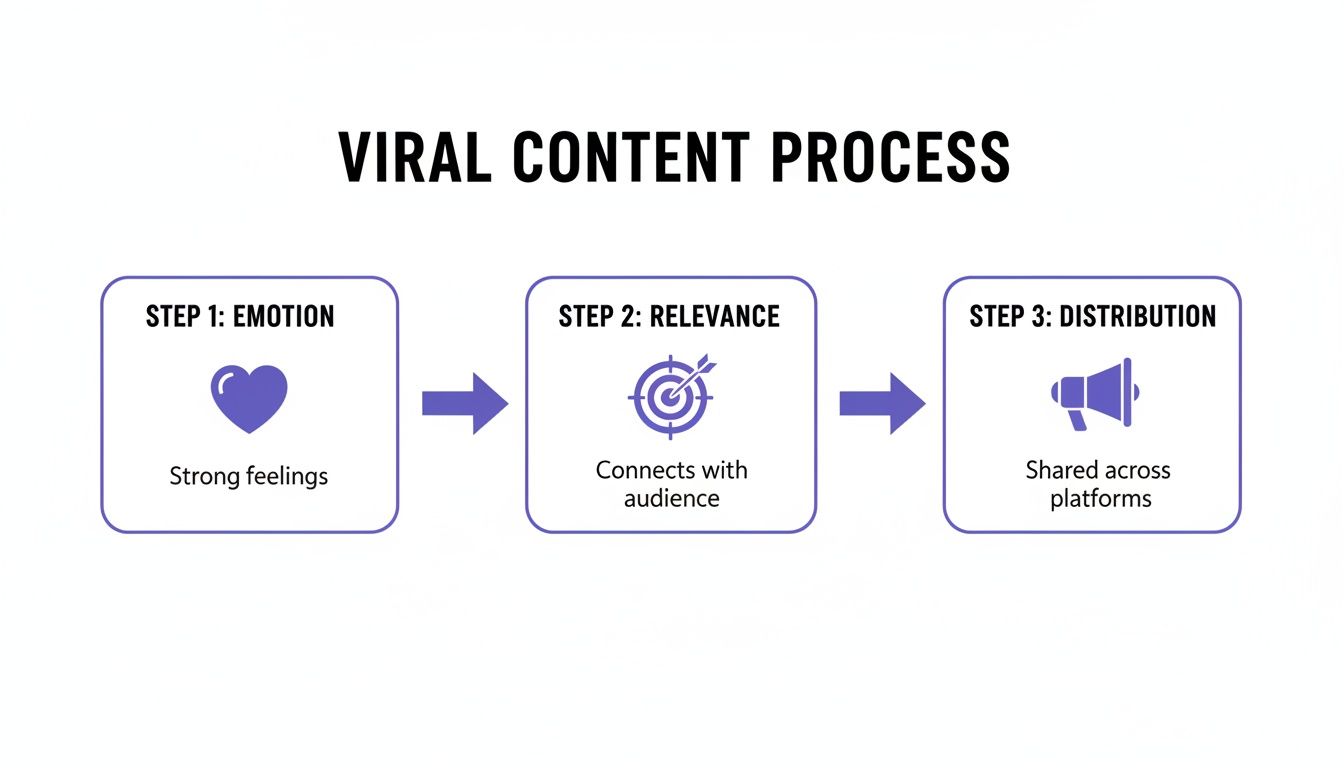
As you can see, the path from a simple idea to a viral hit is a clear progression. Nail each step, and you'll dramatically increase your chances of success.
Finding Your Audience's Unspoken Truths
Let's be honest. Creating something that goes viral isn't about what you want to say. It's about tapping into what your audience is desperate to hear. It all starts with a deep, almost obsessive empathy for the people you're trying to reach.
Forget the surface-level details like age and location for a moment. We need to dig into the psychographics—the beliefs, the frustrations, and the secret desires that actually drive their behavior.
Your mission is to understand them so well that your content feels like it's reading their minds. We're not creating for a generic "target market" here. We're speaking to a single person so clearly that millions of people who share their mindset will feel like you're talking directly to them. That’s the real foundation of content that connects and spreads like wildfire.
Go Beyond Basic Demographics
Demographics tell you who your audience is, but psychographics tell you why they should care. One gives you a mailing address; the other gives you a motive. To uncover these deeper truths, you need to become a bit of a digital anthropologist.
Stop fixating on follower counts and start reading the comments. Go to the places where your audience actually lives online, and just listen.
- Competitor Comment Sections: Check out the top-performing posts from your biggest competitors. The gold isn't the post itself, but the chaos in the comments. What are people asking? What inside jokes are they making? What are they complaining about? That's your raw material.
- Niche Online Communities: Find the subreddits, Facebook Groups, or Discord servers where your people hang out. Think of these as unfiltered, 24/7 focus groups. Pay close attention to the slang they use, the memes they share, and the "unpopular opinions" that get a ton of upvotes.
- Customer Feedback and Reviews: Your own customer service emails, product reviews, and sales call notes are a treasure trove. What specific words do people use to describe their biggest problems? What are the "before and after" stories they tell?
The Key Takeaway: You're hunting for the "unspoken truth"—a belief or frustration your audience feels deeply but rarely sees anyone talk about. When you're the one to finally put it into words, their instant reaction is a visceral, "that is SO me." That feeling is the engine of a share.
Building a Persona That Feels Real
Once you've gathered all this raw intelligence, it's time to stitch it together into a persona. But please, forget the boring one-page templates from marketing textbooks. Your persona should feel like a real person with real, messy problems.
Give them a name. A job. A story. The more specific and vivid you can make them, the easier it will be to create content that genuinely resonates.
Let's say we're trying to create content for a brand selling project management software to small creative agencies.
| Persona Element | Description |
|---|---|
| Name | Alex, the Overwhelmed Agency Owner |
| The Daily Grind | Juggles client calls, giving creative feedback, and chasing invoices. Feels constantly pulled in 10 different directions. |
| Hidden Frustration | Secretly resents all the admin work because it steals time away from the creative side of the business they actually love. |
| Unspoken Aspiration | Dreams of having just one uninterrupted afternoon to brainstorm wild ideas without their phone buzzing every five minutes. |
| Scroll-Stopping Trigger | Anything that acknowledges the sheer chaos of running a small agency and offers a simple, tangible way out. |
See? This isn't just a list of facts; it's a story. We now know that Alex doesn’t just need "software." Alex needs to reclaim their creative spark. That little insight is where viral ideas are born.
Turning Insights into Content Gold
Now that we have a deep understanding of Alex, we can brainstorm content ideas that will hit them right where they live. Instead of churning out generic posts about "productivity tips," we can create content that speaks directly to their unspoken truths.
Here are a few quick examples based on our persona:
- The "Finally, Someone Said It" Post: A short video titled, "You didn't start a creative agency to spend 4 hours a day on invoices." This immediately validates Alex's biggest frustration.
- The "Aspirational" Post: A Reel showing a calm, organized workflow with the caption, "This is what an afternoon of pure creative flow looks like." This taps directly into their deepest desire.
- The "Insider Joke" Post: A meme about the agony of getting client feedback in a 12-page Word doc full of tracked changes. This shows you're one of them—you get it.
This process turns content creation from a frustrating guessing game into a calculated strategy. When you focus on your audience's unspoken truths, you're not just making content they might like. You're making content they feel compelled to share because it makes them feel seen. And that, right there, is the secret.
Weaving the Perfect Hook and Story
So, you've done your homework and understand your audience. That’s your foundation. Now for the fun part: turning those insights into content that grabs people by the collar and doesn't let go.
You’ve got maybe three seconds. Seriously. If the first frame of your video doesn’t scream "this is for you," they’re already gone. The opening isn't just a part of your video; it’s the gatekeeper to everything else you have to say. Mastering how to write viral hooks that stop the scroll is non-negotiable.
This first moment is everything.
The Anatomy of an Unskippable Hook
A killer hook isn't just clever wording—it's a psychological tripwire. It pokes at a curiosity gap, creating an "open loop" in the viewer's mind that they feel compelled to close. That's how you earn the next ten seconds.
From what I’ve seen, the most powerful hooks usually fit one of these molds:
- The Provocative Statement: Hit them with a bold, counterintuitive claim that makes them think, "Wait, what?" Something like, "Your to-do list is actually making you less productive."
- The Relatable Problem: Voice a pain point so precisely it feels like you're reading their mind. For example, "You didn't start a business to spend half your day answering emails."
- The "In Medias Res" Opening: Just drop them right into the action. No intro, no fluff. Kick it off with, "I accidentally deleted our entire customer database last Tuesday."
The idea isn't to be clickbait. It’s about making a genuine promise of value that your content immediately starts to fulfill. For a deeper dive, our guide on creating attention-grabbing hooks with AI video tools has some great pointers.
Structuring Your Story for Maximum Impact
Okay, you've hooked them. Now what? You need a narrative that pulls them through to the end. One of the most reliable frameworks, especially for short-form video, is the classic Problem-Agitate-Solve (PAS) formula. It works because it follows our brain's natural desire to find relief from tension.
It breaks down like this:
- Problem: State the core pain point. This is often your hook.
- Agitate: Don't just state the problem—pour some salt in the wound. Describe why it’s so frustrating, costly, or draining. This is where you build real empathy.
- Solve: Introduce your solution (your product, a tip, a new mindset) as the clear, simple way out of that mess.
Pro Tip: In video, "Agitate" is a visual game. Show the frustration. If the problem is "manual data entry," show someone looking utterly defeated by a spreadsheet. Visually twisting the knife makes the relief of the solution feel that much sweeter.
Using a framework like PAS turns a simple piece of advice into a memorable mini-story. You’re not just sharing information; you’re taking them on an emotional journey, which is what makes content stick.
From Script to Visual Storyboard
A script is just words on a page until you map it out visually. You need to plan how the story will look and feel, second by second. This is where a storyboard comes in, and you don’t need to be an artist to make one.
A storyboard can be as simple as a few bullet points or stick-figure sketches for each scene. What matters is that you're thinking through the visual experience intentionally.
For each scene, ask yourself:
- Visual Pacing: How fast are the cuts? Quick cuts bring the energy up. Longer, slower shots can build tension or create a moment of reflection. The rhythm should match the story's emotional arc.
- Sound Design: What are they hearing? It’s more than just a voiceover. The right sound effect, a subtle music cue, or even a moment of perfect silence can completely change the vibe.
- Platform-Native Aesthetic: Does it feel like it belongs on the platform? A slick, corporate-looking video can feel jarring on TikTok, where a rawer, more authentic style usually wins.
Nailing down these details is what separates content that feels professional and intentional from something that feels cobbled together. This is how you stop hoping for a hit and start engineering one.
Using AI to Scale Your Content Production

The real secret to viral content isn't a single brilliant idea. It's the ability to churn out and test dozens of ideas, see what sticks, and pour fuel on the fire before the trend dies. For years, this was the biggest roadblock, eating up a ton of time, money, and manpower.
That's all changed. AI tools have flipped the script, letting you go from a rough concept to a ready-to-publish video in minutes. This isn't about letting a robot take over your creativity; it's about giving it a massive boost. You can now produce a volume of high-quality content that was just a fantasy a few years ago.
The game is all about getting more "at-bats." The more you test, the more you learn, and the more you learn, the more you win.
From Prompt to Polished Video in Minutes
Think about it: what if you could create five different video ads for one product, each hitting a unique customer pain point, and have them all done before your first meeting of the day? That’s what a good AI workflow brings to the table. Platforms like Sprello pull the entire process under one roof, so you can build out content at an incredible pace.
This gets rid of all the friction. No more bouncing a project between a scriptwriter, a voice actor, an editor, and a designer. You control the entire assembly line. There are some great guides on AI for social media content creation that really dive into how this is reshaping the industry.
A typical workflow might look like this:
- Generate Audience-Aware Scripts: You start by telling the AI who you're talking to. It then spits out multiple script options that hit on their specific problems and desires.
- Choose a Realistic AI Avatar: Pick a digital presenter that matches your brand’s vibe. This completely sidesteps the hassle and cost of live-action shoots and makes "reshoots" as simple as typing a new line.
- Create Custom Visuals: Need B-roll? The AI can generate images and short clips on the fly that perfectly match the story you’re telling.
- Add a Professional Voiceover: Choose from a whole library of natural-sounding AI voices to get the exact tone you’re going for.
Essential AI Features for Mobile-First Content
To make content that feels right on social media, you need to nail the small details. Modern AI video tools have these critical finishing touches built right in, saving you from tedious manual work.
Think about how people scroll on their phones—usually in a noisy place, almost always with the sound off. That means your visuals have to do all the heavy lifting.
Key AI-powered features like one-click background removal and auto-generated captions with dynamic highlighting aren't just cool extras anymore. They're essential for grabbing and holding attention in a world built for mobile.
These features make your videos look professional and, more importantly, easy to consume. Dynamic highlighting, where the words light up as they're spoken, is a proven trick to keep eyes glued to the screen and boost watch time.
The Power of Rapid A/B Testing
The biggest advantage of bringing AI into your content process is the power to test everything. When you can create five versions of an ad in the time it used to take to make one, you unlock a whole new way of thinking about creative.
All of a sudden, you can run experiments that were never practical before.
| Element to Test | Example Variation 1 | Example Variation 2 | Why It Matters |
|---|---|---|---|
| The Hook | "Stop wasting money on ads." | "This one tweak cut our ad spend by 50%." | The first 3 seconds decide everything. Your hook is the highest-leverage thing you can possibly test. |
| The Call-to-Action | "Learn more at our site." | "Get your free checklist now." | Your final instruction has to be crystal clear. Testing different offers tells you what actually gets people to click. |
| The Visuals | Featuring a person in the video. | Using animated text and graphics. | Different styles resonate with different people. You might find that a simple graphic-based video crushes one with a person. |
This cycle of rapid iteration creates an incredible feedback loop. You stop guessing what might work and start using real data to engineer a hit. By constantly testing and refining, you go from hoping for a viral moment to building a system that reliably creates content that connects.
Mastering Your Content Distribution Strategy

Let's be real. You can create the most incredible piece of content the world has ever seen, but if no one sees it, it might as well not exist. Getting content to go viral is only half the battle; the other half is a smart, targeted distribution plan that gives it that initial push.
Hitting "publish" and crossing your fingers is not a strategy. It's a gamble. The goal is to get your content in front of the right people first—the ones who are most likely to watch, engage, and share it. This initial activity signals to the algorithms that you’ve got something good on your hands.
Nurturing Organic Growth Through Seeding
Before you even think about putting money behind your content, you need to plant some seeds. Organic seeding is all about strategically placing your content in the niche communities where your audience already hangs out.
Think subreddits, Facebook groups, Slack channels, or Discord servers. But here's the crucial part: you can't just show up and drop a link. That’s spam. You need to be a genuine member of that community first. Participate in discussions, offer helpful advice, and build some credibility.
When you do share your content, frame it as a resource, not a promotion. Instead of a generic "Check out my new video," try something like, "I've seen a lot of questions about X in here lately, so I put together a quick video breaking it down. Hope it helps!"
The Outreach Rule of Thumb: When you're reaching out to influential creators or group mods, make it about them. Position your content as something that will genuinely benefit their audience. A message like, "Hey, I loved your recent post on Y. I actually created this piece that expands on that exact point and thought your community might find it valuable," is helpful, not self-serving.
Using Paid Amplification to Ignite the Spark
Organic seeding gets the fire started, but paid amplification is the jet fuel. Targeted ads are how you create that first wave of velocity, giving the algorithms all the positive signals they crave. You're not trying to buy virality; you're buying the initial engagement that earns it.
This is where all that A/B testing you can do with AI-powered tools really pays off. You can run small-budget campaigns to quickly figure out what's working.
- Test your hooks: Run the same video but with three different opening lines. See which one keeps people watching the longest.
- Test your captions: Use the exact same visual but try a provocative statement versus a question. Which one gets more shares?
- Test your audiences: Target different interest groups. You might find one segment has a dramatically lower cost-per-share than another.
This data-driven approach takes the guesswork out of the equation. Once you find the winning combination, you can confidently scale up your ad spend. For example, if your audience is on LinkedIn, a winning content distribution strategy for LinkedIn will be essential to amplify your reach effectively.
Creating a Content Series for Sustained Virality
A one-off viral hit is fantastic, but a system that keeps people coming back for more is a game-changer. That's the power of a content series. Instead of creating isolated posts, you build a story that gives your audience a reason to follow and eagerly await the next part.
Serialized content is how you turn a fleeting moment of attention into a long-term relationship. It builds anticipation and literally trains your audience to look for your content. And the data backs this up—a Sprout Social survey found that 57% of consumers want brands to create original content series. People are hungry for ongoing stories.
This approach creates a powerful flywheel effect. The promotion from episode one boosts the organic reach of episode two. The engagement from episode two helps episode three take off even faster. Each piece of content builds on the last, creating a sustainable growth loop that will far outlast the buzz from a single viral video.
Frequently Asked Questions About Viral Content
Trying to make content go viral can feel like a guessing game. It's a world filled with questions, so I've put together some straight-to-the-point answers to the ones I hear most often. This should help you cut through the noise and focus on what actually gets results.
What Is the Best Format for Viral Content?
Right now, short-form vertical video is king. There's really no debate. Platforms like TikTok, Instagram Reels, and YouTube Shorts are designed for it, and the numbers don't lie—this format consistently delivers the best engagement and return for marketers.
The immersive, full-screen experience is a perfect match for our short attention spans. It grabs you instantly. The trick is to create something entertaining, genuinely helpful, or emotionally compelling right in the first few seconds. With AI tools, you can now churn out dozens of variations to test which angle truly hooks your audience.
Do I Need a Big Budget to Go Viral?
Nope. Not at all. A big budget is not the golden ticket, and sometimes, it can actually hurt your chances. Authenticity, creativity, and truly knowing your audience are infinitely more powerful than a Hollywood-sized production fund.
Think about it: many of the most viral videos you've seen were shot on a simple smartphone. People connect with what feels real and relatable, not what looks slick and corporate. Focus your energy on brainstorming great ideas and testing them quickly, not on renting expensive cameras or studio space.
A core truth of modern content is that relatability often beats production value. People share what feels real and what reflects their own experiences, not necessarily what looks the most expensive.
What Metrics Truly Indicate Viral Potential?
It's time to stop obsessing over vanity metrics like view counts and likes. They look nice on a report, but they don’t tell you if your content actually has legs. To understand what the algorithms favor, you need to look at the metrics that signal real, deep engagement.
Here are the three you should be watching like a hawk:
- Watch Time: How long are people sticking around? A high average watch time is a massive signal to the platform that your content is doing its job and holding attention.
- Completion Rate: What percentage of viewers make it all the way to the end? A high completion rate is one of the strongest indicators that you’ve created something compelling from start to finish.
- Shares: This is the ultimate stamp of approval. When someone shares your video, they're putting their own reputation on the line to recommend it to their friends. That's a powerful endorsement that algorithms love to see.
If you optimize for these three, you'll have a much clearer read on what's working and what’s just noise.
How Often Should I Post to Go Viral?
Consistency will always beat frequency. Don't fall into the trap of posting non-stop just to feed the machine. That’s a fast track to burnout and a nosedive in quality. The real goal is to find a sustainable posting rhythm that lets you deliver quality content, every single time.
A great way to do this is by creating a content series. It gives your audience something to look forward to and trains them to come back for more. This steady, reliable approach builds trust with both your viewers and the platform algorithms, making it much more likely that one of your posts will finally break through.
Ready to stop guessing and start engineering viral content? Sprello is the all-in-one AI video suite that helps you produce high-converting ads and social videos in minutes. Go from idea to published content faster than ever at https://sprello.ai.


