
What if you could describe an advertising goal to a smart assistant and, in minutes, get back dozens of video scripts, ad creatives, and audience ideas? This isn't a futuristic dream anymore—it's what's happening right now with AI in advertising. We're moving past the hype to show you how artificial intelligence really works for your business today.
Let's compare the old way of doing things—slow, manual ad creation—with the incredible speed and scale AI now makes possible.
The New Reality of AI-Powered Advertising
For decades, the advertising workflow was a familiar grind. It meant long brainstorming meetings, pricey photoshoots, tedious data analysis, and a fair amount of pure guesswork. A single campaign could easily take weeks to get off the ground, leaving little time or budget to experiment or pivot based on what was actually working.
Frankly, that traditional approach is becoming obsolete.
The game changed when powerful AI tools became widely available. It's best to think of AI not as a robot taking over jobs, but as a creative amplifier that gives your team superpowers. It automates the repetitive, data-crunching tasks that used to eat up so much time, letting marketers get back to what they do best: strategy and big-picture ideas.
From Manual Labor to Automated Excellence
The biggest shift that AI in advertising brings is the move from slow, manual work to smart, automated systems. Instead of one person spending an entire day designing a single ad variation, an AI can spit out hundreds in just a few minutes. This isn't just a small improvement; it unlocks a level of speed and creative exploration that was simply impossible before.
Think about what this means for your team on a practical level:
- Speed: You can go from a simple marketing brief to a live ad campaign in a tiny fraction of the time. This lets you jump on market trends or launch promotions without missing the window.
- Scale: You can test a huge number of ad creatives, headlines, and audience segments all at once. AI can find winning combinations that you'd never discover through manual A/B testing alone.
- Intelligence: You can use predictive insights to figure out which campaigns are most likely to succeed before you even spend a dollar, getting a better return right from the start.
This guide is here to cut through the noise and show you how AI makes advertising more effective, data-driven, and scalable. It’s packed with practical advice for everyone—from small business owners to enterprise marketing teams—proving you don't need a Ph.D. in data science to get real results.
A Co-Pilot for Modern Marketers
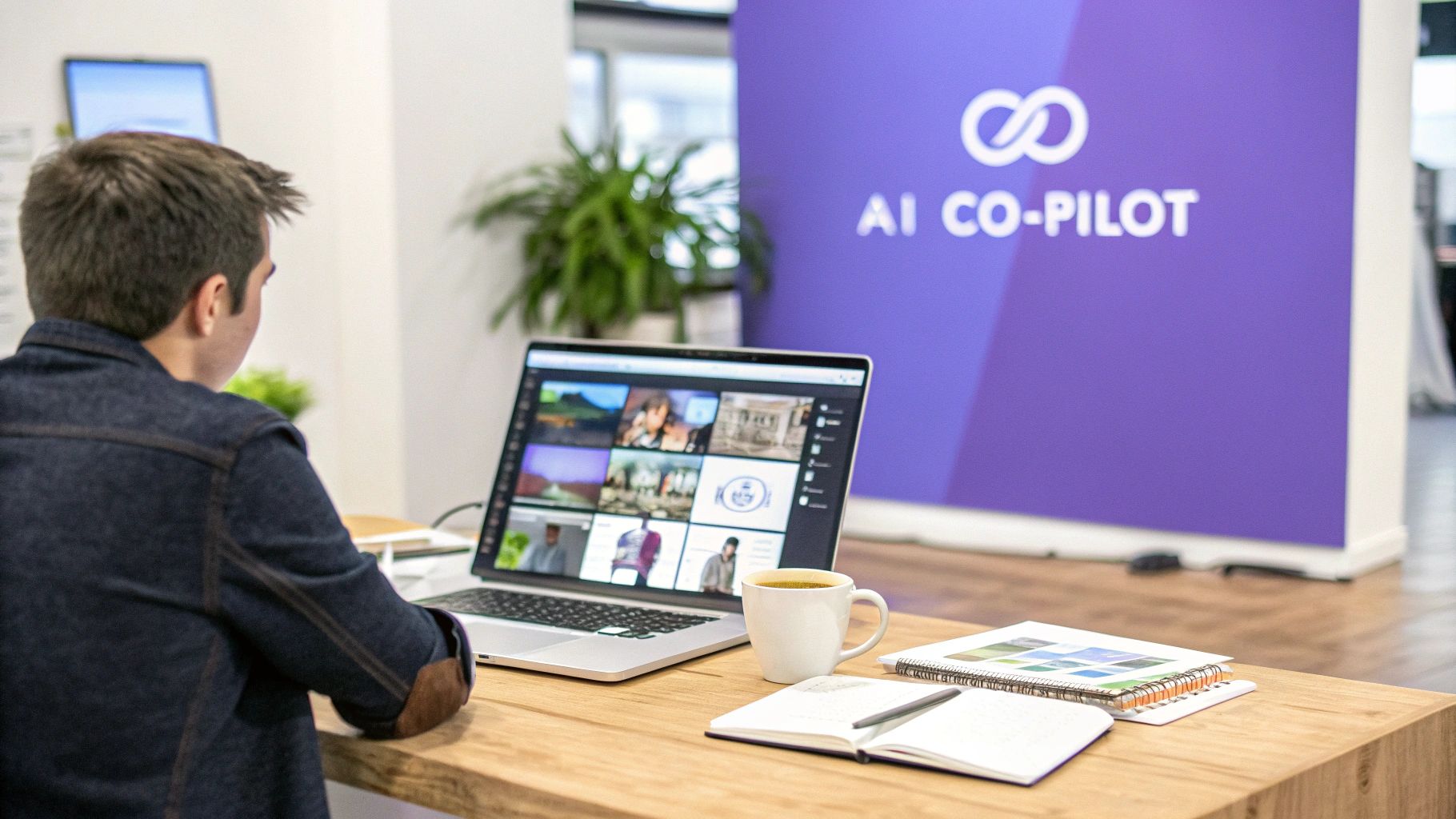
The "co-pilot" metaphor really is the perfect way to think about this. It captures the new, collaborative relationship between a marketer and AI. The marketer is still the pilot, setting the destination with campaign goals, brand voice, and overall strategy. The AI co-pilot handles the tricky parts—navigating the messy data, producing creative assets, and making real-time adjustments to stay on course.
This partnership helps teams do things they couldn't before. By taking the grunt work out of campaign management, AI in advertising is kicking off a new era of marketing where smart, data-backed decisions and limitless creativity are what truly drive growth.
Understanding the Core AI Technologies in Advertising
To really get what AI is doing for advertising, you have to look under the hood at the technologies making it all happen. These aren't just buzzwords or sci-fi concepts; they’re real tools that each have a specific job in making ads smarter and more effective. Think of them as a highly specialized pit crew for your marketing campaigns.
Machine Learning: The Predictive Brain
At the heart of it all is Machine Learning (ML). The best way to think of ML is as a super-powered data analyst who never sleeps. It digs through mountains of your past campaign data—every click, conversion, and user interaction—to find subtle patterns that no human ever could.
This allows it to predict which ad creative, audience, or bidding strategy is most likely to hit the mark next time. In short, ML learns from every dollar you spend to make sure the next one is spent better. It’s the engine running behind the scenes on everything from hyper-specific audience targeting to the real-time bid adjustments that happen in a blink.
Instead of just A/B testing a couple of ad variations, an ML algorithm can analyze thousands of data points simultaneously to keep optimizing your campaigns on the fly. This means less wasted ad spend and a much better return on investment (ROI).
To see this in action, it helps to know a bit about programmatic advertising, where ad space is bought and sold automatically. ML is the brain making those split-second decisions, matching the right ad with the right person at the perfect time.
Key Takeaway: Machine Learning is the predictive engine of your ad strategy. It uses historical data to forecast what will work next, taking the guesswork out of your decisions and pushing for better results.
This predictive power is the foundation for the other AI technologies, starting with the one that understands language.
Natural Language Processing: The Communication Expert
Next up is Natural Language Processing (NLP). If ML is the data analyst, NLP is the communication expert. It's the bridge between messy, human language and a computer's ability to understand it. NLP's job is to read, interpret, and even generate text that feels completely natural.
In the ad world, NLP is fantastic for sifting through customer reviews, social media chatter, and search queries to get a read on public sentiment. These insights help you find customer pain points and craft messages that actually resonate.
For instance, an NLP model can:
- Analyze sentiment to see how people really feel about your latest product.
- Generate punchy ad copy and headlines tuned to specific emotions or needs.
- Run smart chatbots that answer customer questions and nudge them toward a purchase.
This tech makes sure your messaging isn't just seen, but actually felt.
Generative AI: The Creative Engine
Finally, we have Generative AI—the creative powerhouse of the team. While ML predicts and NLP understands, Generative AI creates. It can produce brand-new content from scratch, whether it's text, images, or even entire videos, all from a simple text prompt.
This is probably the most exciting and visible use of AI in advertising right now. Instead of booking a studio and crew for a week, a marketer can now use a tool to create a professional-looking video ad in a matter of minutes.
This unlocks incredible speed and scale. With a good AI video ad generator, a single person can whip up dozens of ad variations to test, a job that used to require a whole creative agency.
When you put these three technologies together, you get a complete system. Machine learning finds the right people, NLP crafts the right message, and Generative AI builds the creative to deliver it. It’s a seamless workflow that's fundamentally changing how brands connect with their customers.
How AI Reshapes Your Advertising Workflow
Thinking about AI in advertising isn't like adding a new app to your phone; it's more like getting a whole new operating system. It completely re-engineers the old, manual advertising process—from creative brainstorming all the way to performance review—into a smarter, faster, and more dynamic cycle. This new way of working is built on four core pillars that touch every single stage of a campaign.
This powerful workflow is driven by the core technologies of Machine Learning, Natural Language Processing, and Generative AI working together.
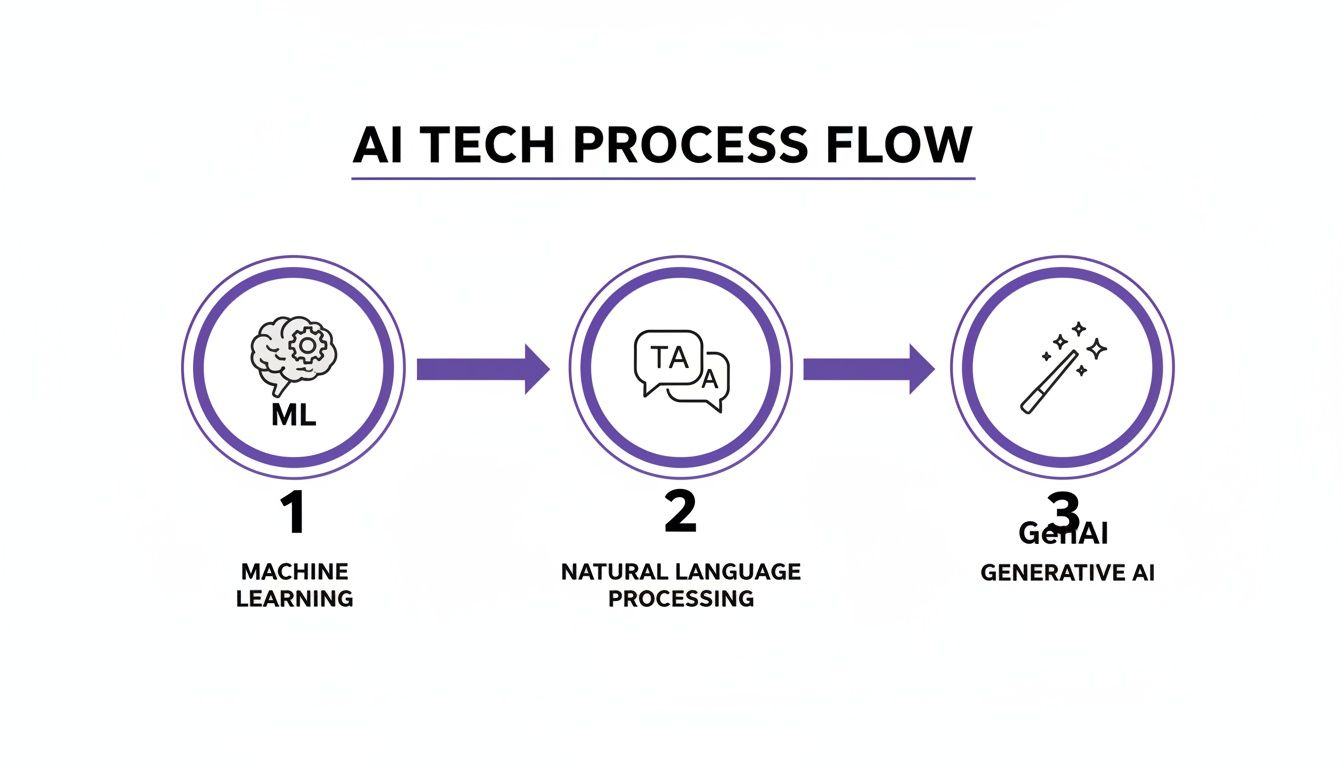
As you can see, AI first learns from data, then figures out the right language, and finally creates brand-new content. It's a complete intelligence system for modern advertising.
Instant Creative Generation
The most obvious change AI brings is in making the actual ads. Not long ago, creating just one video ad was a huge project. You needed writers, designers, editors, and videographers, and it all took time and money. Generative AI essentially bundles that entire team into a single, lightning-fast tool.
You could simply type a description of your product and ideal customer into a prompt. In seconds, an AI platform can spit out multiple video scripts, suggest scenes, and generate a compelling call to action. From there, it can create or find the right visuals, record a natural-sounding voiceover, and even add your branding and captions automatically.
This isn't just about being faster; it’s about creating at a scale that was previously unimaginable. One person can now produce dozens of ad variations in a single afternoon—a job that used to take a whole creative agency weeks. This makes things like effective automated creative testing not just possible, but easy, helping you find what really works without gambling a massive budget.
Hyper-Personalized Targeting
Once you have your ads, you have to get them to the right eyeballs. Traditionally, targeting involved making educated guesses based on broad demographics. AI throws that guesswork out the window and replaces it with laser-focused precision.
Machine learning algorithms can chew through oceans of data that no human ever could. They look at browsing habits, past purchases, social media activity, and all sorts of other signals to find super-specific audience pockets you'd never think to look for.
Think of it like this: A human marketer might target "women aged 25-40 who like fitness." An AI can find "women aged 28-32 who buy organic protein powder, follow yoga influencers on Instagram, and recently read articles about sustainable activewear."
This incredible level of detail means your ads are only shown to people who are genuinely likely to be interested, turning advertising from a megaphone into a one-on-one conversation.
Automated Campaign Optimization
Getting a campaign live is just the starting line. The real magic of AI happens once it's running, with its ability to manage and optimize everything 24/7, in real time. While a human manager might check in on performance a few times a day, an AI is making thousands of tiny improvements every single minute.
These systems constantly watch how your ads are doing. They’ll automatically pull budget from an underperforming ad and push it toward one that’s getting results. They tweak bidding strategies based on conversion likelihood, the time of day, and dozens of other factors to squeeze every last drop of value from your ad spend.
This non-stop optimization loop means your campaign is always running at its absolute best, reacting to market shifts faster than any human ever could.
Predictive Performance Measurement
Finally, AI is even changing how we measure success by helping us predict it before it happens. Instead of looking back at reports to see what worked, predictive analytics can forecast how a campaign might perform before you’ve spent a single dollar.
By analyzing your past data and current market trends, these AI models can estimate key metrics like click-through rates, conversions, and cost per acquisition. This gives you a much clearer picture of which ideas are worth pursuing, minimizing risk and stacking the deck in your favor from the very beginning.
The explosive growth in this area shows just how valuable it is. The global AI marketing market was valued at $20.44 billion in 2024 and is projected to hit $82.23 billion by 2030. This boom is led by North America, which holds 32.4% of the market share, thanks to heavy private investment in AI companies.
Real-World Examples of AI in Advertising
This is where the rubber meets the road. It’s one thing to talk about AI in advertising in theory, but seeing how real brands are putting it to work is where the true power becomes clear. These aren't just futuristic concepts; they are practical, in-the-trenches strategies that show what’s possible when you let algorithms do the heavy lifting.
From massive online stores to highly focused B2B companies, let's look at a few examples of how this technology is solving real problems.
E-Commerce Personalization at Massive Scale
Imagine you run an e-commerce store with thousands of products. How could you possibly create a unique video ad for every single item? It would take a huge team and an even bigger budget. This was the exact problem a major online retailer faced. They wanted to go beyond just showing people ads for products they’d already clicked on.
Their solution was to plug a generative AI platform into their product catalog. By feeding it product images, descriptions, and pricing data, the system churned out thousands of distinct video ads in just a few hours—a job that would have taken a creative agency months.
The results were almost immediate:
- Customers saw ads that felt like they were made just for them, causing engagement to skyrocket.
- Return on Ad Spend (ROAS) jumped by over 40% in the first three months.
- Launching ad campaigns for new products went from a multi-week ordeal to a single day's work.
Pinpointing High-Value B2B Leads
Finding the right decision-makers in the B2B world is a tough, time-consuming game. A leading software company was struggling to find quality leads on platforms like LinkedIn. Their sales team was burning out, manually sifting through profiles and sending messages that rarely got a response.
They switched gears and brought in an AI analytics tool. This system scanned thousands of data points—like job changes, company funding announcements, and online activity—to build a ranked list of prospects who were most likely ready to buy.
The team went from manual guesswork to laser-focused targeting. This single change led to a 300% increase in qualified meetings booked within six months because they were finally talking to the right people at the right time.
This isn't just a niche trend. AI in creative production is going mainstream so fast that industry analysts predict by 2026, roughly 50% of all Super Bowl ads will have used generative AI at some point in their creation.
Optimizing Ad Creative for Peak Performance
Even with perfect targeting, an ad will flop if the creative is wrong. A creative agency was running a big campaign for a client, but their cost to acquire a customer was way too high. They knew they needed to test more creative variations, but their old-school process was just too slow and expensive.
They started using an AI platform that could quickly generate dozens of ad variations—testing different hooks, images, and calls to action. The AI also managed the budget automatically, shifting spend to the winning ads in real time without anyone needing to check in constantly.
This agile testing paid off big time. The agency cut their client's cost-per-acquisition (CPA) by an incredible 60%. They even discovered a completely new ad format that became their top performer, which they then rolled out across other campaigns. You can explore a similar workflow to generate AI UGC ads without creators and see how quickly you can scale your own testing.
When you place the old and new methods side-by-side, the difference is stark.
Traditional vs. AI-Powered Advertising Workflows
The table below breaks down how AI fundamentally changes the day-to-day tasks of running ad campaigns, moving from a slow, manual process to a fast, automated one.
| Task | Traditional Workflow | AI-Powered Workflow |
|---|---|---|
| Creative Development | Weeks of manual work (scripts, design, editing) | Minutes to generate dozens of variations |
| Audience Targeting | Broad demographic guesswork | Hyper-specific, data-driven segments |
| Campaign Optimization | Manual adjustments made daily or weekly | Real-time, 24/7 automated optimization |
| Performance | Slower learning, higher risk of wasted spend | Fast optimization, maximized ROI from day one |
Ultimately, these examples show that AI in advertising isn't just a minor upgrade. It’s a complete shift in how marketing gets done, offering a level of speed, personalization, and efficiency that was simply impossible before.
Getting Started with AI in Your Advertising
Jumping into AI in advertising doesn't have to be a massive, all-at-once project. In fact, the best way to start is to think small. Forget about reinventing your entire marketing department overnight. Instead, pick one specific problem and find one great tool to solve it.
This approach keeps the risk low and makes it much easier to show real, tangible results quickly. Once you've scored an early win, you'll have the confidence, know-how, and momentum to tackle bigger AI initiatives down the road.
Start with a Single, High-Impact Task
First things first: find the bottleneck. Where are you burning the most time or money for the least amount of gain? The sweet spot is a task where AI can step in and deliver an immediate, obvious improvement.
Not sure where to begin? Here are a few common pain points that are perfect for a first AI project:
- Ad Copy Generation: Is your team running on fumes trying to come up with fresh headlines and ad copy? An AI copy generator can spit out dozens of high-quality options in the time it takes to grab a coffee.
- Creative Production: If your design and video production process feels slow and expensive, generative AI tools can create stunning visuals and ad assets on demand, slashing your production timelines.
- Audience Segmentation: Feel like you're just casting a wide net and hoping for the best? AI analytics can dive deep into your data and pinpoint niche audiences that are far more likely to convert.
By zeroing in on a single problem, you simplify everything. You only need to learn one new platform and tweak one part of your workflow—a much smoother process than trying to overhaul your entire operation at once.
Set Clear Goals and Pick the Right Tools
Once you've identified your target, you need to define what a "win" actually looks like. Be specific and make it measurable. A great goal isn't just "improve performance"—it's something concrete, like "reduce Cost Per Acquisition (CPA) by 15%" or "increase our creative testing volume by 50%."
With that clear objective in hand, you can find the right tool for the job. Not all AI platforms are built the same; some are do-it-all behemoths, while others are specialists. Look for a tool that solves your specific problem without burying you in features you don't need.
When you're picking a tool, it pays to think about the future. The AI market is heating up, and some experts predict major consolidation around 2026 as the tech giants battle for control. Choosing a vendor that looks like it has staying power can save you the headache of switching platforms later on.
Empower Your Team, Don't Replace Them
Here’s the most important part: how you introduce AI to your team. Frame it as a powerful new assistant, not a replacement. AI is brilliant at the repetitive, data-crunching tasks that bog humans down and lead to burnout.
This frees up your people to focus on the work that truly requires a human touch:
- Big-picture strategy and campaign planning
- Creative brainstorming and setting the artistic direction
- Understanding the nuances of customer psychology and emotion
When your team sees AI as a co-pilot that helps them work smarter and achieve better results, they'll welcome it with open arms. For example, pointing them to an AI-powered AdWords optimization guide can give them practical strategies for things like AI-driven bidding and predictive targeting. This approach hands them new capabilities, drives real results, and builds a culture that's excited about what's next.
The Future of Advertising Is Already Here
If you take away just one thing from this guide, let it be this: AI in advertising isn't a sci-fi concept anymore. It's happening right now, giving businesses a serious advantage today. The platforms and strategies we’ve covered are changing the game for brands, influencing how they find and talk to their customers every single day.
This isn't about replacing marketers; it's about breaking free from the old, manual grind. When you bring AI into your workflow, you get access to tools and advantages that, until recently, were only available to companies with massive budgets. The benefits are real, and they make a huge difference.
What This Means for Your Business
Adding AI to your advertising doesn't just make things a little better—it fundamentally changes what's possible, from the first creative idea to the final sales report. Here's where you'll see the biggest impact:
Endless Creative Ideas: Imagine testing hundreds of ad variations—different headlines, images, even video scripts—almost instantly. AI makes it possible to find the perfect message that truly connects with your audience.
Smarter Audience Targeting: Go way beyond basic demographics. AI helps you pinpoint incredibly specific groups of people based on their actual behaviors and interests, making your targeting razor-sharp.
Incredible Efficiency: Think about all the time spent on repetitive tasks like adjusting bids, running reports, and managing campaigns. AI automates that, freeing up your team to think bigger and focus on strategy.
Better ROI: Every dollar works harder. By making decisions based on data, not guesswork, you cut down on wasted ad spend and seriously boost your return on investment.
It all comes down to empowerment. Think of AI as the perfect co-pilot for any marketer. It handles the heavy lifting—the complex data analysis and tedious tasks—so you can focus on what humans do best: being creative and strategic.
This technology isn't just a "nice-to-have" anymore; it's a core piece of any successful marketing plan. The tools are here, the results are proven, and the opportunity is wide open. Don’t watch the future of advertising from the sidelines. The time to start experimenting with AI and seeing these benefits for yourself is now.
Got Questions About AI in Advertising? We've Got Answers.
As AI becomes a bigger part of every advertiser's playbook, it’s natural to have questions. It’s a fast-moving field, and everyone’s trying to figure out where they fit in. Let's tackle some of the most common questions head-on so you can feel confident putting these tools to work.
So, Is AI Going to Take My Job?
Nope. The real goal here isn’t replacement—it’s teamwork. Think of AI as the ultimate co-pilot. It’s brilliant at the stuff that bogs us down, like digging through mountains of data for insights, endlessly testing ad variations, or whipping up dozens of creative options in minutes.
By handing off the heavy lifting, AI frees you up to focus on the things humans are uniquely good at: big-picture strategy, genuinely creative thinking, and understanding the subtle, messy, wonderful emotions that make people tick. The advertisers who thrive will be the ones who pair their own intuition and expertise with AI's incredible processing power.
There's a saying making the rounds: "AI won't take your job, but a person using AI might." It's less of a threat and more of a reality check. This is a tool that expands what you're capable of, helping you get results that were simply impossible before.
This partnership is the sweet spot where campaigns become both razor-sharp efficient and truly resonant.
Is This AI Stuff Going to Be Super Expensive?
That’s a big myth. While you can certainly find massive, enterprise-grade AI systems with price tags to match, there are now tons of accessible tools built for businesses of all shapes and sizes. You don't need a Fortune 500 budget to get started.
Here’s how you can dip your toes in without draining your bank account:
- Take it for a spin: Nearly every good AI tool out there offers a free trial or a freemium plan. Use it to see for yourself if it actually helps before you pull out the company card.
- Start small: Most platforms have entry-level plans designed for smaller teams or lower ad volumes. You can always upgrade as you grow.
- Pick one problem to solve: Don't try to boil the ocean. Start with one specific pain point, like writing better ad copy or testing creative more effectively. Once you see a clear return on that small investment, it's much easier to make the case for more.
Ultimately, you should think of the cost of AI as an investment. When it's working right, it pays for itself by making you more efficient and your campaigns more effective.
How Do I Actually Know if AI is Working?
This is the easy part. Measuring the ROI of your AI tools is incredibly direct because their entire purpose is to move your key metrics. You're not guessing—you're looking at the numbers. Most platforms even have built-in dashboards that show you exactly what's happening.
Here are the core metrics to keep an eye on:
- Cost Per Acquisition (CPA): Your CPA should start to drop as AI finds more efficient ways to reach the right people.
- Return On Ad Spend (ROAS): With smarter budget allocation and faster creative optimization, AI is built to push your ROAS higher.
- Conversion Rates: More personalized ads that speak directly to a person's needs almost always lead to better conversion rates.
- Click-Through Rates (CTR): When ads are more relevant and interesting, more people click. Simple as that.
By tracking these KPIs before and after implementing an AI tool, you’ll have hard data to show exactly how it’s impacting your bottom line.
Ready to see how AI can transform your video marketing? Sprello helps you create high-converting video ads in minutes, not weeks. Start producing content that scales your campaigns and drives results. Create your first AI-powered video ad with Sprello today!


